They’ve been a part of football history since the beginning and we often take them for granted but over the years the goals – nets, posts and crossbar – have changed. For this subscriber feature I decided to try to understand what Manchester City’s current goals are constructed of and provide a bit of background on the development of them.
Subscribe to get access
If you would like to read this and all the in-depth articles on this site (including the entire Manchester A Football History book and the audio interview with John Bond) then please subscribe. It works out about £1.67 a month if you take out an annual subscription (£20 per year) or £3 a month if you’d like to sign up for a month at a time. Each subscriber gets full access to the 250+ articles posted so far and the hundreds scheduled to be posted in the coming weeks.
To mark today’s (20th March 2021) FA Cup meeting between Manchester City and Everton here are a few historical facts, memories and video highlights of games between the clubs.
Feature Match
The December 1989 meeting between the two sides was memorable because of events off the field rather than on it. The match ended goalless but the attention the game received from the national media was incredible, and it was all because 20th placed City had appointed the former Evertonian Howard Kendall as manager.
Earlier that season Peter Swales had dismissed the rather quiet, unassuming Mel Machin despite him guiding City to promotion and a memorable 5-1 victory over United. He publicly approached Joe Royle, who turned the club down, and then turned to Kendall.
Almost immediately the ex-Evertonian stamped his authority on the side and quickly brought in Peter Reid and Alan Harper to make their debuts at Goodison. Disappointingly, the highly popular Ian Bishop was named as a substitute. Kendall: “It was not a popular move. I walked out at 2.55pm to hear my supporters chanting, ‘There’s only one Ian Bishop’. Nice welcome that was. The Bishop situation developed into a saga, the like of which I have never experienced in football before.”
It wasn’t long before the long-haired Bishop was sold to West Ham. Earlier in his career Kendall had transferred him out of Everton.
Kendall’s new look City managed to keep ninth placed Everton at bay in a rather dour televised match to earn only their second point in six games. City ended the season in 14th place while Everton finished 6th.
The first League game between the two sides was a 2-1 Everton win on 23rd December 1899 in Division One. The match was played at Hyde Road with Billy Meredith scoring for the newly promoted City, while Jimmy Settle and R Gray netted for the Toffees. City ended their first season in the top division in 7th place while Everton finished 11th.
Television
The first meeting of the two clubs to be televised on BBC’s Match Of The Day was the 1-1 draw on 23rd August 1969. Film here:
The first ‘live’ televised meeting was the famous Howard Kendall match played on 17th December 1989 (see above). The game was shown on ITV.
When Everton appeared in their first FA Cup final it was played at Fallowfield, Manchester. The 1893 final against Wolves was the first, other than the 1886 replay, to be played outside London. Wolves won the match 1-0 and a row of houses in Wolverhampton were given the name Fallowfield Terrace in celebration.
The Fallowfield site now forms part of Manchester University’s student campus.
Well I Never!
City fans demonstrated against the transfer of their hero, Tommy Johnson, to Everton in March 1930 for £6,000. At City Johnson entered the record books by scoring most goals in a season – he netted an incredible 38 in 39 League games during the 1928-9 season. He was a popular player and lived amongst the fans in Gorton. He was often seen drinking draught Bass at The Plough on Hyde Road, and was something of a trend-setter in the area. As soon as he was spotted wearing a wide brimmed trilby hat it quickly became the fashion all young men wanted to follow!
His greatest individual game for City must have been the 6-2 defeat of reigning champions Everton in September 1928, when he scored five goals. Eric Brook scored the other while Dunn and Weldon netted for the Toffees.
In the 1960s Tommy was a regular attender at Maine Road where he and Billy ‘Dixie’ Dean would watch Joe Mercer’s City side. On 28thJanuary 1973 Tommy died at Monsall hospital aged 71.
Record defeat
Everton beat City 9-1 on 3rd September 1906 to record their record victory and City’s record defeat. This was only City’s second match following the findings of the FA investigation into illegal payments which resulted in the suspension of 17 players, the manager Tom Maley, the chairman, and two other directors. The entire summer had been spent finding a new manager and new players – any would do – to fill the void. City’s consolation goal was scored by debutant A.Fisher. The great Sandy Young had netted 4 of Everton’s 9 that day.
Two days before this game, the Blues had been defeated 4-1 by Arsenal in an incredible match that saw City leave the field with only six men. The rest were mainly suffering from heat exhaustion – it was 90 degrees in the shade!
The Young Royle
When Joe Royle made his debut in January 1966 against Blackpool he became the youngest player to appear for Everton in the League. He was 16 years and 282 days. His first game against City was the on 29th April the following year – only his 6th League appearance.
Joe Mercer
Obviously I’m biased but I’d urge everyone reading this article to also read:
The first Premier League meeting between these sides ends in a comfortable City win before 20,242 at Goodison Park. Two goals from Sheron and one from David White gave the Blues a 3-0 lead before an own goal from Brightwell made it 3-1 on Halloween.
1993 – Last Day
On the last day of the season Everton win 5-2 in a frustrating match for City fans. Goalscorers for Everton included future Blues Beagrie (2 goals) and Beardsley. White and Curle (penalty) scored for the home side.
1993 – Rideout Goal
The first away match of the season ends in a 1-0 City defeat. Rideout scored for the Toffeemen on 17th August before 26,025.
1994 – Double Double
Two goals each from Rosler and Walsh give City a 4-0 home win on 27th August. The Maine Road sell out crowd of 19,867 is City’s 3rdlowest crowd in the Premiership. The Kippax Stand was in construction and the capacity was severely restricted as a result.
1996 – Former Blue Scores
Former City hero Andy Hinchcliffe scores a 47th minute penalty to ensure a 2-0 Everton win in February 1996.
2000 – Five Stars
Wanchope (14), Howey (23), Goater (42), Dickov (54), and Naysmith (own goal in 67th minute) give City a thrilling 5-0 victory over Everton at Maine Road in December.
2002 – Anelka hat-trick?
City fans celebrate an Anelka hat-trick but his 14th minute opener is later ruled an own goal, scored by Everton’s Radzinski. In addition, Wright-Phillips is controversially sent off in the 28th minute but this is later downgraded to a yellow card. Despite the controversy and confusion City win the match 3-1 on 31st August.
2003 – New Year’s Day
Over 300 million fans watch this 2-2 draw on Chinese television. Everton took the lead in the 6th minute, City made it 2-1 in the 82ndbefore Everton equalised 2 minutes into injury time on January 1st.
2004 – Keegan’s Disappointment
On the season’s final day, City beat Everton 5-1 with goals from Wanchope (16 & 30), Anelka (41), Sibierski (89) & Wright-Phillips (90). The victory caused the two sides to swap League places. The Blues ended the campaign on 41 points, eight more than relegated Leicester, Leeds and Wolves. A decent enough margin in the end, but that did not change the way most felt about the season.
Prior to that final match Keegan explained truthfully how he felt: “We are just about at the end of the most disappointing season of my managerial career. I haven’t enjoyed it and I am sure the same goes for everyone connected with Manchester City.”
2005 – Early Morning Blues
Everton, so often a bogey team during the previous decade or so, were defeated 2-0 on 2nd October. This was the first Sunday morning kick off in the Premier League and the match commenced at 11.15 with some fans making a point of the early start by wearing pyjamas. It was also Stephen Ireland’s first full Premiership game. Before the match he admitted to being “very nervous” and post-match he commented that the rest of the team had supported him: “That helped me ease my nerves and settle in as one of them.”
2006 – Richards the Hero
One player, who would help City win the FA Cup and Premier League a few years later, was beginning to be seen as one of the club’s most positive assets this season – Micah Richards. He performed to a consistent standard and, on 30th September, he actually netted an equaliser for the club in the dying seconds against Everton to ensure an away point. The 18 year old Richards made his first full international appearance a few weeks later when he played for England against Holland on 15th November. Henry Winter, writing for the Telegraph, claimed: “England may well have discovered Gary Neville’s long term successor.” By this stage in his career Richards had only made 23 Premier League starts.
At Everton Richards’ goal was very important but City’s dominance during the final minutes of the match should have seen the Blues snatch a winner according to goalkeeper Nicky Weaver: “The last five minutes we absolutely battered them and every time the ball went in the box we looked as though we were going to score. Then when [Samaras] hit the post, you’re thinking ‘is it not going to be our day?’ But we kept going and deep, deep into injury time, we got something out of the game.”
Everton’s captain Phil Neville admitted: “It feels like a defeat… we should have got the second goal and killed off the game.”
2011 – Super Mario
In September City defeated Everton 2-0 with goals from substitute Mario Balotelli and James Milner. It was an important victory over a team that continued to be a bit of a bogey side in recent seasons, and ensured the Blues were now back on equal points with Ferguson’s Manchester United, who had drawn 1-1 at Stoke despite leading at half time.
Subscribe to get access
If you would like to read all the in-depth articles and watch all the videos/sound recordings etc. on this site (including the entire Manchester A Football History book) then please subscribe. It works out about £1.67 a month if you take out an annual subscription (£20 per year) or £3 a month if you’d like to sign up for a month at a time. Each subscriber gets full access to the 230+ articles posted so far and the hundreds scheduled to be posted in the coming weeks.
In the build up to Manchester City’s League Cup final against Aston Villa last year (2020) I was somewhat deflated by the way in which some in the media were critical of City fans. There wasn’t any one thing in particular that prompted this but it was something that had been growing for some time. It was all connected with the general stereotyping of City fans and the language being used by some to write negatively about them. I decided to write a lengthy piece on how I felt about this and I published it on my Facebook and twitter accounts the day after the League Cup final (the final was on 1st March 2020).
Sadly, one year on and little has changed. Ah well! So for those who missed it last year here is the piece:
If you would like to read other in-depth articles on this site (including the entire Manchester A Football History book) and listen to my 1995 interview with John Bond, then please subscribe. It works out about £1.67 a month if you take out an annual subscription (£20 per year) or £3 a month if you’d like to sign up for a month at a time. Each subscriber gets full access to the 260+ articles posted so far and the hundreds scheduled to be posted in the coming weeks.
As West Ham visit the Etihad Stadium today (27th February 2021) to face Pep Guardiola’s Manchester City in the Premier League I thought I’d take a look at the special relationship between the fans of the two clubs.
Similarities
Both City and West Ham fans have a shared understanding of football history, status and achievements with supporters aware of their club’s traditions, rivalries and shared history. The two clubs’ roots are very much based around hardworking working class areas of their cities with the supporters of both the Hammers and the Blues coming traditionally from the working classes. In recent years an analysis of the original shareholders at the majority of Football League clubs identified that by 1900 City’s shareholders came mostly from the working class – a larger percentage than at any club other than West Ham who had a slightly higher percentage. This demonstrates that those who owned both City and West Ham were representative of the fans on the terraces and that these clubs were similarly organised and run. As a result of this both clubs were representative of their communities in ways in which their nearest local rivals were not at the time.
Both clubs have enjoyed stylish, attractive football over the years with a belief that the game should be an entertainment. The roots of this go back decades at both clubs with West Ham’s Ted Fenton and Ron Greenwood influencing men such as Malcolm Allison and John Bond who managed the Blues.
Recently, City fans have been delighted to see Manuel Pellegrini and Pablo Zabaleta become Hammers following a line that includes other popular Blues such as Ian Bishop and Trevor Morley.
Attendances
The support both clubs have received has varied at times but what is abundantly clear is that they have remained the most loyal in the country regardless of League status. West Ham, like City, have never been the worst supported club in their division (both United and Arsenal have!) and West Ham’s attendances over the decades have been fairly consistent, never dipping below 16,000. Recent years have of course seen both City and West Ham eclipse previous record average attendances thanks to the larger capacity of their current homes.
Successes and Struggles
Although West Ham did not become a League side until 1919 (City joined the League as Ardwick in 1892), the Hammers didn’t waste much time in progressing, reaching Division One and their first FA Cup final in 1923. The 1960s was a glorious period for West Ham – as it was with City – winning their first European trophy, the ECWC, in 1965. City won the same trophy in 1970 meaning that the Hammers were the second English team to win a major UEFA trophy and City were the fourth (For those wondering – the Fairs Cup was not a UEFA tournament and its entry requirements were not based on performance at times).
Of course both teams have had periods of struggle, ensuring that when success is achieved the fans of both clubs do not take this for granted. The great Malcolm Allison, a former Hammer & Blue, once told me in an interview that it’s important to “celebrate each success as if it’s your first, because it could well be your last.” Although he was perceived as a boastful character at times his philosophy, gained through his experiences at West Ham as a player, is one both sets of fans seem to agree with.
Celebrating the title – 2014
We must not forget how gracious and sporting the majority of West Ham fans were in 2014 when City became champions of England, securing their first ever league and cup double. That day the Blues beat the Hammers 2-0 with goals from Nasri (39) and Kompany (49). Manuel Pellegrini’s City were applauded and congratulated extensively that day – something that hasn’t happened with the fans of some other clubs when City have won the title.
The “You’ll be back” Game
The biggest demonstration of the special relationship between the fans of the two clubs came in May 1987. City were relegated after a 2-0 defeat at West Ham. At the end of the game City supporters and West Ham fans climbed over the fences and onto the pitch. Some thought that the two sets of supporters were about to confront each other, but the fans knew differently. The Hammers began chanting “You’ll be back” and both groups swapped scarves and souvenirs on the pitch. It was the kind of moment that should have been widely reported in the media but at the time focus tended to be on hooliganism and confrontation rather than the positives of football support. City had been relegated, but their supporters did not seek revenge. The West Ham fans could have ridiculed, but they didn’t. If only those condemning football fans at the time could have seen the two sets of loyal supporters genuinely appreciating and understanding each other.
The relationship between the fans of the two clubs is not something that is widely discussed or promoted but it is something that has endured. City fans have never forgotten the ‘You’ll be back’ game and in recent years, as others have unfairly mocked both sets of fans, the supporters of both the Blues and the Hammers seem to understand and respect each other. Inevitably, there will always be banter during a game but outside of the match the mutual recognition and respect always seems to win through.
To many West Ham are the City of the South – a proud football club with a great history and heritage, combined with a loyal and passionate fanbase.
Want To Read More Like This?
If you would like to read more like this and all the in-depth articles on this site (including the entire Manchester A Football History book and the audio interview with John Bond) then please subscribe. It works out about £1.67 a month if you take out an annual subscription (£20 per year) or £3 a month if you’d like to sign up for a month at a time. Each subscriber gets full access to the 250+ articles posted so far and the hundreds scheduled to be posted in the coming weeks.
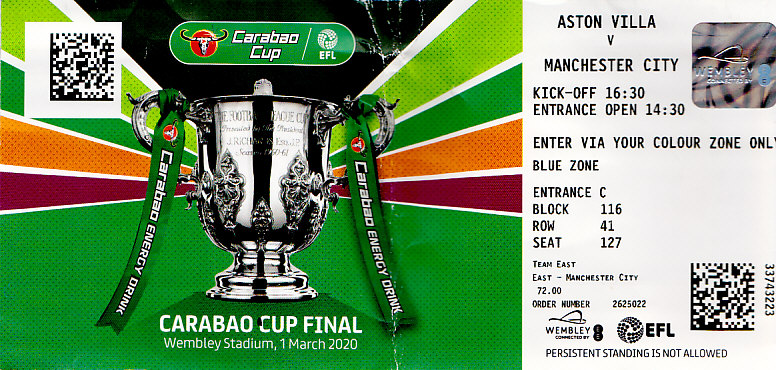
For my first guest blog I’m delighted to say that a writer I’ve admired for years has agreed to contribute. Noel Bayley, the editor of the Manchester City fanzine Bert Trautmann’s Helmet, tells us about the role Covid has played in him sharing the stories of his match tickets. Noel writes…
High up on a shelf in the spare room there is a shoe box. To be honest it’s a trainers’ box but that doesn’t sound quite right. Although, if I’m being pedantic, it’s a blue and white adidas Samba trainers’ box (reduced to £42.49) that has been there for the 17 years I’ve lived in this house. It came with me from the last house so it’s probably more like 20 years old. Maybe older.
The trainers are long gone (lifespan six to 12 months in my hands… or on my feet since we’re being pedantic!) but the very thing that you’re supposed to throw away – the box – lives on. Inside are match tickets. I just throw them in there whenever I get one. But since I haven’t had one for a while (Aston Villa at Wembley on 1 March last year, since you asked) the box should have just sat there quietly doing nothing throughout lockdown.
But then I had an idea. Who hasn’t during lockdown? I’d get them all out, put them in order and, scan them. I’d had an idea to put them on my FaceBook page but as I had a City fanzine FB page, that was the obvious place to put them. So I started doing that at the start of the season. It started off slowly and picked up momentum. Nostalgia’s big business on the internet… “Remember when…” And what might have been a meaningless game to you might have great meaning for someone else. Many of us measure out births, deaths and marriages in football matches; the ticket is the proof positive of the day when all the other details have melted away.
I’m not a ticket collector, you understand. Collectors eschew shoeboxes in favour of A4 folders with transparent pockets and dividers, all neatly arranged. Many years ago at Maine Road, a ticket collector turned up at ‘Fanzine Corner’ happy to show anyone who was even mildly interested his fantastic collection of tickets, going back years – as neat as a new pin.
He was proudly showing someone a ticket from a pre-season friendly in Italy in 1992. “I’ve got that one too,” I told him, “only I went to the match.” That was an understatement. My mate and I had spent a week hitch-hiking to Italy only to find that this very match against Cremonese on a mountain top in the Dolomites had kicked off half an hour early. We got to see an hour of the game anyway! My mate died in the intervening years, but I still have some great memories and a tiny slip of a ticket to mark the highwater mark (literally!) of our great adventure almost three decades ago.
And that’s the thing about tickets and programmes and much of the – mainly paper – ephemera that people collect: it tells a story, and if it’s going to tell a story it might as well be your story! Not that I’m a ticket collector, you understand.
There were several hundred tickets in the box. Easily enough for one every day of a nine/ten-month season, I thought naively. As I painstakingly scanned them I realised that there were some dates when I was spoilt for choice (Boxing Day, for example, and early January when the FA Cup Third Round kicks in) and some days when there were none at all. Not that City hadn’t played, but I’ve had a season ticket for 40 years and for many years all-ticket games were something of a rarity; pay on the gate, no questions asked. Now, of course, every game is all-ticket.
I roped my mate Josh in for a few more – not that he’s a collector either; more of a curator – but there are still gaps. Even so, most days I can put a match ticket on FB with a story to go under it. Remember when indeed! Derby matches, important matches and games that had memorable incidents like last-gasp goals are the most popular ones I have found: Ian Brightwell’s Derby Day equaliser, York away, Blackpool away in the Cup in 1988…
The author Hunter Davies said: ““There is the serious collector, who goes out of their way and actively searches for items. Then there is the accumulator, a much more passive beast. He or she accumulates by never knowingly throwing things away.”
Davies is, without question, a serious collector. I’m more of an “accumulator.” I’m certainly not a ticket collector. No way, not me. They can be found on trains.
Which reminds me: I’ll have to tell you about the model train collection I’ve accumulated over the years when I’ve got more time…
To see Noel’s, err um, collection (not that he’s a collector!) have a look at https://www.facebook.com/leonyelyab It’s updated every day and provides a great ephemeral record of a football goer’s life. Every ticket tells a story.
Over the last few years there’s been a growing tendency by rival fans to mock the support of Manchester City. It’s an extremely odd thing to do, especially as for most of the period between 1981 and 2011 they talked of the loyalty of City fans. It seems, once the Blues started winning trophies again, rival supporters had to find something else to focus on.
Recently, this myth about City’s support has been used by some in extremely strange ways, for example following the Blues 4-1 thrashing of Liverpool at Anfield (see: https://gjfootballarchive.com/2021/02/07/the-last-time-mcfc-scored-4-or-more-at-anfield/ ) some Liverpool fans (and even some journalists!) started to make the point that City’s recent form is down to the fact that ‘they’re used to playing in front of no fans’ with the suggestion being that if Anfield had had fans present then City wouldn’t have won. They go on and suggest that Liverpool would have gained more wins in general and that City would not be top of the League and that Liverpool would be.
This is an extremely strange view, especially as the 2019-20 season (which included some games without fans of course) was the only time Liverpool have won the Premier League since its formation in 1992. In each of those seasons prior to LFC’s first Premier League title crowds were allowed at Anfield. During that same time City have won the League on four occasions. It’s a preposterous idea that ignores the facts.
So for this article I’ve decided to produce evidence of City support in recent decades along with a few comparisons with other leading sides. It makes interesting reading and may embarrass the supporters of certain clubs who constantly ridicule City’s fanbase, despite the evidence. The following in-depth piece can be accessed by subscribing to this blog below.
Subscribe to get access
If you would like to read this in-depth article and all the others on this site (including the entire Manchester A Football History book) then please subscribe. It works out about £1.67 a month if you take out an annual subscription (£20 per year) or £3 a month if you’d like to sign up for a month at a time. Each subscriber gets full access to the 220+ articles posted so far and the hundreds scheduled to be posted in the coming weeks.
Manchester City’s victory over Swansea last night in the FA Cup (3-1 on 10th February 2021) caused a number of fans, media outlets and statisticians to question the record set by City in 2017. Between August 26 and December 3, 2017 Pep’s Blues managed a 20 game winning run that included a League Cup penalty shootout win over Wolves in in October 2017.
In 2017 the International Football Association Board (IFAB) – the body that is the ultimate rule maker and sits above FIFA – stated that wins via penalty shootouts count in sequence records, hence City establishing the record at 20 consecutive wins. Some statisticians argue this point but IFAB are the rule makers while statisticians, fans, the media and historians are merely observers. We may have views but ultimately IFAB are the ones who set the rules regardless of whether we like them or not.
So where does this leave last night’s record? Well, to solve all future debates and arguments it’s fairly simple to me. Last night’s win means that City currently hold two records that no one can quibble with. These are:
Most Consecutive Wins (including penalty shootouts): 20, 2017.
Most Consecutive Wins (excluding penalty shootouts): 15, 2021.
Over the coming weeks hopefully the record established last night will increase and, who knows, it may even overtake the 2017 record but, for common-sense sake, it’s clear to me that regarding it as two records resolves the issue.
One point worth making though concerns Pep’s 200th win. This was regarded as last night’s game by many of the same organisations who do not count the 2017 record due to the penalty shootout. Well, we can’t have it both ways. If 2017 does not count at all because of the penalty shootout then Pep hasn’t yet reached 200 wins – that’s a nonsense of course. I’d love to see what happens when someone from the media, a rival club or a statistician tells him that his single game wins via shoot-outs don’t count. Anyone who thinks differently should have a chat with Pep and tell him what they think.
Incidentally, back in 2017 when City’s penalty shootout win v Wolves was counted as a win by IFAB there had also been a few precedents, for example concerning a consecutive away record Arsenal had (see https://www.arsenal.com/news/features/consecutive-away-wins for the details) and Sir Alex Ferguson’s own win records. These predated City’s 20 game record and remained classified as records. These are clearly precedents that were widely reported at the time.
There are anomalies – people widely point to two-legged ties that are ‘won’ on penalties or extra-time – and whenever people raise these they really should speak with IFAB and seek a definitive decision. Ultimately, as I said earlier, statisticians, media and fans are observers not rule makers.
Statistics hey?
Subscribe to get access
If you would like to view the other in-depth articles on this site then please subscribe. It works out about £1.67 a month if you take out an annual subscription (£20 per year) or £3 a month if you’d like to sign up for a month at a time. Each subscriber gets full access to the 220+ articles posted so far and the hundreds scheduled to be posted in the coming weeks.
It’s Swansea v Manchester City tonight in the FA Cup and so I thought I’d put together a few historical facts and stats about games between the two clubs.
Game One: The first competitive meeting between the two teams came in Division Two on 25 September 1926. The Blues had been relegated the previous May and the historic first meeting with Swansea Town (Swansea was not a city at this point) ended in a 3-1 City victory at Maine Road, before 24,314 fans. George Hicks, Tommy Johnson & Frank Roberts netted for the Blues.
The return game also ended in a 3-1 win on 12 February 1927. Hicks and Johnson both scored again, with Johnson netting twice. A Swansea crowd of 20,345 watched on.
The first top flight game between the sides didn’t come until 21 November 1981 (following Swansea’s promotion) and saw two each from Kevin Reeves and Dennis Tueart (the first a penalty 4 minutes before half time) help City to a 4-0 win. Here’s film of that game – see if you can spot the fan carrying two pints (presumably of Greenall’s or Grunhalle!) back to his seat (the days when we were allowed to drink in our seats or on the Kippax – well, not quite all of us. I was just 14 at the time!):
The first Premier League meeting came on 15 August 2011 – another 4-0 City win. This time Dzeko, Aguero (2) and David Silva each scored at the Etihad before 46,802. Film of that game here:
Incredibly the first FA Cup meeting didn’t come until 16 March 2019 and this saw City win 3-2 at Swansea (OG from Kristoffer Nordfeldt, Bernardo Silva & Sergio Aguero). City had been losing 2-0 (a penalty from Matt Grimes in 20th minute and Bersant Celina netted the other in 29th minute) up until Silva’s 69th minute goal. The action from this game can be viewed here:
Prior to tonight’s game of course: In terms of all time record the two teams have met on 36 occasions:
Played 36; City won 25; Drawn 4; Swansea won 7.
Breakdown by competition is:
League P34; City won 23; Drawn 4; Swansea won 7
FAC P1; City won 1; Drawn 0; Swansea won 0
League Cup P1; City won 1; Drawn 0; Swansea won 0.
The highest scoring game between the teams came in August 1927 when City beat Swansea Town 7-4 in Division Two. 34,316 watched a hat trick from Tommy Johnson and other goals from Peter Bell, Charlie Broadhurst, George Hicks and Frank Roberts.
Here’s hoping tonight’s game brings as much entertainment as that one did.
While you’re here, it’s worth taking a look at something else already posted on http://www.GJFootballArchive.com. It’s a profile of Tommy Hutchison who was a cult hero at MCFC and also spent time with Swansea City:
City goalkeeper Ellie Roebuck has signed a new three year contract, committing herself to the Blues until the summer of 2024.
The 21 year old moved to the Academy Stadium in 2015 as a teenager, having previously been on the books at Sheffield United’s Centre of Excellence, and has already lifted a number of trophies with City.
The England international also scooped the inaugural Barclays FA Women’s Super League Golden Glove award in 2019/20 with ten clean sheets.
The 21 year old has become a key figure for City in recent seasons, figuring prominently throughout the 2019/20 campaign. Joining City in 2015 as a 15 year old, the shot stopper signed her first professional contract with the Blues in January 2018 having made her professional debut as a substitute against Birmingham City two years earlier.
Playing her part as the team won both the FA Continental Tyres League Cup and Women’s FA Cup in 2018/19, the 2019/20 campaign saw the young keeper make her mark as she conceded just nine league goals in 16 games and kept ten clean sheets in the process.
Roebuck also impressed as City retained the Women’s FA Cup in November 20 20 following the continuation of the competition from the previous season. Internationally, she has represented England on five occasions at senior level so far – making her senior debut against Austria in late 2018 – and was a training player in the Lionesses’ 2019 Women’s World Cup squad . One of the game’s most exciting young players, Roebuck has now signed a three – year deal that will see her remain at the Academy Stadium until the summer of 2024.
Speaking about her contract extension, Roebuck said: “I’m delighted to have signed a new deal. It’s really exciting to know that my future lies at City for the next three years – my time here so far has flown by and I can’t wait for what is to come.
“Signing a three – year deal too is something that’s a massive boost – the Club have shown their faith in me, which is amazing. “City is th e place I want to be – it’s where I see myself developing as a player, so I’m very happy to have it all sorted.”
Manchester City Women: An Oral History (the history of City’s women’s team) is available here:
Once again Manchester City fan and player Phil Foden has put in a really good performance in City’s first team and, once again, this has led to some commentating on football to claim that Pep Guardiola does not give the player chances. The general comment being that Pep does not give Phil enough starts or opportunities. So I’ve decided to have a look at Phil’s opportunities so far with City.
Firstly, exactly how many games has Phil appeared in? Well since making his debut at the age of 17 years and five months in 2017 against Feyenoord Phil has played in 93 first team games for City. That’s not far off an average of 30 a season during his developing years. Not bad going for a player who doesn’t get a chance!
This season we’re 24 games in and already Phil has appeared in 19 first team games. Only Raheem Sterling (22) and Rodri (23) have appeared in more games for City this season so far. That doesn’t look like someone who isn’t being given a chance to me. In addition, no player has appeared in more Champions League games for City this season than Phil – one of three players (with Sterling and Silva) to have made six CL appearances.
‘Ah, but what about in the Premier League then? It’s okay appearing in the cups, but what about getting his chance in the League?’ is something else that those criticising Pep will focus on. Well, in terms of the Premier League, Phil has appeared in 11 games. Only Rodri (15), Sterling (14), Ederson (14), De Bruyne (14), Dias (13) and Walker (12) have appeared in more Premier League games this season.
‘Okay, but what about his starts?’ is another popular line taken. These days it’s extremely rare for a manager not to use multiple substitutes in a game and the days of the same eleven that start a game ending a game are extremely rare. Nevertheless, the argument has to be considered.
Ever since his first appearance Phil has made 93 appearances in all first team competitions. Of those 93 appearances he has started 45 games, slightly less than half, but that’s considering his entire career. What about this season? Well, so far this in 2020-21 he has started 68% of all the games he has played – and don’t forget only two players have appeared in more games!
Over the last couple of years I’ve been researching and writing the biography of Peter Barnes (due out later in 2021) and the parallels between the two players are important. Like Phil, Peter was given his debut as a 17 year old (Peter was almost 17 years and 4 months old while Phil was a little older, almost 17 years and 6 months) and was heralded as a great, young, local talent who supported City. Both players were twenty when they made their England debuts, with Peter being described as the ‘saviour of English football’ shortly afterwards by those reporting on international football.
The status of both players was similar at the age of twenty yet the main difference is that Phil has actually made more appearances for his club than Peter had by the time he was the same age as Phil is today. Peter had played 88 first team games while Phil has played 93. Okay, some will say that City play more European games today than they did during Peter’s time. Well that is true, although City were competitors in knock-out European competition during Peter’s career. However, there were more League games in Peter’s day than today, so the overall balance is similar.
What I have found most interesting when comparing Phil and Peter’s early careers is that, like Phil, Peter often started a game, put in a great performance and then found himself dropped for the next match. It happened frequently and it did make fans question the management at times, however the media took a different view to fans. They believed and wrote that Tony Book, the City boss at the time, was ‘protecting’ his young star. That no matter how talented Peter was his boss knew how to help his career develop. In essence, the less he played then the better it was for Peter’s development and, ultimately, for his long term England career. With Phil Foden the media perception seems somewhat different – and this at a time when squad rotation is the norm.
Understandably, as fans we want to see every one of our favourite players appear in every game but for managers they have to think about their club’s chance of success, the development of their players and keeping everyone in the squad happy. That’s not really any different today than it was forty years or so ago when Peter Barnes was making his name.
It’s important to note that Peter Barnes’ City career changed considerably when Malcolm Allison returned as coach and moved on the club’s greatest stars so that he could concentrate on building a new team. Peter left, but Allison’s determination to utilise youthful players failed. Perhaps he needed to exhibit some of the care and protection for his young players that Tony Book did with Peter and Pep Guardiola has been doing with Phil.
So, the point of this article was really to say that despite the criticism that still gets aired by some, Phil Foden is being used effectively by Pep. We may want to see more of him but this season so far Pep has played him more than the majority of the squad. His management through Phil’s development appears to have worked and he should be praised, like Tony Book was in the 70s, for his support of young players.
If you would like to read more pieces like this then please subscribe below. It works out about £1.67 a month if you take out an annual subscription (£20 per year) or £3 a month if you’d like to sign up for a month at a time. Each subscriber gets full access to the 100+ articles posted so far and the hundreds scheduled to be posted in the coming weeks.
Subscribe to get access
Read more of gjfootballarchive.com when you subscribe today.





 Gary James' Football Archive