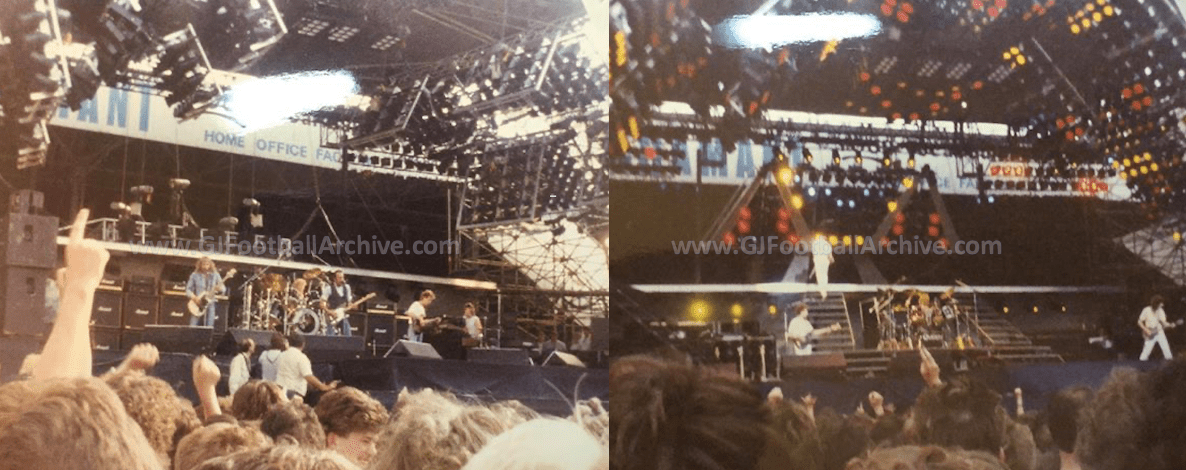
It’s a kind of magic! For day 45 of my posts counting down to the centenary of Maine Road’s opening game I’ve posted these images of Queen & the Rolling Stones at Maine Road. These images are the copyright of Garry Lippett who attended the Queen concert in July 1986.
Garry loaned his photos to me to be used in features about the concert and I’m eternally grateful. It’s quite often the fan photos that capture moments like these. In the days before mobile phones these type of photos are rare and the person taking the image has no idea how good or bad the image may be until it’s developed. Thankfully Garry managed to capture both acts on stage. Status Quo are on the left image and Queen on the right.
Status Quo (left) & Queen 1986 concert at Maine Road. Copyright Garry Lippett
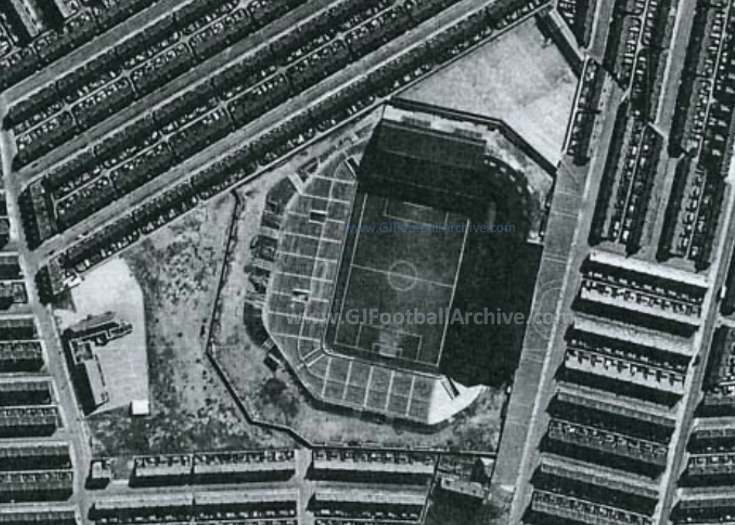
Here’s an aerial photo of Maine Road from 1971. The Queen stage was placed in front of the Platt Lane Stand (numbers 3 to 5). If you look carefully at Garry Lippett’s images you can see the advertising boards at the front of the Platt Lane roof.
Maine Road aerial 1971 from Farewell To Maine Road
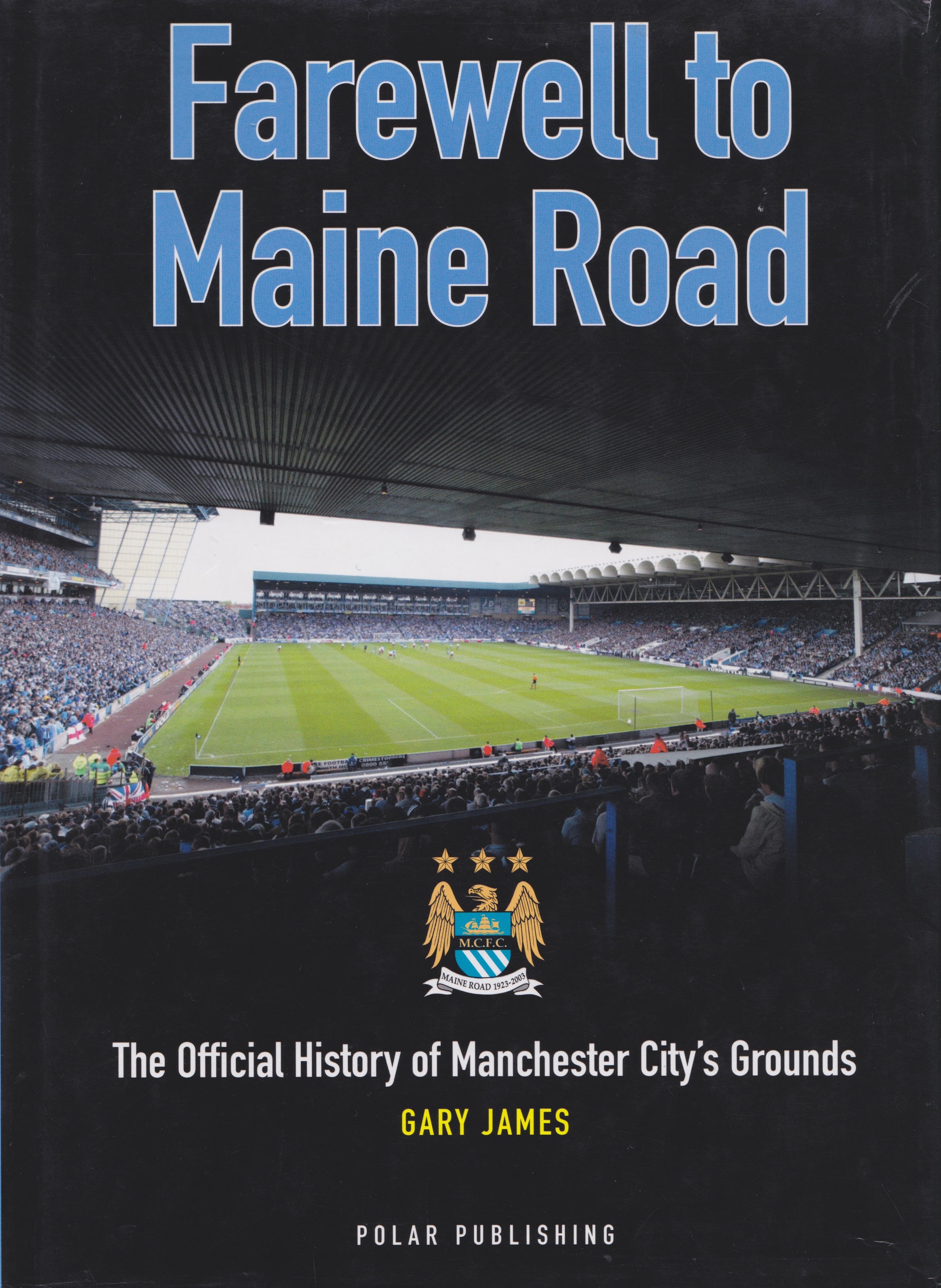
If you’d like to read more on the history of Maine Road, take a look at Farewell To Maine Road, which can be downloaded from this page:
If you enjoy all the free material on my website and would like to support my research and keep this website going (but don’t want to subscribe) then why not make a one-time donation (or buy me a coffee). All support for my research is valued and welcome. It allows me to keep some free material available for all. Thanks.
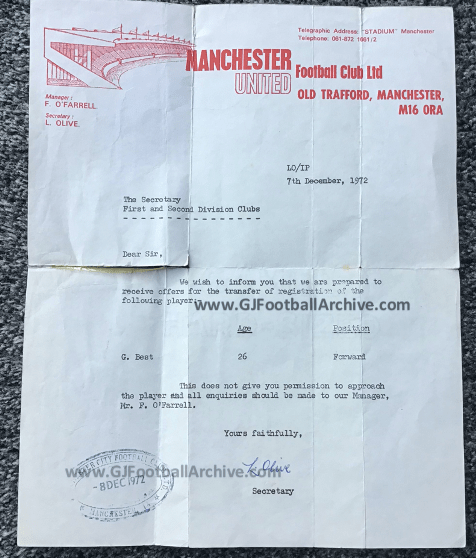
For the first time in my series of my posts counting down to the centenary of Maine Road’s opening game I’ve posted an image of a letter. This Day 44 feature is about the day Manchester United offered George Best to Manchester City.
Basically, Best was put on the transfer list by United and they sent a letter to every team in the top two tiers telling them he was available. In 1968 Best had said that he wanted to play for City as he felt they had the most attack-minded team in the League and he loved the thought of playing in a team that contained Colin Bell (below, seen in 1972-73), Mike Summerbee and Francis Lee.
Malcolm Allison did show interest in signing him but ultimately it never happened. Nevertheless this MCFC stamped letter is a rare item showing that United did offer the player to City and the other clubs in 1972.
Here’s an aerial photo of Maine Road from 1971, the year before Best was offered to City.
Maine Road aerial 1971 from Farewell To Maine Road
If you’d like to read more on the history of Maine Road, take a look at Farewell To Maine Road, which can be downloaded from this page:
If you enjoy all the free material on my website and would like to support my research and keep this website going (but don’t want to subscribe) then why not make a one-time donation (or buy me a coffee). All support for my research is valued and welcome. It allows me to keep some free material available for all. Thanks.
For day 43 of my posts counting down to the centenary of Maine Road’s opening game I’ve posted an unusual image of a screen on the Maine Road pitch. Can you work out what it was for?
This is a photo I took back in May 1999 of the Play Off semi-final away leg at Wigan. It was Springfield Park’s last competitive fixture and demand for tickets was high. I couldn’t get a ticket to be there but, because of the significance of the game, City decided to put a screen up at Maine Road and sell tickets for the Kippax.
Around 10,000 of us attended the game at Maine Road and we booed and cheered as you would if you were actually at the game. At one point Joe Royle appeared on the screen and we all chanted for him to ‘give us a wave’. Of course, Royle was at Springfield Park and couldn’t hear us but that didn’t stop us from booing when he seemingly ignored us! Football humour, hey?
Here’s an aerial photo of Maine Road from 1971. The Main Stand roof is different (as is the Platt Lane Stand and the Kippax Stand) but hopefully this will give an idea of where the screen was for those unfamiliar with Maine Road. It was positioned in front of the players’ tunnel (near 1 on the image) and I was sat in the new Kippax, roughly in between numbers 7 and 8 on this image.
Maine Road aerial 1971 from Farewell To Maine Road
If you’d like to read more on the history of Maine Road, take a look at Farewell To Maine Road, which can be downloaded from this page:
If you enjoy all the free material on my website and would like to support my research and keep this website going (but don’t want to subscribe) then why not make a one-time donation (or buy me a coffee). All support for my research is valued and welcome. It allows me to keep some free material available for all. Thanks.
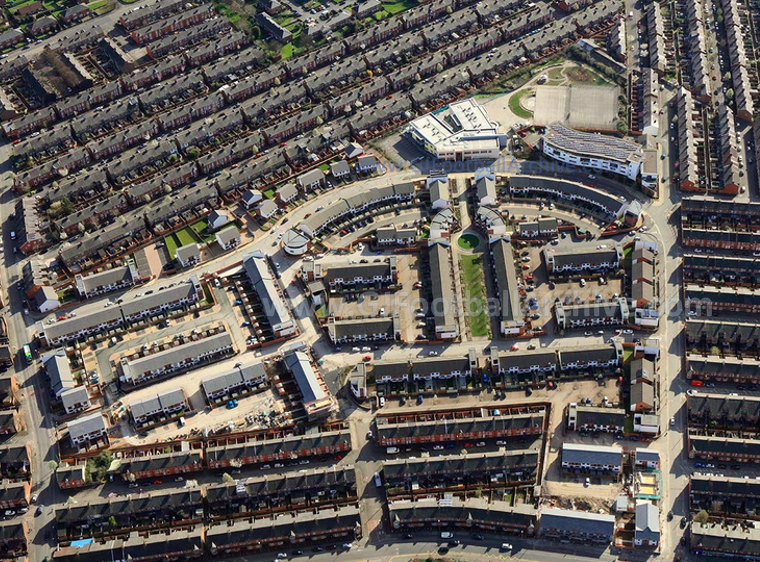
For day 42 of my posts counting down to the centenary of Maine Road’s opening game I’ve posted a then and now style feature on Maine Road from the air.
The angles are not quite the same but I hope the following gives you enough of a feel to recognise the differences between Maine Road c.1946 and Maine Road about a year or so ago.
There are a few obvious consistencies between the two photos – mostly the old terraced streets which predated the building of the stadium. Maine Road itself is on the right and Kippax Street is the street that heads towards the terracing (from the bottom/Claremont Road) in the older image. In the newer image it leads into part of the new housing estate. Note the centre spot/circle in the new image. It appears further north than in the older image but that’s mostly the angle (having said that I’m not entirely convinced it’s in exactly the right spot – I’ve not yet compared actual plans but I guess the architects and planners did).
It’s nice to see that the old directors car park (top right) is now a school playground/facility. This seems appropriate as the players often used that car park as a training area during the week. It’s nice to see some continuity. A passageway, known as ‘Pink Passage’ for many years, existed between the directors car park and the external wall of the Platt Lane Stand – you can just about see it on the old photo going from the back of Thornton Road around the Platt Lane to Maine Road.
Notice how the Kippax/Popular Side terracing in the old photo is narrower the closer it gets to Thornton Road (top)… In a previous post I’ve talked about how they had to square off this terracing when they put a roof on in 1957 and how residents objected because they lost the Granada TV signal! See:
Here’s another aerial photo of Maine Road. This is 1971. Notice the away section of the Kippax built on stilts (to left of number 8). The directors car park is the space behind the Platt Lane (numbers 4 & 5) with the Pink Passage between the two walls of the car park and the Platt Lane Stand. Kippax Street itself (the street not the stand) is just visible on the far right (to the right of number 9 on the edge of the photo).
Maine Road aerial 1971 from Farewell To Maine Road
If you’d like to read more on the history of Maine Road, take a look at Farewell To Maine Road, which can be downloaded from this page:
If you enjoy all the free material on my website and would like to support my research and keep this website going (but don’t want to subscribe) then why not make a one-time donation (or buy me a coffee). All support for my research is valued and welcome. It allows me to keep some free material available for all. Thanks.
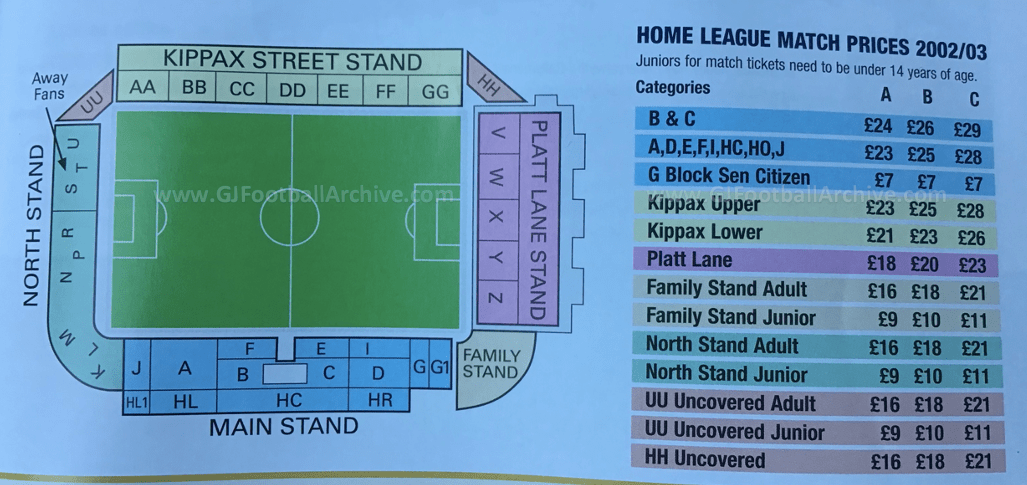
Day 41 of my posts counting down to the centenary of Maine Road’s opening game follows on from yesterday’s feature. Today I cover ticket prices for Maine Road’s last season and provide a bit more on the additional temporary seating. This was of course a Premier League season, but the temporary seating had started to be added several years before, being used in 1998-99 as mentioned yesterday.
The most expensive seat was in the centre blocks B & C at £29 for the highest category game. The cheapest adult seat was £16 for the uncovered temporary stand UU, also known as the Gene Kelly Stand (see yesterday for naming details), and HH (dubbed the ‘Alan Ball Stand’ by one fanzine as it was small and didn’t make much noise!).
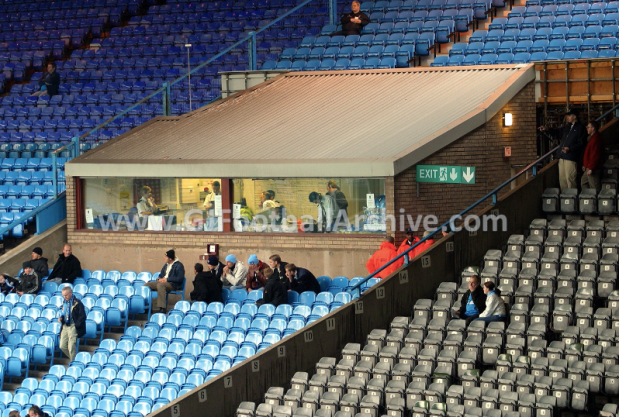
Other temporary stands were now in place in the tunnel between Platt Lane and the Main Stand (block G1 on the plan) and behind the security box (block H1 on the plan). As these were covered they were more expensive than the uncovered temporary stands.
You can see the temporary seating behind the stadium control box here – this would have been an empty space in previous years.
Photo by Ed Garvey
People often forget about these extra temporary stands, focusing only on the Gene Kelly and ‘Alan Ball’ (or Gene Kelly 2 as it was sometimes called). Even those two uncovered stands increased in size over the years. I typically sat in block Y of the Platt Lane this season but I did sit in the ‘Alan Ball’ for the Newcastle game early in the season. It poured down!
This image shows the ground before any temporary stands were built. This was 1995 (the Kippax is still being completed).
Compare the two plans from 2002 (above) and from 1998 (below) to see the additional temporary stands.:
If you’d like to read more on the history of Maine Road, take a look at Farewell To Maine Road, which can be downloaded from this page:
If you enjoy all the free material on my website and would like to support my research and keep this website going (but don’t want to subscribe) then why not make a one-time donation (or buy me a coffee). All support for my research is valued and welcome. It allows me to keep some free material available for all. Thanks.
It’s day 40 of my posts counting down to the centenary of Maine Road’s opening game and today’s feature concerns ticket prices for the 1998-99 season: The only season MCFC spent in the third tier.
Maine Road was all-seater by this point and the most expensive seat was in the centre blocks B & C at £18 for the highest category game. The cheapest adult seat was £9 for the uncovered temporary stand UU, also known as the Gene Kelly Stand as fans there were used to ‘singing in the rain’ – do an internet search on the reference if you’re baffled or think that Gene Kelly played in the 1937 title winning season. Actually, when I set up the original museum in 2003-04 a Manchester tourist using our ‘Virtual Tour of Maine Road’ interactive asked if Gene Kelly had played international football for Scotland!).
Other temporary stands were erected over the next couple of years as Maine Road struggled to cope with demand. This ticket price plan shows that there isn’t yet an uncovered stand between the Kippax and the Platt Lane for example. It also shows where away fans were housed – this had varied over the years but for most of Maine Road’s last 25 years they had been housed in the Kippax away section of the old stand with some seats in either the Main Stand or in block J (there’s a whole series of possible articles on where the away fans were placed game after game – it did vary and I do remember arriving one day and being surprised at a group segregated in a section of the Main Stand that was normally home fans only).
To help with the flashback to 1998 here’s a newspaper cutting on Ian Bishop’s return in 1997-98:
The Manchester Metro News highlights the return of Ian Bishop
Of course the 1998-99 season ended with promotion at Wembley – a stadium that had been built by the same builders as Maine Road and in the same year.
If you’d like to read more on the history of Maine Road, take a look at Farewell To Maine Road, which can be downloaded from this page:
If you enjoy all the free material on my website and would like to support my research and keep this website going (but don’t want to subscribe) then why not make a one-time donation (or buy me a coffee). All support for my research is valued and welcome. It allows me to keep some free material available for all. Thanks.
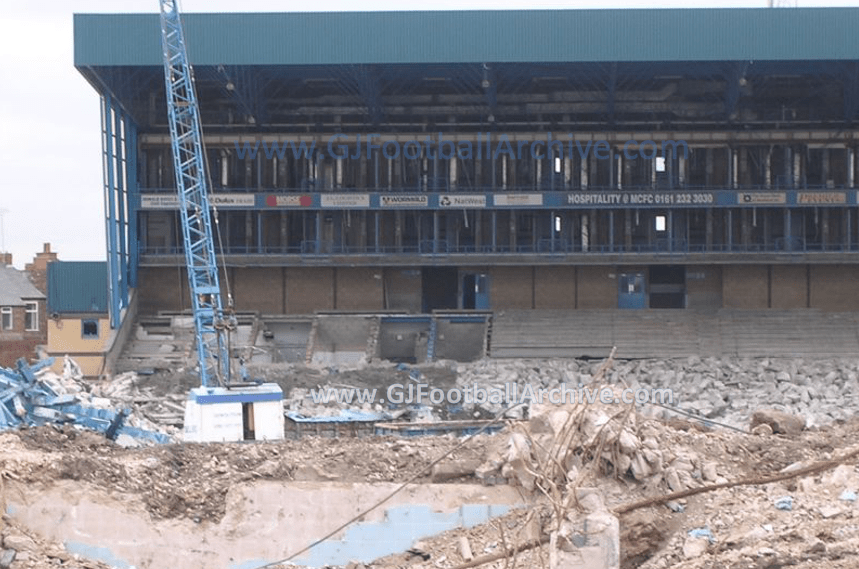
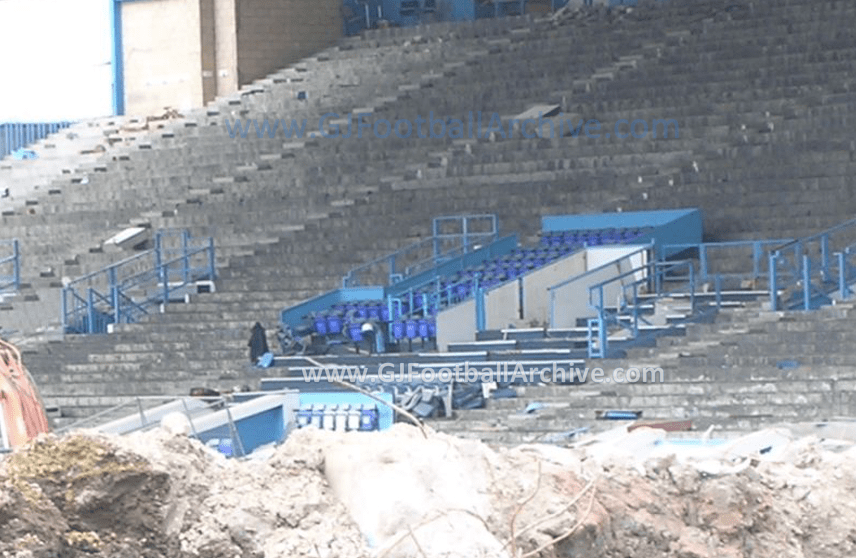
It’s day 39 of my posts counting down to the centenary of Maine Road’s opening game and today’s feature follows on from yesterday’s. It’s the demolition of the Platt Lane Stand during 2003-04.
Here are some images of that end at other times. This was the 1935 version of the stand:
The Main Stand’s benches with the Platt Lane Stand’s maroon and yellow benches in the backgroundThe Platt Lane Stand, 1991
Here’s the 1930s stand during demolition in 1992:
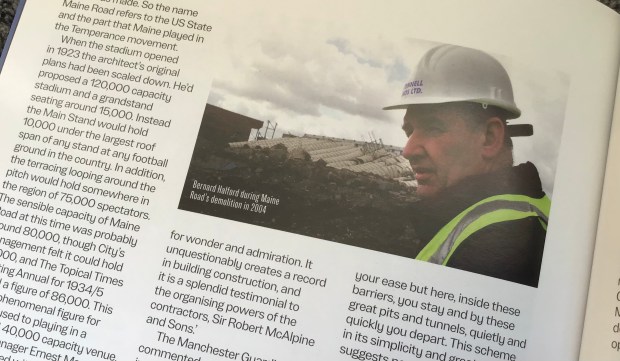
I went with club photographer Ed Garvey and secretary Bernard Halford to have a look at the old place in 2004 as it was being demolished. It was a sad sight.
During the 2022-23 season I did a feature on Maine Road for the match programme at City and included a photo of Bernard Halford from our visit.
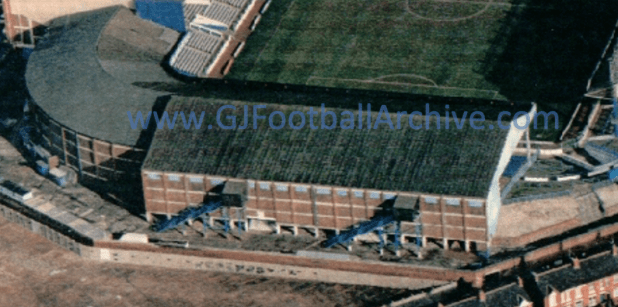
For those unfamiliar with Maine Road this photo may help locate the Platt Lane Stand. The 1930s stand is number 4 & 5 on this image taken in 1971.
Maine Road aerial 1971 from Farewell To Maine Road
If you’d like to read more on the history of Maine Road, take a look at Farewell To Maine Road, which can be downloaded from this page:
If you enjoy all the free material on my website and would like to support my research and keep this website going (but don’t want to subscribe) then why not make a one-time donation (or buy me a coffee). All support for my research is valued and welcome. It allows me to keep some free material available for all. Thanks.
Here for subscribers is the sixth part of Farewell To Maine Road as planned. Subscribers to my website are able to download PDFs of the first four sections of my Farewell To Maine Road book (which retailed at £25) here. So if you’ve not yet had chance, take a look now. Enjoy!
Subscribe to get access – Monthly
If you would like to read the book and download a PDF of it then you can subscribe now at £3 per month or £20 a year. Monthly subscribers access everything posted to the site since 1 October 2022. All subscribers get everything else posted during their subscription too. You could always try a monthly subscription to see what you think (cancel any time).
As well as Farewell To Maine Road annual subscribers get access to everything posted since the site was created in December 2020 (that’s 100s of articles, videos, history talks and PDFs of two other books: Manchester A Football History and my first book From Maine Men To Banana Citizens).
The book has been out of print since 2004 with every copy sold within about six months of publication. Since then I’ve been keen to bring it up to date with stories about the site and the Etihad but that’s not been possible as no publisher has been prepared to invest in the way that Polar Publishing did to ensure it was the right quality.
Copies occasionally appear in second hand book shops or at online retailers but these often sell for ridiculous sums of money. The last time I checked there was one for about £100 here:
When it was published in 2003 apparently, I commented (though I can’t remember saying this, mind you it was 20 years ago): ‘On 320 beautifully illustrated A4 size pages this book tells the story of Maine Road from conception, right through to its final days as a sporting venue. With excellent photographs – including rare illustrations of the stadium during construction never previously published and images from every era – this has been a very interesting book to research, write and compile. I’ve also tried to ensure the views of ordinary fans are included, and some of the most powerful Maine Road moments are captured by the fans who saw them happen.’
In a review, Hugh Ryden wrote in King of the Kippax: ‘The architecture, the moving memories, the reproduction of rare photos and memorabilia and its extensive quotations, make FTMR a must.’
Another King of the Kippax regular Steve Worthington wrote: ‘Following on in the winning formula of his epic “Manchester The Greatest City”, the highly acclaimed author and Manchester City Football Club Historian Gary James has rolled up his sleeves once more and has produced yet another fabulous football book for all to treasure and enjoy. “Farewell to Maine Road” is not only a must for all Manchester City supporters, it is also an essential for all football fans who possess a genuine interest and passion for the history of our great British past time. It catalogues the birth, evolution and ultimate decline of what was once England’s premier and revolutionary provincial football stadium; Maine Road, Moss Side, Manchester M14. Soon to be demolished into oblivion, Maine Road is vividly remembered in all its former glory in this classic portal to the past. Beautifully written with the knowledge and passion you would expect from a lifelong Moss Side Pilgrim, the book provides a definitive literate and graphic illustration of Maine Road’s long and varied history. It contains a rich tapestry of previously unpublished photographs, one of which, a unique atmospheric shot of the famous ‘Ballet on Ice’ (a famous Manchester City V Spurs clash in the late sixties), is arguably worth the cost of the book on it’s own. Having consumed and digested every morsel of information contained within, it is difficult for me to imagine how much painstaking work and dedication it must take to produce and compile a book of such quality. Whilst they continue to produce triumphs such as this, the marriage of Gary James and Polar Publishing is truly one made in a Sky Blue Heaven. This 320-page masterpiece has pushed the boundaries of football publications to a new and higher level and has already prompted tears of nostalgia in my eyes. But don’t take my word for it, sign up a copy and see for yourself, you’ll not be disappointed.’
The publicity blurb said: ‘The only officially approved history of Maine Road is the perfect book for any supporter of City; Maine Road attendee; or general football enthusiast.
‘The book details the history of the stadium focussing on its development, and on the key games and events which have made Maine Road such a famous and important venue. Using first hand accounts, as told by supporters, players, administrators, and the media this book has been written and designed to the same high quality used in the highly acclaimed Manchester: The Greatest City. With special features on all the big City matches, international games, FA Cup semi-finals, League Cup finals, Rugby finals, concerts, religious meetings, and even on United’s use of the stadium during the forties and for European Cup games in the fifties. In addition both City’s former ground Hyde Road and future venue the City of Manchester Stadium have been covered to provide the complete history of City’s three homes.
‘As with earlier works by Gary James & Polar Publishing this book is destined to be regarded as the definitive history of Maine Road & Manchester City’s other grounds.’
My publisher, Julian Baskcomb, commented: ‘Gary James is the appropriate man to write this work after a lifetime’s research on the club and its stadium. As a boy Gary was a regular in the Platt Lane Stand; then at the age of 16 he bought his own season ticket for the Kippax Stand and has been a season ticket holder ever since. He is also a respected journalist with articles for a wide range of publications including The Times and has recently managed the development of Manchester City’s new museum.’
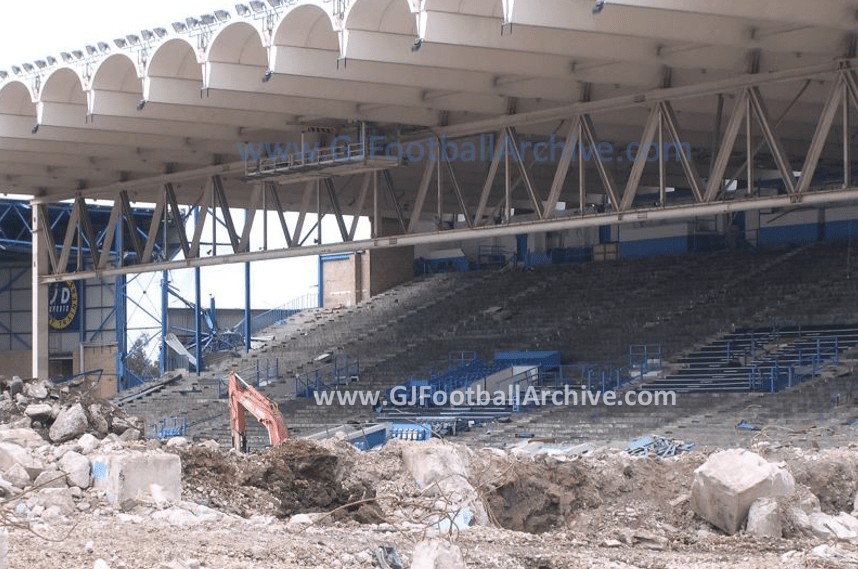
It’s day 38 of my posts counting down to the centenary of Maine Road’s opening game and today’s feature is of a sad scene: The demolition of the Main Stand during 2003-04. Apologies but it had to be shown one day.
I went with club photographer Ed Garvey and secretary Bernard Halford to have a look at the old place in 2004 as it was being demolished. It was a sad sight.
Ed Garvey photographThe directors’ box during demolition 2004. Ed Garvey photograph
During the 2022-23 season I did a feature on Maine Road for the match programme at City and included a photo of Bernard Halford from our visit.
Ed Garvey photographEd Garvey photograph
Warning: tomorrow I’ll post another demolition image.
For those unfamiliar with Maine Road this photo may help locate the Main Stand. It’s number 1 on this image taken in 1971.
Maine Road aerial 1971 from Farewell To Maine Road
If you’d like to read more on the history of Maine Road, take a look at Farewell To Maine Road, which can be downloaded from this page:
If you enjoy all the free material on my website and would like to support my research and keep this website going (but don’t want to subscribe) then why not make a one-time donation (or buy me a coffee). All support for my research is valued and welcome. It allows me to keep some free material available for all. Thanks.
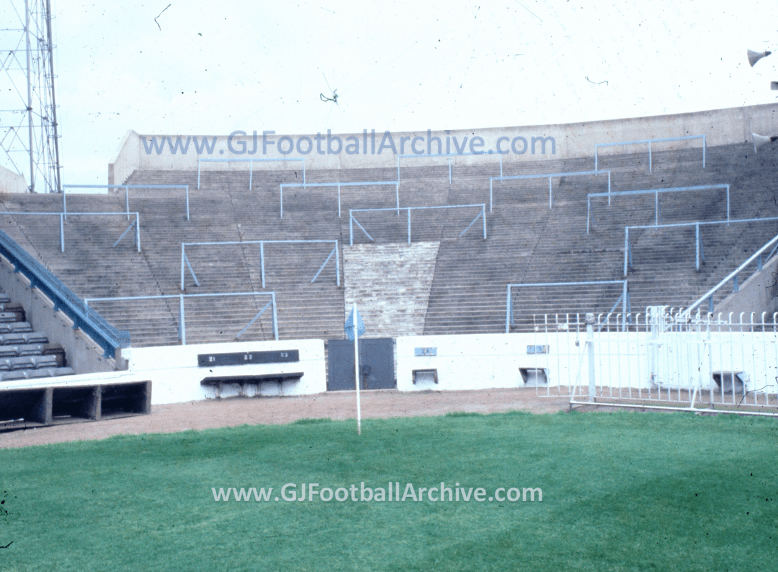
It’s day 37 of my posts counting down to the centenary of Maine Road’s opening game and today’s feature is – don’t get too excited – on this corner! I’ve said before that a photograph can say so much if you look closely at it and learn how to ‘read’ images like this. This is true for this simple photo of the corner between the North Stand (left) and Kippax (right). So what does this picture tell us? Well….
This was built as part of the North Stand development back in 1971 but it remained part of the Kippax. It was never roofed – meaning that this corner and the one on the other side of the Kippax were the only areas of Maine Road never to have a roof over them. If you’re counting the Main Stand had 3 roofs/roof developments during its life; the Platt Lane had 2; the North Stand one, and the Kippax two.
This corner was always accessed via Kippax turnstiles and it was always within the Kippax boundary walls. When the North Stand was built the exterior wall behind the stand was removed and turnstiles built into the stand but this corner never had any of that.
I’m not certain why the original corner terracing was ever demolished. Originally this corner had a large tunnel (like those in the other corners) and maybe they demolished that and built the new terracing because they felt it would increase capacity, but the corner is actually a little smaller than the one it replaced.
The rake of the steps is steeper than the rest of the Kippax and is the same as that in the North Stand. This suggests that there may have been plans to carry the North Stand around the corner. Former chairman Eric Alexander, who was primarily responsible for the new North Stand, had a vision of rebuilding the Kippax next but the arrival of Peter Swales as chairman killed that off. Maybe Eric was thinking ahead?
Strangely, there’s a concrete wedge in the middle which looks like newer concrete, roughly where the original tunnel would have been (though somewhat narrower).
Notice the loudspeaker (top right) pointing to this corner from the Kippax to ensure those standing here could hear the tannoy system. They used to test it in an empty stadium and never understood why fans couldn’t hear it in the Kippax on match day!
The floodlit pylon can be seen at the back, left. Also the blue fence on the left trying to stop fans climbing in to the North Stand – I do remember fans sneaking in occasionally.
There’s also the first pitch side fence on the right. This was positioned in front of the Kippax to stop fans getting on the pitch but all they needed to do was climb into this corner and go through the gate in the wall!
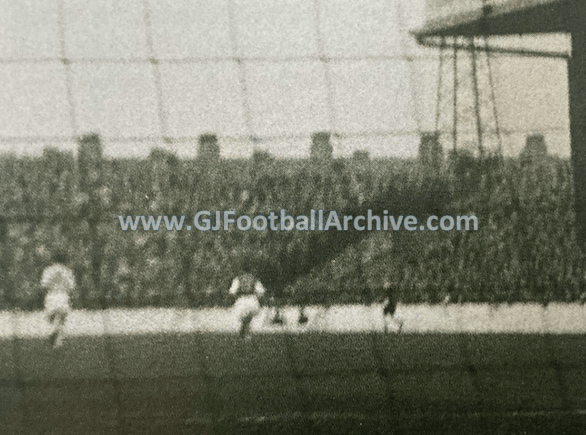
The white wall contains a gate where the old police/first aid dug outs used to be (see photo below of the same corner in the early 1960s) and the small seats built into the wall that the police and first aid people used to sit on at the time this photo was taken.
There’s also the corner flag visible.
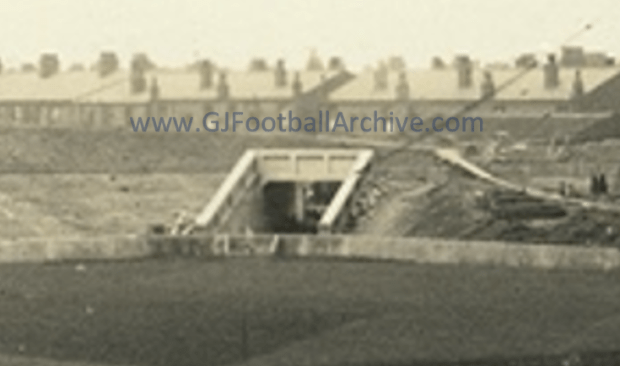
The following is the Platt Lane/Main Stand corner when first built in 1923. It gives an impression of how the North Stand/Kippax corner would’ve looked at that time too.
1923 Platt Lane/Main Stand corner tunnel
The North Stand/Kippax corner was demolished in 1994 and later the ‘Gene Kelly’ temporary stand was located there.
For those unfamiliar with Maine Road this photo may help locate the terraced corner between the North Stand and Kippax. It’s number 9 on this image and you can see the Kippax wall behind it. Note the wall behind the North Stand has yet to be removed from this image, taken in 1971.
Maine Road aerial 1971 from Farewell To Maine Road
If you’d like to read more on the history of Maine Road, take a look at Farewell To Maine Road, which can be downloaded from this page:
If you enjoy all the free material on my website and would like to support my research and keep this website going (but don’t want to subscribe) then why not make a one-time donation (or buy me a coffee). All support for my research is valued and welcome. It allows me to keep some free material available for all. Thanks.














 Gary James' Football Archive