After a glittering career with Preston, Everton and Liverpool, striker David Johnson joined Manchester City on this day (21 March) in 1984. Johnson scored on his City debut – an 83rd minute equaliser v Cardiff in a game the Blues went on to win 2-1 (Image is of that goal). Unfortunately, despite a reputation as a lethal striker – and hard evidence of achievement – Johnson’s time at Maine Road was not particularly successful. After one goal in four (plus two as substitute) games Johnson moved to play soccer in North America in May 1984.
Johnson died in November 2022 and the following piece was written by Samuel Meade and published in the Mirror:
You can read an article on the entire 1983-84 season if you subscribe (see below):
Subscribe to get access
Read more of this content when you subscribe today. It costs £3 per month (cancel anytime) to access everything posted since 1 October 2022 or there’s a special annual rate of £20 per year, which gives greater access and works out much cheaper.
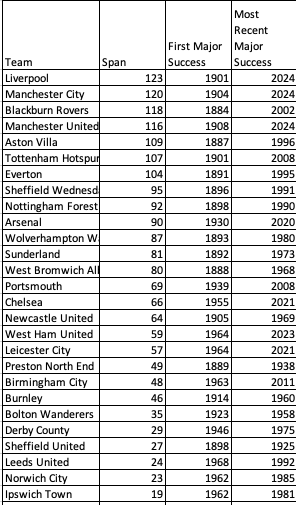
Congratulations Newcastle on defeating Liverpool in today’s League Cup final. The victory also means that 120 years separate their first major trophy success with their most recent. This span equals Manchester City. Every year, usually when the domestic season ends I update the table showing the span of success – i.e. the number of years between a club’s first major success (FA Cup, League, League Cup, major European trophy) and their most recent – for each major men’s trophy winning English club. I last did this after the 2023-24 season ended (see below). There wasn’t much difference between the 2023 final table and the 2024. Both Liverpool and Manchester City increased their span, as did United. Newcastle have leaped from 16th place (just behind Chelsea) to joint second with City. Here’s the table as it stood before today’s game:
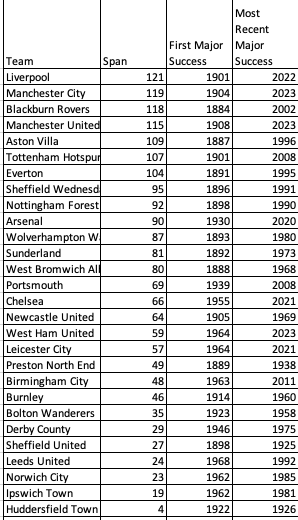
As I always say, the span of success does not show how many trophies each club has won or how frequently that club has experienced great eras of success, but it does demonstrate how wrong those people are who believe certain clubs were unsuccessful until recent years, or those who think certain clubs have always been giants. The column on first major success helps to show when some clubs first became trophy-winning significant (often after transformational investment too!).
There’s not much difference between 2023 and 2024 – numbers have changed but not positions. In 2023 West Ham, like potentially Newcastle this year, proved that if you’re a club that hasn’t won a major trophy for a while putting your focus on achieving trophy success ahead of the odd Premier League position can bring significant reward. In future decades no one will remember who finished seventh, tenth or fifteenth but they will remember the trophies. Here’s the previous year’s table for comparison purposes:
I know clubs focus on their financials but winning a trophy has longevity, gaining the odd Premier League place provides a bit of extra cash now but no long term kudos. Winning a trophy attracts new fans and brings money-spinning opportunities too.
If I was a supporter of any of the major clubs who have not found significant success in recent decades then I would absolutely want my team to go for whichever cup competition seems the most likely to win. That’s what I always wanted from City before they were able to compete for the League again. Winning the FA Cup in 2011 helped everything that followed happen – it gave confidence and a trophy winning mentality.
While you’re here why not take a look at the wide range of articles available on this site? Such as the 100 day series of features on Maine Road:
If you enjoy all the free material on my website and would like to support my research and keep this website going (but don’t want to subscribe) then why not make a one-time donation (or buy me a coffee). All support for my research is valued and welcome. It allows me to keep some free material available for all. Thanks.
On this day (16 March) in 1955 Manchester City defeated Bolton Wanderers 4-2 with goals from Joe Hayes (3) and Fionan Fagan (photographed).
This series on Manchester City in the 1950s includes free items and items only available to subscribers. If you’d like to find out more on the 1954-55 season then subscribe and read the following 3,400 word article on it. It’s a season when City reached the FA Cup final and Don Revie was FWA Footballer of the Year.
This is a subscriber article and you can read it by subscribing below.
Subscribe to get access
Read more of this content when you subscribe today. It costs £3 per month or you can subscriber for the discounted annual rate of £20 per year. Each subscriber gets access to everything posted so far, including PDFs of a couple of my books.
Good luck to Manchester City in today’s Women’s League Cup Final at Derby’s Pride Park. The game kicks off at 12.15 and sees Blues boss Nick Cushing look to capture the first major silverware of the season.
The final is live on BBC One from 11:45, with live radio commentary from 12:00 on BBC 5 Sports Extra and BBC Sounds, and text commentary on BBC Sport website.
Of course City and Chelsea have met before in the League Cup final. You can read this article I did a few years ago on that and on City’s first League Cup success here:
I’ve just got back after attending Steve Fleet’s funeral today. Steve was a wonderful man who played for Manchester City, Stockport County and Altrincham and it was great to see so many staff and former players from the clubs he was involved with in attendance. Fred Eyre read Steve’s own words as the eulogy and, typical of Steve, he did not want a fuss. He did not want Fred to talk of all the wonderful things Steve did or said. Steve was always humble and had a special aura that encouraged positivity.
Last week I posted one of the many interviews I did with Steve here for all to read and, if you missed it, here it is again. This was written in a Q&A style with Steve’s thoughts written out for all to see.
I think that when someone dies it is often best to use their words to describe their life/career. Who better to talk about Steve’s life than Steve himself? Here’s the interview as it was written up in 2004:
IN SEARCH OF THE BLUES – Steve Fleet
Steve Fleet has been involved with Manchester City for over 50 years, first as a player, then as a coach and later as manager of the Platt Lane complex. His early City career saw him as goalkeeping understudy to the great Bert Trautmann. Gary James, author of Farewell To Maine Road, caught up with him last week.
You made your debut against Wolves in 1957, can you remember much about that day?
I actually heard I was making my debut from the Manchester Evening News. I woke up to find a newspaper reporter and photographer on my doorstep, and they told me I was actually going to play. City had told me to report for training pre match but hadn’t said anything about being in the team. The reporter asked me what I thought of the news and then they got me to pose next to my record player – I suppose they wanted me to be doing the sort of things any 20 year old would be doing.
The game was a thriller and ended 4-3 to Wolves, how do you think you played?
I thought I’d played well, and I was fairly happy with my performance. I remember it was a bit of a foggy day and also that Wolves were powerful – they won the League that season and were one of the great sides of the period. Afterwards I saw the newspaper reports and they were full of praise, so that was great. In addition Frank Swift – a truly great City & England ‘keeper – wrote a very complimentary piece in his newspaper column and said I had a great future ahead of me, while Bert Trautmann told reporters I was the best young ‘keeper he had ever seen. All of that praise made me feel terrific of course, but I also knew I was only filling in until Bert was ready to return. He was an outstanding ‘keeper and there was no way any other ‘keeper would replace him if he was fit.
Did you feel despondent knowing you had little chance of replacing him on a regular basis?
No, not at all. I knew I was still young and all the praise made me feel that I would eventually be City’s number one. I suppose I felt I had to serve out my apprenticeship first of all. There were other good ‘keepers at City, including Roy Dixon – the father of the famous Arsenal player Lee Dixon – but I was sure my day would come. I was also delighted to be second choice to Bert. He was a terrific player and a great man.
Did he coach you or help in any other way?
Bert helped in every way. He was a great role model and taught me so much about life as well as football. He was like an older brother to me and I was fortunate to be taken under Bert’s wing. He insisted I presented myself well – clean shoes, wear a tie etc. – at all times. I listened and followed his lead both on and off the pitch.
My father needed a car to go south on holiday once and Bert offered to let Dad use it. For a fortnight my Dad had his car and when it came time to give it back, Bert refused any payment of any kind. He was terrific to be with and he remains a great man. There are few men in football or in life like Bert. Even today every former player looks at Bert Trautmann in awe – he is a true great and there are very few around.
As I was 14 years younger than him I thought I was being groomed as his natural successor. It didn’t quite work out like that, but Bert tried to ensure I was given some opportunities. I only managed to play 5 League games and 1 League Cup match during my City career but Bert ensured I’d play in some of those. I only found out recently but Bert deliberately pulled out of a couple of games simply so that I could get the opportunity. City would try and make him play every game, no matter how fit he was – and he often played when not fully fit because everyone demanded it – but for those games he made sure I got my chance.
Did you always play in goals, or did you start as an outfield player?
I didn’t like playing in goal at first and always wanted to be an outfield player but I was too slow. When I was 9 I played a game in goals and I remember a teacher shouting ‘great save’, and that spurred me on. The encouragement helped me enormously and, later when I became a coach, I always tried to ensure I encouraged and gave opportunities to those playing for me.
My first ever City match was in the Wythenshawe League for City’s 5th team. Charlie Gee, the ex-Everton & England star, was watching and I remember him complimenting me on how I’d played. Again that encouragement gave me a major boost.
What was training like at City when you first started to make it into the first team?
We’d train in the mornings, but nothing in the afternoon. We’d finish at lunch and I’d then go over to United’s training ground, The Cliff, to meet my best friend Eddie Colman. All the United youngsters would still be training hard for Bert Whalley – I think that was the big difference at the time. United under Busby and Wolves under Cullis were concentrating on coaching and on youth development, whereas the Clubs managed by more traditional managers were doing what they had always done.
Sadly, Eddie later died in the Munich disaster and I was a pallbearer at his funeral – no one can underestimate how the disaster affected all Mancunians.
As a young boy I was brought up in Ordsall and played for Salford Boys with Eddie – the first photo ever taken of me playing was in 1951 when Salford Boys beat Manchester Boys 1-0 in front of 11,000 – and they used to take us to watch United. Then I got the chance to go to Maine Road to watch City. I loved the colour of City’s shirts – a beautiful colour – and I also knew that City’s ground was better than Old Trafford – it definitely was.
One of your League appearances was against United in 1961, do you remember much about that?
It was highly controversial! City were the better side in the opening minutes and United’s key danger was Alex Dawson but every time he challenged I had the better of him. Every time he jumped for the ball I would jump higher and catch it. There were no problems. Then it all changed. We both went up and his only chance of beating me was to punch the ball with his fist! He did that and amazingly the referee gave United the goal. I could not believe it, and afterwards Dawson admitted what he had done – I still have the newspaper cutting! – but it was too late, and United went on to win the match.
When Bert’s City career neared its end did you feel your time had arrived?
Unfortunately not. In fact it felt as if my time had already gone. I made a big mistake waiting all those years because, despite the promise and the positive coverage at the start of my career, I had stagnated to some extent in the reserves. It was great being number two to Bert, but I now realise I should have moved on earlier. I would never advise a young boy to wait to fill anybody’s shoes now. You do need first team football if you want to develop. I never achieved my full potential.
I was frustrated when Harry Dowd’s opportunities came but, fortunately, Ken Barnes was now the manager at Wrexham and he asked me to go there. I was at last a true first team footballer.
A couple of years later Bert was manager at Stockport County and he asked me to go there. We won promotion and I started to do a bit of coaching – I coached Ken Mulhearn who became City’s keeper.
Is that when you started moving into coaching?
In 1969 I moved to Altrincham as a player and started coaching there, then a year later I moved back to Stockport as Chief Coach. In 1973 I got the chance to come back to City and work with the Youth team. It was then that we tried to create a Busby style youth dynasty at Maine Road. We figured that if we could find good lads, coach them correctly, and give them the right opportunities we’d be able to keep the Club progressing.
With Harry Godwin, Ken Barnes, and all the other members of City’s backroom staff, you helped find and develop several exciting players. Who was your favourite from a footballing point of view?
Peter Barnes had the greatest skill and he was one of the nicest young players as well. He was always appreciative of the support given to him. He had lots of natural skill but was grateful for the advice given.
Clive Wilson was another very skilful player, but I suppose I was most pleased for Kenny Clements. Initially nobody rated him and he had to go on the groundstaff. We kept throwing him into practice matches and eventually Ian McFarlane recognised his ability and his career blossomed.
Gary Owen was the most enthusiastic player I ever had, while Alex Williams was another nice young man who developed well.
This was a golden period for youth football at City, reaching the FA Youth Cup final in successive years (1979 & 1980). How did it compare to your own playing career?
I loved playing of course, but I believe my biggest contribution to football came after my own playing days were over. The development of the Youth set up during this time saw Ken Barnes, myself and the others give the Club much more than the occasional victory. Some of our players were the backbone of the League side in the seventies and eighties. It was the most productive time in the Club’s history for youth.
Around this time you also had a regular column in the match programme on astrology. That seems an unusual topic for a football programme and a former player. How did that come about?
I was once on holiday in Abersoch and the weather was appalling so I sat reading an article in Cosmopolitan about star signs. I started to look into it further and eventually astrology did help me a little in football. Once I knew someone’s star sign it gave me an indication of how to handle the player. Then one day City had been playing John Bond’s Norwich and Kevin Bond had played well. They’d managed a draw, which was very unusual for Norwich at the time. As they came off the pitch Kevin Bond was asking for a telephone. It seemed a real emergency, so I took him into one of the offices and he made his call. Some of the other backroom staff were around and we all listened to his call. It turned out he’d ‘phoned his mother to tell her about the game. I watched and listened and as soon as he came off the ‘phone I asked “Kevin, I hope you don’t mind me asking but are you a Cancerian?”
It turned out he was and the rest of the staff were amazed that I could guess. There’s no point going through it all now, but during the call Kevin displayed typical characteristics of a Cancerian. One thing led to another and before I knew it I’d been talked into writing a piece by Eddie Booth.
I used to give information on typical characteristics and would try and link this in to players with birthdays etc. After a while it started getting crazy – I was receiving all sorts of letters, nothing to do with football, and we decided to stop the articles before they took over from the football!
Once John Bond arrived as manager, the youth emphasis changed and you found yourself moving on. How do you view the period that followed?
It was a great period for me personally because I went coaching in Iceland and gained a great deal of experience but also developed further as a person. Staying at one club, or in one job, can make you stale, but if you move to other clubs and other countries you get different experiences. There were also the major cultural differences – there was a lot to learn. I was in charge of Akranes – Arni Arason’s team before City – and then IB Vestmann in 1982. At Vestmann we managed to get into Europe two years running – going out to a Polish side and an East German side – so I’m very pleased with that period of my career.
I returned to England in 1984 and worked for Ron Saunders at Birmingham – I know Ron has his City critics but I always got on well with him, and was delighted when he gave me the opportunity he did. At Birmingham I coached Tony Coton and, of course, David Seaman was also there then.
You eventually returned to City as Sports Development Officer and later managed the Platt Lane Complex. Was this another period of personal development for you?
Definitely. Every period of life teaches you something and I found that the experience away from City helped me, but I also found I gained a great deal at Platt Lane. As a player I think I always knew that I wasn’t destined to be a great player, but I always tried to do things in a ‘great way’. I wanted to ensure my approach was right and I think my spells coaching at Maine Road and Platt Lane were my major contribution to this Club.
You left City’s employment for the last time in 2000, what did you do for the final years of your working life?
I worked for Manchester City Council Leisure department as an Events and Activities Co-ordinator. Again I gained much from that role because it brought me back to reality and I started to work with non-footballing people. There were some good people there again, and I enjoyed that final period of work.
Finally, thinking about your retirement, do you miss football?
I still watch City of course, and I also love the involvement with the Former Players’ Association. I enjoy helping people and I do love attending functions and so on. Most of all though retirement allows me to look back and consider how my life has progressed so far. Like everybody else I’ve suffered some major tragedies and problems over the years and, at times, these were extremely hard to face, however I now look back and realise that all of this has helped shape my life and personality.
I am a great believer in fate and I do think that everything happens for a reason, so I’m not one to feel bitter. I’ve enjoyed my footballing life, and am delighted with every aspect of it. I particularly loved coaching City’s youngsters, but I have to say that I am happier today than I have ever been.
Here’s film of the FA Cup 6th round tie from this day (12 March) in 1955 when Manchester City defeated Birmingham City 1-0. Johnny Hart was the City scorer. Enjoy!
This series on Manchester City in the 1950s includes free items and items only available to subscribers. If you’d like to find out more on the 1954-55 season then subscribe and read the following 3,400 word article on it. It’s a season when City reached the FA Cup final and Don Revie was FWA Footballer of the Year.
This is a subscriber article and you can read it by subscribing below.
Subscribe to get access
Read more of this content when you subscribe today. It costs £3 per month or you can subscriber for the discounted annual rate of £20 per year. Each subscriber gets access to everything posted so far, including PDFs of a couple of my books.
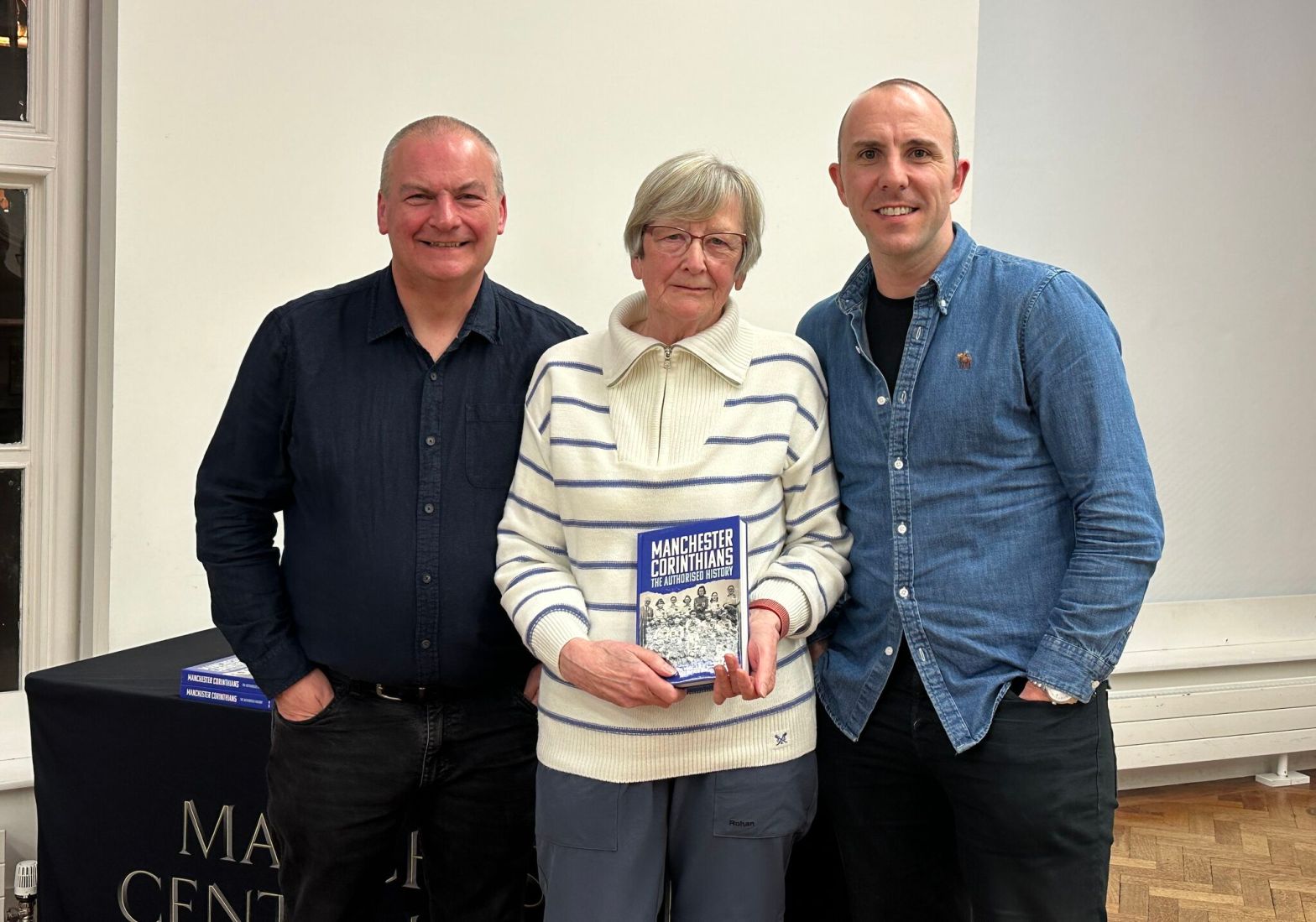
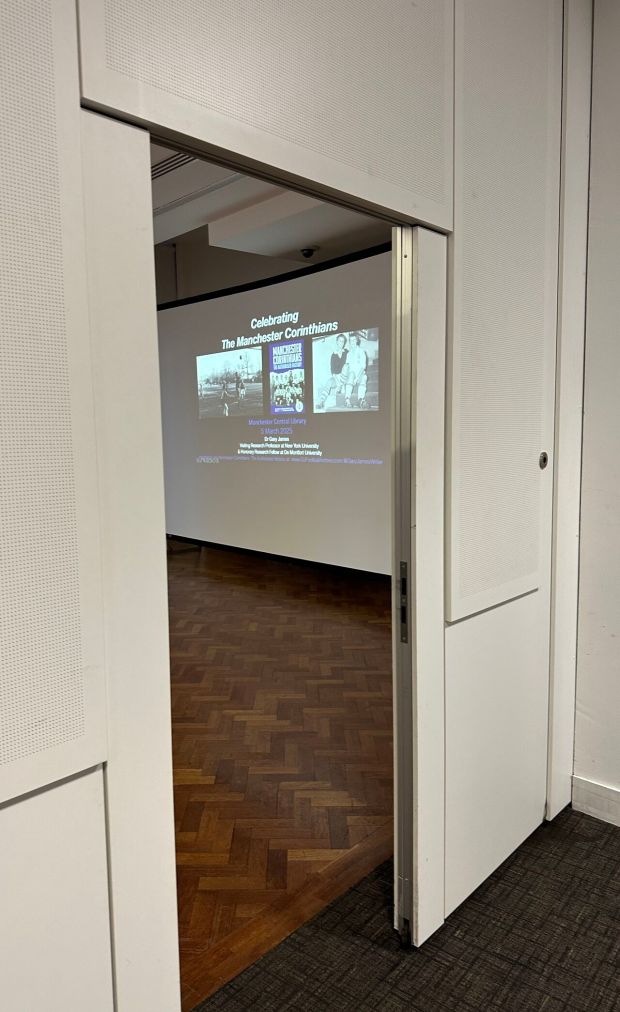
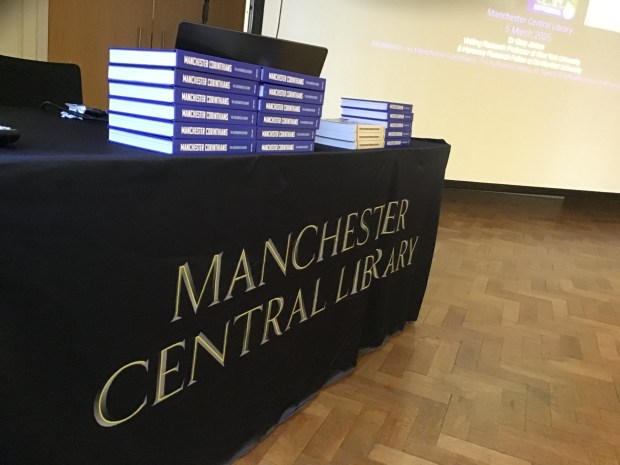
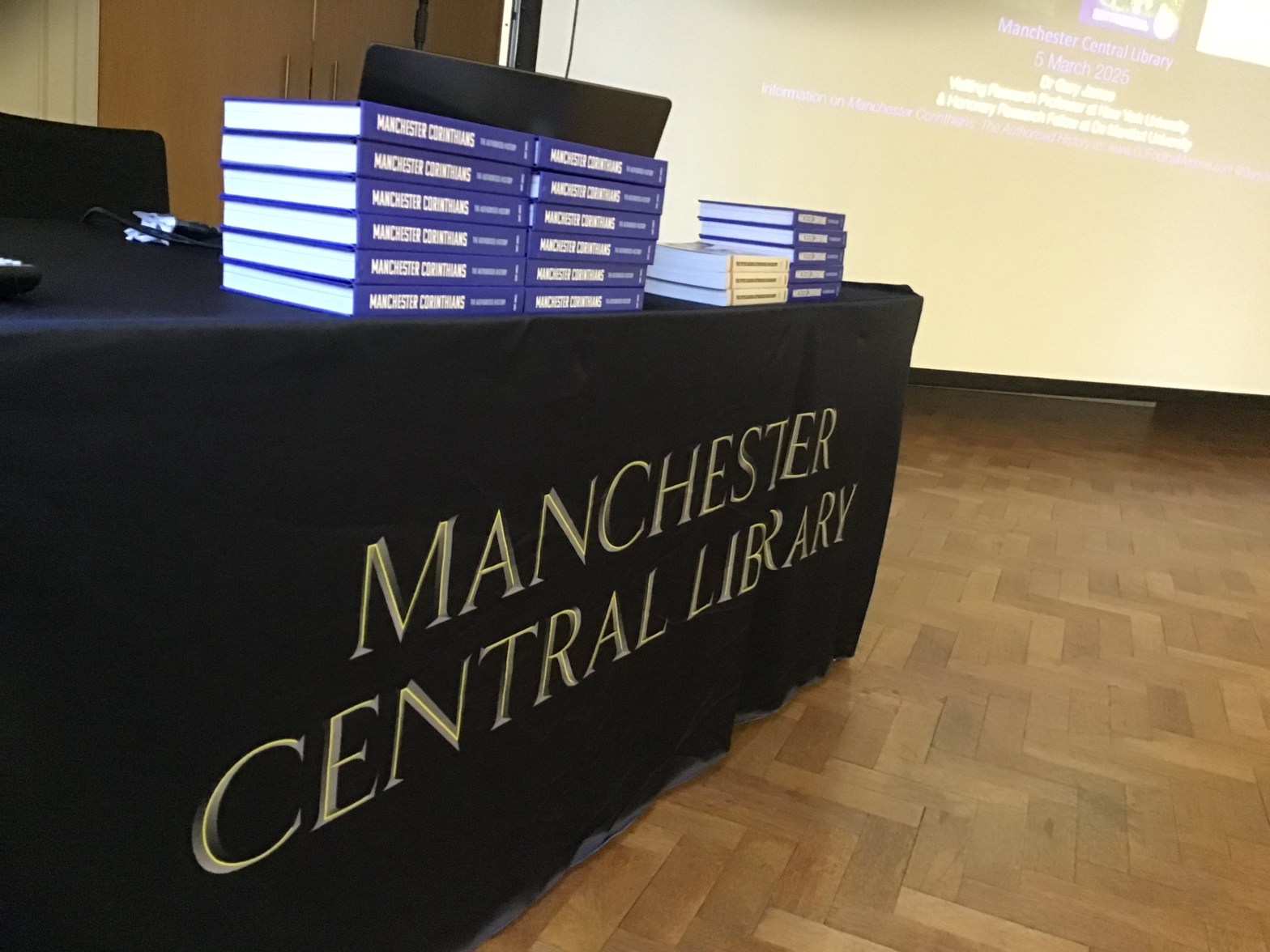
Thanks to all those who came to the Manchester Corinthians event last Wednesday (5 March) at Manchester Central Library. It was great to hear so many interested in the story and I’m sure the addition of Corinthians in the audience added to the event. They truly are remarkable women and there are so many angles to this wonderful football team that toured the globe between 1948 and 1992. There’s another talk tonight in Irlam and others arranged for the coming weeks too. On Wednesday, I promised to post some links in the aftermath of the event for those who want to find out more…
Firstly, Manchester Corinthians: The Authorised History. This book is a must for anyone interested in Manchester or women’s football and consists of 356 pages. It is illustrated throughout and you can order it now for £25 (including UK postage and packaging).
If you live outside the UK then please contact for details of additional postage costs.
You do not need to have a PayPal account to order – use the ‘Pay with PayPal’ button above and it will give you the option to pay by credit/debit card without creating a PayPal account.
UK ONLY – Manchester Corinthians: The Authorised History
The story of a pioneering women’s club as told to Gary James by those who were there. This will be published in late December 2024. This is UK only at £25 (incl UK postage and packaging). Outside UK contact for additional postage costs.
£25.00
Next, here’s the wonderful 18 minute film put together by Imprint Films on the Corinthians. It includes brief interviews with a small group of the women I interviewed, plus I help to explain why they are so significant.
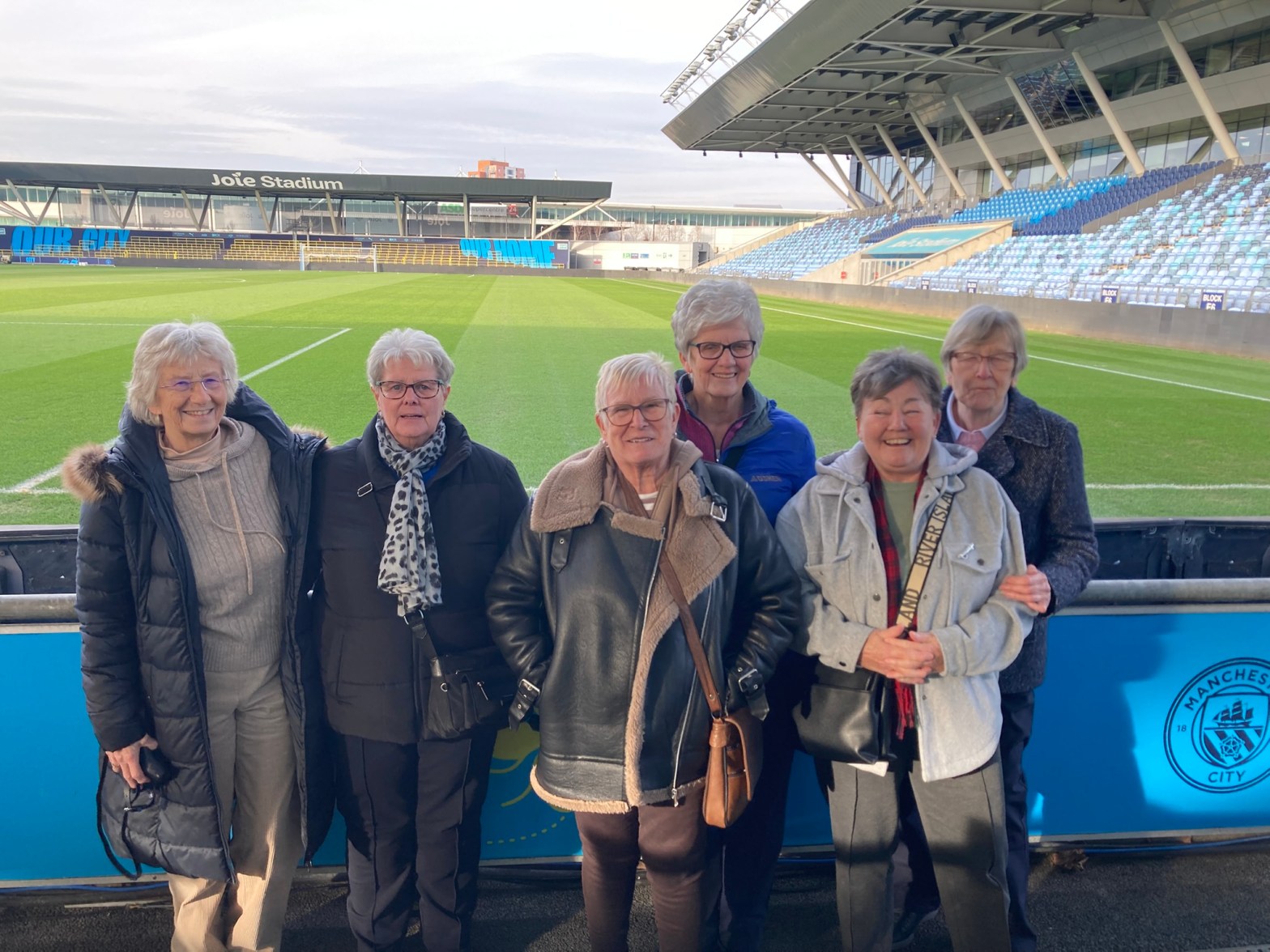
Another wonderful video and feature from @mancity on the Manchester Corinthians from our visit the other week. A few of the Corinthians were guests of the club and this video on them is well worth watching:
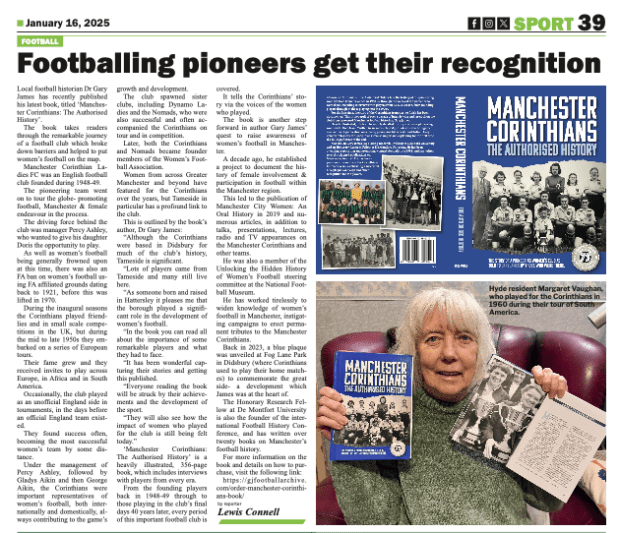
As it’s World Book Day I’m going to mention Manchester Corinthians: The Authorised History. We had a good event last night at Manchester Library and we’ve heard some wonderful stuff on the book. Thanks for all these positive responses which, inevitably, are down to the women who played – they are truly remarkable. A few reviews and features on the Manchester Corinthians book have appeared, alongside a whole series of articles (Watch this space for news of articles at Manchester City and in United We Stand). The Tameside Reporter had this piece a while ago (see page 39):
The book is similar in style to Manchester City Women: An Oral History, published five years ago. However, this book is hardback.
The purchase price is £25. All orders made directly via this website will be signed by author Gary James.
Those with a delivery address in the UK can order here (outside UK please contact for additional postage costs):
UK ONLY – Manchester Corinthians: The Authorised History
The story of a pioneering women’s club as told to Gary James by those who were there. This is UK only at £25 (incl UK postage and packaging). Outside UK contact for additional postage costs.
Following the death of former Manchester City, Stockport County and Altrincham goalkeeper Steve Fleet (who was also the man who had to break the news of Eddie Colman’s death to Eddie’s parents following the Munich air crash) I’ve decided to post one of the many interviews I did with Steve here for all to read. This was written in a Q&A style with Steve’s thoughts written out for all to see.
I think that when someone dies it is often best to use their words to describe their life/career. Who better to talk about Steve’s life than Steve himself? Here’s the interview as it was written up in 2004:
IN SEARCH OF THE BLUES – Steve Fleet
Steve Fleet has been involved with Manchester City for over 50 years, first as a player, then as a coach and later as manager of the Platt Lane complex. His early City career saw him as goalkeeping understudy to the great Bert Trautmann. Gary James, author of Farewell To Maine Road, caught up with him last week.
You made your debut against Wolves in 1957, can you remember much about that day?
I actually heard I was making my debut from the Manchester Evening News. I woke up to find a newspaper reporter and photographer on my doorstep, and they told me I was actually going to play. City had told me to report for training pre match but hadn’t said anything about being in the team. The reporter asked me what I thought of the news and then they got me to pose next to my record player – I suppose they wanted me to be doing the sort of things any 20 year old would be doing.
The game was a thriller and ended 4-3 to Wolves, how do you think you played?
I thought I’d played well, and I was fairly happy with my performance. I remember it was a bit of a foggy day and also that Wolves were powerful – they won the League that season and were one of the great sides of the period. Afterwards I saw the newspaper reports and they were full of praise, so that was great. In addition Frank Swift – a truly great City & England ‘keeper – wrote a very complimentary piece in his newspaper column and said I had a great future ahead of me, while Bert Trautmann told reporters I was the best young ‘keeper he had ever seen. All of that praise made me feel terrific of course, but I also knew I was only filling in until Bert was ready to return. He was an outstanding ‘keeper and there was no way any other ‘keeper would replace him if he was fit.
Did you feel despondent knowing you had little chance of replacing him on a regular basis?
No, not at all. I knew I was still young and all the praise made me feel that I would eventually be City’s number one. I suppose I felt I had to serve out my apprenticeship first of all. There were other good ‘keepers at City, including Roy Dixon – the father of the famous Arsenal player Lee Dixon – but I was sure my day would come. I was also delighted to be second choice to Bert. He was a terrific player and a great man.
Did he coach you or help in any other way?
Bert helped in every way. He was a great role model and taught me so much about life as well as football. He was like an older brother to me and I was fortunate to be taken under Bert’s wing. He insisted I presented myself well – clean shoes, wear a tie etc. – at all times. I listened and followed his lead both on and off the pitch.
My father needed a car to go south on holiday once and Bert offered to let Dad use it. For a fortnight my Dad had his car and when it came time to give it back, Bert refused any payment of any kind. He was terrific to be with and he remains a great man. There are few men in football or in life like Bert. Even today every former player looks at Bert Trautmann in awe – he is a true great and there are very few around.
As I was 14 years younger than him I thought I was being groomed as his natural successor. It didn’t quite work out like that, but Bert tried to ensure I was given some opportunities. I only managed to play 5 League games and 1 League Cup match during my City career but Bert ensured I’d play in some of those. I only found out recently but Bert deliberately pulled out of a couple of games simply so that I could get the opportunity. City would try and make him play every game, no matter how fit he was – and he often played when not fully fit because everyone demanded it – but for those games he made sure I got my chance.
Did you always play in goals, or did you start as an outfield player?
I didn’t like playing in goal at first and always wanted to be an outfield player but I was too slow. When I was 9 I played a game in goals and I remember a teacher shouting ‘great save’, and that spurred me on. The encouragement helped me enormously and, later when I became a coach, I always tried to ensure I encouraged and gave opportunities to those playing for me.
My first ever City match was in the Wythenshawe League for City’s 5th team. Charlie Gee, the ex-Everton & England star, was watching and I remember him complimenting me on how I’d played. Again that encouragement gave me a major boost.
What was training like at City when you first started to make it into the first team?
We’d train in the mornings, but nothing in the afternoon. We’d finish at lunch and I’d then go over to United’s training ground, The Cliff, to meet my best friend Eddie Colman. All the United youngsters would still be training hard for Bert Whalley – I think that was the big difference at the time. United under Busby and Wolves under Cullis were concentrating on coaching and on youth development, whereas the Clubs managed by more traditional managers were doing what they had always done.
Sadly, Eddie later died in the Munich disaster and I was a pallbearer at his funeral – no one can underestimate how the disaster affected all Mancunians.
As a young boy I was brought up in Ordsall and played for Salford Boys with Eddie – the first photo ever taken of me playing was in 1951 when Salford Boys beat Manchester Boys 1-0 in front of 11,000 – and they used to take us to watch United. Then I got the chance to go to Maine Road to watch City. I loved the colour of City’s shirts – a beautiful colour – and I also knew that City’s ground was better than Old Trafford – it definitely was.
One of your League appearances was against United in 1961, do you remember much about that?
It was highly controversial! City were the better side in the opening minutes and United’s key danger was Alex Dawson but every time he challenged I had the better of him. Every time he jumped for the ball I would jump higher and catch it. There were no problems. Then it all changed. We both went up and his only chance of beating me was to punch the ball with his fist! He did that and amazingly the referee gave United the goal. I could not believe it, and afterwards Dawson admitted what he had done – I still have the newspaper cutting! – but it was too late, and United went on to win the match.
When Bert’s City career neared its end did you feel your time had arrived?
Unfortunately not. In fact it felt as if my time had already gone. I made a big mistake waiting all those years because, despite the promise and the positive coverage at the start of my career, I had stagnated to some extent in the reserves. It was great being number two to Bert, but I now realise I should have moved on earlier. I would never advise a young boy to wait to fill anybody’s shoes now. You do need first team football if you want to develop. I never achieved my full potential.
I was frustrated when Harry Dowd’s opportunities came but, fortunately, Ken Barnes was now the manager at Wrexham and he asked me to go there. I was at last a true first team footballer.
A couple of years later Bert was manager at Stockport County and he asked me to go there. We won promotion and I started to do a bit of coaching – I coached Ken Mulhearn who became City’s keeper.
Is that when you started moving into coaching?
In 1969 I moved to Altrincham as a player and started coaching there, then a year later I moved back to Stockport as Chief Coach. In 1973 I got the chance to come back to City and work with the Youth team. It was then that we tried to create a Busby style youth dynasty at Maine Road. We figured that if we could find good lads, coach them correctly, and give them the right opportunities we’d be able to keep the Club progressing.
With Harry Godwin, Ken Barnes, and all the other members of City’s backroom staff, you helped find and develop several exciting players. Who was your favourite from a footballing point of view?
Peter Barnes had the greatest skill and he was one of the nicest young players as well. He was always appreciative of the support given to him. He had lots of natural skill but was grateful for the advice given.
Clive Wilson was another very skilful player, but I suppose I was most pleased for Kenny Clements. Initially nobody rated him and he had to go on the groundstaff. We kept throwing him into practice matches and eventually Ian McFarlane recognised his ability and his career blossomed.
Gary Owen was the most enthusiastic player I ever had, while Alex Williams was another nice young man who developed well.
This was a golden period for youth football at City, reaching the FA Youth Cup final in successive years (1979 & 1980). How did it compare to your own playing career?
I loved playing of course, but I believe my biggest contribution to football came after my own playing days were over. The development of the Youth set up during this time saw Ken Barnes, myself and the others give the Club much more than the occasional victory. Some of our players were the backbone of the League side in the seventies and eighties. It was the most productive time in the Club’s history for youth.
Around this time you also had a regular column in the match programme on astrology. That seems an unusual topic for a football programme and a former player. How did that come about?
I was once on holiday in Abersoch and the weather was appalling so I sat reading an article in Cosmopolitan about star signs. I started to look into it further and eventually astrology did help me a little in football. Once I knew someone’s star sign it gave me an indication of how to handle the player. Then one day City had been playing John Bond’s Norwich and Kevin Bond had played well. They’d managed a draw, which was very unusual for Norwich at the time. As they came off the pitch Kevin Bond was asking for a telephone. It seemed a real emergency, so I took him into one of the offices and he made his call. Some of the other backroom staff were around and we all listened to his call. It turned out he’d ‘phoned his mother to tell her about the game. I watched and listened and as soon as he came off the ‘phone I asked “Kevin, I hope you don’t mind me asking but are you a Cancerian?”
It turned out he was and the rest of the staff were amazed that I could guess. There’s no point going through it all now, but during the call Kevin displayed typical characteristics of a Cancerian. One thing led to another and before I knew it I’d been talked into writing a piece by Eddie Booth.
I used to give information on typical characteristics and would try and link this in to players with birthdays etc. After a while it started getting crazy – I was receiving all sorts of letters, nothing to do with football, and we decided to stop the articles before they took over from the football!
Once John Bond arrived as manager, the youth emphasis changed and you found yourself moving on. How do you view the period that followed?
It was a great period for me personally because I went coaching in Iceland and gained a great deal of experience but also developed further as a person. Staying at one club, or in one job, can make you stale, but if you move to other clubs and other countries you get different experiences. There were also the major cultural differences – there was a lot to learn. I was in charge of Akranes – Arni Arason’s team before City – and then IB Vestmann in 1982. At Vestmann we managed to get into Europe two years running – going out to a Polish side and an East German side – so I’m very pleased with that period of my career.
I returned to England in 1984 and worked for Ron Saunders at Birmingham – I know Ron has his City critics but I always got on well with him, and was delighted when he gave me the opportunity he did. At Birmingham I coached Tony Coton and, of course, David Seaman was also there then.
You eventually returned to City as Sports Development Officer and later managed the Platt Lane Complex. Was this another period of personal development for you?
Definitely. Every period of life teaches you something and I found that the experience away from City helped me, but I also found I gained a great deal at Platt Lane. As a player I think I always knew that I wasn’t destined to be a great player, but I always tried to do things in a ‘great way’. I wanted to ensure my approach was right and I think my spells coaching at Maine Road and Platt Lane were my major contribution to this Club.
You left City’s employment for the last time in 2000, what did you do for the final years of your working life?
I worked for Manchester City Council Leisure department as an Events and Activities Co-ordinator. Again I gained much from that role because it brought me back to reality and I started to work with non-footballing people. There were some good people there again, and I enjoyed that final period of work.
Finally, thinking about your retirement, do you miss football?
I still watch City of course, and I also love the involvement with the Former Players’ Association. I enjoy helping people and I do love attending functions and so on. Most of all though retirement allows me to look back and consider how my life has progressed so far. Like everybody else I’ve suffered some major tragedies and problems over the years and, at times, these were extremely hard to face, however I now look back and realise that all of this has helped shape my life and personality.
I am a great believer in fate and I do think that everything happens for a reason, so I’m not one to feel bitter. I’ve enjoyed my footballing life, and am delighted with every aspect of it. I particularly loved coaching City’s youngsters, but I have to say that I am happier today than I have ever been.





 Gary James' Football Archive