League Dominance – Gap Between Top and Bottom

Following on from my piece the other day about League domination where I challenged a few myths that have developed about Premier League domination. It continues to be said that the Premier League is not as competitive as in the past and that teams at the bottom have no chance. This is of course concerning and there are definitely issues between the haves and have nots in football but is this a recent phenomenon? Is this caused by one club in particular?

Each season there are often one or two clubs who have an extremely low points total and, to be frank, I’m not certain whether the champions (whoever they are and whenever they succeed) can be blamed for the results of games not involving them.

Surely, even if City, Liverpool, Arsenal, Chelsea, United etc. win the League every season by a record amount of points the results between all other 19 clubs have zero to do with that club’s dominance?  If you’re a supporter of a relegated club can you honestly say that you’d stand a chance of winning the League if City or another team did not exist?  You’d need possibly the top ten to disappear before it had a major impact on your chance of League success (I’m not saying that’s acceptable – I’m just stating that it can never be the fault of one club).

Those finishing second may blame the dominant club but surely not anyone outside of those challenging. Blame all the elite maybe. These things never happen over night and because one club wins the League.

So, how do we calculate the gap between the champions and those struggling?  Where do we start?

One method is to look at the team that wins the League and see how big a gap is between them and the relegated clubs. There are often one or two teams that gather few points and so I’ve looked at the difference between the champions and the team finishing 17th (safe from relegation). I’ve taken the lowest points accumulated by the 17th placed team and compared that to the Champions.

This makes interesting reading and shows that the lowest points gathered by the 17th placed ‘safe’ team was almost two decades ago! That’s right, it’s not the current era – it’s all those years ago!

Chelsea were the champions when the lowest points total was accrued by the 17th placed club in 2004-05 (in fact the three lowest were all in the 2000s not the last decade). The five lowest points accumulated by a team in 17th place are (note: 5 of these are 2010 or earlier):

1: 2004-05 Champions Chelsea earned 61 points more than 17th placed WBA (34)

2: 2009-10 Chelsea earned 51 points more than 17th placed West Ham (35)

2: 2008-09 United earned 55 points more than 17thplaced Hull (35)

2: 2019-20 Liverpool earned 64 points more than 17th placed Aston Villa (35)

5th: 1999-00 United earned 55 points more than 17th placed Bradford (36)

5th: 2007-08 United earned 51 points more than 17th placed Fulham (36)

5th: 2013-14 City earned 50 points more than 17th placed WBA (36)

5th: 2017-18 City earned 64 points more than 17th placed Southampton (36)

5th: 2018-19 City earned 62 points more than 17th placed Brighton (36)

5th: 2022-23 City earned 53 points more than 17th placed Everton (36)

Ignoring the first few seasons when there were more than 20 clubs in the Premier League, the highest points total ever gathered by the club in 17th place was 44 (Bolton) in 2002-03 – only two seasons before the lowest points total, showing how these things can vary.

Okay but what about teams actually relegated? Here are the five lowest points accumulated by a team finishing 20th and the difference with the champions that season. Again the lowest points gathered was in the 2000s, not 2020s (Only 2 of these are since 2015 and none are from the 2020s!):

1: 2007-08 Champions United gathered 76 points more than 20th Derby (11 points)

2: 2005-06 Chelsea gathered 76 more than Sunderland (15)

3: 2018-19 City gathered 82 more than Huddersfield (16)

4: 2015-16 Leicester gathered 64 more than Aston Villa (17)

5: 2002-03 United gathered 64 more than Sunderland (19)

5: 2009-10 Liverpool gathered 78 more than Portsmouth (19)

Okay, so what about the actual points gap between the champions and the 20th placed club? Again analysis of every Premier League season shows some interesting information.  The five biggest points differences between top and bottom are (again two of these are from the 2000s):

1st: 2018-19 City 82 points over Huddersfield

2nd: 2019-20 Liverpool 78 points over Norwich

3rd: 2005-06 Chelsea 76 points over Sunderland

3rd: 2007-08 United 76 points over Derby

5th: 2021-22 City 71 points over Norwich

For the next analysis I’ve calculated the difference between the champions and the club finishing in 18th place (usually a relegated place, but not in the first couple of years of the Premier League). The idea being that the bottom two could be way off the pace.

This shows that City’s record 100 points season was the biggest gap between them and the 18th place relegated club. That’s significant, however that was an incredible record breaking season of wins for City. Interestingly though, for a team that’s supposed to be creating barriers between the top and the bottom City only hold two of the top five biggest gaps (Chelsea also hold 2) and one of those top 5 champions is actually Chelsea in 2004-05 – 19 years ago!

If we look beyond the top five there are 3 clubs in joint 6th place including Manchester United in 1998-99 – 25 years ago! Yet it’s supposed to be only now that the gap between top and relegation is vast.

For those wondering here are the highest 10 or so gaps between top and relegated clubs (18th place):

1st: 2017-18 City (the record 100 points season) 67 points over Swansea

2nd: 2019-20 Liverpool 65 points over Bournemouth

3rd: 2018-19 City 64 points over Cardiff

4th: 2004-05 Chelsea 62 points over Crystal Palace

5th: 2016-17 Chelsea 59 points over Hull

6th: 1999-00 United 58 points over Wimbledon

6th: 2020-21 City 58 points over Fulham

6th: 2021-22 City 58 points over Burnley

9th: 2003-04 Arsenal 57 points over Leicester

9th: 2005-06 Chelsea 57 points over Birmingham

11th: 2008-09 United 56 points over Newcastle

11th: 2009-10 Chelsea 56 points over Burnley

What does all this statistical information prove? Well there doesn’t appear to be much difference between the 2000s and the last decade. Some seasons in each decade there were huge gaps.

We all know that the elite are some way ahead of those that struggle and there is an imbalance. That’s concerning for football and the introduction of Financial Fair Play and similar has, so far, strengthened the position of the elite and limited the opportunity for investment at lower clubs. 

You can read my previous post here:

If you enjoy all the free material on my website and would like to support my research and keep this website going (but don’t want to subscribe) then why not make a one-time donation (or buy me a coffee). All support for my research is valued and welcome. It allows me to keep some free material available for all. Thanks.

Choose an amount

£2.50
£5.00
£7.50

Or enter a custom amount

£

Your contribution is appreciated.

Donate

League Dominance?

Lots of tosh has been spoken recently about teams dominating English league football with some claiming that there’s ‘never’ been a time when a team has dominated as much as Manchester City do today. Ignoring the fact that the League campaign is not over yet and will go to the final day (so that’s a nonsense for a start) I decided to pull together a few facts that may be useful. They’re certainly relevant.

So, first of all, the question of whether Manchester City is the first to dominate in a way no other has before (again the season isn’t over and it could go either way yet, so ‘dominate’ is not something I believe anyway!)… City have currently won 3 League titles in a row. A feat that has been done several times before, most recently (before City) by Manchester United in 2006-09.

Ah, but City have won 5 out of 6 titles they say… Yes, but United won 7 out of the first 9 Premier Leagues and were runners up in the other 2. Liverpool achieved the same 7 out of 9 League titles in the 1970s and early 80s. We can’t predict the future of course but City have never managed seven titles in 9 seasons. In fact if City do win the League the stats will show it’s 7 in 11 seasons and at present it’s 7 titles in 12 seasons. So that means two other clubs have had longer spells as ‘dominant’ clubs using the language and phraseology that those criticising the reigning Champions usually use.

One of the other criticisms that’s thrown City’s way is about the Premier League being ‘boring’ because it’s a ‘foregone conclusion’ and ‘other teams have to be perfect’ to finish above City. Well, to be the best you have to beat the best but in terms of the League being ‘boring’ and a ‘foregone conclusion’ then the stats in terms of points gaps say otherwise.

Sure, City’s incredible 2017-18 season when they amassed 100 points was one in which the Blues ran away with the title, but it was also a rarity. City won the League by bettering second place by an astounding 19 points but, wait a minute, that amazing gap is only 1 point  more than the (18 point) gap between 2020 champions Liverpool and second placed City (at a time when City are supposed to be the dominant team!). Not only that but United had an 18 point gap between them and second placed Arsenal in 2000.

Worth noting too that in the 31 season history of the Premier League 14 runners-up teams bettered 2nd placed United’s points tally in 2017-18 when City achieved their 100 points. Surely, no title winning team can be blamed if the runners-up have worse results than in more than 45% of the competition’s seasonal history?

What about the ‘foregone conclusion’ and ‘boring’ line? Well, I suppose it can be argued it’s boring if the League is won many, many weeks before the end of the season. Using that logic it should also be ‘not boring’ if it goes down to the last game (like this season) or the last week (could be 2 or 3 games depending on fixture congestion). So I’ve had a look at how many seasons have finished with 3 points or less separating the top two teams. This shows that there have been 9 seasons when this has been the case. Guess what? 4 of those were seasons when City have won the Premier League (2 United, 1 Arsenal, Blackburn & Chelsea).

This means that 57% of all City’s Premier League title wins have been by less than 3 points! For United (13 PL titles) the figure is 15%; Arsenal (3 PL) it’s 33% and Chelsea (5 PL) is 20%.  Four of United’s PL titles have been won by 10 points or more.

Of course, title races can be exciting when teams win the League by ten points or more, but the argument many put across is that it’s boring when one team walks away with it. Surely there’s less chance of that happening when a team wins the title by less than 3 points?

There are lots of statistics that could be posted and, to be frank, they never actually tell the story of a season. How many times do we see possession stats that are in one club’s favour but the other team is actually winning? Nevertheless, when people try to suggest a season is boring because a club (any club) is running away with it then the stats can help show that something is not true. Similarly, when it comes to dominant football clubs – yes, there are eras of dominance by certain clubs and Manchester City certainly are a dominant club at the moment – we must not be fooled into thinking that a situation has NEVER happened before when it so obviously has (and other clubs may actually have been more dominant!).

Ah well! Football, hey? If only people actually looked at history more before jumping to conclusions.

If you enjoy all the free material on my website and would like to support my research and keep this website going (but don’t want to subscribe) then why not make a one-time donation (or buy me a coffee). All support for my research is valued and welcome. It allows me to keep some free material available for all. Thanks.

Choose an amount

£2.50
£5.00
£7.50

Or enter a custom amount

£

Your contribution is appreciated.

Donate

What a Day That Was: The Final Whistle from MCFC v QPR, 13 May 2012

On this day (13 May) in 2012…

I’m sure it gets boring to some but for those of us there that day the drama and the emotion can never be forgotten. Here’s my own personal film of the moment the final whistle went on that incredible day when MCFC won the Premier League title in 2012.

I know the camera’s all over the place (I was jumping up and down like everybody else) and the sound isn’t great but I hope it helps to show what it was like to all those who couldn’t be there that day.

https://gjfootballarchive.com/wp-content/uploads/2021/02/2012-aguerooooooooo-sd-480p.mov

You can also read this 3,400 article about the day:

Subscribe to get access to the entire site

If you would like to view the other in-depth articles on this site then please subscribe. It works out about £1.67 a month if you take out an annual subscription (£20 per year) or £3 a month if you’d like to sign up for a month at a time. Each subscriber gets full access to the hundreds of articles posted so far and the hundreds scheduled to be posted in the coming weeks.

Women’s FA Cup Final: The Original Manchester United Ladies

My research into women’s football in Manchester has highlighted the stories of many players and clubs over the years. I think people tend to think my research is only about City and the Corinthians but it aims to cover all teams. This includes Manchester United, whose history as a women’s team, I’ve been researching for many years. They have a fascinating story and were pioneers in many ways.

The original Manchester United Ladies team was established via the United Supporters’ Club and played its first game in October 1977, against a team from Ireland. In 1986, while looking back on this period, manager Anne Smith joked: ‘Our standard of football was not very high. It couldn’t have been as I was playing!’

Over the course of the next two years, the club played a number of friendlies until, in 1979, the team joined the long-established Three Counties League and the Women’s Football Association (FA). Anne Smith was one of the leading figures within the club, and became manager around this time. Anne was a driving force behind the club for many years and deserves to be recognised as a pioneer of women’s football, helping to establish competitions in the 1970s and 1980s.

Publicity in the men’s United match programme during the late 1970s encouraged other women to join United and in their first season of league football they finished sixth. The Three Counties League covered a large geographic area and travel to games was difficult, so Anne and the United committee worked with others to create a local league. The Women’s FA gave permission to establish the Greater Manchester Women’s Football League with its first season of operation being 1982-83 (if you have information and seasonal records of the Three Counties League then please get in touch as this will help some of my current projects – Gary@GJFootballArchive.com Thanks).

United Ladies won the competition in its first three seasons and the club remained a leading team in the region for many years. Jane Morley, who is currently the secretary of Stockport County Ladies, was a player for many years:

‘As a United men’s supporter it was great to play for the original women’s team. Wearing the red of United and training at the Cliff was really great and we were a strong team too. We were very successful in the Greater Manchester Women’s League. The two strongest clubs were ourselves and Wythenshawe and games between the two were real tests. Wythenshawe were our main rivals.’

During her time with the team Jane remembers playing at the Old Trafford stadium once: ‘There was a men’s testimonial game and we were asked to play on the pitch as part of the day’s events. That was something special for us all.’

The club continued to develop during the 1980s and 1990s, officially forming part of Manchester United by 2001. However, the club disbanded in 2005, not long after the Glazers takeover of the Reds.

In 2018, a new Manchester United women’s team was established and this team went on to win the Championship in 2019. United women have been a formidable challenger in the FA Women’s Super League ever since and reached the Women’s FA Cup final in 2023 for the first time. They’re in the final again today against Tottenham. Will this be their first major trophy success since the resurrection of the team?

Many former United players also played for the Manchester Corinthians during the 1960s, 1970s and 1980s (if you did then please get in touch). The influence of that club, established in 1949, played its part in the development of Manchester’s footballing life. This year to mark the Corinthians 75th anniversary I’m self funding a book on the club: Manchester Corinthians: The Authorised History will be published late summer and tells the story of the club via the voices of women who played from its first ever game in 1949 right the way through until its final game over 40 years later. Players from every season have been interviewed and anyone ordering the book pre-publication will be able to have their name printed in a special roll of honour at the back.

The Corinthians’ legacy is still felt strongly and their influence on both United’s and City’s women’s teams remain. You can find out more on the book here:

As for Jane Morley… she stayed with the original Manchester United women’s team for six successful years. In 1985, together with other United players, she established FC Redstar and took the team into the North West Women’s Regional Football League where they achieved promotion in 1987 to the top division – at the time the highest league competition available. Playing in Stretford, FC Redstar impressed but player recruitment issues brought a premature end to the club in 1990.

Once her playing days were over Jane coached and managed at various levels with Manchester City Ladies for many years. Always keen to promote football to young girls Jane enjoyed developing an array of talent with the club. She also brought success to the club and managed the first team for a spell when they were based in Urmston, Trafford.

After leaving City Jane continued to develop opportunities for girls and young women within both Greater Manchester and in Cheshire and is secretary of Stockport County’s women’s team, dedicating her adult life to promoting football for women and girls.

You can watch a brief interview, captured as part of a project I did for the Women’s Euros, with Jane here:

Champions City!

On 11 May 1968 Manchester City won the League title and on that same day in 2021 the Blues became Premier League champions. In 2021 City won the League after nearest rivals Manchester United lost 2-1 at home to Leicester City.

It was the Blues seventh League title with their first coming in 1937.

It was an astonishing season with City already winning the League Cup that season, plus they also reached the Champions League final where they were defeated in Porto by Chelsea. Manchester’s Blues also appeared in the FA Cup semi-final season but sadly lost to Chelsea.

The League and League Cup double meant that City had won six major trophies in three seasons.

City’s trophy success in 2021 meant that domestically counting the League, FA Cup and League Cup only United, Liverpool and Arsenal have won more English major trophies. Similarly, only United, Liverpool, Arsenal and Everton havd won more League titles than Manchester’s Blues.

2020-21 was an odd season because of Covid (as was 2019-20) and no fans in the stadium (though some clubs, including those on Merseyside, were allowed a limited number of fans in earlier this season), but the football City played was breathtaking.

Apart from a difficult opening period and a few odd results along the way, City delivered week after week (or should that be weekend after midweek after weekend after midweek – it was a busy season!). They thoroughly deserved the title.

So, by the end of the 2020-21 season City had won the following major honours:

European Cup Winners’ Cup (1)

1970

League/Premier League (7)

1937, 1968, 2012, 2014, 2018, 2019 & 2021

(runners up: 1904, 1921, 1977, 2013, 2015 & 2020)

FA Cup (6)

1904, 1934, 1956, 1969, 2011 & 2019 

(runners up: 1926, 1933, 1955, 1981 & 2013)

League Cup (8)

1970, 1976, 2014, 2016, 2018, 2019, 2020 & 2021

(runners up: 1974)

In 2019 the Blues became the first English men’s team to win a domestic treble. In 2020-21 City achieved a domestic double of the League Cup and the League (a feat they also achieved in 2014 & 2018). Back in 1970 they achieved a European and domestic cup double when they won the League Cup and the European Cup Winners’ Cup.

City’s trophy haul made them the fifth most successful English club of all time based on major domestic and European trophies won (United, Liverpool, Arsenal and Chelsea are ahead of the Blues). In addition only Liverpool and Blackburn had a greater span between their first English trophy and their most recent.

Since 2020-21 so many other trophies have come of course, including in 2023 when City became the first team ever to win the FIFA Club World Cup, UEFA Super Cup, UEFA Champions League, the Premier League and the FA Cup in a calendar year.

If you enjoy all the free material on my website and would like to support my research and keep this website going (but don’t want to subscribe) then why not make a one-time donation (or buy me a coffee). All support for my research is valued and welcome. It allows me to keep some free material available for all. Thanks.

Choose an amount

£2.50
£5.00
£7.50

Or enter a custom amount

£

Your contribution is appreciated.

Donate

69,463 watch MCFC and Burnley in Division Two But Attendances Understated

On 10 May in 1947 a solitary goal from Alec Herd against Burnley was enough to give Manchester City promotion.  The attendance for this Second Division game was recorded by the media at the time as 67,672 but official records reviewed almost sixty years later showed that City actually recorded the attendance as 69,463.

Typically, the attendance figures City used to give the media for League games through to the 1960s tended to exclude season tickets. So the Blues’ management would give the figure of tickets or pay on the gate admission for the game but exclude season ticket holders. Back in 1946-47 City had around 1,800 season ticket holders and almost every League attendance back then is understated by that amount.

FA Cup games were the actual attendances as these were always sold game by game.

As this practice of excluding all season ticket holders continued for many, many decades at Maine Road attendance figures for League games are usually understated (they were often understated in the 1970s & 1980s as well but for different reasons and back then Peter Swales, Bernard Halford and the others involved in calculating attendances would deny any discrepancy despite many fans, fanzines and others challenging them often).

For comparison purposes it’s worth looking at the attendances of the Division One champions in 1947 to see how the Blues compared. This attendance against Burnley was almost 17,000 higher than Division One champions Liverpool’s highest crowd that season (52,512 v Wolves in December) and the Merseyside Reds nearest home game to City’s Burnley match was watched by 48,800 and that was Liverpool v Manchester United (May 3). Liverpool did average 45,732 that season, whereas City averaged 39,283 but they were a Second Division club.

The City-Burnley crowd was the Second Division’s record at the time and it was higher than every First Division crowd since the 1937-38 season (The Second Division record is now held by Tottenham v Southampton which had 70,302 in 1949-50).

Film of City v Burnley does exist but it’s in a most unlikely place. It was actually filmed as part of a Mancunian Films drama called Cup Tie Honeymoon. The company was run by a Manchester City fan who made this film, which starred Sandy Powell and Pat Phoenix (under her original name of Pilkington). A football game is crucial to the plot and scenes were filmed at Maine Road and interspersed with real action from the City-Burnley game to add credibility.

Myself and Will McTaggart have shown these scenes in our Boys In Blue film shows which have been staged at the Dancehouse and Cornerhouse in Manchester over the last decade. Maybe I’ll explain more about the film and those talks another day.

Subscribe to get access

You can access all of the content on this site, including the in-depth articles, audio recordings/interviews and entire content of my Manchester A Football History book by subscribing. It costs £20 a year (about £1.67 a month) and you have full access throughout your subscription. You can also give it a try by signing up for £3 a month (again full access throughout your membership). Thanks Gary.

Anelka Double and Peter The Great

On this day (3 May) in 2003 Manchester City defeated Liverpool 2-1 at Anfield. The newspaper reports that followed tended to praise City ‘keeper Peter Schmeichel most, even though Nicolas Anelka had scored both goals for the Blues. In Manchester, this was a hugely popular City win but this was a strange and emotional period for all connected with the Blues. The following game would be City’s last first team match at Maine Road and while fans celebrated a rare win at Anfield there were many emotions as the club now looked ahead to Maine Road’s farewell.

You can read plenty on this final season elsewhere on the site.

If you enjoy all the free material on my website and would like to support my research and keep this website going (but don’t want to subscribe) then why not make a one-time donation (or buy me a coffee). All support for my research is valued and welcome. It allows me to keep some free material available for all. Thanks.

Choose an amount

£2.50
£5.00
£7.50

Or enter a custom amount

£

Your contribution is appreciated.

Donate

Player of the Year: Manchester City Double

Phil Foden and Khadija ‘Bunny’ Shaw have been named Men’s and Women’s Footballers of the Year by the Football Writers’ Association. It’s an incredible double and adds to an interesting record: Manchester City remain the only club to ever win both accolades during the same season, with Raheem Sterling and Nikita Parris achieving the same feat in 2018-19.

City academy graduate Foden’s outstanding performances saw him receive 42% of the vote while Jamaican international Shaw secured the most votes in the history of the women’s award, during a remarkable season in which her goals have helped lead City to the top of the Women’s Super League.

Foden has scored 24 goals and made 10 assists in all competitions as Pep
Guardiola’s side hope to become the first men’s team in English football history to secure fourth consecutive top-flight titles and also record consecutive Premier League and FA Cup doubles.

Foden commented: “Being named the Football Writers’ Association Footballer of the Year is a huge honour. I’m very, very happy to receive this award but I could not have done it without the help of my team-mates. We have a very special squad of players at City, and I’m privileged to be a part of that group. I want to thank all my team-mates as well as Pep and the coaches for all the support and advice they have given me.


“I strive to be the best that I can be every single day and that is all down to the way the manager and my colleagues always seek to improve and get better. I would also like to take this opportunity to thank everyone who voted for me as well as my fellow nominees.”

Shaw secured 53% of nominations to be named FWA Women’s Footballer of the Year ahead of Chelsea’s Lauren James and City teammate Alex Greenwood. The Jamaican international has scored 22 goals in all competitions this season, with 21 of those leading her to the top of the Women’s Super League scoring charts and her team to the top of the league, during a season in which she also became the Club’s all-time top scorer.


Shaw said: “I am very proud and privileged to have received this award and to be recognised in this way is a special honour. I want to also thank all of my team-mates. They provide me with the chances to score goals and I could not have won this award without them.


“I also owe such a lot to Gareth, the rest of the coaching team and everyone else here at City. It’s a pleasure to be part of such a special group. Many thanks to all who voted for me and to my fellow nominees. It means such a lot to have won this award. Hopefully the side can now finish off the season in style and give everyone special cause to celebrate.

Haaland’s 35th

On this day (3 May) in 2023 it was a privilege being at the Etihad to see Erling Haaland break the Premier League’s seasonal goalscoring record with City’s second in their 3-0 victory over West Ham United. He netted his 35th Premier League goal of the season and then Phil Foden scored the 1000th goal of Pep’s City reign.

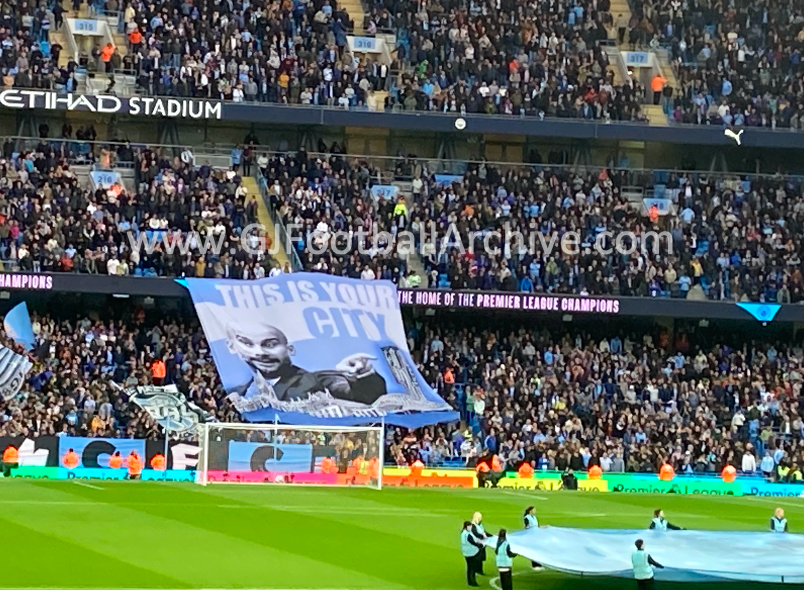
Ths South Stand pre-match, City v West Ham 3 May 2023. The new Pep flag.

Haaland’s goal that night meant that only 47 players had scored more competitive goals for City than Haaland had in the club’s entire history – that’s in their entire careers, not in most of one season! Also, it’s worth highlighting that Haaland had netted 5% of the 1000 goals scored under Pep at City. Phenomenal stuff!

I said it then and I’ll say it now, it’s always great for a historian to experience history being made. Nice work Haaland and City!

After the game Haaland was given a guard of honour by the City players, boss Pep Guardiola and the club’s backroom staff. Afterwards the player commented: ‘It was a nice feeling scoring that goal, it always is… It was painful when everyone hit me on the back in the guard of honour.’

Manager Pep commented: ‘He’s just 22… and still has five games left. How many games I made the substitution after a hat-trick in 60 minutes, maybe he’d have scored more. But maybe he’d have got injured. He’s special. Congratulations to him.

‘We expected him to score goals but to break Cole and Shearer records… I’m pretty sure what he wants is to win the Premier League.’

‘It’s unbelievable. How many important goals he’s scored to win games, we are so satisfied. He’s a unique person and he’s so special. He deserved the guard of honour because it’s an incredible milestone. Another day he might break his own record. He’s scored a lot of goals!’

Looking towards the South Stand pre-match, City v West Ham 3 May 2023 (West Ham fans unusually did not sell out their allocation)

Ian ‘Spider’ Mellor

I’ve heard the news that Ian Mellor has passed away at the age of 74 and so I wanted to pay tribute by publishing an interview I did with him several years ago and also provide a few biographical details too. As always, I think it’s best in these moments to remember the player by using their own comments and thoughts, so I’ll start with that.

In December 2003 I interviewed Ian for a feature in the Manchester City match programme. Here is the interview as it was written and published back then:

IN SEARCH OF THE BLUES – IAN MELLOR

Ian Mellor made his debut in March 1971 and went on to make a total of 48 League and Cup appearances for the Blues.  In 1973 he moved on to Norwich.  Gary James, author of Farewell To Maine Road, caught up with Ian last week.

Let’s start with your role today, you’re still very much involved in football.  Can you explain your role and how it came about?

I’m the Commercial Executive to the Professional Footballers’ Association (PFA).   I suppose it started when I first finished playing.  I was 34 and unemployed for about four months.  I needed to find something new and like any former player it can be difficult at first, but I got myself on to an intensive sales course and really tried to push myself in that direction. 

I was in the Sheffield area – I’d been a player with Wednesday and so that helped to some extent – but it was a very tough time to be selling there.  The industry had been decimated.

Eventually the athlete Derek Ibbotson – who had been involved with fitness training at City when I was a player – brought me in to work for Puma and my involvement with sports commercial activities really started then.  One of my main activities was to persuade key League players to wear Puma goods. 

Did your playing career help?

Yes, of course.  The fact that I’d played did help, but it wasn’t too difficult.  Paul Gascoigne was signed up and, like with any major sports company today, it’s great if a major star wears your products.  From that I went on to work for Gola and I’d also spent some time talking with the PFA about providing sportswear for their various initiatives.  One thing led to another and, through Mickey Burns, Gordon Taylor asked me to join the PFA as its first Commercial Manager about ten years ago.

As a player did you feel the PFA was important?

Like many unions you don’t appreciate what they do until you need them. As an ex-player the game took its toll on my body and I’ve had to have 2 new hip joints replaced and without the support of the PFA I would have been a cripple. I’m just one of thousands of members of the PFA who have received vital assistance when needed. As a player I didn’t really think about it at the time, but now I have come to realise how much the union helps present and former players, and is involved in so many areas such as community programmes, anti racism campaigns and supporters’ organisations.  As you get older you also start to understand how football’s developed and what the union has achieved.  The PFA has a major role in football and it puts so much back into the game that we all love.

Going back to your early career, did your elevation to the first team come easily?

I was certainly worried – I’d been sent to Altrincham on loan and was paid something like £2 a week.  I played two games and started to wonder what was going on.  When that happens you can’t help but feel your career is not going to be in the first team.  Then Ken Barnes started working closely with the City youngsters and he started to look at me.  That got things moving.

Your debut came against Coventry in March 1971.  Do you feel you performed well?

It was a lot to handle really.  I was nervous, very nervous.  I knew I’d be facing Wilf Smith who I think was the most expensive fullback in the game at the time.  I became a nervous wreck, and in the first half I think that was obvious.  I just wasn’t right.  Malcolm Allison had a real go at me at half time and warned: “If you don’t pull your finger out, you’ll be off!”  So that got me playing!  The second half I really worked hard and played my normal game.  I tried not to worry.  I just got on and did it.

You must have performed well enough because you kept your place.

Well the Coventry draw was on 20th March and four days later I played in the second leg of the European Cup Winners’ Cup and managed to score, so it was a great start really.   I still wasn’t a regular, but I played in another five league games and even scored against United in the derby match on the last day of the season.  As a City fan the derby meant an awful lot and scoring your first League goal in a derby is something special, especially for a local lad.

Was that your biggest moment?

I suppose my biggest moment came when I actually signed professional forms.  Johnny Hart took me into a little room hidden away under the Main Stand at Maine Road and I signed the forms.  All the time I was thinking where’s the press?  Where’s Granada?  Instead of the hype you always imagine surrounds these things there were Johnny and I in a damp, cold corner of the ground.  Johnny though said something which has stuck with me ever since, he said: “I wish you all that you wish yourself”.  Which is a great comment because in football… and in life for that matter… you have to have aims and dreams.  You need to want to be a player to be a player. 

Who would you say was the biggest influence in your playing career?

Well, we were very fortunate at City to have Johnny Hart, Ken Barnes, and Dave Ewing in the coaching set up.  They were very knowledgeable and men of real quality.  They knew what they were talking about and they also cared passionately about the game and the Club.  They’d all had great careers and as a young player you listened and learned. 

At times they could be very hard.  They pushed you because they knew you had to be hard to survive in football, and they certainly made you work.  They gave me the right sort of grounding.

The biggest coaching influence though has to be Malcolm Allison.  In those days he was the best as a coach and motivator and I learnt so much from him.  Again he could be tough, but you listened because he had already delivered so much by the time I got into the first team.

As players did you socialise as a group?

There were quite a few of us who came up the ranks together so people like Donachie, Carrodus, Gibbons, McBeth, and Jeffries were the ones I went out with.  I suppose there were two age groups.  The older players were married and had also come through the Sixties team together, and then there were the younger single guys.  Naturally, as in any environment, you stick in your peer groups, but obviously on the pitch you’re one team and work hard for each other.

Willie Donachie was probably the closest to me.  Our wives went to the same school and he was the Best Man at my wedding, and we get on really well.

Was it one of the players who gave you the nickname ‘Spider’?

Ah yes.  Spider’s been my nickname since those early days at City.  It was Ken Mulhearn who gave it to me, although he probably doesn’t realise that now.  On a Saturday morning if we were at an away match and sat in the hotel, we’d usually watch a bit of television and it always seemed to be that Spiderman was on.  Ken shouted “look it’s Ian Mellor” and the name Spider then stuck because of my long legs and the comparison with Spiderman! 

The funny thing is there are many, many of my business contacts who don’t really know my proper name.  It’s always Spider.  I always get introduced as Spider, and so if I ever give my name as Ian Mellor when I’m calling someone I deal with they get confused.  It’s amazing how these things stick, but it’s great.

How did the fans treat you?

Always well.  It was a great side to join, and as long as you put the effort in the fans loved you.  I never received any stick and the fans have always loved to see players who attack.  Once I’d made my first appearance I started to get recognised.  Being tall and thin helps you get noticed, and I enjoyed the support they gave.

The team was great as well.  There was tremendous camaraderie and the success must have helped to create that spirit.

Clearly, there must have been a downside.  What was your biggest regret?

Leaving!  I should never have gone to Norwich.  I went from a top five side to a bottom five side overnight and it was such an alien environment.  Norwich is a nice place, and a good club, but at that time the move was totally the wrong move to make.  Because they were struggling there was no confidence.  The contrast with City was unbelievable.

At City everything was so positive, and as a Blue I shouldn’t have gone.

You come from a family of Blues, don’t you?

Yes.  We were season ticket holders and I used to stand on the Kippax.

Naturally, I have to ask how you felt when your son Neil played for Liverpool against City in the FA Cup last season?

It was great to see him play at Maine Road, and I felt very proud.  It was a very strange feeling really though because he was playing against the family’s team.  We’re all Blues and the best result would have been for him to score but for City to win.  It didn’t go that way of course, but it was great to see him play in that match.  A great feeling.

I hope that gave a sense of the man and now here’s a brief career overview:

Ian Mellor Career Detail

Ian was with Manchester City between July 1968 and March 1973. He also played for Norwich City (joined 7 Mar 1973), Brighton & Hove Albion (6 May 1974), Chester City (24 Feb 1978), Sheffield Wednesday (11 June 1979), Bradford City (24 June 1982), Hong Kong (Jan 1984) and Worksop Town. and here is a brief profile of him:

Known affectionately as Spider, Ian Mellor was recognised for his speed and dedication. He signed for City first as an amateur (July 1968) then as a professional (16 Dec 1969), making his Reserve debut in October 1970 away at Aston Villa. A former Cheshire Boys player, he won an England youth cap with City.

In March 1971 there was an injury crisis at Maine Road and Spider was given his debut against Coventry City (h) on 20 March. City drew 1-1 with Franny Lee scoring.

Ian scored his first League goal in the last match of the 1970-71 season against United. He was virtually an ever-present for the first half of the following season until replaced by Tony Towers.

You can see a goal he scored at Arsenal in 1971 here:

In 1972-73 his appearances were limited and then came a controversial transfer to Norwich City in March for £70,000. This transfer was often cited as the cause of the resignation of Malcolm Allison who felt that the player had been sold behind his back. Spider’s last City appearance was against Wolves on 3 March 1973.

Later Ian was employed by a sportswear company and also for the PFA in Manchester.