Back in 1978-79 Manchester City had reached the quarter-finals of the UEFA Cup by beating Milan (2-2 at the San Siro and 3-0 at Maine Road). It was the first time City had reached the quarter finals of a European trophy since 1971 and was to be their third appearance in a major European quarter final. Unfortunately, the January UEFA draw wasn’t kind as it paired City with top German side Borussia Mönchengladbach.
With West Bromwich Albion, Hertha, Duisberg, Dukla Prague, Honved and Red Star Belgrade all through the Blues had hoped for one of the less powerful sides. Nevertheless, the Blues were hopeful. Years later City player Kenny Clements told me: “We thrashed Milan at Maine Road in the second leg and I felt we’d made our mark as a European power. Everybody was talking about us, and we should have progressed further but we messed up.”
How they messed up became part of the ‘Typical City’ DNA of the club that always seemed to plague the Blues in the late 70s to 2010s (and occasionally has reared its head since then but thankfully not that often these days).
The first leg of the quarter final occurred on 7th March 1979, before a 39,005 crowd at Maine Road and the City team was: Corrigan; Donachie, Power, Reid, Watson, Booth, Channon, Viljoen, Kidd, Hartford & Barnes.
Believe it or not (this may surprise a modern audience but leading clubs often did what I’m about to say) Liverpool, in particular Bob Paisley, had spent considerable time helping the Blues prepare for this match by providing vital information on the West German side. Liverpool had faced Mönchengladbach on five occasions, the most famous was the 1977 European Cup final and the most recent being in the 1978 European Cup semi-final. Paisley told City that the game would be tough, and outlined the players to watch. He also suggested that Dave Watson and Tommy Booth might be the key men in City’s side as the Germans seemed to lack ability to attack the ball in the air.
In the 1977 European Cup final, Liverpool had defeated Mönchengladbach by playing to the strengths of players like Tommy Smith and Paisley felt City should do the same. The first leg saw Malcolm Allison, who had returned to the Blues in January as the self-styled ‘coaching overlord’, perform one of his many shock moves when Nicky Reid was thrust in to the spotlight at the age of 18 for his debut. Allison selected him to mark Allan Simonsen. It was an amazing selection at the time, but Reid did enough to justify Allison’s bold move.
Mike Channon, who was rumoured to be unhappy at the Club, managed to give the Blues a 1-0 lead. Unfortunately, the highly disciplined Mönchengladbach kept the pressure on and managed to snatch an equaliser and the often vital away goal.
The second leg of the tie took place 13 days later, on 20th March 1979 watched by around 30,000. The City team was: Corrigan; Donachie, Power, Viljoen, Watson, Booth, Channon, Reid (Deyna), Henry, Hartford & Barnes
Nicky Reid retained his place for the second leg (but still didn’t make his League debut until eleven days later when he scored against Ipswich). He was clearly a talented player but his arrival in the heat of European competition without even making an appearance in the League did raise many questions about the way Malcolm Allison was influencing things. Reid went on to captain the Blues to the FA Youth Cup final the following May, and was voted City’s young player of the year.
Malcolm Allison made yet another surprise selection as Tony Henry – another reserve who up to that point had only featured in two League game (once being substituted by Kenny Clements, once coming on for Asa Hartford) – was included while experienced European campaigners Deyna, Bell, and Kidd were left on the bench with Paul Futcher.
It was not a good night at all for City and having so much experience on the bench seemed baffling to fans, the media and also most of the players. City were very much the underdogs throughout and were losing 3-0 when, late on, Reid was substituted by Deyna. The experienced Pole provided City’s only goal of the match, but it was too late and City were out of Europe.
Kenny Clements later explained to me: “I broke my leg a few weeks after Milan so that made life a bit difficult for me, but the big problem was the return of Malcolm Allison. I know he was a great coach first time at City, but second time he really did ruin everything. All the older players told me it’d be great having him back, and then when he was back they all admitted they were wrong. I think he’d become too hung up on new ideas that he forgot about the basics. I remember he used to give us homework. He’d tell us to go home and write “I must win” or “I will win” a thousand times, then the next day he’d ask us if we’d done it.
“I always used to say ‘yeah’, but some of the younger, more impressionable lads would produce their lists and some would even write out twice as many lines! He insisted we drank coffee before a game to keep us alert, and brought in lots of motivational people. It didn’t motivate me I’m afraid!
“By the time of the next UEFA match (Mönchengladbach) I was fit but didn’t start, and then for the second leg both Brian Kidd and I had to sit it out while Nicky Reid made his debut marking one of the greatest players of all time. When we were two goals down Kiddo threw his shirt at Allison in anger.”
For many connected with City Mönchengladbach became the game that would be quoted when they discussed how things had changed following Allison’s return. Tony Book had developed a good team with a nice blend of young up-and-coming talent, like Peter Barnes (who was still only 21 but an exciting England winger), with the older experienced internationals like Dave Watson, Brian Kidd, Asa Hartford. Book’s team had been runners up to Liverpool in 1977 and had impressed with many great individual victories since then, especially that Milan victory of course, but the return of Malcolm Allison changed the dynamics at the club.
Ah well! Without that I guess City wouldn’t have what they have today, but for those of us who lived through the 70s to the present, it was the return of Allison that started the process of transforming City from regular challenging giant into a club that had lost its way. The 1978-79 Mönchengladbach games are a reminder of what we were, what we lost, but also of what we have now. Let’s ensure we enjoy the present because, as Allison once said to me: “Celebrate every success as if it’s your first, because it could be your last!”
In 1978-79 the Milan victory was City’s last in Europe until 2003-04. When City walked out to face Mönchengladbach in the quarter final none of us, especially Allison, expected it would be our last European tie for 25 years! To read about the significance and facts of City’s European heritage (there are a few points that may surprise fans of certain other clubs) then take a look at another post: https://gjfootballarchive.com/2021/01/11/manchester-citys-european-heritage-facts-not-fiction/
This post has been published prior to City’s 2020-21 meeting with Borussia Mönchengladbach in the Champions League. It should be noted that the two teams have met in the intervening years. The results are:
Mark Metcalf has been working with the Professional Footballers’ Association (PFA) on a number of ‘blue plaque’ initiatives in recent years. One, which should be unveiled in August this year, is for a major figure in both Stalybridge Celtic’s and Manchester United’s history. That man, Bert Whalley, is perhaps not too well known amongst football fans today but his influence on the Manchester United of the 1950s was immense.
I’ve asked Mark if he would write this guest blog in the hope that it helps United fans, and football in general, to remember Bert and his contribution. On a personal level, I have to declare an interest. Bert Whalley was a friend of my grandfather, Fred. Fred was a United fan who travelled to most of United’s cup finals up to the 1980s and he’d known Bert through footballing connections when he was a young man. Bert’s death as a result of the Munich Air Crash inevitably affected Fred, as it did many people in 1958 (if you would like to learn more about the air crash and how it affected Manchester at the time please read the in-depth piece I posted here: https://gjfootballarchive.com/2021/02/05/the-munich-air-disaster-a-long-read/ ).
Here’s Mark Metcalf’s piece on Bert Whalley…
Bert Whalley information for PFA plaque unveiling at Stalybridge Celtic in the summer of 2021, provisional date is Saturday 7 August 2021 and followed by a special tribute match
Bert Whalley: 1912- 1958
Born in Ashton-Under-Lyne on 6 August 1912, Herbert (Bert) Whalley played as a central defender for Stalybridge Celtic in the Cheshire League during the second half of the 1933/34 season. Following which he moved in May 1934 to Second Division Manchester United where he remained as a player and coach until his tragic death at Munich on 6 February 1958.
Stalybridge Celtic (SC)
After three SC reserve games, Whalley made his first team debut for the club on Saturday 16 December 1933 in the Cheshire County League home fixture at Bower Fold against strugglers Sandwich Ramblers. He replaced at centre half Bliss, who had injured his ankle, in 3-0 victory. ‘Looker-On’ in the Ashton-under-Lyne Reporter (ALR) felt that despite ‘the conditions not being the best on which to judge his true merits, he gave a really polished display, exhibiting some delightfully tricky footwork.’
The new man had originally played for Ferguson-Pailin, where he worked, in the Manchester Amateur Alliance League. He had also recently signed for Third Division North side Stockport County, whose reserves also played in the Cheshire League. This move had been blocked by new rules that an amateur, as Whalley was, signed to one club in the CL could not be signed by another club in the same league. County were forced to withdraw Whalley’s signing on forms.
Whalley remained in the SC first team for the match at Bower Fold on 23 December 1933 and Prescot Cables were beaten 3-1. According to the ALR he played ‘impressively’ in a deserved victory.
Playing away to Mossley, SC grabbed a point with a last-minute equaliser in a 2-2 draw. There was praise for Whalley in the ALR. “He is not as skilful with his head as his feet, but he tackles well and never gets flurried.”
League champions Macclesfield were heavily beaten 6-3 when Stalybridge Celtic visited them on New Year’s Day 1934. The ALR commented: ‘to a man, the team.. was excellent ..each played his part splendidly… Whalley again deputised for Bliss at centre-half with credit.’ (Monday 1st January)
The victorious team had though been beaten two days earlier, 2-1 at Northwich Victoria. Whalley was expected to drop out of the side as Bliss’s ankle injury was now sufficiently recovered but late in the week he contracted tonsilitis and was confined to bed. As such ‘Whalley appeared for the fourth successive game at centre-half, and again gave a promising display, supplying his forwards with clever passes.’ Prince in the home goal produced a series of great saves that included a penalty stop from Prior.
On Saturday 6 January, Whalley’s side beat Congleton Town 3-1 at home and he had a fine game, especially in the first half, being ‘conspicuous with pretty and effective work which was much appreciated by the spectators.’ (ALR) Prior scored twice from the penalty spot.
The following Saturday, Whalley, although reported as not well, was at Bower Fold to play in a 3-2 victory against Witton Albion. In a lengthy match report his name did not appear once.
However, Stalybridge Celtic then suffered a shock defeat 4-3 at home to amateur side ICI (Alkali) in the first round of the Cheshire Senior Cup. Whalley’s place at centre-half was taken by Bliss. ICI of the Manchester League were more used to playing the Celtic reserves.
When SC beat Winsford 5-2 away on 10 February 1934, Whalley was back at centre half and came in for praise as, ‘resourceful.. tackling determinedly when he and he and his partners, Suttie and Kellard, spent much time helping Mountney and Thornley.’(ALR) (the full-backs) Staffs Sentinel reporter noted ‘Parkin and Whalley were dangerous on the rare occasions when Celtic attacked, but Robinson made two wonderful saves.’
A month later on 10 March 1934, Celtic were beaten 3-0 at Runcorn but Whalley was noted by the paper in a brief report as ‘relieving the pressure’ in the first period. The following weekend Whalley was part of the Celtic XI that fell behind at home to Nantwich only to later dominate their opponents to win 10-3.
In mid-April, Chester Reserves beat Stalybridge Celtic 2-0 and according to the Liverpool Echo reporter ‘Whalley’s generalship was the feature of the Celtic’s team work.’ His side of Travis, Thornley, Mountney, Suttie, Whalley, Kellard, Prior, Scullion, Parkin, Hornby, Murphy was beaten 4-2 in the penultimate game of the season away to Crewe Alexandra reserves.
The following weekend saw a heavy 6-3 defeat at home to Tranmere Rovers with Mayers at centre-half struggling to contain the Rovers centre-forward Spencer who notched three. Midway through the second period, Suttie took over at centre-half.
Against Chester at home, the half-backs were reported as ‘delightfully skilful, both in attack and defence’ and the visitors left beaten 2-0.
There was a crowd of over 3,000 to witness a 3-3 draw at Hyde United, who recovered to grab a point after falling two goals behind. Whalley was praised for his efforts.
At home to Nantwich, SC fell behind to a side they had beaten 16-2 the previous season at Bower Field. A shock though was not on the cards as Whalley’s side soon equalised and went on to win 10-3 with Hornby grabbing three and Allen, leading the attack for the first time, scoring four.
It was reported that ‘Whalley gave a magnificent display. Celtic’s centre-half plays the third back game to perfection, while in attack he exerts a commanding and forceful influence.’
Away to Prescot Cables, Whalley’s team drew 2-2 and he ‘never allowed Harris, Prescot’s centre-forward any scope, while his passes were so perfect that Prescot were continually chasing the shadow.’ Playing before a crowd close to 2,000, Prescot grabbed a point with two late efforts.
Hyde deservedly beat Stalybridge Celtic 2-0 on the last day of March 1934. On a hard ground at Bower Fold they dealt more easily with a bouncing ball than their opponents. A late Whalley header might have reduced the arrears but it was a day to forget for the home side who ended the day in seventh place in the Cheshire County League.
Stalybridge drew 1-1 at home to Mossley on Good Friday with the home goal coming after a good run by Whalley saw the centre half then find Prior who crossed for Murphy to turn the ball into the net from close range.
On Tuesday 16 April 1934, Stalybridge Celtic played their last home league match of the 1933-34 season and drew 1-1 with Wigan Athletic. It was probably a game the home side should have won in a match where the ALR felt ‘Whalley was inclined to over-dribble at times but when he discarded this policy he was at his best.’
Stalybridge were beaten 4-3 at home to Macclesfield in the Cheshire League Challenge Cup. The winner in extra-time, which because of the emerging darkness had been cut to five minutes each way by the referee, Mr Sergeant, came at the very end of the additional time that had been played and following which the official dashed off to the dressing room as he sounded the whistle. With many home fans believing there was still a minute or so remaining this incensed a fair number who made a rush after Mr Sergeant. The arrival of police officers prevented any serious disturbance. The defeat came despite Celtic having led 3-1 at one point. Whalley played in a half back line-up that included Suttie to his right and Kellard to his left.
There was better fortune in the Ashton Challenge Cup as Celtic beat Hurst 3-2 in a midweek semi-final fixture with the winner coming on 86 minutes. The winning side’s strength was the half-back line with ‘Whalley putting an effective check on Halliday.’ (ALR)
A 3-1 defeat at Buxton was reported as being the result of the away forwards missing a number of chances whilst the ALR contended that ‘Celtic’s half-back line was their best department.’
Hyde United had overcome Ashton National away to reach the Ashton Challenge Cup Final against Stalybridge Celtic that was played on National’s ground.
Prior to the final, Celtic, winning 2-1 at the interval, were beaten 4-2 at Crewe Alexandra. There was, again, praise for the half-back line up ‘which has been one of the strongest and most consistent departments in the team since Whalley was brought into the side.’
The Ashton Challenge Cup kicked off at 6.45 on Friday 11 May. Hyde had won the trophy in the previous three seasons and started the match as slight favourites.
The crowd was a large one but they saw a poor game in which Hyde just squeezed home by two goals to one with Keers at outside left, who had earlier scored the equalising goal, netting the winner on the 84th minute. Whilst Whalley was good in defence he was rarely able to get forward to shine in attack. When the Hyde captain, Dennis Izon, was presented with the cup, there were large cheers and scenes of great enthusiasm amongst the Hyde players and their supporters.
The Reporter of May 12, 1934 that ‘Whalley, who had played as an amateur for most of the season… before signing as a professional for Celtic several weeks ago… signed professional forms for Manchester United on Monday,’ which would be 7 May.
Whalley, aged 20, 5’ 10” tall and weighing 11st 7llbs, had joined Celtic at the start of the 1933-34 season but after only playing a few reserve games he left to join Ferguson Pailin’s team, where he was employed.
When he returned to Celtic reserves he was then also signed for Stockport County as an amateur. This resulted in the Cheshire League passing a resolution barring any player from the league playing with the reserves in another League. Whalley was allowed to remain at Celtic and his break came when Bliss, Celtic’s centre-half, was injured and when the reserve player stepped up a level he was an immediate success.
Whalley was reported as being a keen cricketer, playing for the Trafalgar square first XI in the Glossop and District League.
Also leaving Bower Field was Ronald Hornby, who had joined Celtic in November 1933. The clever inside-left had made 34 consecutive appearances for the club and scored 13 goals. Hornby joined Burnley.
It was to be eighteen months before Bert Whalley made his first team debut for his new club.
He was selected by manager Scott Duncan for the Old Trafford side’s Second Division fixture against Doncaster Rovers at home on 30 November 1934. The match ended in a 0-0 draw before a crowd of 23,569.
Bert Whalley’s Manchester United debut side was Langford, Griffiths, Porter, Whalley, Voce, McKay, Cape, Mutch, Bamford, Rowley and Manley
In a playing career cut short by WWII, during which played for United and Bolton Wanderers in unofficial wartime competitions, and injury, Whalley went on to make 32 League and 6 FA Cup appearances for Manchester United. His final game for Manchester United was at home to Blackburn Rovers in Division One on 19 April 1947. This resulted in a 4-0 victory before a 46,196 crowd. With Old Trafford out of use due to war damage this game was played at Maine Road, Manchester City’s ground at the time. Whalley was by now the longest serving professional at Old Trafford and in 1946-47 he led the reserves to the Central League championship. The Manchester Evening News of 18 March 1947 said of him; “The experience of Bert Whalley is a real asset to Manchester United…. signed from Stalybridge Celtic in 1934. His transfer cost nothing, but he has turned out as an invaluable utility player – as pivot, wing-half and even full-back.”
His final first team game side was Jack Crompton, Johnny Carey, John Aston senior, Jack Warner, Whalley, Henry Cockburn, Jimmy Delaney, Johnny Morris, Jimmy Hanlon, Stan Pearson, Jack Rowley
Later in 1947, Whalley, who according to Jimmy Murphy, manager Matt Busby’s assistant, always described himself as “just an honest trier”, was coaching some schoolboys at Stockport County when a miskicked ball hit him in the eye. The player did not complain until on the way to a reserve match at Newcastle United, he confessed that he was having trouble with his vision.
On visiting a Tyneside hospital, he refused to be kept in and returned to Manchester for treatment. On Christmas Eve 1947, Whalley was as depressed as anyone as he faced losing his sight in one eye and the end of his football career. It was then that Matt Busby showed one of the reasons why he was a great manager by demonstrating loyalty. Busby, who had become manager at United in 1945, told Whalley that when left hospital he had just the job. In August 1948, Whalley replaced Arthur Gale as the man in charge of Manchester United’s ‘A’ side, the third team at the club.
Manchester United had ended the 1946-47 season as runners-up in Division One but nevertheless Matt Busby took seriously the comment of Jimmy Murphy, who had managed the successful Central League side that season, when he told him there was not one reserve who could strengthen the first team. Busby replied: “in that case we will have to find our own youngsters.”
That remark led, after a time, to great players such as Duncan Edwards, Dennis Violet, Bobby Charlton and later George Best. Getting these players was no fluke and in addition to Murphy the two key men were Joe Armstrong, the Manchester United chief scout, who was a shrewd judge of a schoolboy, and Bert Whalley, one of the best coaches in England. Armstrong oversaw a small group of scouts that covered Britain and Ireland and when a youngster came to Old Trafford consideration as a member of the ground staff, he was assessed by Whalley and Murphy, who ultimately had the final say.
With Murphy, by now assistant manager to Busby, occupied with the Wales national team at the time, Bert Whalley, by now the chief coach, accompanied the first team to Belgrade for European tie with Partizan Belgrade in February 1958. On the return flight he, along with many players he’d worked with over the years. was tragically killed at Munich on 6 February 1958.
Bert Whalley’s funeral was held on Thursday 13 February 1958. Thousands lined the route to Dukinfield Crematorium for what was the longest funeral procession for many years in Ashton and surrounding areas. Crowds of people gathered at factory entrances, having been given time away from their work benches. Shop assistants lined the pavements and school children looked on.
The cortege of 50 cars stopped briefly a few yards from the Trafalgar Square Methodist Church where Bert worked voluntarily for many years at the youth club. James Scullion, who originally signed the player for SC, was amongst those at the crematorium. Jimmy Murphy was present as was Sandy Busby, representing his father Matt, plus Henry Cockburn and John Aston senior. Stalybridge Celtic were represented by J Turner, R Peace and ex-manager Ernest Ollershaw. There were floral tributes from a number of football clubs including Manchester City, who had lost of one their own at Munich in Frank Swift.
Family members listed at the funeral include
Mrs W Whalley
Mr and Mrs R Whalley
Mr and Mrs D Whalley
John Doherty – a member of the Manchester United side that won the title in 1955/56 described Bert: “What a lovely man. It was a pleasure to have known Bert and I don’t think I’ve ever heard a single soul say a wrong word about him…. it was clear that he had been a useful performer in his time, a stylish central defender who was comfortable on the ball and invariably had time to move it on without panicking.
“He was not big for a centre-half, standing perhaps two inches under 6ft, and certainly he didn’t go around kicking people, but he carried authority because he had a certain presence about him…
“The hierarchy when I arrived was Matt Busby at the top, with Jimmy Murphy and Bert doing most of the coaching and sharing an office until Bert died at Munich.
“He was terrific to all the young players, always ready with a kind work to lift our spirits. A Methodist lay-preacher, he was a quiet man, in contrast to Jimmy, who was more fire-and-brimstone in his approach, likely to singe the hair on the back of the neck.
“Bert offered a buffer zone where we could recover our equilibrium after feeling the Murphy wrath, although he was nobody’s fool and people couldn’t take advantage of his good nature…looking back, I loved them both.”
Taken from The Insider’s Guide to Manchester United: Candid Profiles of every Red Devil form Rowley to Rooney by John Doherty with Ivan Ponting. Bert Whalley is listed at number 1 in this book.
Further details on the plaque unveiling can be obtained from Mark Metcalf, who is responsible for the project on behalf of the PFA as well as two further projects in 2021 that will see plaques unveiled to Joe Mercer and Stan Cullis in Ellesmere Port: metcalfmc@outlook.com
Thanks Mark for writing this. It is important men like Bert Whalley are remembered. I am also delighted that Joe Mercer will be having a plaque unveiled to him in Ellesmere Port later this year. This is great news. If you’ve not read my pieces on meeting Mercer take a look at: https://gjfootballarchive.com/category/joe-mercer/
My City Voices project was launched a couple of weeks ago. The project is looking to catalogue the stories and experiences of Manchester City fans through the decades. The aim is to capture as many different voices and experiences as possible to allow a detailed history of what being a Manchester City fan has been like throughout the years.
It doesn’t matter whether you’ve been a Blue for ninety years or nine; whether you come from the City Of Manchester or elsewhere – all views count and are of interest.
Over the three decades or so since I first started researching and writing about Manchester football I have been keen to record the experiences of fans. Back in the 1990s I recorded the stories of City supporters who could talk about the 1910s and attending games at Hyde Road. I know now that fans who can talk of specific moments at Hyde Road are no longer with us – time causes us to lose so many stories and voices. It is therefore vital we capture the stories of our family, friends and so on while we can.
There will be a number of outputs from this project. It’s too early to say exactly what will be produced but I think most people know what usually follows when I embark on something like this.
Thanks to all those who have taken part so far. It is appreciated.
I was interviewed on 17th February 2021 about the great Joe Mercer for the ‘esk podcast’ – an Everton podcast. I talk about meeting Joe; about writing his biography; about Joe’s time at Everton, Arsenal, Manchester City and so on. I also tell the story of Norah Mercer insisting that Bobby Charlton phones me to apologize (it was somewhat of a shock at the time)! We also discussed Everton and City in preparation for their game that night (17th February 2021). No matter who you support it’s well worth listening to.
If you would like to read all the in-depth articles (including the entire Manchester A Football History book) then please subscribe below. It works out about £1.67 a month if you take out an annual subscription (£20 per year) or £3 a month if you’d like to sign up for a month at a time. Each subscriber gets full access to the 230+ articles posted so far and the hundreds scheduled to be posted in the coming weeks.
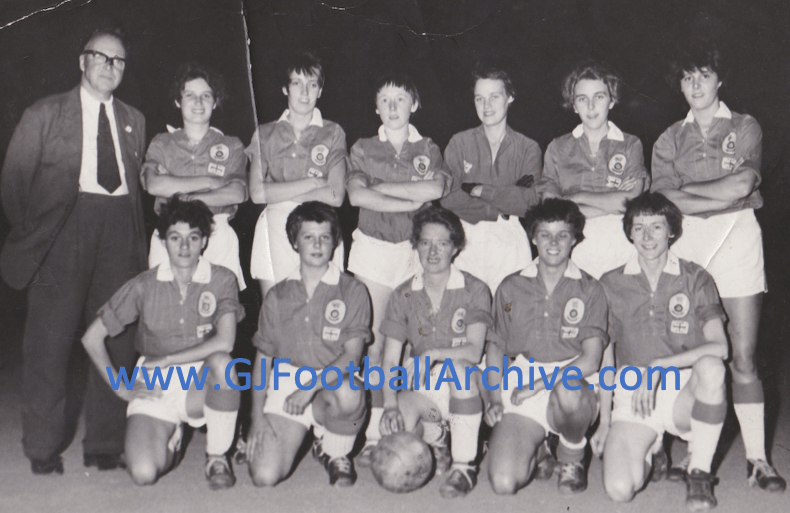
2019 marked the 70th anniversary of the establishment of Manchester Corinthians – a pioneering women’s team that toured the globe promoting women’s football and Manchester.
The Manchester Corinthians were a team of local women who were brought together under the management of Percy Ashley at a time when the FA banned women from playing on FA affiliated grounds. Established in 1949, Ashley’s team toured the world promoting the sport and demonstrating what a dedicated group of players the club possessed. This was at a time when FA affiliated clubs were banned from allowing women’s games on their grounds.
Many of the Corinthians are now in their seventies and eighties but they still get together from time to time to talk of their exploits. In September 2019 I managed to arrange with Manchester City for some of the women who played for the Corinthians to be guests of City at a women’s game at the Academy Stadium. While there I chatted with a few of the women. Margaret Hilton, who now lives in Australia, told me her memories of a groundbreaking tour in 1957: “Bert Trautmann, the City ‘keeper, joined us on a tour of Germany. He acted as an ambassador and watched some of our games. We saw him around but I was too shy to chat to him. It was great having that recognition and support.”
Corinthians, representing England, won a major competition in Germany which was, at the time, regarded as a women’s European Cup – these were the early days of cross-continent football and UEFA were not involved with organising competitions for the women’s game. Anne Grimes felt that winning that competition in 1957 encouraged the club to make further trips abroad and to play in major stadia. 50,000 watched them in a game at Benfica and then in 1960 the Corinthians ventured outside of Europe for a tour of South America. It was supposed to be a six week tour but such was the popularity of the games that the women were asked to stay for three months. Margaret ‘Whitty’ Whitworth told me: “We stayed in all the best hotels and it was quite glamourous. There were lots of scrapes along the way. We were young women and loved every minute of it. We didn’t care about the FA ban, we just got on and played.”
Whitty had joined the club as an eleven year old in 1958 and was fourteen when she travelled to South America. Her parents had to give permission but some of the women also gave up their jobs for the opportunity of representing Manchester – and England – on the tour. Whitty: “What a great experience for us all! The stadiums… the reception from the crowd… it was all incredible but we all just took it in our stride. It’s only afterwards that you look back and realise how significant it all was.”
A second team was established by Percy Ashley as time progressed called the Nomads – it’s no coincidence that Ashley chose the names Corinthians and Nomads. Both these names had been used by prominent amateur male football clubs that had toured promoting the game and this is exactly what he sought from his women’s teams. He wanted them to promote all that was positive about female participation in football and they certainly achieved that over the decades. The Nomads and Corinthians would face each other regularly, raising money for charity and, to ensure fairness and quality, the teams would be balanced when appropriate.
The Corinthians and Nomads won a host of tournaments and trophies over the years and in 1970 Whitty was player of the tournament when they found trophy success at Reims in France. Margaret Shepherd, nicknamed Tiny due to her height (she was a tall central defender!), remembers the excitement of that trip and the celebrations that followed the victory over Juventus in the final: “It was a great experience and the celebrations were so special.”
The experience of playing against leading European teams was to have a major impact on the lives of the women. In fact, Jan Lyons, decided to move to Italy to spend more time playing football and ended up playing for Juventus for two seasons in the Italian women’s league of the period.
Manchester Corinthians survived into the modern era and continued to play once the FA ban was lifted – a ban they had challenged. The club was still going strong in 1982 but, due to ground changes and related issues it soon officially changed its name to Woodley Ladies, though was often still known as Corinthians. Some of the 1980s team members became players with Manchester City’s women’s team in its inaugural season of 1988-89. By that time the volume of women’s clubs, leagues and competitions had grown.
The club was resurrected for a period in the late 1980s, playing in Tameside, but it was during the period between 1949 and 1975 that Corinthians were true pioneers. They promoted the sport globally at a time when many refused to accept that women could play football.
Hopefully, over the coming years, we’ll be able to promote the club, its achievements and these pioneering women further in Manchester.
I’m writing a detailed history of women and football in Manchester. If you played an active part in developing women’s football prior to the FA ban then please get in touch by emailing gary@GJFootballArchive.com or follow me on twitter: @garyjameswriter or facebook.com/garyjames4
My book on Manchester City Women (which talks of the evolution of women’s football since the late 70s and the Corinthians women who played for City) can be ordered here (all copies will be signed by me): https://gjfootballarchive.com/shop/
It’s another Manchester derby on Friday (12 February 2021) – this one is in the Women’s Super League and kicks off at 7pm. To mark this game I wanted to give a bit of focus to the early history of Manchester derbies in women’s leagues. The history of women’s football in Manchester does not always get the attention it deserves and many of us have been determined to change that for years. So hopefully the following will be of interest. It includes a few quotes from those involved in previous decades…
While the perception will always exist that Manchester United’s women’s team has always been City’s rivals and vice versa, for both clubs the real rivals have varied over the years. Derby matches have been played against Manchester Belle Vue and other prominent local clubs. However, any game between City and United takes on extra significance. United fans established a Manchester United Ladies team in the 1970s with close ties to the men’s club. This eventually was closed down by the men’s club before re-emerging in 2018 as a WSL 2 club. In September 2019 the first WSL Manchester derby between City and United occurred at the Etihad following United’s move into the top flight. This was a truly special day for both clubs and for those of us present.
The first competitive derby between City and United was actually in September 1990 in the North West Women’s Regional Football League Second Division when Neil Mather was City’s manager: “I was nervous for weeks on end, and it was coming and coming and coming. I thought ‘we’ve got to beat United in the first competitive Derby.’ Being a big blue it was like ‘whatever we do we’ve got to beat them.’ We were 4-1 up with about five minutes to go and then had a five minute collapse where I thought we’re going to blow this. At one point it had looked like we were going to get five or six and annihilate them and then we nearly lost it! Thank God we hung on for a 4-3 win, but I’ll never forget that game. We had a girl called Jenny Newton who was a manic City fan and scored and I don’t think I’ve ever seen anything like it. When she scored her eyes were bulging and it meant the world and a lot of our girls were City fans. It meant the world to beat them.”
Lesley Wright: “The first time we played United in a competitive game there was about 150 there. They were a really strong team. Better than us at the time and they’d been established a lot longer.”
Rita Howard: “Despite being a United fan I loved playing as City Ladies against United. I absolutely loved it. Even though I’m a United fan I never contemplated joining them because the support from City, even when it waned a little, was far superior to anything United got. At best they’d get a kit and then it was ‘on your way.’ I know our closeness to City came from that beginning with Neil. His enthusiasm got us the kit, the tracksuits, the minibus…. All sorts of things. I know that wasn’t happening at United and at that time I don’t think any club connected in any way to a Football League side were as close as we were then. I think we got a lot more recognition from the beginning and that has carried on to today. Look at what City have done.”
Jane Morley: “I’m a season ticket holder at Manchester United but I was a manager at City Ladies. One day I’d been with City at a tournament and then went straight to Old Trafford for a men’s game. I was sat there when the bloke next to me – who I didn’t know – said ‘what you doing with that on!’ I realised I still had my City jacket on. I had to explain to him that I managed City Ladies.”
Bev Harrop was a Manchester United fan playing for City: “I had a United shirt underneath my City shirt! (laughs) Most of the time. Not later on, I grew out of it eventually, but at first, I did.”
Jane Morley: “It angers me when people say that Manchester United now have their first women’s team. As with City when the relaunch happened that implies the stuff we did for the club years before doesn’t count. I played for United in the 70s and 80s before a few of us broke away to set up FC Redstar. We left United because we wanted to test ourselves. We had some great players and wanted to progress but those who ran United wanted to stay in a Manchester League and not join the North West League. So we broke away in 1985 and formed FC Redstar.
“Many of the teams we know today as WSL clubs are actually men’s clubs that have taken over established women’s clubs. Teams like Leasowe Pacific became Everton. I have to bite my lip sometimes when some clubs claim they created a women’s team… no, you took and rebranded a team. There were quite a few big teams around the time City Ladies started such as Broadoak with Tracey Wheeldon.”
These snippets are from my book on Manchester City’s women’s team. Copies (signed by me) can be ordered here: https://gjfootballarchive.com/shop/
If you would like to read all the in-depth articles on this site (including the entire Manchester A Football History book) then please subscribe. It works out about £1.67 a month if you take out an annual subscription (£20 per year) or £3 a month if you’d like to sign up for a month at a time. Each subscriber gets full access to the 500+ articles posted so far and the hundreds scheduled to be posted in the coming weeks.
It’s Swansea v Manchester City tonight in the FA Cup and so I thought I’d put together a few historical facts and stats about games between the two clubs.
Game One: The first competitive meeting between the two teams came in Division Two on 25 September 1926. The Blues had been relegated the previous May and the historic first meeting with Swansea Town (Swansea was not a city at this point) ended in a 3-1 City victory at Maine Road, before 24,314 fans. George Hicks, Tommy Johnson & Frank Roberts netted for the Blues.
The return game also ended in a 3-1 win on 12 February 1927. Hicks and Johnson both scored again, with Johnson netting twice. A Swansea crowd of 20,345 watched on.
The first top flight game between the sides didn’t come until 21 November 1981 (following Swansea’s promotion) and saw two each from Kevin Reeves and Dennis Tueart (the first a penalty 4 minutes before half time) help City to a 4-0 win. Here’s film of that game – see if you can spot the fan carrying two pints (presumably of Greenall’s or Grunhalle!) back to his seat (the days when we were allowed to drink in our seats or on the Kippax – well, not quite all of us. I was just 14 at the time!):
The first Premier League meeting came on 15 August 2011 – another 4-0 City win. This time Dzeko, Aguero (2) and David Silva each scored at the Etihad before 46,802. Film of that game here:
Incredibly the first FA Cup meeting didn’t come until 16 March 2019 and this saw City win 3-2 at Swansea (OG from Kristoffer Nordfeldt, Bernardo Silva & Sergio Aguero). City had been losing 2-0 (a penalty from Matt Grimes in 20th minute and Bersant Celina netted the other in 29th minute) up until Silva’s 69th minute goal. The action from this game can be viewed here:
Prior to tonight’s game of course: In terms of all time record the two teams have met on 36 occasions:
Played 36; City won 25; Drawn 4; Swansea won 7.
Breakdown by competition is:
League P34; City won 23; Drawn 4; Swansea won 7
FAC P1; City won 1; Drawn 0; Swansea won 0
League Cup P1; City won 1; Drawn 0; Swansea won 0.
The highest scoring game between the teams came in August 1927 when City beat Swansea Town 7-4 in Division Two. 34,316 watched a hat trick from Tommy Johnson and other goals from Peter Bell, Charlie Broadhurst, George Hicks and Frank Roberts.
Here’s hoping tonight’s game brings as much entertainment as that one did.
While you’re here, it’s worth taking a look at something else already posted on http://www.GJFootballArchive.com. It’s a profile of Tommy Hutchison who was a cult hero at MCFC and also spent time with Swansea City:
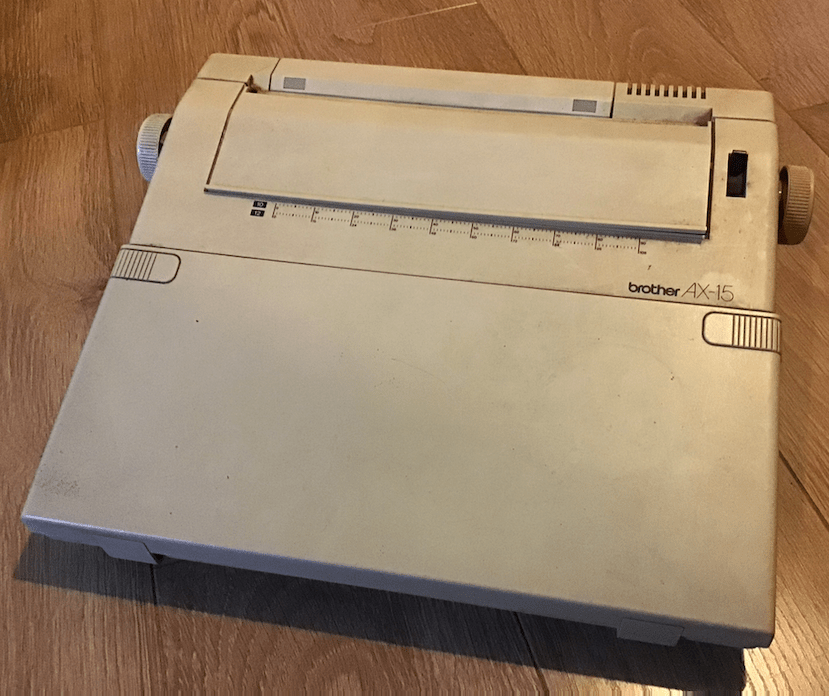
Recently, I’ve been sorting through some of the items my mum has kept over the years and I rediscovered my old Brother typewriter. My mum died during 2020 and it has been extremely tough at times for my dad and the family in general. I know a lot of people have experienced great sadness over the last year and my thoughts are with everyone who has suffered a tragedy during this time. It’s been a tough year.
I thought I’d got rid of the typewriter many, many years ago and so seeing it brought back many memories. It reminded me of some of my earliest writing on football and so I thought I’d share on my blog the story of this typewriter.
I bought this typewriter with the royalties from my first book – I can’t remember exactly how much it cost but I know I just about earned enough to pay for it. My first book was ‘From Maine Men To Banana Citizens’ (a pictorial history of Manchester City) which was published in April 1989. I’d handwritten that book! Fortunately, as it was a pictorial history there actually wasn’t much writing – just captions really.
As I’d handwritten the captions and posted them to the publisher there were times when they misread my writing. I had written the captions in capitals mainly, but my writing in whatever style is awful (at primary school my headteacher – an obsessed MUFC fan – used to tell me my writing was like a ‘drunken spider walking across the page’). Words like ‘the’ would occasionally read as ‘one’ to those unfamiliar with my poor writing.
In From Maine Men to Banana Citizens some of my writing was misread and wasn’t picked up in the review process and so I know there are a few ‘one’s where ‘the’s should be (if you’ve got the book see if you can spot any!).
Once the book was published and I spotted these I knew I needed to get a typewriter. Once I’d received my royalties I bought my electric Brother typewriter. I bought a Brother typewriter because they were Manchester City’s sponsors at the time and I wanted my money to go to a company that supported people I approved of (and some think sponsorship doesn’t influence).
I was still living at my parents back then and I used the typewriter to write my sections of my second book The Pride of Manchester (co-written with Steve Cawley). This book told the story of the Manchester derby and we could every friendly and competitive game from 1880 through to publication in 1991. As the book was really a game by game story of the derby I would type a page or so at a time and the typewriter meant it wasn’t too laborious – the laborious aspect was the in-depth research.
The book was published in 1991 by which time I was already researching and writing my third book – Football With A Smile: The Authorised Biography of Joe Mercer, OBE. I soon realised that due to the volume of writing each chapter needed and the amount of times I’d changed the flow/tone of each chapter that using a typewriter was proving to be time consuming. I decided that I needed to buy something different. My Pride Of Manchester co-author Steve owned an Amstrad PCW and this seemed to offer more flexibility.
I then used the royalties from my second book to buy an Amstrad PCW like Steve’s. It cost me about the same amount my typewriter had cost and my royalties had once again been spent – I soon realised that it was nigh on impossible to make money from writing about football!
The Amstrad PCW did make my writing life easier (until of course I could afford a PC – from the combined royalties of my Joe Mercer book AND my fourth book, Manchester The Greatest City, published in 1997!) although I had a problem with a damaged Amstrad disk which meant I lost the entire first chapter of the Mercer book. I’d been crafting it for weeks trying to get it right and then my own stupidity meant the disk became damaged. I couldn’t bear to start again – and I hadn’t backed it up (first major lesson!) – and so I wrote the rest of the book before I came back to chapter one. When I did write the new chapter one I knew (and still know) that it is not as good as the one I lost.
When I moved out of my parents’ house I took my Amstrad PCW as I was still writing the Mercer book but I must have left behind the Brother typewriter. I don’t remember ever seeing it after that until I rediscovered it the other week, almost 30 years after I last used it.
When Covid allows I’ll take the Brother typewriter to a charity shop and, hopefully, it will find a new life for itself. It served its purpose back in 1989-91 but maybe there’s still a bit of life left in it.
Who knows how many Amstrads, PCs, Apple products and so on I’ve been through since I bought my brother. Most are long gone, but somehow the Brother survived.
I’ve posted 199 separate articles to this website so far and so, for my 200th post, I felt it was about time I paid tribute to the former Manchester City and England manager Joe Mercer for his influence on my writing.
Joe, as most reading this will be aware, was the most successful City manager of all time prior to the recent successes of Pep Guardiola. He remains the only City manager to bring a major European trophy to the club (though hopefully that will change soon!).
When I began writing my first book in 1987 my co-author told me he had been helped during his research into Nottingham Forest by Joe (Joe’s father played for Forest) and he felt that, if the book progressed as planned, Joe would possibly agree to write the foreword to our book. Sadly my co-author Keith Mellor died during the research phase of the book and the entire project looked in jeopardy.
After a while, Keith’s wife contacted me to urge me to continue with the book and she also gave me Joe Mercer’s address, suggesting I should write to him about the book.
I wrote to Joe and told him about the book Keith and I had been compiling (it was a pictorial history of City) and asked if Joe would be interested. I received a phone call from Norah, Joe’s wife, and she invited me over to meet Joe.
At that time I was about 19 and did not have a car and so I asked Norah if I could bring my dad – a passionate City fan. She of course said yes and we made arrangements.
Unfortunately, on the day of our visit, my dad’s car broke down and, knowing we could not let the Mercers down, we quickly arranged to borrow the only vehicle available to us – a white battered and bruised transit-style van. We drove to the Wirral and arrived at the Mercers’ street about 45 minutes early, so we parked up around the corner about 100 yards from their home. We had decided that we could not pull up outside a former England manager’s house in a white works van, and we believed we were hidden.
When we were due to arrive, we climbed out of the van, walked the 100 yards or so and knocked on the door. Immediately Joe, with that huge great grin of his, was in front of us. His Cheshire smile welcomed us in. He did not ask our names, he just asked us in. Within seconds Norah popped out of the kitchen and said: ‘You’ve been very naughty, haven’t you? You’ve been hiding in that van for the last 45 minutes!’ We all laughed and, as we were guided into their house, my dad and I explained about the breakdown and so on. Joe, being Joe, asked if he could do anything. Could he arrange a lift for us, or help get the car repaired. It was immediately clear to me that Joe Mercer was a wonderful man and his wife Norah was a terrific woman.
Can you imagine if we’d have said yes to Joe helping us? What would our neighbours back in Manchester say if we’d have turned up with Joe Mercer in the hope the footballing legend could get dad’s car fixed?
We spent a good couple of hours with Joe and Norah that day and Joe even offered to let us stay to watch the football on television. We had to return to Manchester, but it had been a wonderful afternoon.
The highlight in many ways was Joe taking us in to a room where he kept his scrapbooks and memorabilia. The ball from the 1950 FAC final was there and he brought it over to show us. It was an incredible experience and Joe was so interested in my book plans. He agreed to write the foreword – an incredible gesture – and his words in my first ever book remain by far the best part of that publication.
I saw Joe several times after that, with perhaps my fondest meeting coming the day after Arsenal had defeated Liverpool in 1989 to win the League title. The former Arsenal man was particularly lively that day and spent some time talking about the Gunners, George Graham, and even his own time training at Anfield. It was superb and I remember Norah telling us: ‘George has been on the ‘phone.’ It felt like we were part of something special and when Norah talked of George she just assumed we’d know straight away it was the Arsenal manager and not another George from down the road.
It’s worth pointing out here that George Graham had been brought to England by Joe when he was the Aston Villa manager and so that 1989 Arsenal title success meant a great deal to Joe. A success for his former club and by a former pupil of his. Of course, the fact Joe was a proud Evertonian helped too! I was delighted for Joe and, while at this time in my football supporting life I would ordinarily have preferred Liverpool to have beaten Arsenal that all changed that weekend. The joy and excitement the Mercers demonstrated for Arsenal was clear and I realised just how much the Gunners meant to Joe.
After the delays and various other issues, my first book came out in April 1989 (why we didn’t wait until June I don’t know!) and the trip in May to the Mercers had been to give Joe a couple of copies. They offered to pay – I couldn’t believe it.
Foreword to From Maine Men To Banana Citizens (Published April 1989)
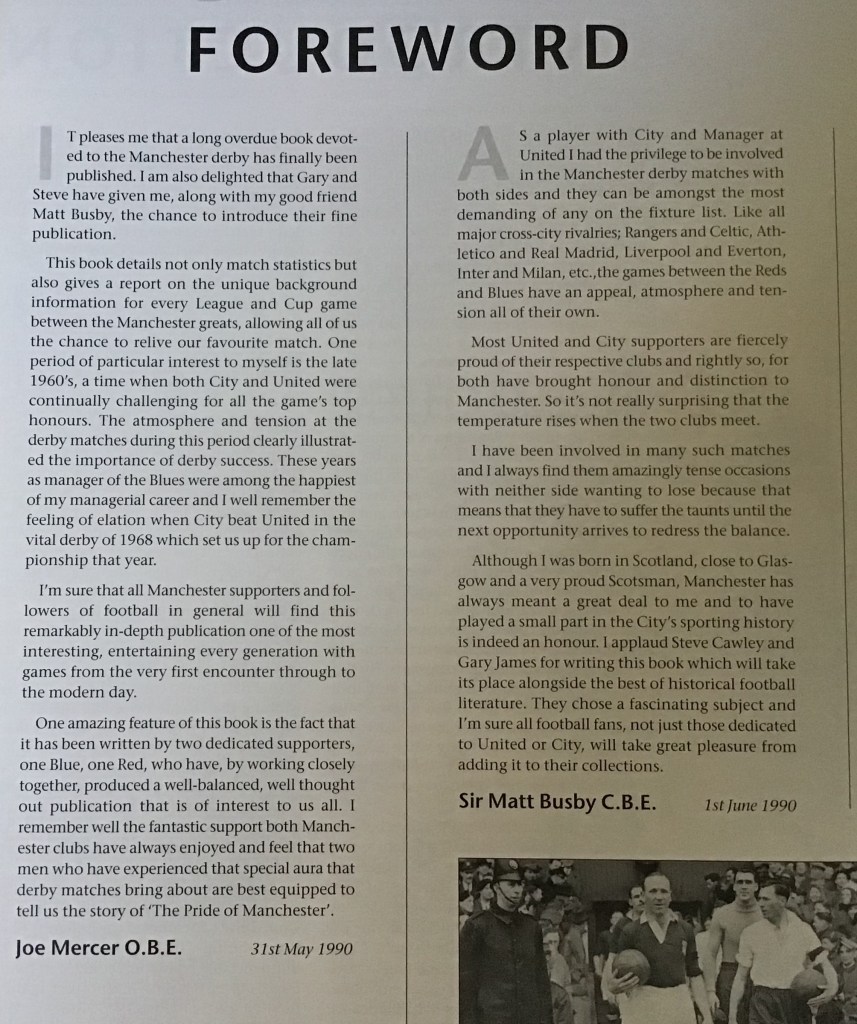
By that time I had already started work on my second book and I also knew that I wanted to write something specifically about Joe. I reasoned with myself that Joe’s book would wait until after my second book The Pride of Manchester was complete. The Pride of Manchester was a history of the Manchester derby co-written with Steve Cawley. Steve & I were quite fortunate in that, thanks to the connection with Joe, we also managed to ask Matt Busby to write a foreword too. To have the two men who were, by some way, at that time the two most successful managers of the Manchester clubs write our foreword and introduction was incredible. We were eternally grateful.
Foreword to The Pride Of Manchester (published September 1991)
The Pride of Manchester was due out in August 1990 and then I planned to get working on a book on Joe Mercer’s years at Manchester City. Unfortunately, technical issues meant that the Pride of Manchester was to be delayed by a few months and, as the new football season would mean at least one derby match would be played before the book came out, we decided to delay it a full year and include the 1990-91 season. That would also mean my Joe Mercer idea would have to wait.
Sadly, the last time I last saw Joe was on 31 May 1990 when I went through the wording of his contribution to The Pride Of Manchester. Joe had been suffering with Alzheimer’s for sometime and by this stage it had clearly developed significantly. I realised that day that Norah must have been under tremendous pressure, yet somehow she got on with looking after Joe. It must have been extremely difficult for her but, as she had proved throughout her life with Joe, Joe’s happiness was vitally important to her.
On Thursday 9 August 1990 the suffering ended. Joe was celebrating his seventy-sixth birthday with his family. He relaxed in his armchair after an enjoyable day and then passed away peacefully.
Over the months and years that followed I continued to visit Norah as often as I could. My idea of writing a book on his time at City still floated around in my head but I was disappointed that I hadn’t managed to publish it before his death. The delay to The Pride Of Manchester really upset me but I knew that it couldn’t have been helped.
When the time was right I visited Norah and mentioned the book idea. Norah, being as wonderful as ever, said: ‘Only do it if you want to. Don’t do it for me or for Joe. Don’t go to all that trouble unless you want to for you.’ She was pleased that I wanted to do it but genuinely did not want me to go to any trouble. I told her it would be a honour and she told me she would help however she could.
Over the next couple of years I spent a lot of time at Norah’s. Often Joe & Norah’s son David would arrive – another wonderful member of the family – and he used to laugh about ‘the old fella’ while Norah would tell me wonderful stories of how she met ‘Cheeky face Mercer!’
It was a wonderful period and Norah used to always bring out the sandwiches or a bowl of Scouse for me and my girlfriend. One day I arrived at her house and she insisted on pouring me a beer. As she brought it in she whispered to my girlfriend ‘watch his reaction’ and then she handed me a silver tankard. I looked at it and it was the 1961 League Cup Final tankard Joe had been given for guiding Villa to success. Inside was my beer! I tried to persuade her to put the beer into a regular glass but she insisted. It was the first (and so far only) time I have drunk from a major footballing award.
Early into my research for the book I realised that a book simply on Joe’s time at City wouldn’t do him justice. No matter how significant that period was for City or in my life as a fan, it was still only a small fraction of what he had achieved in his life. I soon decided that if I was to write a book on Joe it had to be his full biography. My publisher Julian Baskcomb – always keen on creating quality books – encouraged me to write the full story no matter how many words.
In the end the book was published in December 1993 and contained approximately 110,000 words (almost double the standard biography size at that time) and hundred of photographs from every stage of Joe’s life. A few weeks before it was published I gave David Mercer a full copy of the text to read. I’d agreed with him and Norah that they’d see the text shortly before it was published and, if there was anything significant, I’d change it.
David phoned me within 24 hours of receiving the text and had read every word. He phoned me and told me that I had captured his father perfectly. He became somewhat emotional when we discussed the book and, for the first time ever, I felt my writing mattered. I knew that I’d been fortunate in being able to write about a truly wonderful and marvellous man, and that the support of Norah & David had made this a great experience for me.
All these years on Joe Mercer, OBE: Football With A Smile remains the book I am most proud of; the book I enjoyed writing the most; and the book that I always want to aspire to with my new material. I remain ever grateful to Joe, Norah, David and the family for allowing me the opportunity to first meet Joe and then to write the book. I updated it in 2010, adding material from various parts of his life.
I continued to meet Norah over the years. David would usually pop in while I was there and we’d chat about ordinary things. Occasionally, Norah would say things like: ‘I told Jimmy about the book last week’ and I’d be thinking ‘Jimmy?’ then she’d say something else and it’d be obvious it was Jimmy Hill. Once during my research I arrived at her house and she told me ‘I phoned George and told him he must talk to you about Joe. Here’s his number.’ I was handed a piece of paper with Norah’s writing on reading: ‘George Graham’ and then his direct office number at Highbury. I contacted George and he set up an interview for me in his office.
The week before we launched Joe’s biography I was sat at home one evening when my telephone rang. I answered it. The voice on the other end said: ‘Hello Gary? It’s Bobby Charlton here. I’m sorry I can’t come to the launch. I’ll be in Kuala Lumpur then. I called Norah to tell her but she told me I must call you to apologise, so I’m really sorry I can’t make it. Is that okay?’
Me: ‘Er, yes. Thanks for letting me know.’
I came off the ‘phone and couldn’t get it out of my head that Norah had ‘told’ Bobby Charlton to call me and apologise. Even more impressive is the fact that he did! Norah was brilliant but if she told you to do something you did it, no matter who you were!
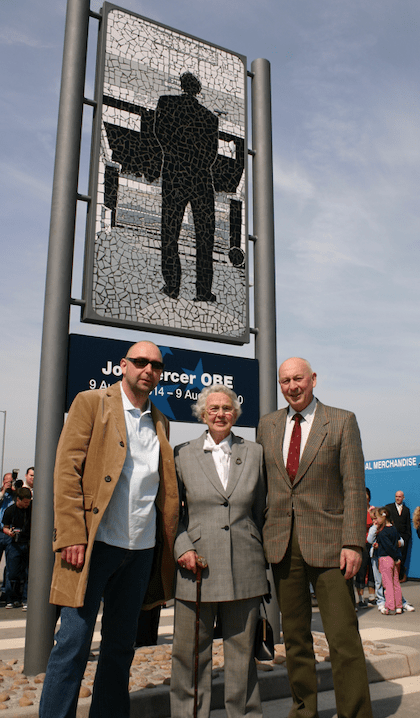
Around the time of City’s move to their current stadium I became involved in a few projects at the club on a freelance basis. One was setting up the initial museum and another was the erection of the Mercer mosaics on Joe Mercer Way. I won’t go into all the discussions and stories connected with that here, but one of the areas that I contributed to was the selection of the images for mosaic artist Mark Kennedy to recreate as mosaics. I spoke with Norah about the options and showed her a few I’d shortlisted that I’d used in the book.
We agreed that one had to show Joe lifting a trophy at City – the League Championship was chosen – and the other ended up a view of Joe from the back looking out towards the Kippax from the Maine Road tunnel. Although I loved that photo (it came from Norah’s collection and became a major image in my book) I wasn’t certain Norah would like a back view of Joe. I was wrong. As soon as she saw it she said ‘That’s it! That’s Joe! Look at his bandy legs! There’s no mistaking those legs.’
When we did the reveal Norah and David came of course and Norah thanked Mark Kennedy for capturing Joe so superbly, although she did say to him ‘That one with the trophy is okay; but this one with his bandy legs… that’s Joe!’
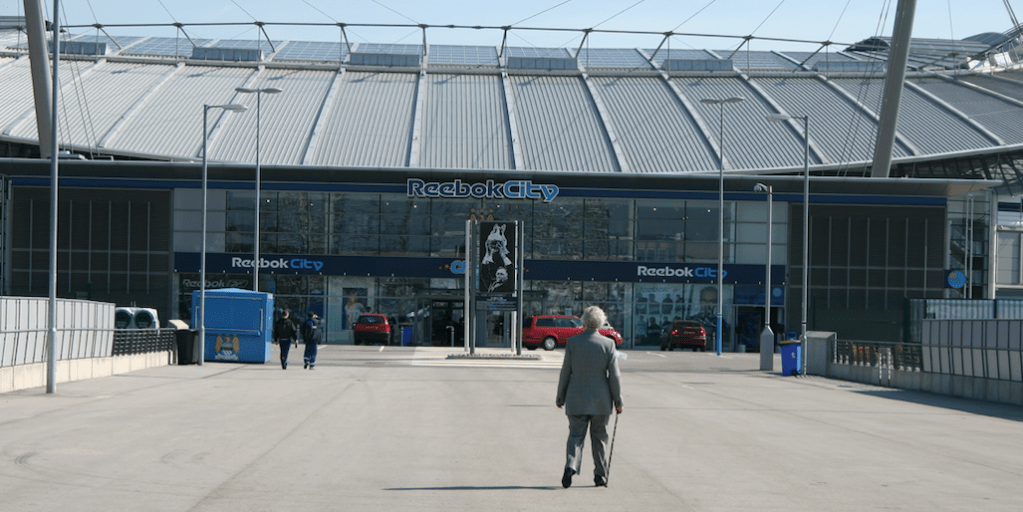
Mark Kennedy, Norah & David Mercer with ‘bandy legs’ Mercer mosaicWhen everybody else had gone, Norah asked me if she could see the mosaic from a distance, as the fans would on match day walking down Joe Mercer Way
Sadly, in the years that followed first David and then Norah have died. Both were wonderful people who supported my work and trusted me to tell Joe’s story. They demonstrated what a wonderful family they were and – to me this is extremely significant – their warmth matched Joe’s. I don’t think it’s any coincidence that throughout Joe’s time at City and for the following decades City were often described as ‘the friendliest club’. Joe set the tone and direction for the club. He was a great ambassador for Manchester City (and the other clubs he was involved with).
Joe helped establish the Manchester City that many City fans fell in love with.
Fancy Reading More Like This?
If you would like to read everything else on this site then please subscribe. I’m not employed by anyone and do not take advertising on this site, so every subscription directly helps my research and writing. It works out about £1.67 a month if you take out an annual subscription (£20 per year) or £3 a month if you’d like to sign up for a month at a time. Why not sign up for a month, see what’s here and then cancel if you don’t think it’s appropriate for you? Each subscriber gets full access to the 200+ articles posted so far and the hundreds scheduled to be posted in the coming weeks. The entire Manchester A Football History is being posted by the end of February 2021, so subscribers will get all of that too!
I’ve seen it mentioned often in the build up to today’s FA Cup tie between Manchester City and Cheltenham Town that the two clubs have never met before. Well, that may be true for competitive fixtures but there has been a previous meeting.
On August 2nd 1994 the two teams met in a testimonial for Cheltenham midfielder Steve Brooks. City classed the game as a reserve team friendly and my own records show the following details:
I have the attendance as an estimated 300 but Cheltenham sources say 816 which has to be more like it (I’ll correct my records now!).
The City team was: Margetson, Kerr, Beech, Simpson, Foster (Smith 66), Harkin, Finney, Groenendijk, Mike (Brown 75), Griffiths (Thomas 46), Whitley (Sharpe 46). Unused sub: Nurse.
The goals were scored by Carl Griffiths (2) and Michael Brown for City; Jimmy Smith and Simon Cooper for Cheltenham.
Thanks to Martin Wilson for reminding me of this game.










 Gary James' Football Archive