This site was launched on January 1 this year and already I’ve reached the 300th post. I’d like to take this opportunity of thanking all those who have commented on the site and, especially, those who have subscribed. 22,326 people have visited the site since it’s launch. I’m bowled over by the response. It really is appreciated.
For those that haven’t subscribed here’s some background to the site and comments on the material that you can find here.
I set the site up as an archive of new writing and of my past works with the intention being that over time as much of my past writing can be posted here for the enjoyment of subscribers. Subscribers can access all content on here, including the entire 2010 edition of my Manchester A Football History book (PDFs of every chapter from this out of print history of men’s football within the Manchester region) and exclusive audio interviews with John Bond, Malcolm Allison and George Graham. Much more to come of course.
There’s also the oldest surviving film of Manchester City Ladies (now Women), captured in January 1989 and numerous other articles (including some of my academic work) and stories.
Many of the articles are in-depth pieces of several thousand words.
If you would like to see the type of feature that’s been posted and do not currently subscribe use the ‘Free’ tab above to see a selection of posts, including an audio interview with Trevor Sinclair and profiles of Colin Bell, Sergio Agüero plus others.
For those of you that do subscribe I’d like to say ‘thanks’. It really is appreciated and I hope you’re happy with everything on the site. If you would like to suggest content (don’t worry I’ve got plenty scheduled over the coming months, but I’m always open to ideas from subscribers) then please contact me.
I’ve been asked a few times why I’ve set this site up and why much content is only available to subscribers. Well, at present I do not have a regular outlet for my writing, research and interviews and so I’ve set up this website to help share my 32 years plus writing and research. The intention is to develop the archive and to provide access to as much of my material as possible over the coming weeks, months & years.
I am not employed by anyone and no one pays me to do research or interviews. Similarly, I do not have sponsorship or advertising either and so the choice was either find advertisers (which potentially may then have a detrimental effect on one of the other great Manchester writers/bloggers/vloggers who do have advertising – there’s only so many advertisers to go around) or have a subscription model. I chose the subscription model as this seems fairest. If people want to subscribe then that’s appreciated and I’m grateful; if not then that’s absolutely fine. That’s personal choice which I always support.
It costs £20 a year (it works out £1.67 a month) or £3 if you’d like to sign up a month at a time to get full access for as long as you subscribe (you can always try it for a month if you’ve doubts). It’s worth bearing in mind that the 2010 Manchester A Football History cost £24.95 and all subscribers will be able to access all of that for as long as they are a subscriber (plus all the other stuff of course). You can subscribe below.
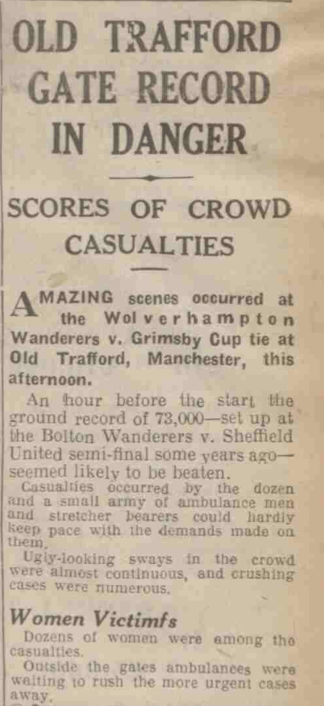
On this day (March 25) in 1939 Old Trafford attracted its highest ever attendance when 76,962 packed Manchester United’s ground to see Wolves defeat Grimsby 5-0 in the FA Cup semi-final.
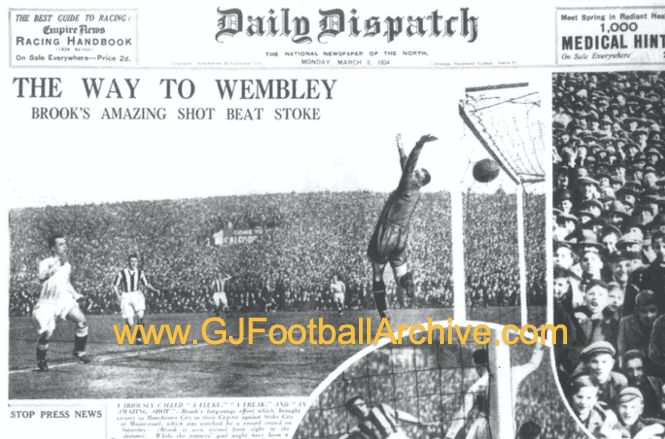
At the time this was the third highest attendance ever attracted in Manchester (behind 84,569 MCFC v Stoke, 1934 & 79,491 MCFC v Arsenal, 1935; fourth highest was 76,166 MCFC v Cardiff, 1924) and today it is the eighth highest.
You can view film of the semi-final here. Well worth watching to see Old Trafford at that time. The Old Trafford scenes begin after about 48 seconds:
There were lots of crowd safety issues at this game – these were the days when fans were packed in without the authorities really considering the potential for disaster or injury (which happened frequently).
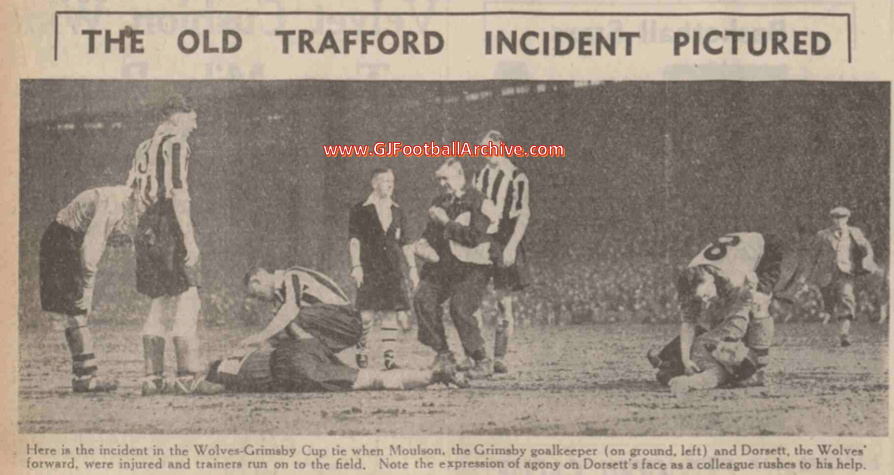
Incidentally, Dorsett (seen below after a collision) was related to two of Manchester City’s early heroes Joe and George Dorsett.
You can read about the 84,569 record attendance set in 1934 for Manchester here:
I’d like to thank you for taking the time and trouble to visit my website. I set up this website in December 2020 to help share my 32 years plus writing and research. The intention is to develop the archive and to provide access to as much of my material as possible over the coming weeks, months & years. Annual subscribers can access everything on here including the entire Manchester A Football History book and audio interviews with former City bosses Malcolm Allison and John Bond.
It costs £20 a year (it works out £1.67 a month) or £3 if you’d like to sign up a month at a time to get full access for as long as you subscribe (see below). Thanks for the support, Gary.
It costs £3 if you’d like to sign up a month at a time to get full access to everything posted since 1 October 2022 and for as long as you subscribe (see below). Thanks for the support, Gary.
The news that Manchester City will be installing rail seats at the Etihad this summer (2021) means that for the first time since 1994 the stadium will possess a section that is designed to allow people to stand. Whether officially they’ll be allowed to depends on the legislation in place at the time but, whichever way you look at it, this is good news for those who like to stand at football matches.
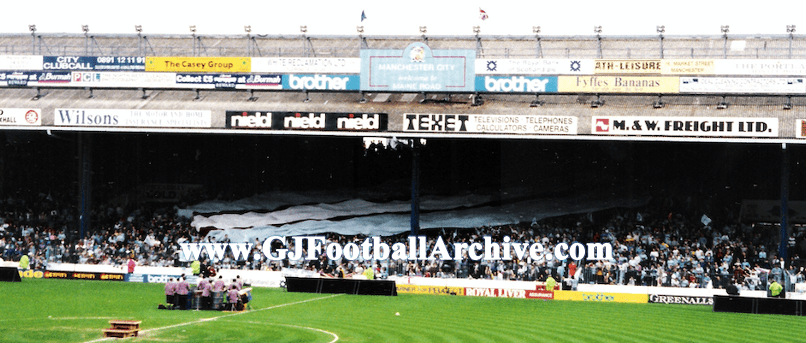
It is now almost 27 years since we said goodbye to terracing in Manchester and for those of us old enough to remember those days at Maine Road there was one standing area which, above all else, represented the passion fans had for their club – The Kippax.
Unlike most other grounds City’s main terracing ran the full length of the pitch and wasn’t tucked away behind a goal. Because of its positioning the Kippax breathed life into every area of the stadium and was huge. Originally, it held in excess of 35,000, but even in its final days it still gave the impression of power and passion.
The Kippax was originally known as the Popular Side, matching a similarly dominant feature of the Blues’ Hyde Road ground, when it opened in 1923. That first season it held an estimated 35,000 in a crowd of 76,166 – then a national record attendance for a club ground. In 1934 when 84,569 packed into the stadium City’s vast stand may well have held almost 40,000. Incidentally, that 84,569 became the new national record attendance for a club ground (a record that still stands as Wembley is a national stadium, not officially a club ground). You can read about that crowd and game here:
Incidentally, I know City fans get a lot of abuse these days from fans of certain other clubs about filling stadia etc. Well, if you need any ammunition that 84,569 record crowd is over 22,000 higher than Liverpool’s record crowd (61,905 – a figure which wouldn’t get anywhere near City’s top ten crowds!).
Throughout the period up to the mid-50s the Popular Side developed its reputation but it was when it was roofed in 1957 that it became the true heart of the club. Back then it was extended slightly, although legislative changes had reduced terracing capacities by this time. The club announced it would be known as The Kippax Street Stand and that is what it officially remained until 1994 although most of us knew it simply as The Kippax. Its capacity by this time was about 32,000, reducing to 26,155 by the end of the 1970s.
The Kippax accommodated fans of every age and gender and, although it was a formidable place for opposition supporters, it was a welcoming stand for Manchester’s Blues. Young children would sit on the walls and railings, while older fans would find their own preferred viewing spot. Here’s a few snippets about the old stand:
Originally four vast tunnels (one in each corner and two built into the stand) and two significant stairways allowed fans to move onto the Popular Side.
A flag pole, positioned at the back of the terracing up to 1957, allowed a blue and white flag emblazoned with the words City FC to proudly fly. The flag was then re-positioned until it disappeared for good in the 1960s.
Chanters Corner, also known as The Sways, was the area where the more vocal members of City’s support gathered. Packed above a tunnel and next to the segregation fence, fans here often generated the main chants.
The 1960s saw The Kippax’s reputation grow. Fans sang their way through success after success as Joe Mercer’s Aces won the European Cup Winners’ Cup and every domestic trophy possible. The Kippax would begin every game with the chant “Bring on the Champions!” and then follow up with a song for every player as they warmed up.
The final capacity of The Kippax was 18,300 – making this the largest terraced area at a League ground on its final day (The Kop held its final game on the same day but had a smaller capacity).
The Kippax was used for the last time on 30 April 1994 for the visit of Chelsea.
The Blue Print flag was a popular presence on many match days from the late 1980s until 1994, making its last appearance at The Kippax’s final game. The flag had been reduced in size by then. But it still covered much of the terracing. Blue Print was a City fanzine and they had paid for the flag.
Segregation was unnecessary for most of the stand’s existence, but by the end of the 1960s a rope would often be used to separate City and United fans on derby day. This was replaced by permanent barriers in the mid-70s which were increased over the years to keep home and away fans apart. Away fans were positioned at the Platt Lane end of the stand by this time.
It says much about the passion of the place that in the late 1970s the BBC came to film The Kippax chanting and in full flow.
In 1985 when City defeated Charlton 5-1 in a promotion decider on the final day of the season the Kippax was so packed that supporters remain convinced that its official capacity of 26,155 was significantly exceeded. Those of us on the terraces that day will never forget the shock we all experienced when the official crowd of 47,285 was announced – some 5,000 short of capacity!
The Kippax is no more, but those of us who experienced the stand will never forget its power, passion and presence. Its spirit lives on with thousands of Blues who stood there now bringing their own children and grandchildren to the Etihad who, if legislation allows, will soon be able to stand in a section specifically created for that purpose.
If you’re interested you can read how Maine Road got its name here:
While you’re here I’d like to thank you for taking the time and trouble to visit my website. I am not employed by anyone and no one pays me to do research or interviews. I do not have sponsorship or advertising either. I’ve set up this website to help share my 32 years plus writing and research. The intention is to develop the archive and to provide access to as much of my material as possible over the coming weeks, months & years. Subscribers can already access over 280 articles/posts including the entire Manchester A Football History book and audio interviews with former City bosses Malcolm Allison and John Bond.
It costs £20 a year (it works out £1.67 a month) or £3 if you’d like to sign up a month at a time to get full access for as long as you subscribe (see below). Thanks for the support, Gary.
Subscribe to get access
This has been a sample of the material on http://www.GJFootballArchive.com If you would like to read all the in-depth articles and listen to the audio interviews then please subscribe. It works out about £1.67 a month if you take out an annual subscription (£20 per year). Each subscriber gets full access to the 280+ articles posted so far and the hundreds scheduled to be posted in the coming weeks.
To mark today’s (20th March 2021) FA Cup meeting between Manchester City and Everton here are a few historical facts, memories and video highlights of games between the clubs.
Feature Match
The December 1989 meeting between the two sides was memorable because of events off the field rather than on it. The match ended goalless but the attention the game received from the national media was incredible, and it was all because 20th placed City had appointed the former Evertonian Howard Kendall as manager.
Earlier that season Peter Swales had dismissed the rather quiet, unassuming Mel Machin despite him guiding City to promotion and a memorable 5-1 victory over United. He publicly approached Joe Royle, who turned the club down, and then turned to Kendall.
Almost immediately the ex-Evertonian stamped his authority on the side and quickly brought in Peter Reid and Alan Harper to make their debuts at Goodison. Disappointingly, the highly popular Ian Bishop was named as a substitute. Kendall: “It was not a popular move. I walked out at 2.55pm to hear my supporters chanting, ‘There’s only one Ian Bishop’. Nice welcome that was. The Bishop situation developed into a saga, the like of which I have never experienced in football before.”
It wasn’t long before the long-haired Bishop was sold to West Ham. Earlier in his career Kendall had transferred him out of Everton.
Kendall’s new look City managed to keep ninth placed Everton at bay in a rather dour televised match to earn only their second point in six games. City ended the season in 14th place while Everton finished 6th.
The first League game between the two sides was a 2-1 Everton win on 23rd December 1899 in Division One. The match was played at Hyde Road with Billy Meredith scoring for the newly promoted City, while Jimmy Settle and R Gray netted for the Toffees. City ended their first season in the top division in 7th place while Everton finished 11th.
Television
The first meeting of the two clubs to be televised on BBC’s Match Of The Day was the 1-1 draw on 23rd August 1969. Film here:
The first ‘live’ televised meeting was the famous Howard Kendall match played on 17th December 1989 (see above). The game was shown on ITV.
When Everton appeared in their first FA Cup final it was played at Fallowfield, Manchester. The 1893 final against Wolves was the first, other than the 1886 replay, to be played outside London. Wolves won the match 1-0 and a row of houses in Wolverhampton were given the name Fallowfield Terrace in celebration.
The Fallowfield site now forms part of Manchester University’s student campus.
Well I Never!
City fans demonstrated against the transfer of their hero, Tommy Johnson, to Everton in March 1930 for £6,000. At City Johnson entered the record books by scoring most goals in a season – he netted an incredible 38 in 39 League games during the 1928-9 season. He was a popular player and lived amongst the fans in Gorton. He was often seen drinking draught Bass at The Plough on Hyde Road, and was something of a trend-setter in the area. As soon as he was spotted wearing a wide brimmed trilby hat it quickly became the fashion all young men wanted to follow!
His greatest individual game for City must have been the 6-2 defeat of reigning champions Everton in September 1928, when he scored five goals. Eric Brook scored the other while Dunn and Weldon netted for the Toffees.
In the 1960s Tommy was a regular attender at Maine Road where he and Billy ‘Dixie’ Dean would watch Joe Mercer’s City side. On 28thJanuary 1973 Tommy died at Monsall hospital aged 71.
Record defeat
Everton beat City 9-1 on 3rd September 1906 to record their record victory and City’s record defeat. This was only City’s second match following the findings of the FA investigation into illegal payments which resulted in the suspension of 17 players, the manager Tom Maley, the chairman, and two other directors. The entire summer had been spent finding a new manager and new players – any would do – to fill the void. City’s consolation goal was scored by debutant A.Fisher. The great Sandy Young had netted 4 of Everton’s 9 that day.
Two days before this game, the Blues had been defeated 4-1 by Arsenal in an incredible match that saw City leave the field with only six men. The rest were mainly suffering from heat exhaustion – it was 90 degrees in the shade!
The Young Royle
When Joe Royle made his debut in January 1966 against Blackpool he became the youngest player to appear for Everton in the League. He was 16 years and 282 days. His first game against City was the on 29th April the following year – only his 6th League appearance.
Joe Mercer
Obviously I’m biased but I’d urge everyone reading this article to also read:
The first Premier League meeting between these sides ends in a comfortable City win before 20,242 at Goodison Park. Two goals from Sheron and one from David White gave the Blues a 3-0 lead before an own goal from Brightwell made it 3-1 on Halloween.
1993 – Last Day
On the last day of the season Everton win 5-2 in a frustrating match for City fans. Goalscorers for Everton included future Blues Beagrie (2 goals) and Beardsley. White and Curle (penalty) scored for the home side.
1993 – Rideout Goal
The first away match of the season ends in a 1-0 City defeat. Rideout scored for the Toffeemen on 17th August before 26,025.
1994 – Double Double
Two goals each from Rosler and Walsh give City a 4-0 home win on 27th August. The Maine Road sell out crowd of 19,867 is City’s 3rdlowest crowd in the Premiership. The Kippax Stand was in construction and the capacity was severely restricted as a result.
1996 – Former Blue Scores
Former City hero Andy Hinchcliffe scores a 47th minute penalty to ensure a 2-0 Everton win in February 1996.
2000 – Five Stars
Wanchope (14), Howey (23), Goater (42), Dickov (54), and Naysmith (own goal in 67th minute) give City a thrilling 5-0 victory over Everton at Maine Road in December.
2002 – Anelka hat-trick?
City fans celebrate an Anelka hat-trick but his 14th minute opener is later ruled an own goal, scored by Everton’s Radzinski. In addition, Wright-Phillips is controversially sent off in the 28th minute but this is later downgraded to a yellow card. Despite the controversy and confusion City win the match 3-1 on 31st August.
2003 – New Year’s Day
Over 300 million fans watch this 2-2 draw on Chinese television. Everton took the lead in the 6th minute, City made it 2-1 in the 82ndbefore Everton equalised 2 minutes into injury time on January 1st.
2004 – Keegan’s Disappointment
On the season’s final day, City beat Everton 5-1 with goals from Wanchope (16 & 30), Anelka (41), Sibierski (89) & Wright-Phillips (90). The victory caused the two sides to swap League places. The Blues ended the campaign on 41 points, eight more than relegated Leicester, Leeds and Wolves. A decent enough margin in the end, but that did not change the way most felt about the season.
Prior to that final match Keegan explained truthfully how he felt: “We are just about at the end of the most disappointing season of my managerial career. I haven’t enjoyed it and I am sure the same goes for everyone connected with Manchester City.”
2005 – Early Morning Blues
Everton, so often a bogey team during the previous decade or so, were defeated 2-0 on 2nd October. This was the first Sunday morning kick off in the Premier League and the match commenced at 11.15 with some fans making a point of the early start by wearing pyjamas. It was also Stephen Ireland’s first full Premiership game. Before the match he admitted to being “very nervous” and post-match he commented that the rest of the team had supported him: “That helped me ease my nerves and settle in as one of them.”
2006 – Richards the Hero
One player, who would help City win the FA Cup and Premier League a few years later, was beginning to be seen as one of the club’s most positive assets this season – Micah Richards. He performed to a consistent standard and, on 30th September, he actually netted an equaliser for the club in the dying seconds against Everton to ensure an away point. The 18 year old Richards made his first full international appearance a few weeks later when he played for England against Holland on 15th November. Henry Winter, writing for the Telegraph, claimed: “England may well have discovered Gary Neville’s long term successor.” By this stage in his career Richards had only made 23 Premier League starts.
At Everton Richards’ goal was very important but City’s dominance during the final minutes of the match should have seen the Blues snatch a winner according to goalkeeper Nicky Weaver: “The last five minutes we absolutely battered them and every time the ball went in the box we looked as though we were going to score. Then when [Samaras] hit the post, you’re thinking ‘is it not going to be our day?’ But we kept going and deep, deep into injury time, we got something out of the game.”
Everton’s captain Phil Neville admitted: “It feels like a defeat… we should have got the second goal and killed off the game.”
2011 – Super Mario
In September City defeated Everton 2-0 with goals from substitute Mario Balotelli and James Milner. It was an important victory over a team that continued to be a bit of a bogey side in recent seasons, and ensured the Blues were now back on equal points with Ferguson’s Manchester United, who had drawn 1-1 at Stoke despite leading at half time.
Subscribe to get access
If you would like to read all the in-depth articles and watch all the videos/sound recordings etc. on this site (including the entire Manchester A Football History book) then please subscribe. It works out about £1.67 a month if you take out an annual subscription (£20 per year) or £3 a month if you’d like to sign up for a month at a time. Each subscriber gets full access to the 230+ articles posted so far and the hundreds scheduled to be posted in the coming weeks.
The first Manchester derby at Manchester City’s new stadium occurred on this date (14th March) in 2004. To mark this anniversary I’ve interviewed former City winger Trevor Sinclair. Trevor scored in that game, which the Blues won 4-1. Here he talks about being a City fan; signing for City; scoring the first competitive goal at the City Of Manchester Stadium (now Etihad); and the 4-1 derby. He also talks about the 3-1 victory over Manchester United in 2006 (again he scored); present day City and other memories.
Here’s the audio from our chat (it lasts about 26 minutes so get yourself a brew and settle down to listen):
While you’re here I’d like to thank you for taking the time and trouble to visit my website. I have been researching and writing about Manchester football for a long time (no wonder I’m going grey!) with my first book published in 1989. I am not employed by anyone and no one pays me to do research or interviews like the one posted here. I do not have sponsorship either. I’ve set up this website to help share my 32 years plus writing and research.
From Wednesday, for subscribers I’ll be posting the entire hour long plus interview I did with Malcolm Allison about his first period at Manchester City. Here’s a brief clip from the interview (he’s talking about his relationship with Joe Mercer):
The intention is to develop the archive and to provide access to as much of my material as possible over the coming weeks, months & years. Subscribers can already access over 280 articles/posts including the entire Manchester A Football History book and an audio interview with former City boss John Bond I performed in 1995. My interview with Allison will also be available from Wednesday.
If you’d like to support my research and writing while benefitting from accessing all the content on here then it costs £20 a year (it works out £1.67 a month) or £3 if you’d like to sign up a month at a time (you get full access for as long as you subscribe).
If you enjoyed the interview posted here then please subscribe (see below) to access all the content and, over time, I’ll add other interviews too. Thanks for the support and interest in my work, Gary.
Subscribe here for £20 per year or £3 per month
Each subscriber gets full access to the 280+ articles posted so far and the hundreds scheduled to be posted in the coming months.
Thirty years ago, while researching for my biography of Joe Mercer, I interviewed Malcolm Allison in his flat at Yarm. Starting on Wednesday 17th March I will be serialising the interview over five days for subscribers to this site.
In the interview Malcolm talks about meeting Joe Mercer for the first time; joining Manchester City; the relationship with Joe; the signing the players; the major successes; the set-up of Manchester City at the time and much more.
Here’s a brief section of audio from our chat:
Obviously, this was recorded on an old cassette recorder so, at times, the quality is not the best, but I’m sure you’ll agree that this exclusive interview is worth listening to. To hear the entire interview please subscribe and from Wednesday the interview will be posted a section at a time over five days (it’s over 1 hour in total).
While you’re here I’d like to thank you for taking the time and trouble to visit my website. I have been researching and writing about Manchester football for a long time (no wonder I’m going grey!) with my first book published in 1989. I am not employed by anyone and I do not have sponsorship either and so I’ve set up this website to help share my 32 years plus writing and research. The intention is to develop the archive and to provide access to as much of my material as possible over the coming weeks, months & years. Subscribers can already access over 280 articles/posts including the entire Manchester A Football History book and an audio interview with former City boss John Bond I performed in 1995.
It costs £20 a year (it works out £1.67 a month) or £3 if you’d like to sign up a month at a time to get full access for as long as you subscribe (see below). Thanks for the support, Gary.
On this day (11th March) in 1941 Old Trafford was hit by bombs dropped by the German Luftwaffe. The highly industrialised Trafford Park had been the target and by daybreak the news of damage to Old Trafford was circulating around Manchester, although the Manchester Guardian and other newspapers did not mention the ground by name. Due to the wartime situation the newspaper did not want to give away too much information and reported: “Slight damage was done to dwelling-houses in one or two working class districts and slight outbreaks of fire were reported from a football ground and a training institute.”
The ‘slight damage’ saw a bomb hit United’s Main Stand. The stand was almost completely wrecked, while the pitch was scorched by the blast. Manchester City contacted United and offered the use of Maine Road immediately and the first home United match to be staged at City’s ground was the 5th April meeting with Blackpool in the North Regional League. The Seasiders’ won 3-2 before a crowd of around 2,000.
Further wartime matches followed over the course of the next four years with United paying the Blues an annual rent of £5,000 plus a share of the gate receipts. Initially City were to use United’s training ground, The Cliff, for reserve fixtures, but both sides also used Old Trafford at times.
After the war United were granted £4,800 to help cover the costs of tidying up the venue, and then a further £17,478 was given to help rebuild the Main Stand and damaged terracing. This allowed the redevelopment of Old Trafford to commence and between 1945 and 1949 the Main Stand was rebuilt as was the terracing at the Popular Side (United Road).
This is a sample of the in-depth material available on this site on Manchester’s clubs, players & grounds. If you would like to read all the in-depth articles (including the entire Manchester A Football History book) then please subscribe. It works out about £1.67 a month if you take out an annual subscription (£20 per year) or £3 a month if you’d like to sign up for a month at a time. Each subscriber gets full access to the 270+ articles posted so far and the hundreds scheduled to be posted in the coming weeks.
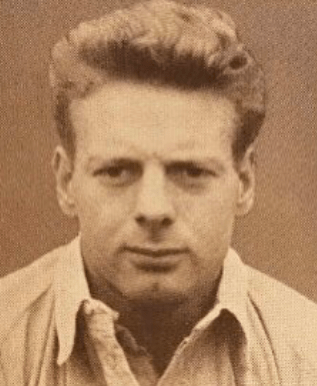
I have been informed by Matthew Phoenix that his father, Ron Phoenix died on 9th March from vascular dementia. Ron was on the books of both Manchester City and Manchester United, as well as Rochdale, Altrincham and Hyde. My thoughts are with Matthew and the rest of Ron’s family and friends. Here’s a brief summary of Ron’s career:
Ron Phoenix came from a footballing family. One brother, Eric, played for Knutsford, Hastings United, Gillingham and Exeter, while another brother, Jack, was a pre-WW2 amateur with Manchester United.
Prior to joining Manchester City in 1949 Ron had been a member of Matt Busby’s youth set up at Manchester United. The approach United took back then set the groundwork for youth systems in the decade that followed.
Ron made his City reserve debut as an amateur on Boxing Day 1949 at home to Huddersfield and he signed as a professional on 11th March 1950. At the time of his League debut (26th January 1952) he was playing as an inside-forward and he scored in the 2-2 draw at Arsenal. He kept his place for a prestigious friendly against River Plate FC from South America, this time at wing-half, and the following programme congratulated the youngster on two great displays against strong opposition.
Ron broke a leg against Newcastle in February 1953 having scored one of City’s goals in a 2-1 victory, and this injury sidelined him until the following season when he played mainly in the A team.
Despite the injury and other setbacks he did remain with the Blues until 1960, his most successful run of first team appearances as a wing-half coming in the latter half of the 1958-59 season. Sadly, family tragedy struck when in 1959 he tragically lost two children through illness.
Ron later moved on to Rochdale where he made 64 League appearances. At City he had made 52 League appearances (2 goals) & 2 FA Cup appearances. He’d also played 190 appearances in the reserves, scoring 15 goals.
Previously I’ve posted about the City Voices project capturing the stories and memories of Manchester City fans (if you’ve missed the story take a look at: https://gjfootballarchive.com/2021/02/06/city-voices-project/ ). The idea is to capture the experiences of Blues from all over the globe regardless of age, gender, ethnicity etc. Basically, if you’re a City fan I’d love to hear from you.
I’ve been capturing the stories of City fans since the early 1990s and always love hearing individual’s memories and stories. Back in 2002 I interviewed a female supporter called Fran Parker. At the time she was in her early 80s and she was able to talk to me about attending Maine Road in the 1920s to 1950s plus a few memories from the 1990s (for example, she talked about the sadness she felt when Paul Lake swallowed his tongue and how she feared for his life). I loved the fact that she was still attending games and still felt as enthusiastic in 2002 as she had in 1932.
For me it’s the experience of football that needs capturing. The media capture the games and the key moments but supporter views are often ignored or misunderstood. To give you an idea of what I’m talking about here’s a brief trailer of the interview I did with Fran. She does talk about goals, but it’s details like how she felt when Eric Brook scored in the 84,569 game; her umbrella and Dave Ewing stories that are different.
Anyway, have a listen:
If you would like to complete the City Voices questionnaire then please download it here and email it to me at gary@GJFootballArchive-com
One important point to note is that I am keen to hear from fans of all ages based in Manchester, the United Kingdom and around the world. The greater the number that respond the better the archive of fans’ stories will become.
As for Fran Parker’s interview… Over the coming months http://www.GJFootballArchive.com will develop to include some of my interviews (my John Bond interview from 1995 has already been posted). IF you would like to subscribe then see below:
If you would like to read all the in-depth articles (including the entire Manchester A Football History book and the audio interview with John Bond) then please subscribe. It works out about £1.67 a month if you take out an annual subscription (£20 per year) or £3 a month if you’d like to sign up for a month at a time. Each subscriber gets full access to the 270+ articles posted so far and the hundreds scheduled to be posted in the coming weeks.
Today (8th March 2021) is International Women’s Day and so I thought I’d post a few links to great content about pioneering women connected to Manchester football on this website.
My intention over the coming months and years is to make http://www.GJFootballArchive.com an archive of my past writing and new material on all aspects of football in the Manchester region (and material on activity beyond Manchester or involving national figures connected with the region). To subscriber to my site then please see the details below.
This includes material on the women’s teams of Manchester, such as the pioneering Wythenshawe/Manchester Ladies of the 1940s & 1950s; the Manchester Corinthians (globe trotting pioneering team of the 1940s to 1980s); Manchester City; Manchester United and the other clubs, such as FC Redstar, that have existed in our region. It also includes profiles and interviews with footballers; those working in football and the media; footballers’ partners; supporters and more.
All of this is based on my detailed research and writing on football in the region. I attended my first women’s game in 1988 (home team was F.C. Redstar) and was a regular at their games and Manchester City Ladies (now Women) during their formative years, including brief details on their first ever game in my first book published in 1989. Since then I’ve also written Manchester City Women: An Oral History (see https://gjfootballarchive.com/shop/ to order copies) and am researching for a detailed history on women and football in Manchester at the moment.
Listed here are a few links to articles connected with women, football and Manchester that may be of interest:
I did an interview with Premier League World on Manchester City Women. It’s episode 38 and can be viewed here (if you have Amazon Prime): https://www.amazon.co.uk/Premier-League-World/dp/B08HDGSNZN Or it can be viewed on the following channels:
BT Sport 1 Monday 12pm
BT Sport 1 Tuesday 12:30am
Sky Sports Premier League Thursday 5pm
Sky Sports Premier League Friday 3pm
Sky Sports Premier League Saturday 8am
The feature is the last one shown in the programme, so please keep watching to the end. The piece starts after about 18 minutes.
To access all of the above and everything else on this site please subscribe:
Subscribe to get access
If you would like to read all the in-depth articles on this site (including the entire Manchester A Football History book and the audio interview with John Bond) then please subscribe. It works out about £1.67 a month if you take out an annual subscription (£20 per year) or £3 a month if you’d like to sign up for a month at a time. Each subscriber gets full access to the 270+ articles posted so far and the hundreds scheduled to be posted in the coming weeks.






 Gary James' Football Archive