It’s the 40th anniversary of the 1981 FA Cup final on May 9 and ten years ago, as we looked forward to Manchester City appearing in the 2011 FA Cup final, I was asked by the Manchester Evening News to write profiles of the eleven players who started the 1981 final.
For the next few days I will post those profiles, one a day, free to read here. These will only be free to view until May 16, so please read them while you can. Thanks.
Here’s the latest (appearing here as it was written in 2011)…
As we look forward to the 2011 FA Cup final, Gary James takes a look at the eleven players who made the starting line-up for City’s last FA Cup final in 1981. Today,midfielder Steve Mackenzie
Malcolm Allison’s signing of Steve Mackenzie stunned the football world. The 17 year old signed from Crystal Palace for an incredible £250,000 in July 1979. The fee alone was huge – six months earlier the transfer record stood at £516,000 – but the fact that Mackenzie hadn’t even appeared in the League and was now the costliest teenager ever was astounding.
Inevitably, great pressure followed. Mackenzie appeared in the opening 14 League games of 1979-80 but spent more time playing reserve football. However, by the spring of 1981 Mackenzie was a permanent fixture in the side, delivering game after game. Captain Paul Power said at the time: “We look a different team when Steve is playing. He has fought his way back and proved to the boss that we can’t afford to be without him. He adds stability to our midfield.”
Mackenzie, as well as general play, contributed some significant goals such as the spectacular 25 yarder in the 4thround tie against Norwich, and the solitary goal in the February ’81 Manchester derby – “Mac The Knife” read the MEN headline.
It was Mackenzie who rolled a free kick to Power – a move they had worked on in training – that brought the only goal of the semi-final.
In the 58th minute of the final with the Blues leading 1-0, Mackenzie came close to scoring. John Bond remembered: “Reeves and Mackenzie played this magnificent 1-2. Mackenzie got behind the defence, went around the goalkeeper, went to slot the ball into the net and it hit the post and went wide. They’d have been dead and buried!”
Three minutes after Spurs had taken an 8th minute lead in the replay, Mackenzie equalised with one of the greatest cup final goals of all time. A Ranson free kick was met by a half clearance allowing Mackenzie to volley home from about 20 yards. It was a tremendous goal and the type of effort that should have won the cup. Paul Power: “I still believe Steve Mackenzie’s strike was just as impressive as Villa’s second goal. If that goal had been the match winner it’s possible that would have been voted the best goal of all time.” Bond agreed: “Steve Mackenzie’s volley was unbelievable!”
As we all know, Spurs went on to win the replay. Mackenzie played in one further City game but was sold – to raise money for the purchase of Trevor Francis – for £600,000 to West Bromwich Albion the following August. Considering his age and performances during 1981 it was a disappointing departure.
Spells at Charlton and John Bond’s Shrewsbury followed. Once his playing career came to an end Mackenzie pursued his interest in computers to gain a BA Hons degree in Interactive Multimedia Communication in 1998. With a strong interest in teaching and learning Mackenzie gained further qualifications in teaching and e-learning.
He also obtained the Advanced Level FA Football Coaching award and coached at West Brom’s Academy until 2000. He also had an enjoyable two year stint in non-league management at Atherstone United.
Since 2003 he has worked full time in Higher Education at De Montfort University primarily as a designer and developer of distance learning courses.
In 2004 at the age of 42 he made one appearance – and scored – for Gresley Rovers. Today he keeps in touch with the game, reporting for the Press Association, and takes a keen informal interest in football coaching and player development.
Looking back in 2011, Mackenzie’s strongest recollections from 1981 focus on his side’s endeavours: “pride in fighting so hard to win the cup, knowing if we had to lose we could not have done much more.” The highlight remains, of course, his goal: “the exhilaration of scoring a spectacular goal to get us back in the game – I think my beaming smile said it all.”
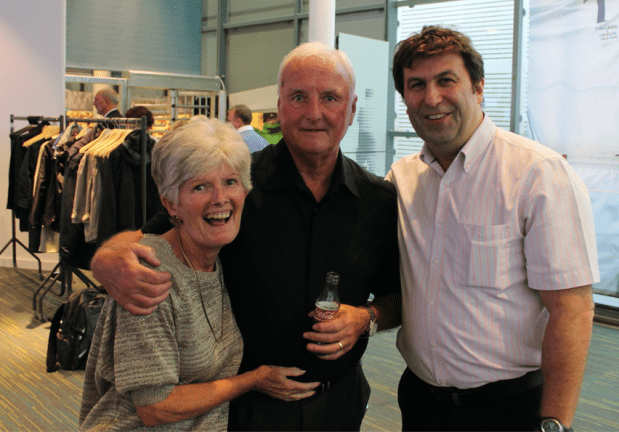
Janice Monk (former City Store), Glyn Pardoe and Steve Mackenzie at the launch of Manchester The City Years in 2012
My biography of Peter Barnes is now available to subscribe to. Order by May 15 and you will receive a copy signed by me & Peter, the book posted to your home address before it appears in any shop AND your name printed in the book. Order (and more details) here:
It’s the 40th anniversary of the 1981 FA Cup final on May 9 and ten years ago, as we looked forward to Manchester City appearing in the 2011 FA Cup final, I was asked by the Manchester Evening News to write profiles of the eleven players who started the 1981 final.
For the next few days I will post those profiles, one a day, free to read here. These will only be free to view until May 16, so please read them while you can. Thanks.
Here’s the latest (appearing here as it was written in 2011)…
As we look forward to the 2011 FA Cup final, Gary James takes a look at the eleven players who made the starting line-up for City’s last FA Cup final in 1981. Today, 1981’s number two Ray Ranson.
Despite being only twenty at the time of the 1981 FA Cup Final, England under-21 right back Ray Ranson had been a member of City’s first team for over two years. After making a name with both the Merseyside and England schoolboy sides, Ranson signed as an apprentice for the Blues in July 1976. Other sides, including Liverpool, Leeds and Arsenal, had shown interest in him, but once he arrived at Maine Road his love of the Blues developed at a pace. The right back later admitted that he became ‘City daft’ from the moment he arrived.
Ranson’s first team opportunity came when he was 18 following injury to Kenny Clements. He made his debut against Nottingham Forest on 23 December 1978 and the following season, after several impressive performances both for club and at Under-21 level for England, he established himself as the Blues’ regular right-back. This meant that he was already a very experienced defender, despite his age, when the 1981 final was staged.
The match programme for the 1981 final described him as a “player of high potential” and it is true that much was expected of him at Wembley. In the 29th minute of the first game, Ranson didn’t disappoint as he played a huge part in ensuring the Blues took the lead. An exciting exchange of passes between Dave Bennett and Kevin Reeves near the right corner led to a great centre by Ranson. Tommy Hutchison dived spectacularly to head the opening goal.
Ultimately, the final went to a replay. In the seventh minute Spurs took the lead. Three minutes later it was Ranson’s free-kick that led to City’s equaliser. His kick was met by a half clearance which allowed Steve Mackenzie to volley home from 20 yards – a goal that was worthy of winning any cup final. Sadly, Spurs went on to win the final with a goal that has become one of the most repeated in television history and one that must pain Ranson every time he sees it. During an amazing weaving run Ricky Villa seemed to pass a dozen players but he actually passed Tommy Caton twice, Ranson and then Joe Corrigan. Ranson will forever be reminded of this. It’s an absolute certainty that at some point on Cup Final day this year the right-back will be forced to relive the nightmare moment once again.
After Wembley Ranson remained a City regular during a difficult period for the Blues. Then in November 1984 the St. Helens’ born player moved to Birmingham City. At the time it was reported he had fallen out with manager Billy McNeill. The fee City received was a bargain £15,000 – desperately low for a FA Cup finalist who was still only 24. At St. Andrew’s he won promotion alongside City in 1985.
Ranson later played for Newcastle – under Kevin Keegan for a spell – and then returned to Maine Road initially on loan under Peter Reid in January 1993.
A move to Reading came in the summer of 1993, but a serious Achilles injury in February 1994 prematurely ended his time there. Ranson eventually became player-manager of Witton Albion, before becoming involved with the finance industry.
Shortly after City’s move to the new stadium, media reports suggested Ranson was interested in buying into the Blues, then similar stories appeared linking him with a potential takeover of Aston Villa. Later in the decade stories suggested he had come close to taking over City, but ultimately he fronted a takeover of Coventry City. Ray Ranson became chairman of the ‘other’ Sky Blues in December 2007 but stood down at the end of March this year (2011) taking on a football consultancy role saying: “I am more than happy to assist the new Chairman and Board as well as the football management team to get our results back on track.”
Ranson’s City career saw him make a total of 234 (plus 2 as substitute) appearances but interestingly Ranson’s spell with the Blues in 1993 meant that he was the only member of City’s 1981 FA Cup final team to appear for the Blues in the Premier League.
My biography of Peter Barnes is now available to subscribe to. Order by May 15 and you will receive a copy signed by me & Peter, the book posted to your home address before it appears in any shop AND your name printed in the book. Order (and more details) here:
It’s the 40th anniversary of the 1981 FA Cup final on May 9 and ten years ago, as we looked forward to Manchester City appearing in the 2011 FA Cup final, I was asked by the Manchester Evening News to write profiles of the eleven players who started the 1981 final.
For the next few days I will post those profiles, one a day, free to read here. These will only be free to view until May 16, so please read them while you can. Thanks.
Here’s the latest (appearing here as it was written in 2011)…
As we look forward to the 2011 FA Cup final, Gary James takes a look at the eleven players who made the starting line-up for City’s last FA Cup final in 1981. Today, captain Paul Power.
The scorer of the only goal in the semi-final victory over Bobby Robson’s treble-chasing Ipswich Town, Mancunian Paul Power was a wonderful choice as captain during the early eighties. He was given the responsibility in October 1979 but his first year came at a time of struggle for the Blues. However, the atmosphere improved considerably with the arrival of manager John Bond. Power later recalled: “By the time we reached Wembley in 1981 the captaincy was relatively easy. The other experienced players were able to marshal their areas of the pitch well, and the mix between inexperience and experience was good.”
Reaching the final – and it should be remembered the semi-final of the League Cup – was ultimately a great achievement for City but, inevitably, the replay defeat remains a painful memory: “I’m still very disappointed about the final result,” he admitted when I interviewed him in 2004. “But it was a major honour to be there and to captain the side.”
“Everybody knows the story of the own goal and of the replay, but I still believe that had the game been played to a conclusion on the Saturday then we’d have won. We were still going strong and were still confident. Some of the Spurs players were suffering with cramp and we definitely had the game under our control.”
In the years that followed Wembley City’s fortunes took a spectacular nosedive and in 1983 the Blues were relegated: “Looking back I realise that experiencing the bad times helps you appreciate the good times more, but back then I didn’t feel like that at all. A very, very low moment.”
Power could easily have moved on but he vowed to help City return to the top flight. Bargain basement signings were made due to the club’s poor financial state but, despite a gallant effort, the Blues missed out on promotion. Power, perhaps because he was a reminder of what City had been only a few years earlier, did receive some minor abuse at times: “I had a great relationship with supporters overall, but I guess for that one season we all felt the frustration. Funnily, twelve months later we won promotion and I was voted player of the year.”
In 1986 Power captained City to the Full Members Cup final against Chelsea. It was a fairly short-lived tournament, with the final watched by 68,000, and at the end of that season the 32 year old captain was transferred to Everton as cover for Pat Van Den Hauwe. He astounded almost everyone – including himself – when he went on to appear in all but two games as Everton won the League title: “I suppose in many ways it was like being dropped into City’s Championship team of 1968. Every member of the side was of the right quality and all I had to do was pass the ball on.”
Despite his modesty, Power thoroughly deserved his title medal, it was just a pity he was wearing Everton’s blue and not City’s. That season he also scored a memorable goal against his former side: “I kicked the ball and remember thinking ‘save it, save it’, but he didn’t and I scored! I felt awful. I couldn’t celebrate. I knew City were struggling and I couldn’t bear inflicting any pain. Awful!”
Power did ultimately return to City to take on a role with the Blues highly successful Academy. Worth recalling that when he was first spotted by City, Chief Scout Harry Godwin’s view was that the 13 year old Power needed development himself: “His left foot was a beauty, but there was nothing on the lad. No flesh, no height. Paul was the tiniest of tots, he made Ronnie Corbett look like a giant!”
After much effort on the young player’s part Godwin took a second look: “He’d grown, the stride had lengthened and the delicate left foot was still there. I’d seen all I needed to in the first half hour of the game.”
In 2011 Power now helps some of the Academy’s youngest and brightest prospects develop, but he will always be remembered fondly for his unwavering dedication to the Blue cause during the highs and lows of the early 1980s.
My biography of Peter Barnes is now available to subscribe to. Order by May 15 and you will receive a copy signed by me & Peter, the book posted to your home address before it appears in any shop AND your name printed in the book. Order (and more details) here:
Last night Manchester City reached the final of the Champions League for the first time in their history. Manchester has now become only the second non-capital city to have had two teams reach a European Cup final. Manchester was of course the first British city to have two teams competing in the European Cup in the same season (1968-69).
Last night was a remarkable night and other records were established:
City broke the record for longest winning run by an English club in European Cup history (7)
They became the first English side to win 11 games in a single European Cup/Champions League campaign (they are one off equalling Real Madrid’s record of 12 games)
This Champions League win is an important step in the club’s journey and to celebrate I’m going to make my special 1 hour audio recording commemorating an earlier important step in this journey free to listen to until May 12th.
This audio recording was made to commemorate the tenth anniversary of Manchester City’s FA Cup semi final victory over Manchester United at Wembley (April 16 2011). To me that game was a crucial step towards the success that came over the ten years that followed, just like last night’s feels like a major step in the club’s development.
The audio recording looks at the years between the 1976 League Cup success and the FA Cup glory of 2011. The 2011 semi-final was a crucial step in City’s journey since the 2008 takeover and I felt it was vital to do a special marking this.
So what’s in this special recording? Well, I’ve included exclusive material from interviews and recordings I’ve done over the years with Garry Cook, Brian Marwood, Roberto Mancini, Peter Barnes and Peter Swales. Why Swales? Well, have a listen and you’ll hear why. Basically though I’m trying to set the tone for why the 2011 FA Cup semi final victory was so significant.
On Mancini… I include a few words from him recorded in 2011 and at one point he talks about the view that was then being expressed that City were ‘trying’ to buy success (now they say City ‘have’ bought success!). His words are a reminder that City have been having that particular criticism thrown at them for over a decade! Oh well, I wonder how long those criticisms were laid at other clubs who had seen major investment which propelled them forward?
Anyway, get yourself a brew and be prepared to be transported back in time. Here’s the recording:
If you enjoy the recording then please let me know, comment or subscribe to the site. If it’s of interest then, over the coming months and years, I’ll produce others like this highlighting key points in Manchester City – and Manchester’s – footballing history. It costs £20 a year to subscribe (it works out £1.67 a month) or £3 if you’d like to sign up a month at a time to get full access for as long as you subscribe (you can always try it for a month). It’s worth bearing in mind that the 2010 Manchester A Football History cost £24.95 and all subscribers will be able to access all of that for as long as they are a subscriber (plus all the other stuff of course). You can subscribe below.
Some people say that history repeats. I’m not so certain about that but I do think we can learn a lot from history about modern society and how things develop. Actions are often similar decades apart and, unless we learn from what’s gone before, we do often make similar mistakes or not consider how things could turn out. Parallels should be looked for and considered.
This weekend (May 2 2021) has seen the postponement of the Manchester United – Liverpool Premier League game due to concerns over the safety of players and staff. Whether it should have been or whether there had been any potential for players to be injured is debateable but postponed it was.
United fans had been protesting on the forecourt outside Old Trafford a few hours before the match and some managed to find their way into the stadium. Footage of some smashing a door down and others seemingly walking straight into the stadium at a door manned by stewards have circulated, causing various conflicting views as to how fans managed to get into a stadium that should be impenetrable (if a few hundred fans can get in to a closed and secure stadium what does this say about the general security of the venue?).
The fans that made it in to the stadium found their way on to the pitch and television broadcast the scenes. Eventually the stadium was cleared, although Sky TV told us of a second group of fans who had got into the stadium through the second tier. Ultimately, all fans were cleared but the game was postponed. Fans were also positioned outside the Lowry Hotel where the United team were and television told us that there were concerns as to whether the team would be able to safely travel to Old Trafford.
Similar views were expressed about Liverpool (don’t get me started on the safety of teams arriving at Anfield!).
Whether any player was in actual danger or not didn’t seem to matter. This was the view being expressed by those paid to describe the scene.
So, what should we make of all this? Well, we have been told that the protests were against the owners of Manchester United, the Glazer family, and the birth of the European Super League. The Super League plan has been halted (I’m sure it will keep coming back as the birth of the Premier League did) but the Glazers still own United.
I opened this post by saying how parallels should be looked for and considered and, as a historian, I cannot help but compare what’s happened this weekend with events at Manchester City in 1993. Back then the Blues were run by chairman Peter Swales.
Swales had mismanaged the club for two decades and had taken a hugely profitable and successful club, piled it with debt and seen it lose pace with some of its traditional rivals. Fans had been angry about his chairmanship for years and had demonstrated regularly. Swales Out was often the most popular chant at Maine Road and the pre and post-match demonstrations were an everyday part of life as a City supporter. Fans loved City but hated Swales.
Inevitably, when City were successful the Swales Out protests were not as visible as they were at times of failure – and this has been true at United. There have been many, many United fans who have constantly highlighted the faults of the club’s ownership and they have campaigned, but the wider fan base has been quiet when the successes have occurred. This was true at City (though successes were less frequent at City during Swales’ chairmanship).
Frustrations at Manchester City continued, even when the club had relatively successful seasons. For example, the Blues finished fifth two years running in 1991 & 1992 – poor by 1970s standards but better than the 80s – but fans still wanted Swales out. Part of the reason lay in his support for the proposed Premier League, which began in 1992-93 but had been discussed for several years before that (it was initially planned as a complete breakaway from the Football League by the biggest clubs who were determined to reduce the money they passed down to the rest of football – hmm, parallels here that often get forgotten!).
The Premier League was anticipated to make the rich richer and clubs that had lost their way, like City because of Swales and his supporting directors who had placed the club in enormous debt (for the time) which meant they struggled to compete for the best, were going to make up the numbers to some extent.
The first season of the Premier League went okay for Manchester City. They finished ninth which was a little disappointing but in itself was not the main concern. That was still Swales’ chairmanship and the general mood was poor. Fans had had enough.
City’s chance of glory that season faded in a FA Cup quarter final with Tottenham and fans’ frustrations at their chairman and directors spilled out. It was a day when Swales’ new stand was opened – the Umbro Stand – and this was small-time compared to the club’s history and heritage. The stand it had replaced held over 9,000 seated. The new stand was basically two rows of executive boxes with about 4,500 seats in front. The ordinary fan felt that with that stand and the birth of the Premier League they were no longer relevant. Hospitality, money and TV deals seemed to matter most to club owners.
The frustrations that had been bubbling for years (and we must NEVER underestimate the efforts City fans made demonstrating against their directors and for how many years they did this) bubbled on to the pitch. Live television captured the scenes as City fans invaded the pitch and the FA Cup quarter final was halted.
The media criticised the couple of hundred fans who made it on to the pitch. They didn’t ask why they’d done it, they just assumed City fans were unhappy at losing a FA Cup game. Had they bothered to ask fans – I was there and knew the situation and have over the years discussed this extensively with people who were on the pitch – they would have realised that they climbed on to the pitch out of frustration. Frustration at the way football was developing and frustration at Peter Swales and his supporting directors.
Fans were right to be frustrated and history has shown that their predictions (covered extensively in City fanzines at the time) about the way football was developing to create an elite and more money for certain clubs was right.
I interviewed Peter Swales about two years after that pitch invasion and he told me that he should have listened to the fans and resigned that night. I agree – things would have been different for him and for City. Maybe in a few years the Glazers will say the same about this weekend?
That 1992-93 season saw Manchester United win the top flight for the first time in 26 years and United’s success brought added pressure to those in charge at Maine Road. The frustration of seeing your nearest rival achieve something that you’ve not done for years (City had been the last Manchester team to win the League prior to 1992-93 as they’d won it in 1967-68) gave fans further ammunition. Fans could point out to Swales that he became chairman of a club that had been hugely successful (four major trophies in the previous 5 seasons before his chairmanship) and profitable (previous chairman Eric Alexander was proud of the profitability of the Blues in the years before Swales). They could also ask ‘where did the money go’, ‘Why were we mismanaged?’ etc.
That event in City’s history is similar to some extent to what’s happened at United. Years of frustration at the owners/directors; the recognition that a rich club had been placed in significant debt; the proposed birth of a new league; the resurrection of a neighbour who seems destined to have a bright future just at a time when your directors don’t seem able or willing to compete etc.
The proposed change of structure to football, where greed of club owners seemed more important than what the fans wanted, was the catalyst to the demonstrations at United this weekend.
Please don’t be fooled into thinking this is a demonstration against the European Super League – that’s the catalyst but United fan dissatisfaction runs much deeper than that. As with City’s 1993 FAC quarter final defeat and the birth of the Premier League that season, these are catalysts that bring the wider fan base on board (and often the media attention), but they are not solely the cause.
In 1993 the media claimed City fans were unhappy because they’d lost the FAC tie. Well, yes, but they’d lost plenty of other FAC ties over the years and never invaded the pitch. That tie became the visible outpouring of dissatisfaction, just like the European Super League has created a situation which has allowed United fans to bring more visibility to their longstanding protests against the club’s owners.
So where do we go from here? Well, there’s one major change since 1993 and that is that the majority of media coverage seems to have sympathy with fans this time. But those working in the media should ensure they go and talk to the fans who were actually on the Old Trafford pitch and ask them why they were there. That would help frame the discussions about what it all actually meant. Some media coverages has said in rather simple terms that United fans were campaigning against the European Super League – no, it’s part of a long standing dissatisfaction with the club’s owners, but I’m not a fan who went on the pitch (that’s my interpretation but best way to find out is to ask those who were in Old Trafford).
In 1993 the media didn’t ask City fans why and they made assumptions which painted football fans extremely negatively. Instead of showing them as people who cared about how their club was developing they were presented as hooligans.
If we’re thinking about parallels then it’s worth considering what happened next in 1993 so that United fans can shape things differently or prepare for the worst! Back in 93 the momentum at Maine Road continued but, as with the widespread protest of the 1980s at City, nothing could change while the majority shareholders supported Swales. Put simply, if you own the club no amount of fan pressure can force you to sell. You only sell when you want to.
Swales felt the protests would die down (he explained all of this to me in an interview) but this time, as protests continued in 1993-94, former player Francis Lee decided to mount a takeover. That was eventually what forced Swales to stand down.
Sadly, for City the damage was done though and financially Lee’s City couldn’t compete with clubs who were able to spend freely like Blackburn (a major benefactor at the time) and those who were already benefitting financially from Premier League success. City ended up dropping to their worst ever position in the late 1990s and were financially adrift of many of their traditional rivals. Only the takeovers of 2007 and 2008 could help the club regain its position as a serious trophy challenger.
If we consider the City situation as an example, then it seems that the best chance United fans have got to change the ownership of the club is if someone like Gary Neville came in to front a major takeover of the club. Even then, as with City, it may well be that the damage done to the Reds and the debt placed on the club limits its future.
It does make you wonder what would have happened had Alex Ferguson, who had spoken out against the Glazers before the takeover, opposed the Glazers when they took over his club. Had Ferguson stood down back then maybe the protests against the Glazers would have been immense?
Football owners have never been properly policed and there are examples throughout the English league system of clubs whose futures were jeopardised by owners who have gambled on future success by borrowing to fund purchases, or who have sold club assets or placed a club in debt for their own personal gain. Change in football’s governance is needed. Simply changing owners is not the answer because football is a business and any owner wants his/her business to be profitable for him/her and shareholders.
Fans views, whether in the 1980s or 1990s campaigning against the Premier League and football chairmen, or in the 2020s campaigning against the Super League and football owners need to be listened to. Understand us and work with us – you might help make football an even greater spectacle.
Subscribe to get access
This is a taster of the material on this site. If you would like to read everything (including the entire Manchester A Football History book) then please subscriber. It’s £20 a year (works out about £1.67 a month) and you’ll have access to all 340+ articles/interviews etc. posted so far and the others coming during your subscription.
Don’t forget if you order The Peter Barnes Authorised Biography before publication you can get your name printed in it and your copy will be signed by Peter and myself. Details here:
It’s the 40th anniversary of the 1981 FA Cup final on May 9 and ten years ago, as we looked forward to Manchester City appearing in the 2011 FA Cup final, I was asked by the Manchester Evening News to write profiles of the eleven players who started the 1981 final.
For the next few days I will post those profiles, one a day, free to read here. These will only be free to view until May 16, so please read them while you can. Thanks.
Here’s the latest (appearing here as it was written in 2011)…
As we look forward to the 2011 FA Cup final, Gary James takes a look at the eleven players who made the starting line-up for City’s last FA Cup final in 1981. Today, centre-back Nicky Reid.
Switched to the centre of defence when John Bond brought in Bobby McDonald, twenty year old Nicky Reid formed, with Tommy Caton, the youngest centre-back pairing in FA Cup final history when they appeared in the 1981 final. Reid, who Malcolm Allison gave a debut to in a UEFA Cup quarter-final two years earlier, was a versatile player who had already performed well as a midfielder, left-back, right-back and in the centre of defence.
Reid would probably have played in any position for the Blues, such was his love of City: “I’ve always been a fanatical City supporter. I would have joined any professional club but obviously when City came in for me, I jumped at the chance.”
He originally joined the Club from school in 1977 under the guidance of youth coaches Steve Fleet and Dave Ewing: “They gave me my first experience of proper football. They showed me what being a professional was all about.”
As the man who gave Reid his first team opportunity, Malcolm Allison once described the player as “the fiercest tackler since Dave Mackay” – a major compliment, particularly as it came at the start of his career and set expectations. Nevertheless, Reid did impress and Allison had been a major influence: “He gave me the belief I could do the business and he instilled a lot of confidence in me.”
Inevitably for a committed defender, disciplinary matters meant Reid did not figure in every tie during the 1981 FA Cup run. In fact, his sending off in a January League game with Middlesbrough came in very unusual circumstances. Firstly, the visitors wore Manchester United’s home kit as the game was to be televised and Boro arrived with shirts bearing their sponsor’s name – shirt advertising was not allowed on TV at the time. They made a quick dash to Old Trafford to use the Reds’ shirts instead.
Later, an over-reaction by the referee saw Reid and Boro’s Hodgson given red cards for a bit of arm and shirt-pulling. What made this newsworthy was the fact that this was the last day before the red card system ended – it did eventually return later in the decade. Reid was suspended for the fourth round.
In the build-up to the ’81 final Shoot magazine highlighted the role the Mancunian was to play: “It is Reid’s job to shackle the menace of the opposing dangermen – a task he carried out to devastating effect when he subdued Dalglish and Mariner in semi-final ties recently.”
The magazine was fairly accurate with its prediction and Reid received significant praise for his performance in the initial drawn game. In fact the Daily Mail named Reid as one of the reasons why Tottenham did not deserve a second chance: “For what they are worth to the bewildered Tommy Hutchison, the defiant Joe Corrigan, the prodigious Nicky Reid and the inspiring John Bond, my sympathies are with City. At least they gave their all for 90 minutes and then dredged up a little extra for the additional half-hour. With the heroic exception of Graham Roberts, Tottenham’s approach was a disgrace.”
Despite Reid’s endeavours in both games, he left Wembley defeated, but he remained a very popular and important member of Bond’s side, and then later Billy McNeill’s Blues.
Apart from a summer spent playing in the USA Reid remained a Blue until 1987 when he transferred to Blackburn. He helped the side gain promotion and then spells at West Bromwich Albion, Wycombe, Woking, Witton Albion, and Bury followed. In 1997 he became Sligo Rovers player-manager, winning the FAI League Cup, but soon decided to concentrate on the rehabilitation of footballers instead, taking degrees in Sports Rehabilitation and also in Physiotherapy.
Years of study followed: “The studying has been a long hard slog, and It would have been very difficult for me financially but the PFA sponsored me. I am sports-mad and I just saw physiotherapy as a way to stay involved in sport.”
After various fitness and physio roles at Burnley, City, Barrow, Bury and Hyde, he replaced Paul Lake as physio at Macclesfield Town in 2008.
In 2011, his current role has his full focus and keeps him involved in a sport he loves.
My biography of Peter Barnes is now available to subscribe to. Order by May 15 and you will receive a copy signed by me & Peter, the book posted to your home address before it appears in any shop AND your name printed in the book. Order (and more details) here:
It’s the 40th anniversary of the 1981 FA Cup final on May 9 and ten years ago, as we looked forward to Manchester City appearing in the 2011 FA Cup final, I was asked by the Manchester Evening News to write profiles of the eleven players who started the 1981 final.
For the next few days I will post those profiles, one a day, free to read here. These will only be free to view until May 16, so please read them while you can. Thanks.
Here’s the latest (appearing here as it was written in 2011)…
As we look forward to the 2011 FA Cup final, Gary James takes a look at the eleven players who made the starting line-up for City’s last FA Cup final in 1981. Today, forward Kevin Reeves.
When Malcolm Allison signed Kevin Reeves in March 1980 he was only the fourth footballer to have cost £1m or more, with City responsible for 50 per cent of those signings. Allison was happy with his £1.25m purchase: “He is the nearest thing in today’s soccer to Kevin Keegan… City fans will soon be delighted. We can all thank the astuteness of our Chairman Peter Swales. Mr Swales has backed his beliefs and his management team.”
As with Steve Daley, City’s record transfer at the time, the fee put Reeves under tremendous pressure, the difference was that by the time of the 1981 final the former Norwich player was delivering game after game. Reeves: “There’s no denying that with City struggling under Malcolm there was pressure, but once John Bond came in the entire atmosphere changed and the fact I had cost a million didn’t matter any more.”
Reeves was also playing for a team he loved: “My interest in City came when I was about ten and first getting seriously keen on football. City were winning everything. The FA Cup final in 1969 was the day I really became a fan. I wasn’t from Manchester but as a young boy interested in playing I had to support the team that played the type of attractive football I wanted to play.”
In the 1981 FA Cup final replay Reeves scored City’s second goal from the penalty spot – “a remarkably composed despatch” was how one journalist described it – but he felt Spurs held the advantage: “Steve Mackenzie scored a great volley and I netted a penalty, but Spurs had momentum and once Villa scored that goal it was clear they would win. It’s nice that it’s remembered as one of the great cup finals and it is also the greatest occasion I played in. I have to say though it is also my biggest disappointment. There was nothing anyone could say to lift me. It’s a day when you understand exactly how the fans feel.”
Joe Corrigan felt that Reeves’ contribution both in the final, and the season in general, had been high: “Kevin Reeves was injured early on and that was a major blow – he is one of City’s most underrated players. Reeves was a very, very good player.”
It should be remembered that he was also at the centre of controversy in the League Cup semi-final against Liverpool. The Blues were harshly treated with a Reeves’ goal being disallowed for ‘illegal jumping’: “This was the most controversial incident of my time really. There was absolutely nothing wrong with that goal and the television film proved it. It was perfectly legitimate and the referee could never properly explain why he disallowed it. What made it worse was that after scoring I ran to the Kippax celebrating with the other players unaware of the referee’s decision, and then discovered Liverpool were attacking our goal. The entire match changed by a very, very unfair decision. We were all furious. If I’d have known I’d done something wrong then I’d have owned up at the time but, believe me, all these years later I still know I did nothing wrong that day.”
That goal would, almost certainly, have seen the Blues progress to the 1981 League Cup final as well, but the initiative swung to Liverpool who went on to win the tie 2-1 on aggregate.
Reeves finished both the 1980-81 and 1981-82 seasons as City’s top scorer and proved to be the best value of City’s million pound stars of the high-spending late 70s/early 80s, but relegation in 1983 brought an end to his City career: “It was the worst moment of my City career. The club needed to cut costs and inevitably I had to leave. A terrible period really.”
A move to John Bond’s Burnley followed but ultimately Reeves’ career was to be cut short by an arthritic hip. Various coaching posts followed, most notably with Swansea. In 2011, Kevin Reeves is chief scout at Wigan Athletic.
My biography of Peter Barnes is now available to subscribe to. Order by May 15 and you will receive a copy signed by me & Peter, the book posted to your home address before it appears in any shop AND your name printed in the book. Order (and more details) here:
It’s the 40th anniversary of the 1981 FA Cup final on May 9 and ten years ago, as we looked forward to Manchester City appearing in the 2011 FA Cup final, I was asked by the Manchester Evening News to write profiles of the eleven players who started the 1981 final.
For the next few days I will post those profiles, one a day, free to read here. These will only be free to view until May 16, so please read them while you can. Thanks.
Here’s the latest (appearing here as it was written in 2011)…
As we look forward to the 2011 FA Cup final, Gary James takes a look at the eleven players who made the starting line-up for City’s last FA Cup final in 1981. Today, midfielder Gerry Gow.
Gerry Gow arrived at Maine Road in October 1980 as John Bond’s third signing in two days. The others were Tommy Hutchison and Bobby McDonald. Shortly before his death in the mid-90s City chairman Peter Swales remained convinced that those signings were of immense significance to the Blues: “probably the three best players we’ve ever had as a group.” He added: “If Gerry Gow had been injured – which he could’ve been – we would probably have gone down that season.”
Although it wasn’t publicised at the time, according to Bond his chairman took a major gamble on Gow: “There was no way in the world he would have been able to sustain a medical examination because he would have failed it! I had a chat with Swales and he asked me what I wanted to do and I said that I still wanted to sign him. So he let me pay £175,000 and we just had to take a chance… but what a chance. He was a revelation.”
Gow was only 28 but with his wild hair and handlebar moustache he gave the impression of a very experienced combatant. Most opponents would have feared him. According to Bond he had an immediate impact: “Gerry Gow stopped everything happening for the opposition, and that rubbed off on the rest of the players. Gow’s tenacity rubbed off on Ray Ranson, Tommy Caton and Nicky Reid and the others.”
The midfielder did also contribute a few goals, including the second in the 6-0 thrashing of Bond’s former side Norwich in the fourth round and an equaliser at Goodison in the quarter-final. Worthy contributions, but it was in the final that Gow was at his tenacious best. Early in the first half he made both Ardiles and Hoddle feel his presence – the Daily Mail described him as “Manchester’s lunging hit-man Gow” while the Observer said “Gow was to employ his talents as a bone-cruncher on Hoddle.”
City fans loved Gow’s commitment, although the Daily Mail felt “The lionising of Gerry Gow may tell us much that is wrong with English football.” What it actually told everyone was that the midfielder was loved for his determined approach and, whereas some players may have frozen on the big stage, Gow seemed more committed than ever. He was viewed as the most effective member of the side by many neutrals and it is a fact that he helped ensure Spurs’ midfield were largely ineffectual.
Sadly, Gow did also play a part in Tottenham’s equaliser. John Bond did not blame the player, but he did feel there was some irony in the fact that Gow and Hutchison, who actually scored the equalising own goal, had been two of the driving forces in City’s transformation: “Gerry Gow was the one who caused the free kick because he was on the half way line with the ball, and was robbed of the ball. He chased the player right back to the edge of the penalty area and then he fouled him. He used to get upset when somebody beat him. He gave a foul away and Hoddle shot at goal.”
The replay ended in defeat. “Gow had given so much in the first game that he must have been drained for the second match,” was the honest assessment of goalkeeper Joe Corrigan. “He still did well, though.”
After Wembley, Gow suffered with cartilage problems and in January 1982 he moved on to Rotherham. A spell at John Bond’s Burnley followed in 1983, and later he became manager of Yeovil and then Weymouth. More recently he has worked as a publican, and in the engineering trade in Dorset.
Today, he remains a hero at both City and at his previous club Bristol City. In April, without his trade mark wild hair, he was given the best reception of the night by Bristol City fans at a function honouring some of the club’s biggest stars. No doubt something similar would occur at Eastlands.
Gow only appeared in 36 City games but it was enough to ensure he achieved cult status.
NOTE: Sadly, Gerry Gow died on October 10 2016.
My biography of Peter Barnes is now available to subscribe to. Order by May 15 and you will receive a copy signed by me & Peter, the book posted to your home address before it appears in any shop AND your name printed in the book. Order (and more details) here:
It’s the 40th anniversary of the 1981 FA Cup final on May 9 and ten years ago, as we looked forward to Manchester City appearing in the 2011 FA Cup final, I was asked by the Manchester Evening News to write profiles of the eleven players who started the 1981 final.
For the next few days I will post those profiles, one a day, free to read here. These will only be free to view until May 16, so please read them while you can. Thanks.
Here’s the latest (appearing here as it was written in 2011)…
As we look forward to the 2011 FA Cup final, Gary James takes a look at the eleven players who made the starting line-up for City’s last FA Cup final in 1981. Today, midfielder Dave Bennett.
In the days before squad rotation became the norm, 21 year old Dave Bennett was initially used by manager John Bond in the League Cup to fill the gaps left by the cup-tied Hutchison and Gow, and in League games following injury to Tueart.
The young Mancunian had made his debut in 1979, but it was in the 1980-81 League Cup run that he really impressed, scoring five goals in the four games he played leading up to the semi-final. He admitted: “I’ve really battled hard in recent months, because there were times before when my attitude wasn’t quite right. I’ve had my chance to grab a regular place in the side, but didn’t play well enough.”
Most assumed Bennett’s chance of appearing at Wembley ended with the League Cup semi-final defeat but, surprisingly, Bennett was selected for the FA Cup semi-final. Shoot magazine explained: “Bond opted for the speed and control of Bennett in preference to the guile and experience of Dennis Tueart.”
Bennett performed well and was desperate to be selected for the final: “Wembley is the ultimate aim. I want to play, and I don’t care if it’s in midfield or up front as long as I’m out there. John Bond is a very determined man and he’s also a winner. I hope I get this opportunity to prove that I can be a winner as well.”
Bennett was selected, becoming the first black footballer to represent either Manchester side in a FA Cup final. The Mancunian played a part in the final’s first goal and, in the replay, he was the player pushed by Spurs’ Miller which led to a penalty, scored by Reeves. The final ultimately ended in defeat of course, meaning Bennett’s chance of being a FA Cup winner was over – for a while at least.
Five days after the 1981 FA Cup final Bennett played in City’s 1-0 League defeat at Anfield. It was the last game of the season but, surprisingly, it was also Bennett’s last competitive game for the Blues. The arrival of Martin O’Neill in June for £275,000 made it clear that Bennett’s opportunities would be limited and the following September he was sold to Cardiff for £100,000.
O’Neill’s form at City was poor. Many fans felt that City would have been much better, both financially and on the pitch, had they kept Bennett.
A promotion with Cardiff in 1983 was followed by a move to Coventry City. In 1987 Bennett scored and set up another goal as the ‘other’ Sky Blues won their first major trophy, the FA Cup. He was also the undisputed Man of the Match. It remains the highlight of his career: “So special, and it felt like revenge as we beat Spurs who I lost to with Man City in the FA Cup final six years earlier.”
In 1989 he moved to Sheffield Wednesday and then Ossie Ardiles’ Swindon a year later. The two had come face to face at Wembley in 1981 when Bennett rated him as the best in the League: “Ossie has skill, control and a quick footballing brain. He is dangerous, but I’m hoping we can shackle him.”
Obviously, he did enough to impress Ardiles. Unfortunately, Bennett was unlucky with injury and only managed one appearance for Swindon. He suffered four leg breaks between 1988 and 1992, bringing his League career to a premature end.
Employment outside of the game, including work as a warehouseman, followed. Today Bennett is a regular commentator on Mercia Radio covering Coventry’s games. In March this year he was highly critical when the Board – at the time under the final days of Ray Ranson’s chairmanship – sacked manager Boothroyd: “Ten managers in 10 years? Not good is it. We’ve had enthusiasm, we’ve had experience, now we need a magician.” He joked: “I’d like to see Merlin come in next!”
When interviewed he often talks fondly of his influences at City, including players Colin Bell and Brian Kidd: “they gave me a great boost and were mentors for me. Tony Book gave me my first chance as a professional footballer and took me under his wing. John Bond helped me improve.”
My biography of Peter Barnes is now available to subscribe to. Order by May 15 and you will receive a copy signed by me & Peter, the book posted to your home address before it appears in any shop AND your name printed in the book. Order (and more details) here:
It’s the 40th anniversary of the 1981 FA Cup final on May 9 and ten years ago, as we looked forward to Manchester City appearing in the 2011 FA Cup final, I was asked by the Manchester Evening News to write profiles of the eleven players who started the 1981 final.
For the next few days I will post those profiles, one a day, free to read here. These will only be free to view until May 16, so please read them while you can. Thanks.
Here’s the latest (appearing here as it was written in 2011)…
As we look forward to the 2011 FA Cup final, Gary James takes a look at the eleven players who made the starting line-up for City’s last FA Cup final in 1981. Today, left-back Bobby McDonald.
Bobby McDonald joined the Blues six months before the 1981 final and soon became hugely popular with City fans. Together with Tommy Hutchison, he was new manager John Bond’s first signing. The two men arrived for a combined fee of £320,000 with McDonald’s value an estimated £275,000.
The former Coventry men, together with Bond’s third key-signing Gerry Gow, added a bit of footballing guile and experience to a side the manager felt needed on-the-pitch guidance. Fifteen years later Bond gave his ultimate assessment on McDonald: “I had a few doubts about him when I found out a bit more about him, but he still did a good job for us. He had a streak in him which was a bit wayward, a bit naughty. But he did a job and the fans loved him.
“So we’d got a left back who was a real left back, we’d got a midfielder [Gow] who could tackle, win balls and make things happen, and we had a tremendous fellow [Hutchison] up front. It seems a simple concept really.”
The fans did love left-back McDonald a great deal, particularly for his exploits during the Cup run. Most memorably in the quarter-final against Everton. He played a part in City’s equalising goal at Goodison Park, then in the replay he scored twice in the space of three minutes. The first coming after 65 minutes. The match ended 3-1 with McDonald the undisputed Man Of The Match. “He loved the glory, ” Bond later laughed.
When it came to the final McDonald – an ‘unexpected hero’ claimed the final’s match programme – made his presence felt immediately. Garth Crooks certainly knew he was there as the City man pressured his every move. At one point Crooks appealed for a penalty as McDonald cleverly interrupted his advance on to a pass from Ardiles. It set the tone.
Together with Paul Power, McDonald also kept England star Glenn Hoddle under control.
Fate played its part of course and the final went to a replay. When Ricky Villa made the replay 3-2 to Spurs, Bond made a switch as the Blues searched for an equaliser. On came winger Dennis Tueart and off came left-back McDonald in the 79th minute.
After Wembley, McDonald was a consistent member of Bond’s defence, with his most-headline grabbing moment coming three games into the 1982-83 season. In only the third minute against newly promoted Watford, goalkeeper Joe Corrigan suffered a dislocated shoulder. These were the days before substitute ‘keepers. McDonald: “We didn’t have anyone named before the game for Joe’s job, and it was a shock to see Joe injured. As soon as I was told to go in goal I accepted it, and it seemed the best decision at the time because Paul Power could take over from me at left-back.”
For the remaining 87 minutes McDonald performed superbly, making many fine saves. In fact a Gerry Armstrong shot two minutes from time resulted in a save that any ‘keeper would have been delighted to make. McDonald’s performance helped City win 1-0 and head the table after three straight victories.
During the game the supporters chanted ‘Scotland’s Number One’. McDonald: “I appreciated the reaction from the supporters.”
At the end of that season the arrival of Billy McNeill, following relegation, brought a premature end to McDonald’s Maine Road career. A well-publicised breach of club discipline during the 1983 pre-season led to the left-back being transferred to Oxford United that September. The majority of supporters were disappointed to see the player go, but the manager wanted to ensure his total authority from the start.
McDonald helped his new club to the Third Division and Second Division titles in successive years, and later had spells at Leeds, Wolves and a host of non-League sides, including VS Rugby, Redditch United and Burton Albion.
In 2011, McDonald coaches in Scotland and is a youth coach with Aberdeen FC helping guide youngsters in the Glasgow area.
My biography of Peter Barnes is now available to subscribe to. Order by May 15 and you will receive a copy signed by me & Peter, the book posted to your home address before it appears in any shop AND your name printed in the book. Order (and more details) here: