The new series on Manchester City in the 1940s continues with this feature on the 1945-46 season. This feature includes comments from George Smith (photographed against United a few years later), who I interviewed in 2003.
This is a subscriber article and you can read it by subscribing below.
Subscribe to get access
Read more of this content when you subscribe today. It costs £3 per month or you can subscriber for the discounted annual rate of £20 per year. Each subscriber gets access to everything posted so far, including PDFs of a couple of my books.
Here’s film of the FA Cup semi final from this day (26 March) in 1955 when Manchester City defeated Sunderland 1-0 at Villa Park. Roy Clarke was the City scorer. Enjoy: https://www.britishpathe.com/asset/59403/
This series on Manchester City in the 1950s includes free items and items only available to subscribers. If you’d like to find out more on the 1954-55 season then subscribe and read the following 3,400 word article on it. It’s a season when City reached the FA Cup final and Don Revie was FWA Footballer of the Year.
This is a subscriber article and you can read it by subscribing below.
Subscribe to get access
Read more of this content when you subscribe today. It costs £3 per month or you can subscriber for the discounted annual rate of £20 per year. Each subscriber gets access to everything posted so far, including PDFs of a couple of my books.
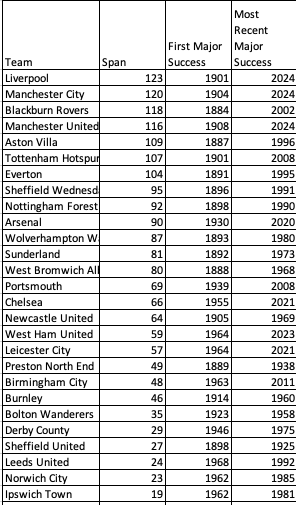
Congratulations Newcastle on defeating Liverpool in today’s League Cup final. The victory also means that 120 years separate their first major trophy success with their most recent. This span equals Manchester City. Every year, usually when the domestic season ends I update the table showing the span of success – i.e. the number of years between a club’s first major success (FA Cup, League, League Cup, major European trophy) and their most recent – for each major men’s trophy winning English club. I last did this after the 2023-24 season ended (see below). There wasn’t much difference between the 2023 final table and the 2024. Both Liverpool and Manchester City increased their span, as did United. Newcastle have leaped from 16th place (just behind Chelsea) to joint second with City. Here’s the table as it stood before today’s game:
As I always say, the span of success does not show how many trophies each club has won or how frequently that club has experienced great eras of success, but it does demonstrate how wrong those people are who believe certain clubs were unsuccessful until recent years, or those who think certain clubs have always been giants. The column on first major success helps to show when some clubs first became trophy-winning significant (often after transformational investment too!).
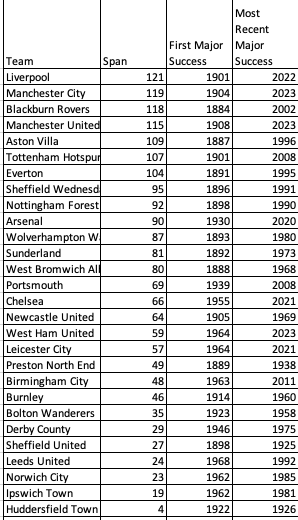
There’s not much difference between 2023 and 2024 – numbers have changed but not positions. In 2023 West Ham, like potentially Newcastle this year, proved that if you’re a club that hasn’t won a major trophy for a while putting your focus on achieving trophy success ahead of the odd Premier League position can bring significant reward. In future decades no one will remember who finished seventh, tenth or fifteenth but they will remember the trophies. Here’s the previous year’s table for comparison purposes:
I know clubs focus on their financials but winning a trophy has longevity, gaining the odd Premier League place provides a bit of extra cash now but no long term kudos. Winning a trophy attracts new fans and brings money-spinning opportunities too.
If I was a supporter of any of the major clubs who have not found significant success in recent decades then I would absolutely want my team to go for whichever cup competition seems the most likely to win. That’s what I always wanted from City before they were able to compete for the League again. Winning the FA Cup in 2011 helped everything that followed happen – it gave confidence and a trophy winning mentality.
While you’re here why not take a look at the wide range of articles available on this site? Such as the 100 day series of features on Maine Road:
If you enjoy all the free material on my website and would like to support my research and keep this website going (but don’t want to subscribe) then why not make a one-time donation (or buy me a coffee). All support for my research is valued and welcome. It allows me to keep some free material available for all. Thanks.
Here’s film of the FA Cup 6th round tie from this day (12 March) in 1955 when Manchester City defeated Birmingham City 1-0. Johnny Hart was the City scorer. Enjoy!
This series on Manchester City in the 1950s includes free items and items only available to subscribers. If you’d like to find out more on the 1954-55 season then subscribe and read the following 3,400 word article on it. It’s a season when City reached the FA Cup final and Don Revie was FWA Footballer of the Year.
This is a subscriber article and you can read it by subscribing below.
Subscribe to get access
Read more of this content when you subscribe today. It costs £3 per month or you can subscriber for the discounted annual rate of £20 per year. Each subscriber gets access to everything posted so far, including PDFs of a couple of my books.
On this day (27 February) in 2024 Erling Haaland scored five against Luton Town in the FA Cup. On a night when memories of Denis Law scoring six in the FA Cup against Luton (and then getting them all wiped from the records as the game was abandoned) it was a wonderful performance, coming in Manchester City’s 6-2 victory.
When asked about the goals afterwards City manager Pep Guardiola discussed both Haaland’s scoring and the influence of Kevin De Bruyne too: ‘Erling is on fire and Kevin… the connection was perfect… Kevin needs players like Erling and Erling needs players like Kevin. Erling needs a guy with the vision, the quality, the generosity. Kevin is the less selfish player in front of goal. Kevin needs the movement from Erling. We know how aggressive they are.’
By this time De Bruyne had made nine assists in his previous five FA Cup games for De Bruyne. Surprisingly, one more than he managed in his first 23 appearances for City in the competition but he’d been waiting for a player like Haaland to come along for some time. De Bruyne was making similar moves and passes but the end product had not been there consistently prior to Haaland’s arrival.
Talking of De Bruyne, Haaland commented: ‘Kevin De Bruyne is massive. He is doing what he is best at. It’s a pleasure playing with him. We know what we both want from each other. It clicks well. He is a smart player and I like to play with him.’
Haaland became the 3rd Manchester City player to score 5 in a men’s FA Cup (and it still stands) game. Earlier players who achieved this feat are Frank Roberts & Bobby Marshall. Here’s Roberts’ game (there’s film of that match in 1926 via the link):
For Haaland there were a few records/points to note:
He became the first player to score five or more in the FA Cup (1st round onwards) since Duane Darby scored 6 for Hull v Whitby in 1996-97.
He was the first to score five or more for a top-flight club in the FA Cup since George Best scored 6 for United v Northampton in 1970.
This was the second time Haaland has scored five goals in a game in his senior career, previously doing so for City against RB Leipzig in the Champions League in March 2023.
Since his debut for City in July 2022, Haaland had scored 79 goals in 83 games in all comps, 30 more than any other Premier League player in the that time (Salah 49) after that Luton game.
He became the first to score five against Luton for City since Denis Law in 1961 when Law scored 6 but all were wiped from the records as the game was abandoned. See:
Every year, once the domestic season ends I update the table showing the English clubs’ span of success – i.e. the number of years between a club’s first major success (FA Cup, League, League Cup, major European trophy) and their most recent. I last did this after the 2023-24 season ended (see below). There wasn’t much difference between the 2023 final table and the 2024. Both Liverpool and Manchester City increased their span, as did United. Next month there’s a chance Newcastle can leap from 16th place (just behind Chelsea) to joint second with City. Here’s the table as it stands at present:
As I always say, the span of success does not show how many trophies each club has won or how frequently that club has experienced great eras of success, but it does demonstrate how wrong those people are who believe certain clubs were unsuccessful until recent years, or those who think certain clubs have always been giants. The column on first major success helps to show when some clubs first became trophy-winning significant (often after transformational investment too!).
There’s not much difference between 2023 and 2024 – numbers have changed but not positions. In 2023 West Ham, like potentially Newcastle this year, proved that if you’re a club that hasn’t won a major trophy for a while putting your focus on achieving trophy success ahead of the odd Premier League position can bring significant reward. In future decades no one will remember who finished seventh, tenth or fifteenth but they will remember the trophies. Here’s the previous year’s table for comparison purposes:
I know clubs focus on their financials but winning a trophy has longevity, gaining the odd Premier League place provides a bit of extra cash now but no long term kudos. Winning a trophy attracts new fans and brings money-spinning opportunities too.
If I was a supporter of any of the major clubs who have not found significant success in recent decades then I would absolutely want my team to go for whichever cup competition seems the most likely to win. That’s what I always wanted from City before they were able to compete for the League again. Winning the FA Cup in 2011 helped everything that followed happen – it gave confidence and a trophy winning mentality.
While you’re here why not take a look at the wide range of articles available on this site? Such as the 100 day series of features on Maine Road:
If you enjoy all the free material on my website and would like to support my research and keep this website going (but don’t want to subscribe) then why not make a one-time donation (or buy me a coffee). All support for my research is valued and welcome. It allows me to keep some free material available for all. Thanks.
On this day (12 February) in 1966 Manchester City and Grimsby met in the FA Cup with City winning 2-0 before 37,918 at Maine Road. Mike Summerbee scored and the other was an own goal. Subscribers can read more on Manchester City during the 1965-66 season below. This was an important season in City’s development.
If you’d like to read this 4100 word article, plus all other articles on the site, then please subscribe (see below). As with most of the other features in this series it includes words from interviews I have performed with those who were there.
Subscribe to get access
Read more of this content when you subscribe today. It costs £3 per month (cancel anytime) or sign up for a year at the discounted price of £20 per year (works out £1.67 per month). Subscribers access the 1000+ articles posted so far and the others scheduled during the life of your subscription.
I think we all anticipated it’d be Manchester City v Plymouth Argyle after their victory. Here’s the draw in full:
Preston v Burnley Aston Villa v Cardiff City Doncaster or Crystal Palace v Millwall Manchester United v Fulham Newcastle United v Brighton Bournemouth v Wolves Manchester City v Plymouth Argyle Exeter or Nottingham Forest v Ipswich
Ties to be played between 28 Feb – 3 March.
City and Plymouth have met before in key cup games of course such as:
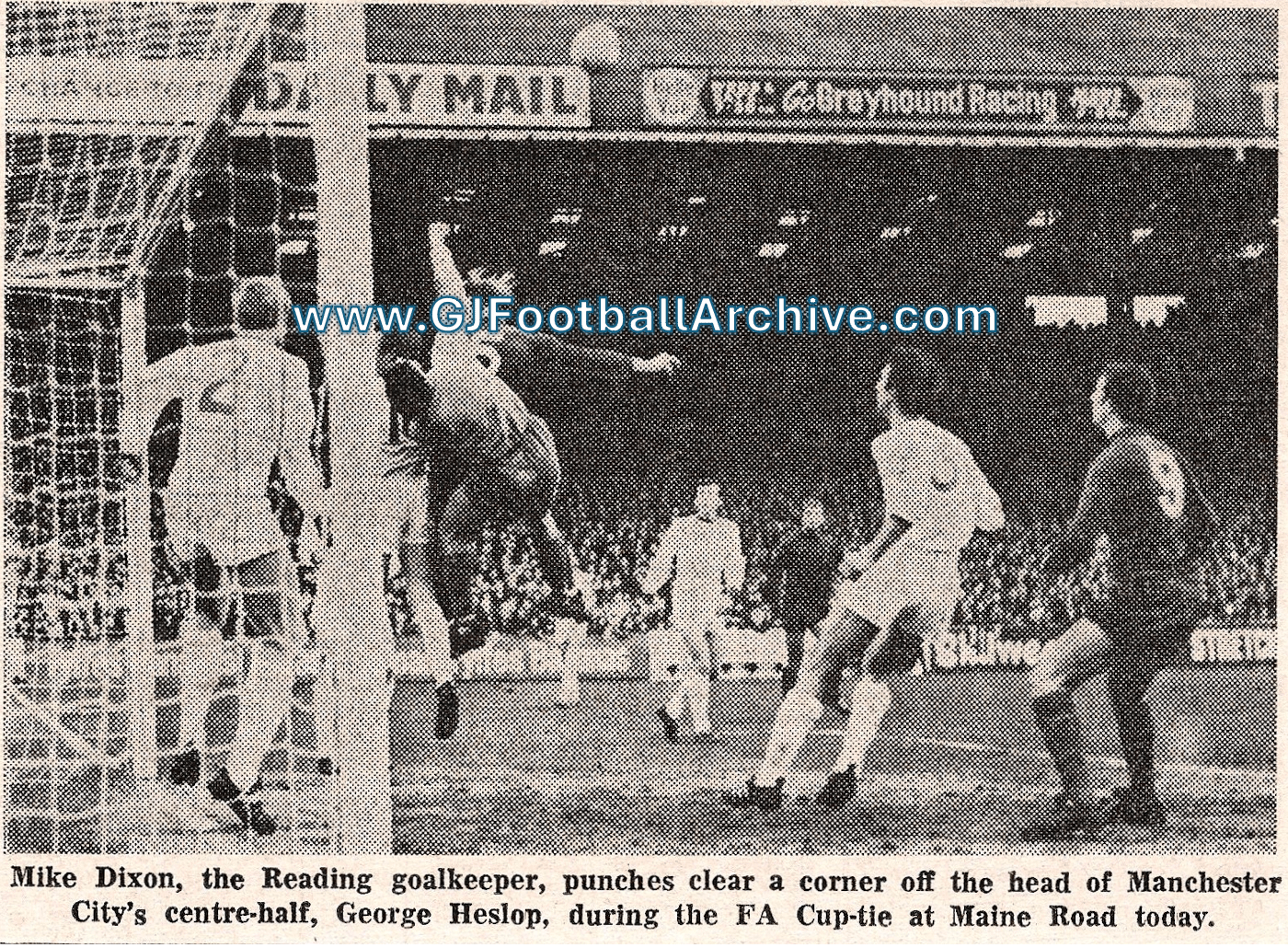
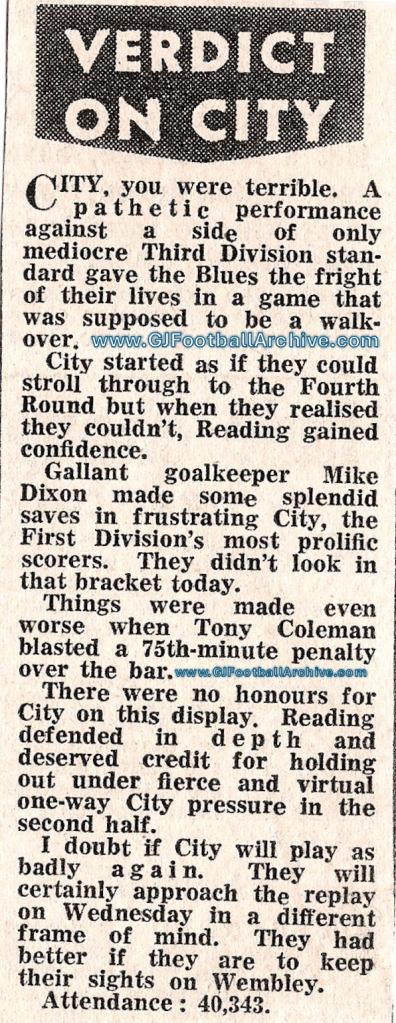
On this day (27 January) in 1968 40,343 watched as Manchester City and Reading played out a goalless draw in the FA Cup at Maine Road. City had missed a penalty too! The Manchester Evening News reporter Peter Gardner was not impressed with City (see below report). A nice reminder that even the greatest of teams can have off days!
Peter Gardner’s summary of MCFC V Reading, FAC January 1968
The tie went to a replay and you can find out what happened next in the following 7,600 word article (yes, 7,600 words on one season!) on the 1967-68 season. This is available to subscribers, who also have access to all other articles on the site. As with most of the other features in my series on the 1960s it includes words from interviews I have performed with those who were there.
Subscribe to get access
Read more of this content when you subscribe today. It costs £3 per month (cancel anytime) or sign up for a year at the discounted price of £20 per year (works out £1.67 per month). Subscribers access the 1000+ articles posted so far and the others scheduled during the life of your subscription.
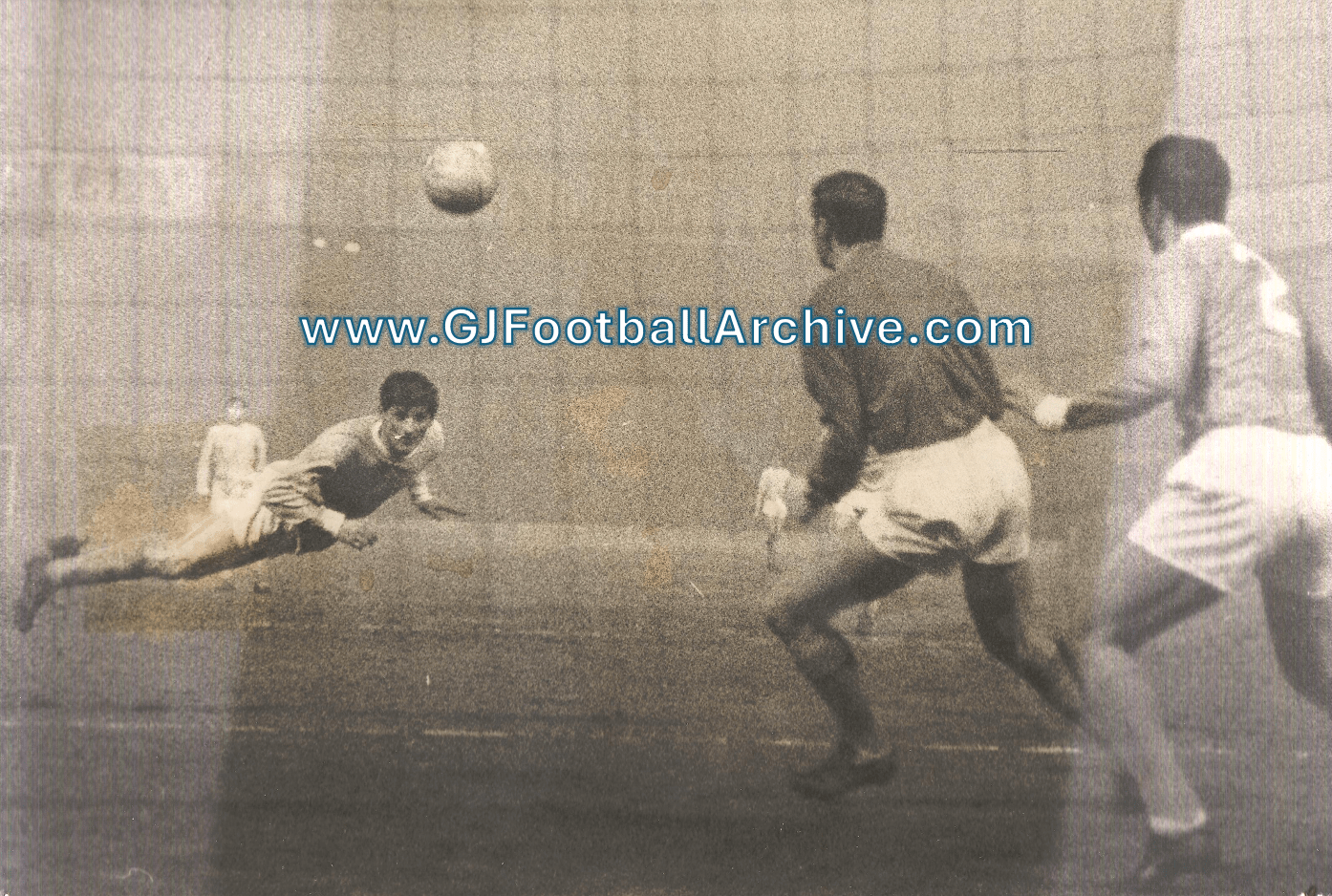
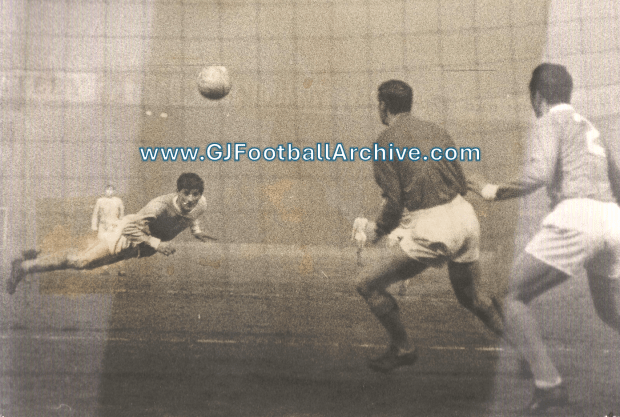
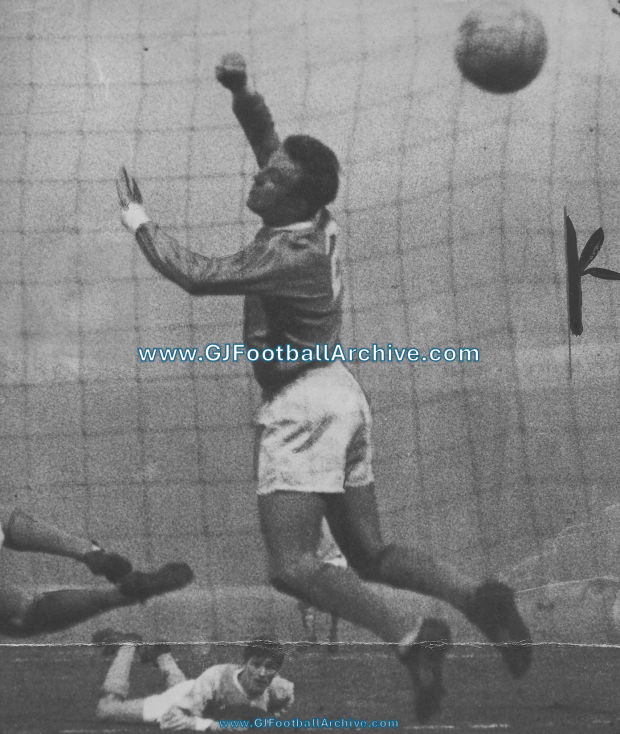
Here are a couple of interesting photos of Johnny Crossan’s goal in the game I mentioned earlier today (24 January 1966; City defeated Blackpool 3-1 in the FA Cup). The number 2 is Blackpool’s Jimmy Armfield who does remarkably well to get up so high during the time inbetween these two photos being taken, even though he’s not able to stop the goal. I’ve not yet found film of the game but Crossan’s goal looks somewhat impressive. Here are the two images in sequence:
First of two shots of Johnny Crossan Scoring v Blackpool 24/1/1966 Jimmy Armfield is Blackpool number two. Second of two shots of Johnny Crossan Scoring v Blackpool 24/1/1966 Jimmy Armfield is Blackpool number two.
1965-66 was an important season in MCFC history and you can read more on it in the following 4100 word article. This (plus all other articles on the site) is available to subscribers (see below). As with most of the other features in this series it includes words from interviews I have performed with those who were there.
Subscribe to get access
Read more of this content when you subscribe today. It costs £3 per month (cancel anytime) or sign up for a year at the discounted price of £20 per year (works out £1.67 per month). Subscribers access the 1000+ articles posted so far and the others scheduled during the life of your subscription.



 Gary James' Football Archive