Restored 2011: The All-Manchester FA Cup Semi Final

To commemorate the tenth anniversary of Manchester City’s FA Cup semi final victory over Manchester United at Wembley (April 16 2011) I’ve produced Restored 2011: The All-Manchester FA Cup Semi Final. This special 1 hour audio recording looks at the game and the years between the 1976 League Cup success and the FA Cup glory of 2011. The 2011 semi-final was a crucial step in City’s journey since the 2008 takeover and I felt it was vital to do a special marking this.

Following last night’s Champions League victory for City (May 4th – City beat PSG to reach the Champions League final) this will now be free to listen to until May 12th. After that date, as with audio recordings with John Bond, Malcolm Allison and George Graham (and hundreds of articles), it will only be available to subscribers to the site. So, if you don’t subscribe, have a listen now while you can.

So what’s in this special recording? Well, I’ve included exclusive material from interviews and recordings I’ve done over the years with Garry Cook, Brian Marwood, Roberto Mancini, Peter Barnes and Peter Swales.  Why Swales? Well, have a listen and you’ll hear why. Basically though I’m trying to set the tone for why the 2011 FA Cup semi final victory and overcoming Manchester United was so significant.

On Mancini… I include a few words from him recorded in 2011 and at one point he talks about the view that was then being expressed that City were ‘trying’ to buy success (now they say City ‘have’ bought success!). His words are a reminder that City have been having that particular criticism thrown at them for over a decade! Oh well, I wonder how long those criticisms were laid at other clubs who had seen major investment which propelled them forward?

Anyway, get yourself a brew and be prepared to be transported back in time. Here’s the recording:

If you enjoy the recording then please let me know, comment or subscribe to the site. If it’s of interest then, over the coming months and years, I’ll produce others like this highlighting key points in Manchester City – and Manchester’s – footballing history. It costs £20 a year to subscribe (it works out £1.67 a month) or £3 if you’d like to sign up a month at a time to get full access for as long as you subscribe (you can always try it for a month). It’s worth bearing in mind that the 2010 Manchester A Football History cost £24.95 and all subscribers will be able to access all of that for as long as they are a subscriber (plus all the other stuff of course). You can subscribe below.

Subscribe to get access to the full site

£20 per year to access everything

Match Stats for the 2011 FA Cup Semi-final

City 1-0 United (HT 0-0)

Yaya Toure 52

City: 25 Hart 04 Kompany (yellow card), 05 Zabaleta (yellow card), 13 Kolarov, 19 Lescott, 11 Johnson (Wright-Phillips 79), 18 Barry, 21 Silva (Vieira 86), 34 De Jong (yellow card), 42 Y Toure, 45 Balotelli (yellow card). Substitutes 12 Taylor, 38 Boyata, 07 Milner, 08 Wright-Phillips, 24 Vieira, 10 Dzeko, 27 Jo

United: 01 Van der Sar, 03 Evra, 05 Ferdinand, 15 Vidic, 22 O’Shea (Fabio Da Silva 84), 13 Park Ji-Sung, 16 Carrick, 17 Nani, 18 Scholes (red card), 25 Valencia (Hernandez 65), 09 Berbatov (Anderson 74). Substitutes 29 Kuszczak, 12 Smalling, 20 Fabio Da Silva, 08 Anderson, 28 Gibson, 07 Owen, 14 Hernandez

Referee: Dean

Attendance: 86,549

Manchester City Women: The First Game After Relaunch

On this day (April 13) in 2014 Manchester City’s women’s team played its first competitive game after the relaunch. It was a FA Cup tie against Reading played at the Regional Athletics Arena. 

Here for subscribers is a section of Manchester City Women: An Ora History discussing that opening game:

Subscribe to get access to this and entire site

Read this and have access to the rest of the site throughout your subscription. £20 per year (works out about £1.67 a week).

If you would like to buy Manchester City Women: An Oral History copies are available direct from me (I’ll sign them) via:

Old Trafford’s Record Crowd – Wolves v Grimsby

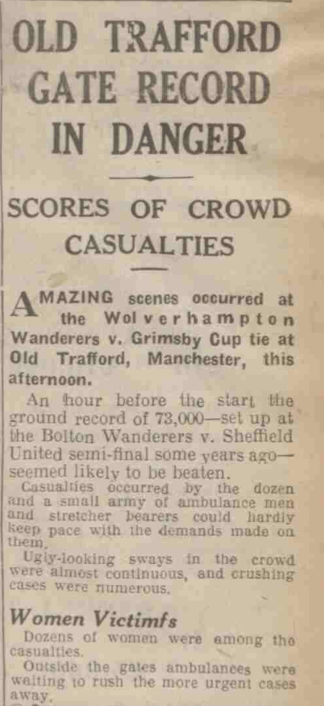
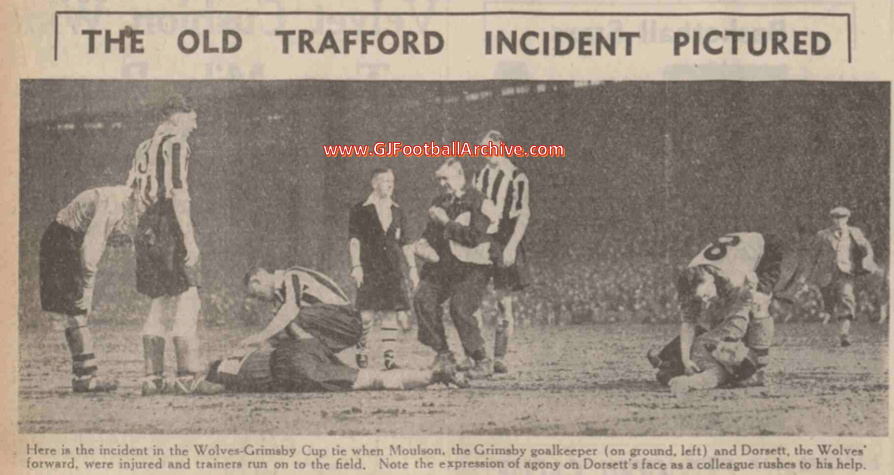
On this day (March 25) in 1939 Old Trafford attracted its highest ever attendance when 76,962 packed Manchester United’s ground to see Wolves defeat Grimsby 5-0 in the FA Cup semi-final.

At the time this was the third highest attendance ever attracted in Manchester (behind 84,569 MCFC v Stoke, 1934 & 79,491 MCFC v Arsenal, 1935; fourth highest was 76,166 MCFC v Cardiff, 1924) and today it is the eighth highest.

You can view film of the semi-final here. Well worth watching to see Old Trafford at that time. The Old Trafford scenes begin after about 48 seconds:

There were lots of crowd safety issues at this game – these were the days when fans were packed in without the authorities really considering the potential for disaster or injury (which happened frequently).

Incidentally, Dorsett (seen below after a collision) was related to two of Manchester City’s early heroes Joe and George Dorsett.

You can read about the 84,569 record attendance set in 1934 for Manchester here:

Subscribe to get access to all the site – Annual

I’d like to thank you for taking the time and trouble to visit my website. I set up this website in December 2020 to help share my 32 years plus writing and research. The intention is to develop the archive and to provide access to as much of my material as possible over the coming weeks, months & years. Annual subscribers can access everything on here including the entire Manchester A Football History book and audio interviews with former City bosses Malcolm Allison and John Bond.

It costs £20 a year (it works out £1.67 a month) or £3 if you’d like to sign up a month at a time to get full access for as long as you subscribe (see below). Thanks for the support, Gary.

Subscribe to get access on a monthly basis

It costs £3 if you’d like to sign up a month at a time to get full access to everything posted since 1 October 2022 and for as long as you subscribe (see below). Thanks for the support, Gary.

1956 Semi Final and Abuse for Trautmann

On this day (17th March) in 1956 a solitary goal from Bobby Johnstone was enough to see Manchester City beat Spurs in the FA Cup semi-final at Villa Park. The game led to considerable abuse for City’s German ‘keeper Bert Trautmann. To understand why read the story of the semi-final here (for subscribers):

Subscribe to get access

Read more of this content when you subscribe today.

Spurs, The Umbro Stand, Swales Out and That Pitch Invasion!

On this day (7th March) in 1993 Manchester City faced Tottenham in the FA Cup Quarter-Final at Maine Road. It was a day that saw the media express shock at the behaviour of City’s fans when they invaded the pitch during the tie with Spurs.  They condemned the supporters without understanding the background story.  To put the record straight it’s vital the day’s events are covered correctly.  Here for subscribers is the full story of that game, including quotes from Niall Quinn and Peter Swales (from my interviews with them in the years since that day…

Subscribe to get access

If you would like to read this and all the in-depth articles on this site (including the entire Manchester A Football History book and the audio interview with John Bond) then please subscribe. It works out about £1.67 a month if you take out an annual subscription (£20 per year) or £3 a month if you’d like to sign up for a month at a time. Each subscriber gets full access to the 260+ articles posted so far and the hundreds scheduled to be posted in the coming weeks.

A National Record – 84,569

“I think Brook played in every position for the Club – he certainly went in nets once – and was a very good player.  When the goal went in it was marvellous.  Nirvana.  On the final whistle I didn’t need to use my feet to leave I was wedged in a solid wall of human flesh and swept through the exit gate like a surfboarder.” Supporter Denis Houlston talking in 2003 about Eric Brook’s goal in the 1934 FA Cup tie with Stoke which was watched by 84,569.

It has virtually slipped out of living memory but in 1934 the largest footballing crowd ever assembled on a club ground witnessed a game that still, almost 90 years later, remains etched in the record books.  84,569 paid to watch City face Stoke in the FA Cup quarter-final at Maine Road in March 1934 – a crowd that surpassed Manchester’s previous best (also a national record at the time) by around 8,000 (set in 1924 when Cardiff faced City in another FA Cup quarter-final). Here for subscribers is a long read on the day when 84,569 gathered for a football match in Manchester:

Subscribe to get access

If you would like to read this and all the in-depth articles on this site (including the entire Manchester A Football History book and the audio interview with John Bond) then please subscribe. It works out about £1.67 a month if you take out an annual subscription (£20 per year) or £3 a month if you’d like to sign up for a month at a time. Each subscriber gets full access to the 260+ articles posted so far and the hundreds scheduled to be posted in the coming weeks.

The story of City’s game against Sheffield Wednesday (Hillsborough’s record crowd) can be read here:

https://gjfootballarchive.com/2021/02/17/hillsboroughs-record-crowd-swfc-v-mcfc/

City’s record League crowd can be read here:

https://gjfootballarchive.com/2021/02/23/manchester-citys-record-league-crowd/

Hyde v Preston – A Record Breaking Day

On 15th October 1887 one of the most remarkable FA Cup games of all time occurred at Preston and featured Hyde FC, who were formed in 1885 at a meeting attended by approximately forty men in the White Lion public house. For subscribers to this site here is the story of a remarkable day that saw Hyde, the town I spent the first 18 years of my life living in, enter the history books. 

Subscribe to get access

If you would like to read this piece and all the other in-depth articles (including the entire Manchester A Football History book) then please subscribe below. It works out about £1.67 a month if you take out an annual subscription (£20 per year) or £3 a month if you’d like to sign up for a month at a time. Each subscriber gets full access to the 240+ articles posted so far and the hundreds scheduled to be posted in the coming weeks.

Guest Blog – Noel Bayley: To Be Retained

For my first guest blog I’m delighted to say that a writer I’ve admired for years has agreed to contribute. Noel Bayley, the editor of the Manchester City fanzine Bert Trautmann’s Helmet, tells us about the role Covid has played in him sharing the stories of his match tickets. Noel writes…

High up on a shelf in the spare room there is a shoe box. To be honest it’s a trainers’ box but that doesn’t sound quite right. Although, if I’m being pedantic, it’s a blue and white adidas Samba trainers’ box (reduced to £42.49) that has been there for the 17 years I’ve lived in this house. It came with me from the last house so it’s probably more like 20 years old. Maybe older.

The trainers are long gone (lifespan six to 12 months in my hands… or on my feet since we’re being pedantic!) but the very thing that you’re supposed to throw away – the box – lives on. Inside are match tickets. I just throw them in there whenever I get one. But since I haven’t had one for a while (Aston Villa at Wembley on 1 March last year, since you asked) the box should have just sat there quietly doing nothing throughout lockdown.

But then I had an idea. Who hasn’t during lockdown? I’d get them all out, put them in order and, scan them. I’d had an idea to put them on my FaceBook page but as I had a City fanzine FB page, that was the obvious place to put them.  So I started doing that at the start of the season. It started off slowly and picked up momentum. Nostalgia’s big business on the internet… “Remember when…” And what might have been a meaningless game to you might have great meaning for someone else. Many of us measure out births, deaths and marriages in football matches; the ticket is the proof positive of the day when all the other details have melted away.

I’m not a ticket collector, you understand. Collectors eschew shoeboxes in favour of A4 folders with transparent pockets and dividers, all neatly arranged. Many years ago at Maine Road, a ticket collector turned up at ‘Fanzine Corner’ happy to show anyone who was even mildly interested his fantastic collection of tickets, going back years – as neat as a new pin. 

He was proudly showing someone a ticket from a pre-season friendly in Italy in 1992. “I’ve got that one too,” I told him, “only I went to the match.” That was an understatement. My mate and I had spent a week hitch-hiking to Italy only to find that this very match against Cremonese on a mountain top in the Dolomites had kicked off half an hour early. We got to see an hour of the game anyway! My mate died in the intervening years, but I still have some great memories and a tiny slip of a ticket to mark the highwater mark (literally!) of our great adventure almost three decades ago.

And that’s the thing about tickets and programmes and much of the – mainly paper – ephemera that people collect: it tells a story, and if it’s going to tell a story it might as well be your story! Not that I’m a ticket collector, you understand.  

There were several hundred tickets in the box. Easily enough for one every day of a nine/ten-month season, I thought naively. As I painstakingly scanned them I realised that there were some dates when I was spoilt for choice (Boxing Day, for example, and early January when the FA Cup Third Round kicks in) and some days when there were none at all. Not that City hadn’t played, but I’ve had a season ticket for 40 years and for many years all-ticket games were something of a rarity; pay on the gate, no questions asked. Now, of course, every game is all-ticket.  

I roped my mate Josh in for a few more – not that he’s a collector either; more of a curator – but there are still gaps. Even so, most days I can put a match ticket on FB with a story to go under it. Remember when indeed! Derby matches, important matches and games that had memorable incidents like last-gasp goals are the most popular ones I have found: Ian Brightwell’s Derby Day equaliser, York away, Blackpool away in the Cup in 1988…

The author Hunter Davies said: ““There is the serious collector, who goes out of their way and actively searches for items. Then there is the accumulator, a much more passive beast. He or she accumulates by never knowingly throwing things away.”

Davies is, without question, a serious collector. I’m more of an “accumulator.” I’m certainly not a ticket collector. No way, not me. They can be found on trains. 

Which reminds me: I’ll have to tell you about the model train collection I’ve accumulated over the years when I’ve got more time…

To see Noel’s, err um, collection (not that he’s a collector!) have a look at https://www.facebook.com/leonyelyab It’s updated every day and provides a great ephemeral record of a football goer’s life. Every ticket tells a story.

Watch this space for other guest blogs soon.

The Day Manchester City Chose To Wear Scarlet!

With City playing Everton this week (17th February 2021) here for subscribers is an in-depth piece on the time the Blues chose to wear scarlet in a crucial match with the Toffees.

Here is the story of the game:

Subscribe to get access

If you would like to read this in-depth article and all the others on this site (including the entire Manchester A Football History book) then please subscribe. It works out about £1.67 a month if you take out an annual subscription (£20 per year) or £3 a month if you’d like to sign up for a month at a time. Each subscriber gets full access to the 230+ articles posted so far and the hundreds scheduled to be posted in the coming weeks.

Johnny Bond, Johnny Bond, Johnny Bond

On September 25 2012 former City manager and West Ham FA Cup winner John Bond died at the age of 79. Bond followed Malcolm Allison as manager of the Blues in October 1980 and within his first seven months he turned a struggling side into one that reached the FA Cup final and the League Cup semi-final. I wrote an obituary to John in the days that followed.

Here, for the benefit of subscribers to my blog, is that obituary.

Subscribe to get access – Annual

If you would like to listen to read this and the other in-depth articles on this site (including the entire Manchester A Football History book) then please subscribe. It works out about £1.67 a month if you take out an annual subscription (£20 per year) or £3 a month (see below) if you’d like to sign up for a month at a time.

Subscribe to get access – Monthly

If you would like to listen to read this and the other in-depth articles on this site (including the entire Manchester A Football History book) then please subscribe. It costs £3 a month (cancel anytime) if you’d like to sign up for a month at a time or there’s the special price of £20 a year (see above).

I’ve also posted an audio interview I performed with John back in 1995. For details see: https://gjfootballarchive.com/2021/02/12/the-john-bond-interview/