It’s the men’s FA Cup final today. For those wanting to read content in preparation for the big game here are all the articles/features on my site that are tagged ‘Crystal Palace’ and all those tagged ‘FA Cup’. Enjoy:
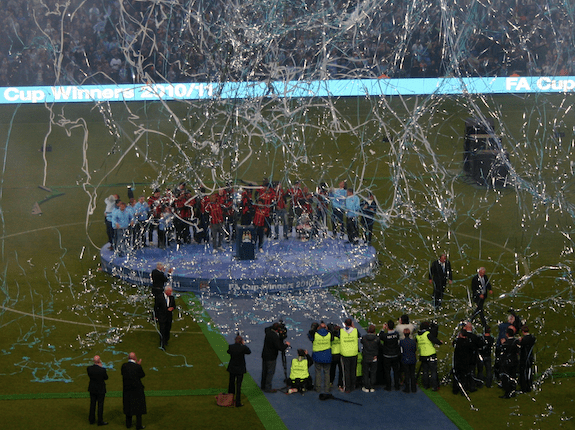
Looking forward to this weekend’s men’s FA Cup final. Back in 2011 Manchester City won their first FA Cup since 1969. The success became the first major trophy win of the current City ownership. To reach the final in 2011 City defeated Manchester United in that season’s FA Cup semi final. A few years back I produced Restored 2011: The All-Manchester FA Cup Semi Final and as we build up to this year’s FA Cup final it’s well worth reminding ourselves of this time when fans hoped for success. It’s a nice reminder of how significant the FA Cup has been to City’s modern success.
This special 1 hour audio recording looks at the years between City’s 1976 League Cup success and the FA Cup glory of 2011. 2011 was a crucial step in City’s journey since the 2008 takeover and I felt it was vital to do a special marking this.
So what’s in this special recording? Well, I’ve included exclusive material from interviews and recordings I’ve done over the years with Garry Cook, Brian Marwood, Roberto Mancini, Peter Barnes and Peter Swales. Why Swales? Well, have a listen and you’ll hear why. Basically though I’m trying to set the tone for why the 2011 FA Cup semi final victory and overcoming Manchester United was so significant.
On Mancini… I include a few words from him recorded in 2011 and at one point he talks about the view that was then being expressed that City were ‘trying’ to buy success (now they say City ‘have’ bought success!). His words are a reminder that City have been having that particular criticism thrown at them for over a decade! Oh well, I wonder how long those criticisms were laid at other clubs who had seen major investment which propelled them forward?
Anyway, get yourself a brew and be prepared to be transported back in time. Here’s the recording:
If you enjoy the recording then please let me know, comment or subscribe to the site. If it’s of interest then, over the coming months and years, I’ll produce others like this highlighting key points in Manchester City – and Manchester’s – footballing history. It costs £20 a year to subscribe (it works out £1.67 a month) or £3 if you’d like to sign up a month at a time to get full access for as long as you subscribe (you can always try it for a month). It’s worth bearing in mind that the 2010 Manchester A Football History cost £24.95 and all subscribers will be able to access all of that for as long as they are a subscriber (plus all the other stuff of course). You can subscribe below.
Here’s film of the FA Cup final from this day (7 May) in 1955 when Manchester City were defeated by Newcastle 3-1 at Wembley. Bobby Johnstone was the City scorer. Enjoy: https://www.britishpathe.com/asset/59534/
This series on Manchester City in the 1950s includes free items and items only available to subscribers. If you’d like to find out more on the 1954-55 season then subscribe and read the following 3,400 word article on it. It’s a season when City reached the FA Cup final and Don Revie was FWA Footballer of the Year.
This is a subscriber article and you can read it by subscribing below.
Subscribe to get access
Read more of this content when you subscribe today. It costs £3 per month or you can subscriber for the discounted annual rate of £20 per year. Each subscriber gets access to everything posted so far, including PDFs of a couple of my books.
On this day (May 1) in 1934 Manchester City, who had won the FA Cup for the second time in their history, took part in an incredible home coming parade. Over a million people were on the streets to welcome back the club. You can see film of that below:
That commentary is a bit cringeworthy but listen out for comment about a million people on the streets; the scenes certainly suggest there was too.
Deservedly Manchester took time out to celebrate and what seemed like the whole of Manchester lined the city’s streets. The authoritative Pathe News claimed there were over a million on the streets. The film company was not known for exaggeration and if that figure is accurate – and their footage suggests it is – then this remains the largest homecoming in Mancunian football history (It was claimed in 1999 that 700,000 people had welcomed Manchester United’s treble winning team through the streets).
Various speeches were made into a microphone set up on the Town Hall steps (the BBC were broadcasting this live on radio), and the players and officials were given a civic reception. Mancunians enjoyed the success and wanted more.
In Albert Square Mancunians sang their celebratory songs including “Who Said City Couldn’t Play” – the earliest known recording of a City specific song:
Who Said City Couldn’t Play,
City Couldn’t Play, City Couldn’t Play,
Who Said City Couldn’t Play,
City Couldn’t Play football?
You can hear a recording of the song and read more about it here:
The 1933-4 League programme still had two games left for the Blues. On 2nd May – the day after the parade – City suffered a 3-2 defeat at Liverpool, and then on 5th May City demolished Wolves 4-0 at Maine Road. Before the game City staff, assisted by a couple of police officers, carried the trophy around the ground on some kind of wooden board. The fans were delighted.
During a week of FA Cup celebrations an illuminated bus journeyed around the city covered in City’s colours. On the front above the bus number, ‘City 2 1’, was the Manchester coat of arms. On the side the message ‘Welcome to the victors’ proudly illuminated next to a picture of the FA Cup and a drawing of Sam Cowan.
You can see film of this illuminated ‘Victory Bus’, preserved by the North West Film Archive at Manchester Metropolitan University, here (the bus can be seen after 5 mins 38 seconds but other scenes connected with the homecoming can be viewed after about 3 minutes):
This has been a taster of the material on this site. Subscribers have access to over 500 articles and posts, with many more scheduled over the coming weeks. Posted already for subscribers are exclusive audio interviews I have performed with Malcolm Allison, John Bond and George Graham (more to follow); the entire Manchester A Football History book (now out of print) and various other long read articles. It costs £20 a year (that’s about £1.67 a month) or £3 per month if you want to sign up a month at a time. Whichever subscription is taken out subscribers get full access to everything posted for as long as they are subscribers. You can subscriber here:
With City and Palace now scheduled to meet in the FA Cup final it’s worth remembering that on 20 February 1926 City recorded an amazing victory over Palace in the competition. It was a fifth round FA Cup tie with Crystal Palace at Maine Road. The Blues, without a manager since November, were being managed by committee with director Albert Alexander senior making the final decisions. It’s an incredible thought that a director without ever being known as a player, could make these decisions but Alexander was a knowledgeable football man and had been with the club since formation in 1894.
By half-time the score was 7-0 to the Blues, but Palace would not give up and quickly pulled back four goals. City were knocked out of their period of complacency and soon found their goalscoring touch again. By the end it was 11-4 and, according to a number of spectators present on the day, Manchester fans rushed on at the final whistle and carried off the Palace ‘keeper shoulder high. Apparently he had played extremely well and, somehow, managed to keep the score down, although one cannot help wondering if he’d have been given such a reception had the scores been reversed.
Frank Roberts was the City star for this particular game, scoring a remarkable five, while Tommy Browell also earned a few plaudits with his hat-trick. The other scorers were: Billy Austin, George Hicks and Tommy Johnson.
With no management and such a miserable time in the League, no one could believe how City had been able to deliver such strong cup performances. Here’s film of the game:
Tomorrow brings the 2025 FA Cup semi final between Manchester City and Nottingham Forest at Wembley – I’m always pleased that my team has reached Wembley but I do wish FA Cup semi finals were played at neutral League grounds instead! For many fans the timing and cost of a Wembley semi final are simply too much. Sadly, I don’t think they’ll ever change that now. Reaching the semi does give opportunity to remember past Wembley trips. A few years back I made this special audio recording talking about the years building up to the 2011 FA Cup semi and the day itself from a Manchester City perspective. Many of you have listened to this already but if you haven’t then it tells the story of the 2011 FA Cup semi final and the years between 1976 and that moment in 2011 for City.
I included audio from interviews I did with a variety of people including Khaldoon, Peter Swales, Garry Cook, Brain Marwood and many others.
If you have heard it before then maybe you should listen again to remind yourself of how we all felt and why that game was so significant.
I included a few words from Roberto Mancini recorded in 2011 and at one point he talks about the view that was then being expressed that City were ‘trying’ to buy success (now they say City ‘have’ bought success!). His words are a reminder that City have been having that particular criticism thrown at them for well over a decade! Oh well, I wonder how long those criticisms were laid at other clubs who had seen major investment which propelled them forward?
Anyway, get yourself a brew and be prepared to be transported back in time. Here’s the recording:
If you enjoy the recording then please let me know, comment or subscribe to the site. If you don’t fancy doing that then there’s also the option to make a welcome donation to keep this site going (see below). I’ve produced videos/talks like this highlighting key points in Manchester City’s footballing history which subscribers can watch too.
If you enjoy all the free material on my website and would like to support my research and keep this website going (but don’t want to subscribe) then why not make a one-time donation (or buy me a coffee). All support for my research is valued and welcome. It allows me to keep some free material available for all. Thanks.
Read more of this content when you subscribe today. It costs £20 a year to subscribe (it works out £1.67 a month) or £3 if you’d like to sign up a month at a time. Annual subscribers get full access for as long as you subscribe (you can always try it for a month). It’s worth bearing in mind that the 2010 Manchester A Football History cost £24.95 and all subscribers will be able to access all of that for as long as they are a subscriber (plus all the other stuff of course).
It costs £3 a month to subscribe a month at a time. Why not give it a try! Monthly subscribers get access to everything posted since 1 October 2022 for as long as you subscribe.
On this day (20 April) in 1946 Manchester City defeated the Football League North league leaders Sheffield United 3-2 at Bramall Lane. The City scorers were Lew Woodroffe, Jimmy Constantine and George Smith. The image shows the results from that day.
A crowd recorded as 40,000 watched this match. Although this game was played in peacetime the regional war leagues were still being played, with the Football League returning the following season.
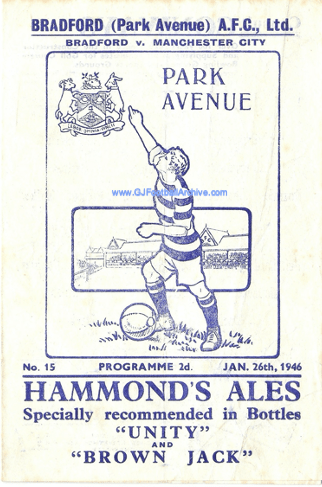
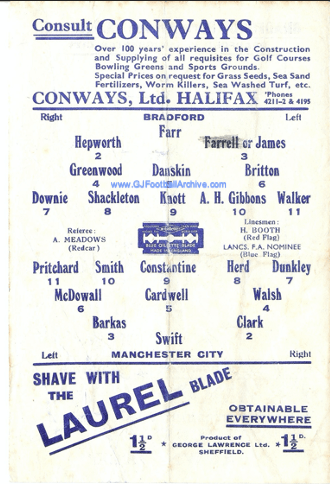
There was FA Cup action though and you can read about that in the following feature on the 1945-46 season.
This is a subscriber article and you can read it by subscribing below.
Subscribe to get access
Read more of this content when you subscribe today. It costs £3 per month or you can subscriber for the discounted annual rate of £20 per year. Each subscriber gets access to everything posted so far, including PDFs of a couple of my books.
The new series on Manchester City in the 1940s continues with this feature on the 1945-46 season. This feature includes comments from George Smith (photographed against United a few years later), who I interviewed in 2003.
This is a subscriber article and you can read it by subscribing below.
Subscribe to get access
Read more of this content when you subscribe today. It costs £3 per month or you can subscriber for the discounted annual rate of £20 per year. Each subscriber gets access to everything posted so far, including PDFs of a couple of my books.
Here’s film of the FA Cup semi final from this day (26 March) in 1955 when Manchester City defeated Sunderland 1-0 at Villa Park. Roy Clarke was the City scorer. Enjoy: https://www.britishpathe.com/asset/59403/
This series on Manchester City in the 1950s includes free items and items only available to subscribers. If you’d like to find out more on the 1954-55 season then subscribe and read the following 3,400 word article on it. It’s a season when City reached the FA Cup final and Don Revie was FWA Footballer of the Year.
This is a subscriber article and you can read it by subscribing below.
Subscribe to get access
Read more of this content when you subscribe today. It costs £3 per month or you can subscriber for the discounted annual rate of £20 per year. Each subscriber gets access to everything posted so far, including PDFs of a couple of my books.
Congratulations Newcastle on defeating Liverpool in today’s League Cup final. The victory also means that 120 years separate their first major trophy success with their most recent. This span equals Manchester City. Every year, usually when the domestic season ends I update the table showing the span of success – i.e. the number of years between a club’s first major success (FA Cup, League, League Cup, major European trophy) and their most recent – for each major men’s trophy winning English club. I last did this after the 2023-24 season ended (see below). There wasn’t much difference between the 2023 final table and the 2024. Both Liverpool and Manchester City increased their span, as did United. Newcastle have leaped from 16th place (just behind Chelsea) to joint second with City. Here’s the table as it stood before today’s game:
As I always say, the span of success does not show how many trophies each club has won or how frequently that club has experienced great eras of success, but it does demonstrate how wrong those people are who believe certain clubs were unsuccessful until recent years, or those who think certain clubs have always been giants. The column on first major success helps to show when some clubs first became trophy-winning significant (often after transformational investment too!).
There’s not much difference between 2023 and 2024 – numbers have changed but not positions. In 2023 West Ham, like potentially Newcastle this year, proved that if you’re a club that hasn’t won a major trophy for a while putting your focus on achieving trophy success ahead of the odd Premier League position can bring significant reward. In future decades no one will remember who finished seventh, tenth or fifteenth but they will remember the trophies. Here’s the previous year’s table for comparison purposes:
I know clubs focus on their financials but winning a trophy has longevity, gaining the odd Premier League place provides a bit of extra cash now but no long term kudos. Winning a trophy attracts new fans and brings money-spinning opportunities too.
If I was a supporter of any of the major clubs who have not found significant success in recent decades then I would absolutely want my team to go for whichever cup competition seems the most likely to win. That’s what I always wanted from City before they were able to compete for the League again. Winning the FA Cup in 2011 helped everything that followed happen – it gave confidence and a trophy winning mentality.
While you’re here why not take a look at the wide range of articles available on this site? Such as the 100 day series of features on Maine Road:
If you enjoy all the free material on my website and would like to support my research and keep this website going (but don’t want to subscribe) then why not make a one-time donation (or buy me a coffee). All support for my research is valued and welcome. It allows me to keep some free material available for all. Thanks.