The First Manchester Cup Final

2025 marks the 140th anniversary of the first final of the Manchester Cup (later known as the Manchester Senior cup). The Manchester Cup was the first competition either Manchester United (as Newton Heath) or Manchester City (as Ardwick) won and was a hugely significant competition at the time of their first victories. In many ways it was more important locally than the FA Cup. The final was held on 25 April 1885 and you can read a match report of the game here and then my own words on the final:

The first season of the Manchester Cup proved to be very exciting with games involving Hurst and Newton Heath grabbing much attention in the local newspapers.  In fact the two sides competed in the first Manchester Cup final.  This was played at Manchester FC’s Whalley Range ground and had an attendance of approximately 3,500.  The Ashton club won 3-0 and at the end of the match all the Hurst players were lifted shoulder high by their fans and there was tremendous excitement on the pitch.  It was perhaps the first time a Manchester side had experienced success that actually meant something.  Hurst could rightly claim to be the best in the area, and after the game finished the President of the Manchester FA, Mr. Colbert, presented the cup to J. Ingham, Hurst’s Captain.  The Reporter newspaper then described the fantastic parade that took place all the way back to Ashton:  ‘All the way from Whalley Range the victors kept cheering and the band playing, the cup being held up in front of one of the carriages in which the journey to Ashton was made.  On arriving in town their cheers were redoubled and they received a great ovation in the streets.

‘The victors crowded into the Pitt & Nelson, and Mr. Joseph Fletcher, holding in his hand the cup which was filled with liquor, and addressing the captain of the club, said he had great pleasure in presenting to Mr. Ingham the cup on behalf of the Hurst Cricket & football Club.’

Joseph Fetcher was the landlord of the Pitt & Nelson and according to the Reporter he made a speech saying that he: ‘had lately been in Blackburn and he could assure them that the fame of the Hurst club was well known in that district and he was certain that the next season they would be called upon to play with teams from that district, the Mother of the Game.’

This was undoubtedly the finest moment for any of the Manchester clubs at this stage in history, and Hurst were worthy recipients of the praise.  Hurst had done more than most to encourage the game to develop and, as well as entering the FA Cup, they also tried to arrange fixtures with teams beyond the Manchester boundaries.  In March 1885 they had welcomed Welsh side Rhyl to Hurst and the Ashton side won 8-1 before 3,000 fans, then on Good Friday they played their return match and, according to reports from the period over 750 fans travelled from Ashton for the game which Hurst won 4-0.  Considering the nature of travel, working conditions, and the state of the game at the time this was a major achievement.

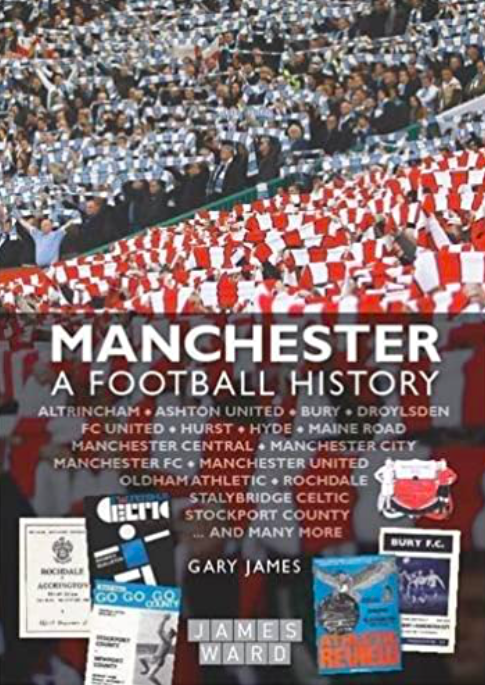
You can find out more about the origins of football in Manchester in my book Manchester A Football History. The book is long out of print but PDFs of the entire 2010 edition is available to subscribers to this site.

This is the Introduction for the 2010 edition of the book Manchester A Football History (Gary James, published by James Ward). As with everything else on this site copyright laws apply. The book is published here for the personal use of subscribers to this site. For any other use please email the publishers at info@manchesterfootball.org

Subscribe to get access

Read more of this content when you subscribe today. You can subscribe for £20 a year (works out about £1.67 per month) or £3 per month (cancel any time). Why not try it for a month?

Barney Daniels

I’ve heard the sad news that the former Manchester City and Stockport County player Barney Daniels has died. He also played for Manchester United (though not in the first team), Chester City, Ashton United and Hyde United.

He joined City on 30 March 1973 and made his first team debut against Derby County on 6 Feb 1974 (report below). In total he played 3 games in 1973-74 (debut v Derby 1-0 win; 9/2/74 at Chelsea & came on as sub at Liverpool on 16/4/74).

Screenshot

The following season (1974-75) he made ten appearances and the first of those was against Leicester on 23/11/74 when he scored 2 goals and made the headlines as he helped City go to the top of the top flight (see following report):

Daniels moved to Chester City on 9 July 1975 (Chester’s record signing at the time) and went on to join Stockport County (July 1976), Ashton United (1978-82), Hyde United 1982 and back to Ashton United (1982-84).

At City he was a consistent performer for the reserves.


John Maddocks (City’s former statistician/historian in the 80s/90s) gave these notes he’d written on Barney in the late 1990s which are worth posting here: ‘Most enjoyable it was watching Barney Daniels in action in the Reserves in the 1970’s. He scored an average of almost a goal a game in 1973-74 including several hat-tricks and he deserved his first team chance when it came. He had had trials with Blackpool, scoring three goals in four reserve games, but was not taken on, and in his first season with Ashton United he scored 27 goals. City bought him for £1,000 and also played a friendly at Ashton.

‘Barney was top reserve team marksman in consecutive seasons from 1973-75, scoring 44 times.’

John’s stats showed that Barney made the following City appearances:

FL:9+4 apps. 2 gls.

TOTAL:9+4 apps. 2 gls.         

Res:61+1 apps. 44 gls.

Other:10+2 apps. 12 gls.

Manchester A Football History part 30

This is the twenty-ninth chapter of the 2010 edition of the book Manchester A Football History (Gary James, published by James Ward). As with everything else on this site copyright laws apply. The book is published here for the personal use of subscribers to this site. For any other use please email the publishers at info@manchesterfootball.org

Subscribe to get access

Read more of this content when you subscribe today.

Manchester A Football History part 23

This is the twenty-second chapter of the 2010 edition of the book Manchester A Football History (Gary James, published by James Ward). As with everything else on this site copyright laws apply. The book is published here for the personal use of subscribers to this site. For any other use please email the publishers at info@manchesterfootball.org

Subscribe to get access

Read more of this content when you subscribe today.

Manchester A Football History part 22

This is the twenty-first chapter of the 2010 edition of the book Manchester A Football History (Gary James, published by James Ward). As with everything else on this site copyright laws apply. The book is published here for the personal use of subscribers to this site. For any other use please email the publishers at info@manchesterfootball.org

Subscribe to get access

Read more of this content when you subscribe today.

Manchester A Football History part one

This is the Introduction for the 2010 edition of the book Manchester A Football History (Gary James, published by James Ward). As with everything else on this site copyright laws apply. The book is published here for the personal use of subscribers to this site. For any other use please email the publishers at info@manchesterfootball.org

Subscribe to get access

Read more of this content when you subscribe today. You can subscribe for £20 a year (works out about £1.67 per month) here.

Subscribe to get access

Read more of this content when you subscribe today. You can subscribe for £3 per month here, paying a month at a time. Cancel any time.

Manchester’s Footballing Pioneers, 1863–1904: A Collective Biography

ABSTRACT: Association football had become a prominent part of Manchester’s sporting landscape by 1904 when Manchester achieved its first national success. Its journey had been difficult, relying on the efforts of several key individuals whose relentless determination to widen the sport’s participation ensured the game succeeded. This paper provides an analysis of three pioneering figures, John Nall, Fitzroy Norris, and Joshua Parlby, who took the game from its formalized inception in the region through to its first national successes, considering their class, experience, shared history, and connections, while analyzing what these narratives add to the wider origins of football debate. The author concludes that football’s emergence depended primarily on the activities of key individuals from varying backgrounds who provided the energy, enthusiasm, and organizational structures necessary, while relying on cross-class connections, to establish the game within a region.

If you would like to read the full article and other pieces like this then please subscribe below. It works out about £1.67 a month if you take out an annual subscription (£20 per year) or £3 a month if you’d like to sign up for a month at a time. Each subscriber gets full access to the 100+ articles posted so far and the hundreds scheduled to be posted in the coming weeks.

Subscribe to get access

Read this article when you subscribe today.