On this day (April 29) in 1933 Manchester City and Everton became the first teams to wear numbered shirts in the FA Cup final. To mark this occasion here is an article on the history of numbered shirts…
This 1700 word article is available to subscribers to my website.
Subscribe to get access
Read more of this content when you subscribe today. It costs £20 a year of £3 per month and you then can access everything on the site. Have a search around and see the volume of content on here or try for a month.
Manchester City had reached their second consecutive FA Cup final in 1934. They were to face Portsmouth at Wembley on April 28 1934.
Here for subscribers is a long read on City’s preparations for the final and the game itself:
Subscribe to get access
Subscribers can read this and all 300+ articles & interviews (including audio interviews with Malcolm Allison, George Graham & John Bond). It costs £20 a year (works out £1.67 a month) or £3 a month. Sign up for a month and see what you think. Thanks
On this day (April 27) 1974 Denis law played his last League game on a day that saw Manchester United relegated. Law was in his second spell at Manchester City and, over the years, many myths have developed about his final game and the weeks that followed.
United fans like to say that this game had no bearing on relegation (though pre match United were not relegated and still had a chance of survival) while City fans like to boast that Law’s goal relegated United (mathematically it did not). Many in the media claim Law’s goal was his last in first team football (it wasn’t) and that he retired immediately afterwards (he didn’t). There are other myths about the pitch invasions (there were two not one) and the actions of the ref, so here for the benefit of subscribers is the true story of that day, including quotes from interviews I have performed over the years. Those quoted are Dennis Tueart, Tommy Docherty, Denis law and Willie Donachie.
So get yourself a brew and enjoy this long read on that infamous day:
Subscribe to get access
Read more of this content and access everything else on this site when you subscribe today. £20 per year (£1.67 a month) or £3 a month at a time.
The experience of attending a football match isn’t just about seeing great football (but I love those of us who support Manchester City have been blessed with that over the last few years of course!), it’s about what happens in the stands and around the stadium. Fan culture has been something that has mattered to me for decades and I love the atmosphere and mood around watching City.
City fans have had a great reputation for their humour and their ability to add something different to the match day experience. From the 1890s when fans would bring musical instruments and wear fancy dress to City games at the Blues’ Hyde Road ground, through to the 1980s banana craze and on to recent years, attending City games has always been more than simply watching a match.
So for today’s subscriber piece I want to talk about something that swept the club in 2010-11 that has this season been making steps towards returning en masse at the stadium. That is The Poznan!
The following 1,700 word article is available to all subscribers to this site (see below). If you don’t subscriber then why not join up? It costs £20 a year (that works out about £1.67 a month) and for that you get access to every article on here, plus some audio interviews and PDFs of the entire Manchester A Football History and From Maine Men To Banana Citizens books. You’ll also get everything else added during your period of subscription. You can also give it a try by subscribing at £3 per month (cancel any time) if you’d prefer. Whichever subscription is taken out you then access everything. Thanks.
Subscribe to get access
Read this article and the rest of the content when you subscribe today.
On April 26 1969 Manchester City defeated Leicester City in the FA Cup final. It is worth pausing to consider how the Blues compared to football’s other successful sides in the competition at this point. City’s four FA Cup successes placed them behind Aston Villa (7), Blackburn Rovers (6), Newcastle United (6), Tottenham Hotspur (5), The Wanderers (5) and West Bromwich Albion (5). Bolton, Sheffield United and Wolves had, like City, each won four FA Cups, while Manchester United had only won three, Liverpool one and Chelsea had not yet won the trophy. In fact Chelsea had only won one major trophy (the League Championship) at this point in their history.
Here for subscribers is a long read on that final and the events surrounding it:
Subscribe to get access
Read more of this content when you subscribe today.
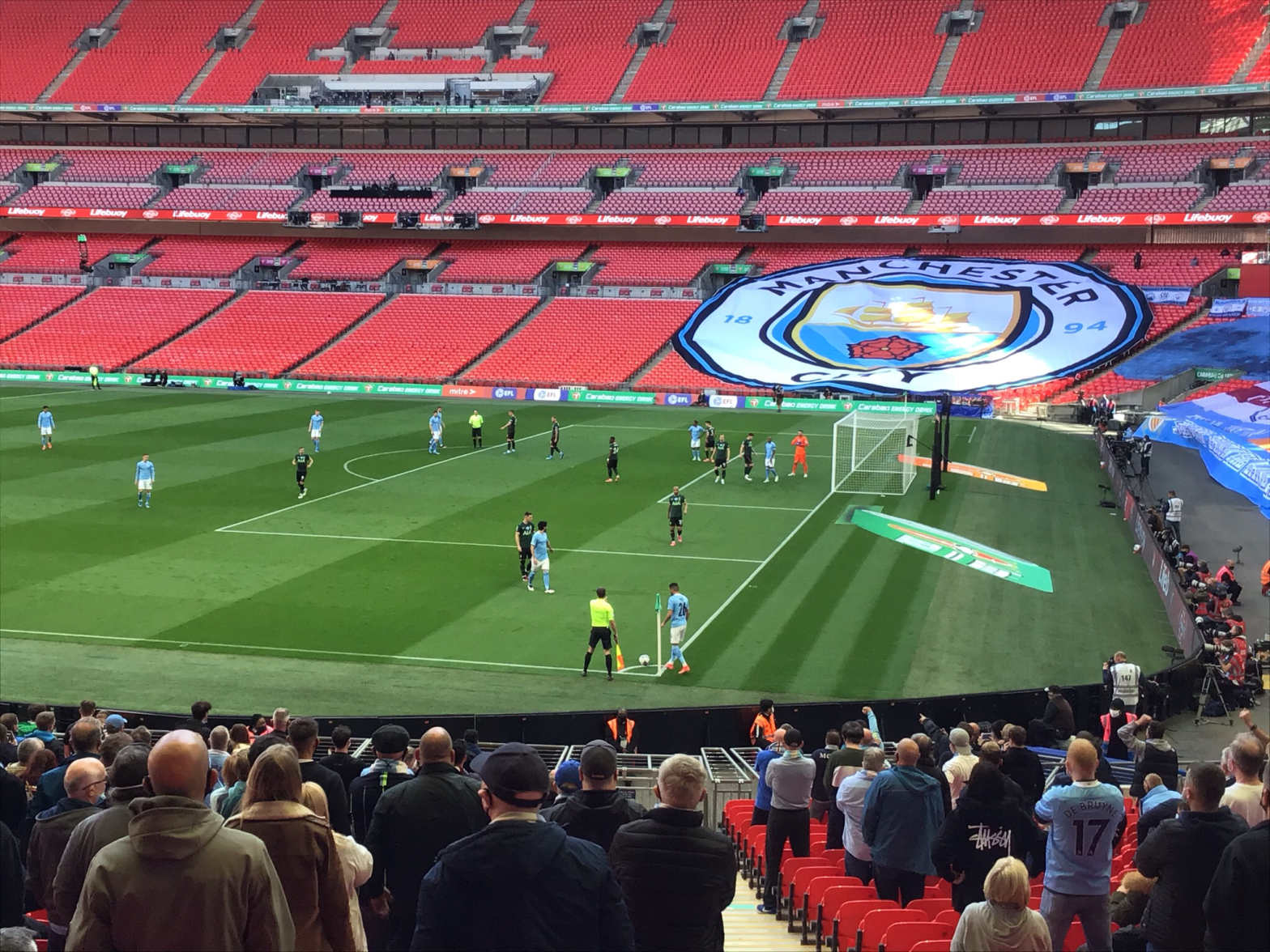
On this day (25 April) in 2021 Manchester City defeated Tottenham Hotspur 1-0 thanks to a Laporte goal in the League Cup final at Wembley. The game was played in front of a Covid restricted crowd of 7,773.
On this day in 1904 (23 April) Manchester found its first major trophy success. The captain and goalscorer was the great Billy Meredith. Last year, following the purchase of the oldest surviving FA Cup by Sheikh Mansour (to loan to the National Football Museum) I helped Manchester City with the story of the cup and its significance to Manchester. They’ve produced a video telling the story and it can be viewed here:
Did you play football for a women’s team in the Trafford area or are you a female footballer from Trafford? If so, I’m keen to interview you for a new Heritage Lottery Funded project seeking to capture the stories of women footballers who came from the Trafford borough. Already I’ve heard from players connected with Manchester United’s original women’s team; FC Redstar; Trafford Ladies, Manchester Corinthians and more BUT I’m keen to capture as many stories as possible over the coming weeks. The project is part of a wider project connected with the Women’s Euros to be staged this summer (See below for details).
There are some excellent people in Trafford involved with the project and in the wider national project too. I’m delighted to be working with them. The interviews from this last week or so the first interviews with former footballers connected with Trafford occurred and the stories they have told will help the project enormously. We need more though and, not only that, but fans can contribute too.
Maybe you can help the project? We’re keen to capture your stories and memories. The details are:
In preparation for the Women’s Euros which will open at Old Trafford at the start of July Trafford Local Studies are keen to interview women who have played football. We are particularly keen on hearing the stories of women footballers from the borough or from women who played for teams within Trafford.
For those uncertain the Trafford borough covers a number of towns and areas including Altrincham, Bowden, Flixton, Irlam, Old Trafford, Sale, Stretford, Timperley, Trafford Park and Urmston. If you are a woman from the area and played football then please get in touch. Also, if you played either for or against a team from the Trafford area then we also want to hear your memories of that game.
The Trafford area has incredibly strong links to the history of women’s football. In 1921 a game between Dick, Kerr Ladies and Bath Ladies at Old Trafford was watched by over 30,000 and over the following century significant games were staged at White City, Stretford, Timperley and other venues in our borough.
Over the last fifty years or so many prominent local teams have developed and played in the area such as Sale Hotel, Trafford, Redstar, Urmston and many others, while women from Trafford have played for prominent teams outside of the borough.
We are keen to hear the memories of women who have contributed to this rich history of women’s football in the area. If you are from Trafford or played for a team based in our borough then please get in touch. Your memories will help to develop our archive and ensure future generations are aware of the experiences of women footballers.
In addition, we are keen to locate objects, match programmes and memorabilia associated with women’s football, so if you have an item that you feel may help please get in touch. If you’ve got objects/images/programmes but don’t want to be interviewed please get in touch anyway – your collection will help us develop a wider understanding of women’s football in the area and the aim is to record as much about our teams as possible over the next few weeks.
If you would like to help then please email me via gary@GJFootballArchive.com
This project is part of a National Lottery Heritage funded progamme which seeks to bring this history into the light through a number of physical and virtual exhibitions, and to create a documentary record of the game at this moment, through oral history interviews with local players and fans and a contemporary collecting programme.
Malcolm Allison gave Manchester City confidence and a will to win that few have ever equalled. He was an exceptionally brilliant and confident coach – some would say the greatest the world has ever seen (probably Allison himself would say this!) – and working with Joe Mercer he helped the Blues achieve incredible success.
Subscribe to get access
Read more of this content when you subscribe today.
As League champions, the Blues were expected to coast through the 1968-9 season, particularly as the Charity Shield match against Cup winners West Bromwich Albion ended in a comfortable 6-1 City victory. Unfortunately life is rarely that easy and only one of the first nine games ended in victory – a 3-2 win over Wolves. The Blues simply could not get into the rhythm they had enjoyed the previous season. One of the reasons for this was that they had embarked on a rather disastrous tour of America during the summer which, amongst other problems resulted in an injury to captain Tony Book He was kept out of action until January.
Subscribe to get access
Read more of this content when you subscribe today.



 Gary James' Football Archive