The 1970s: FA Cup win at WBA

On this day (11 January) in 1977 Manchester City defeated West Bromwich Albion 1-0 in a FA Cup 3rd round replay. The original game had ended 1-1 with Kidd scoring for City at Maine Road. The goalscorer in the replay was Joe Royle. It’s well worth reading this report which highlights there was a bit of a conflict in the game too! Enjoy!

Dave Watson, Joe Royle and Albion’s John Wile

If you enjoy all the free material on my website and would like to support my research and keep this website going (but don’t want to subscribe) then why not make a one-time donation (or buy me a coffee). All support for my research is valued and welcome. It allows me to keep some free material available for all. Thanks.

Choose an amount

£2.50
£5.00
£7.50

Or enter a custom amount

£

Your contribution is appreciated.

Donate

The 1980s: 1985-1986 Trophy Success

A new daily series of articles for subscribers started last week covering the 1980s. This is a seasonal journey through a truly important decade in the history of Manchester City Football Club. Today’s article is a 2,500 word feature on the 1985-86 season. Enjoy!

Subscribe to get access – Monthly

Read more of this content when you subscribe today. It costs £3 per month (cancel anytime) to access everything posted since 1 October 2022 or there’s a special annual rate below which gives greater access and works out much cheaper.

Subscribe to get access – Annual

Read more of this content when you subscribe today. It costs £3 per month (above) or £20 a year (here) to access everything posted since the site was created in December 2020. This special rate works out about £1.67 a week and gives access to everything posted, including PDFs of 3 of my books.

If you’d like to know more about subscribing then see:

Tomorrow’s feature is on the 1986-87 season. If you missed the earlier features then start here:

The 1980s: 1980-1981 Gow, Hutchison & McDonald

The 1980s: 1984-1985 Promotion

A new daily series of articles for subscribers started last week covering the 1980s. This is a seasonal journey through a truly important decade in the history of Manchester City Football Club. Today’s article is a 2,600 word feature on the 1984-85 season. Enjoy!

Subscribe to get access – Monthly

Read more of this content when you subscribe today. It costs £3 per month (cancel anytime) to access everything posted since 1 October 2022 or there’s a special annual rate below which gives greater access and works out much cheaper.

Subscribe to get access – Annual

Read more of this content when you subscribe today. It costs £3 per month (above) or £20 a year (here) to access everything posted since the site was created in December 2020. This special rate works out about £1.67 a week and gives access to everything posted, including PDFs of 3 of my books.

If you’d like to know more about subscribing then see:

Tomorrow’s feature is on the 1985-86 season. If you missed the earlier features then start here:

The 1980s: 1980-1981 Gow, Hutchison & McDonald

First Live Manchester Derby

Today (26 October) is the anniversary of the first ever Manchester Derby shown live on television. The game was the 109th League derby between the teams and ended in a 1-1 draw (Frank Stapleton for United; Mick McCarthy for City). Subscribers can read a feature on the game, including a match report and background, below:

Subscribe to get access – Monthly

Read more of this content when you subscribe today. It costs £3 per month (cancel anytime) or there’s a special £20 Annual subscription (see below).

Subscribe to get access – Annual

Read more of this content when you subscribe today. It costs £20 per year (works £1.67) or £3 per month (above). Annual subscribers get access to everything posted since the site started in December 2020, including the entire contents of 3 books and well over 1000 articles/interviews/features. Do a search to see what’s on the site or sign up for a month to see the benefits.

Maine Road 100 – Day 18

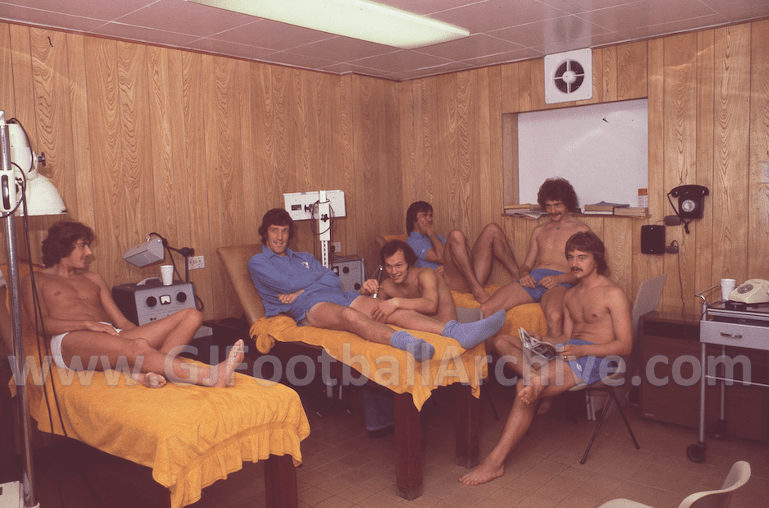
The 1970s Maine Road treatment room… It’s day 18 of my posts counting down to the centenary of Maine Road’s opening game. A photograph can say so much about the era.

This photo shows the treatment room at Maine Road with physio Roy Bailey working on Tommy Booth’s leg. On the bed to the left is Gary Owen and the other players are Dave Watson (on bed to the right either hiding his face or making a secret gesture with his fingers!), Kenny Clements and Tony Henry (with magazine).

What else can we spot? The telephone on the wall (and one on the trolley) and the ‘modern’ equipment. The closed off window, which shows that this room backed on to the main external frontage of the stadium. Years earlier that window would have been glazed with small glass blocks like the others were. There’s the fake wood panelling popular in the 70s – maybe Peter Swales got a job lot from somewhere and had the boardroom, offices and other spaces fitted out in it – the tiled ceiling and the wall heater. All very 1970s.

I’m pretty certain the equivalent facilities at the Etihad & CFA are somewhat more extensive than this but, at the time, City did claim they were ahead of most rivals in this area. Obviously, Roy Bailey would be able to talk more about support (or lack of it) from above, while the players could also talk about how they were treated overall.

For those unfamiliar with Maine Road this photo may help locate where the photo was taken from. It was taken in a room inside the Main Stand, in the lower level, somewhere behind and to the left of number 1.

Maine Road aerial 1971 from Farewell To Maine Road

If you’d like to read more on the history of Maine Road, take a look at Farewell To Maine Road, which can be downloaded from this page:

If you enjoy all the free material on my website and would like to support my research and keep this website going (but don’t want to subscribe) then why not make a one-time donation (or buy me a coffee). All support for my research is valued and welcome. It allows me to keep some free material available for all. Thanks.

Choose an amount

£2.50
£5.00
£7.50

Or enter a custom amount

£

Your contribution is appreciated.

Donate

Borussia Mönchengladbach, City and Romark’s curse!

Today (7 March) in 1979 Manchester City faced top German side Borussia Mönchengladbach in the first leg of the UEFA Cup quarter-final at Maine Road.

There was a 39,005 crowd present and the City team was: Corrigan; Donachie, Power, Reid, Watson, Booth, Channon, Viljoen, Kidd, Hartford & Barnes.

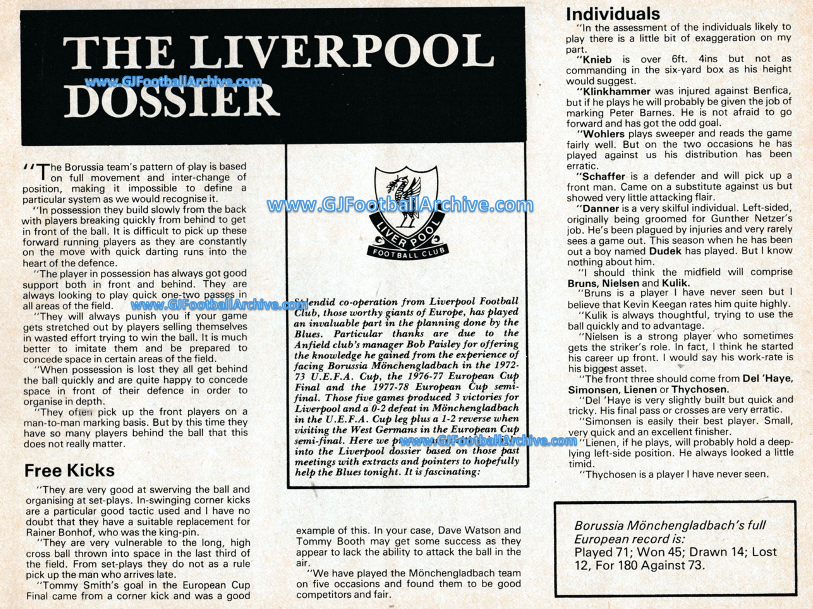
Believe it or not (this may surprise a modern audience but leading clubs often did what I’m about to say) Liverpool, in particular Bob Paisley, had spent considerable time helping the Blues prepare for this match by providing vital information on the West German side.  

Liverpool had faced Mönchengladbach on five occasions, the most famous was the 1977 European Cup final and the most recent being in the 1978 European Cup semi-final.  Paisley told City that the game would be tough, and outlined the players to watch.  He also suggested that Dave Watson and Tommy Booth might be the key men in City’s side as the Germans seemed to lack ability to attack the ball in the air.

While City had Liverpool doing all they could to help there was someone who was becoming a bit of a thorn in the side of Malcolm Allison. That was hypnotist Romark. Romark had previously ‘cursed’ Allison while the City man had been manager of Crystal Palace (a really interesting story which I covered in my biography of Peter Barnes, published in 2021).

The Peter Barnes book is available here:

The hypnotist had offered to help Allison but Big Mal was having none of it. The following year Romark helped Halifax Town defeat City in the FA Cup! If only Allison had not angered the hypnotist all those years ago. Maybe life would’ve been so different for City!

The first leg saw Malcolm Allison, who had returned to the Blues in January as the self-styled ‘coaching overlord’, perform one of his many shock moves when Nicky Reid was thrust in to the spotlight at the age of 18 for his debut.  Allison selected him to mark Allan Simonsen.  It was an amazing selection at the time, but Reid did enough to justify Allison’s bold move.

Nicky Reid

Mike Channon, who was rumoured to be unhappy at the Club,  managed to give the Blues a 1-0 lead.  Unfortunately, the highly disciplined Mönchengladbach kept the pressure on and managed to snatch an equaliser and the often vital away goal.  

The second leg of the tie took place 13 days later, on 20 March 1979 watched by around 30,000. The City team was: Corrigan; Donachie, Power, Viljoen, Watson, Booth, Channon, Reid (Deyna), Henry, Hartford & Barnes

Nicky Reid retained his place for the second leg (but still didn’t make his League debut until eleven days later when he scored against Ipswich).  He was clearly a talented player but his arrival in the heat of European competition without even making an appearance in the League did raise many questions about the way Malcolm Allison was influencing things.  Reid went on to captain the Blues to the FA Youth Cup final the following May, and was voted City’s young player of the year.

Malcolm Allison made yet another surprise selection as Tony Henry – another reserve who up to that point had only featured in two League game (once being substituted by Kenny Clements, once coming on for Asa Hartford) – was included while experienced European campaigners Deyna, Bell, and Kidd were left on the bench with Paul Futcher.  

It was not a good night at all for City and having so much experience on the bench seemed baffling to fans, the media and also most of the players. City were very much the underdogs throughout and were losing 3-0 when, late on, Reid was substituted by Deyna.  The experienced Pole provided City’s only goal of the match, but it was too late and City were out of Europe.

Kenny Clements explained to me when I interviewed him years later: “I broke my leg a few weeks after Milan so that made life a bit difficult for me, but the big problem was the return of Malcolm Allison.  I know he was a great coach first time at City, but second time he really did ruin everything.  All the older players told me it’d be great having him back, and then when he was back they all admitted they were wrong.  I think he’d become too hung up on new ideas that he forgot about the basics.  I remember he used to give us homework.  He’d tell us to go home and write “I must win” or “I will win” a thousand times, then the next day he’d ask us if we’d done it.  

“I always used to say ‘yeah’, but some of the younger, more impressionable lads would produce their lists and some would even write out twice as many lines!  He insisted we drank coffee before a game to keep us alert, and brought in lots of motivational people.  It didn’t motivate me I’m afraid!

“By the time of the next UEFA match (Mönchengladbach) I was fit but didn’t start, and then for the second leg both Brian Kidd and I had to sit it out while Nicky Reid made his debut marking one of the greatest players of all time.  When we were two goals down Kiddo threw his shirt at Allison in anger.”

For many connected with City Mönchengladbach became the game that would be quoted when they discussed how things had changed following Allison’s return. Tony Book had developed a good team with a nice blend of young up-and-coming talent, like Peter Barnes (who was still only 21 but an exciting England winger), with the older experienced internationals like Dave Watson, Brian Kidd, Asa Hartford. Book’s team had been runners up to Liverpool in 1977 and had impressed with many great individual victories since then, especially that Milan victory of course, but the return of Malcolm Allison changed the dynamics at the club.

Ah well! Without that I guess City wouldn’t have what they have today, but for those of us who lived through the 70s to the present, it was the return of Allison that started the process of transforming City from regular challenging giant into a club that had lost its way. The 1978-79 Mönchengladbach games are a reminder of what we were, what we lost, but also of what we have now. Let’s ensure we enjoy the present because, as Allison once said to me: “Celebrate every success as if it’s your first, because it could be your last!”

When City walked out to face Mönchengladbach in the quarter final none of us, especially Allison, expected it would be our last European tie for 25 years! To read about the significance and facts of City’s European heritage (there are a few points that may surprise fans of certain other clubs) then take a look at another post:

https://gjfootballarchive.com/2021/01/11/manchester-citys-european-heritage-facts-not-fiction/

The results of City’s 1979 meetings with the German side are:

7/3/1979 City 1-1 Mönchengladbach (UEFA Cup)

20/3/1979 Mönchengladbach 3-1 City (UEFA Cup)

Borussia Mönchengladbach and Manchester City: The First Time

Back in 1978-79 Manchester City had reached the quarter-finals of the UEFA Cup by beating Milan (2-2 at the San Siro and 3-0 at Maine Road). It was the first time City had reached the quarter finals of a European trophy since 1971 and was to be their third appearance in a major European quarter final. Unfortunately, the January UEFA draw wasn’t kind as it paired City with top German side Borussia Mönchengladbach.  

With West Bromwich Albion, Hertha, Duisberg, Dukla Prague, Honved and Red Star Belgrade all through the Blues had hoped for one of the less powerful sides.  Nevertheless, the Blues were hopeful. Years later City player Kenny Clements told me: “We thrashed Milan at Maine Road in the second leg and I felt we’d made our mark as a European power.  Everybody was talking about us, and we should have progressed further but we messed up.” 

How they messed up became part of the ‘Typical City’ DNA of the club that always seemed to plague the Blues in the late 70s to 2010s (and occasionally has reared its head since then but thankfully not that often these days).

The first leg of the quarter final occurred on 7th March 1979, before a 39,005 crowd at Maine Road and the City team was: Corrigan; Donachie, Power, Reid, Watson, Booth, Channon, Viljoen, Kidd, Hartford & Barnes.

Believe it or not (this may surprise a modern audience but leading clubs often did what I’m about to say) Liverpool, in particular Bob Paisley, had spent considerable time helping the Blues prepare for this match by providing vital information on the West German side.  Liverpool had faced Mönchengladbach on five occasions, the most famous was the 1977 European Cup final and the most recent being in the 1978 European Cup semi-final.  Paisley told City that the game would be tough, and outlined the players to watch.  He also suggested that Dave Watson and Tommy Booth might be the key men in City’s side as the Germans seemed to lack ability to attack the ball in the air.

In the 1977 European Cup final, Liverpool had defeated Mönchengladbach by playing to the strengths of players like Tommy Smith and Paisley felt City should do the same.  The first leg saw Malcolm Allison, who had returned to the Blues in January as the self-styled ‘coaching overlord’, perform one of his many shock moves when Nicky Reid was thrust in to the spotlight at the age of 18 for his debut.  Allison selected him to mark Allan Simonsen.  It was an amazing selection at the time, but Reid did enough to justify Allison’s bold move.

Mike Channon, who was rumoured to be unhappy at the Club,  managed to give the Blues a 1-0 lead.  Unfortunately, the highly disciplined Mönchengladbach kept the pressure on and managed to snatch an equaliser and the often vital away goal.  

The second leg of the tie took place 13 days later, on 20th March 1979 watched by around 30,000. The City team was: Corrigan; Donachie, Power, Viljoen, Watson, Booth, Channon, Reid (Deyna), Henry, Hartford & Barnes

Nicky Reid retained his place for the second leg (but still didn’t make his League debut until eleven days later when he scored against Ipswich).  He was clearly a talented player but his arrival in the heat of European competition without even making an appearance in the League did raise many questions about the way Malcolm Allison was influencing things.  Reid went on to captain the Blues to the FA Youth Cup final the following May, and was voted City’s young player of the year.

Malcolm Allison made yet another surprise selection as Tony Henry – another reserve who up to that point had only featured in two League game (once being substituted by Kenny Clements, once coming on for Asa Hartford) – was included while experienced European campaigners Deyna, Bell, and Kidd were left on the bench with Paul Futcher.  

It was not a good night at all for City and having so much experience on the bench seemed baffling to fans, the media and also most of the players. City were very much the underdogs throughout and were losing 3-0 when, late on, Reid was substituted by Deyna.  The experienced Pole provided City’s only goal of the match, but it was too late and City were out of Europe.

Kenny Clements later explained to me: “I broke my leg a few weeks after Milan so that made life a bit difficult for me, but the big problem was the return of Malcolm Allison.  I know he was a great coach first time at City, but second time he really did ruin everything.  All the older players told me it’d be great having him back, and then when he was back they all admitted they were wrong.  I think he’d become too hung up on new ideas that he forgot about the basics.  I remember he used to give us homework.  He’d tell us to go home and write “I must win” or “I will win” a thousand times, then the next day he’d ask us if we’d done it.  

“I always used to say ‘yeah’, but some of the younger, more impressionable lads would produce their lists and some would even write out twice as many lines!  He insisted we drank coffee before a game to keep us alert, and brought in lots of motivational people.  It didn’t motivate me I’m afraid!

“By the time of the next UEFA match (Mönchengladbach) I was fit but didn’t start, and then for the second leg both Brian Kidd and I had to sit it out while Nicky Reid made his debut marking one of the greatest players of all time.  When we were two goals down Kiddo threw his shirt at Allison in anger.”

For many connected with City Mönchengladbach became the game that would be quoted when they discussed how things had changed following Allison’s return. Tony Book had developed a good team with a nice blend of young up-and-coming talent, like Peter Barnes (who was still only 21 but an exciting England winger), with the older experienced internationals like Dave Watson, Brian Kidd, Asa Hartford. Book’s team had been runners up to Liverpool in 1977 and had impressed with many great individual victories since then, especially that Milan victory of course, but the return of Malcolm Allison changed the dynamics at the club.

Ah well! Without that I guess City wouldn’t have what they have today, but for those of us who lived through the 70s to the present, it was the return of Allison that started the process of transforming City from regular challenging giant into a club that had lost its way. The 1978-79 Mönchengladbach games are a reminder of what we were, what we lost, but also of what we have now. Let’s ensure we enjoy the present because, as Allison once said to me: “Celebrate every success as if it’s your first, because it could be your last!”

In 1978-79 the Milan victory was City’s last in Europe until 2003-04. When City walked out to face Mönchengladbach in the quarter final none of us, especially Allison, expected it would be our last European tie for 25 years! To read about the significance and facts of City’s European heritage (there are a few points that may surprise fans of certain other clubs) then take a look at another post: https://gjfootballarchive.com/2021/01/11/manchester-citys-european-heritage-facts-not-fiction/

This post has been published prior to City’s 2020-21 meeting with Borussia Mönchengladbach in the Champions League. It should be noted that the two teams have met in the intervening years. The results are:

7/3/1979 City 1-1 Mönchengladbach (UEFA Cup)

20/3/1979 Mönchengladbach 3-1 City (UEFA Cup)

30/9/2015 Mönchengladbach 1-2 City (CL)

8/12/2015 City 4-2 Mönchengladbach (CL)

14/9/2016 City 4-0 Mönchengladbach (CL)

23/11/2016 Mönchengladbach 1-1 City (CL)