Manchester City v Bradford Park Avenue

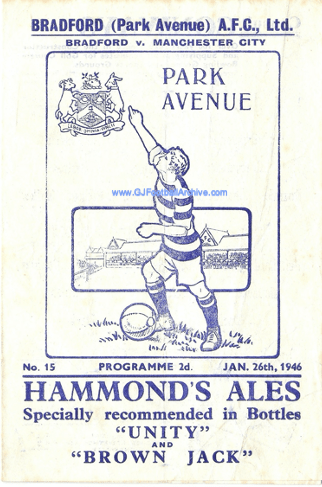
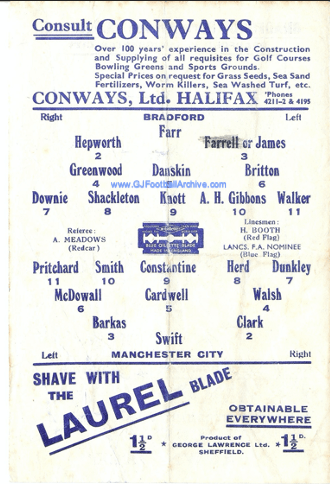
On this day (26 January) in 1946 a comfortable 3-1 victory for Manchester City over Bradford Park Avenue in the fourth round of the FA Cup seemed certain to put the Blues through to the fifth round.  Goals from George Smith 2 and Alec Herd. However, this first season of FA Cup football after the war saw games played on a home and away basis and the Blues had to face Bradford again a few days later.

You can read about that day below.

The 1940s: Film of City v Chelsea 1948

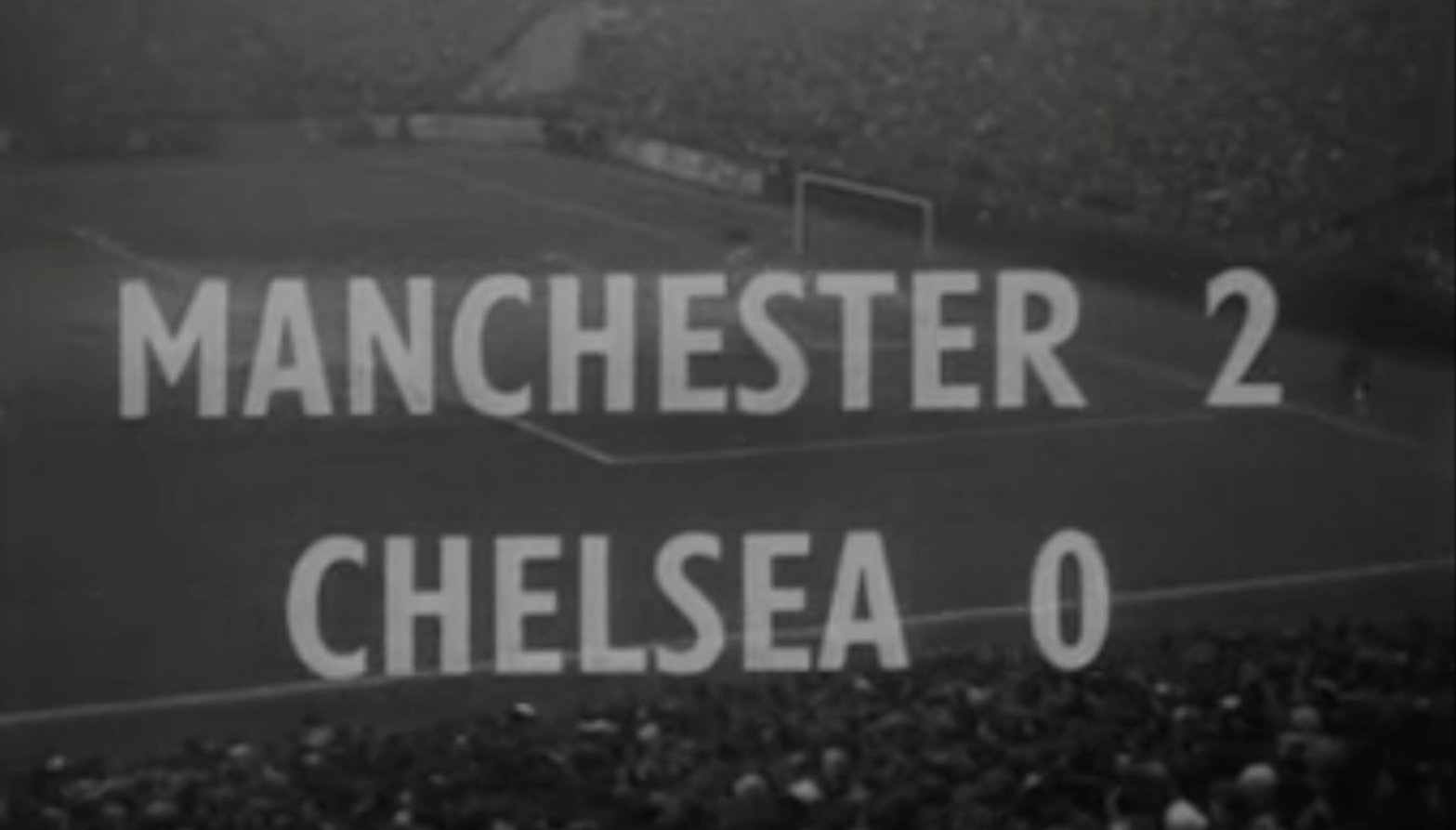
There’s a wonderful film of Manchester City’s 2-0 victory over Chelsea in the FA Cup on 24 January 1948 which really needs to be seen. I’d urge everyone to watch this, even if it’s just for Frank Swift’s reaction to a decision. You’ll also see some wonderful coverage of Maine Road too. The film can be seen here: https://www.britishpathe.com/asset/84094/

The City scorers were Billy Linacre and George Smith.

If you’d like to find out more on the 1947-48 season then the following 1000 word subscriber article can be read by subscribing below.

Subscribe to get access

Read more of this content when you subscribe today. It costs £3 per month or you can subscriber for the discounted annual rate of £20 per year. Each subscriber gets access to everything posted so far, including PDFs of a couple of my books.
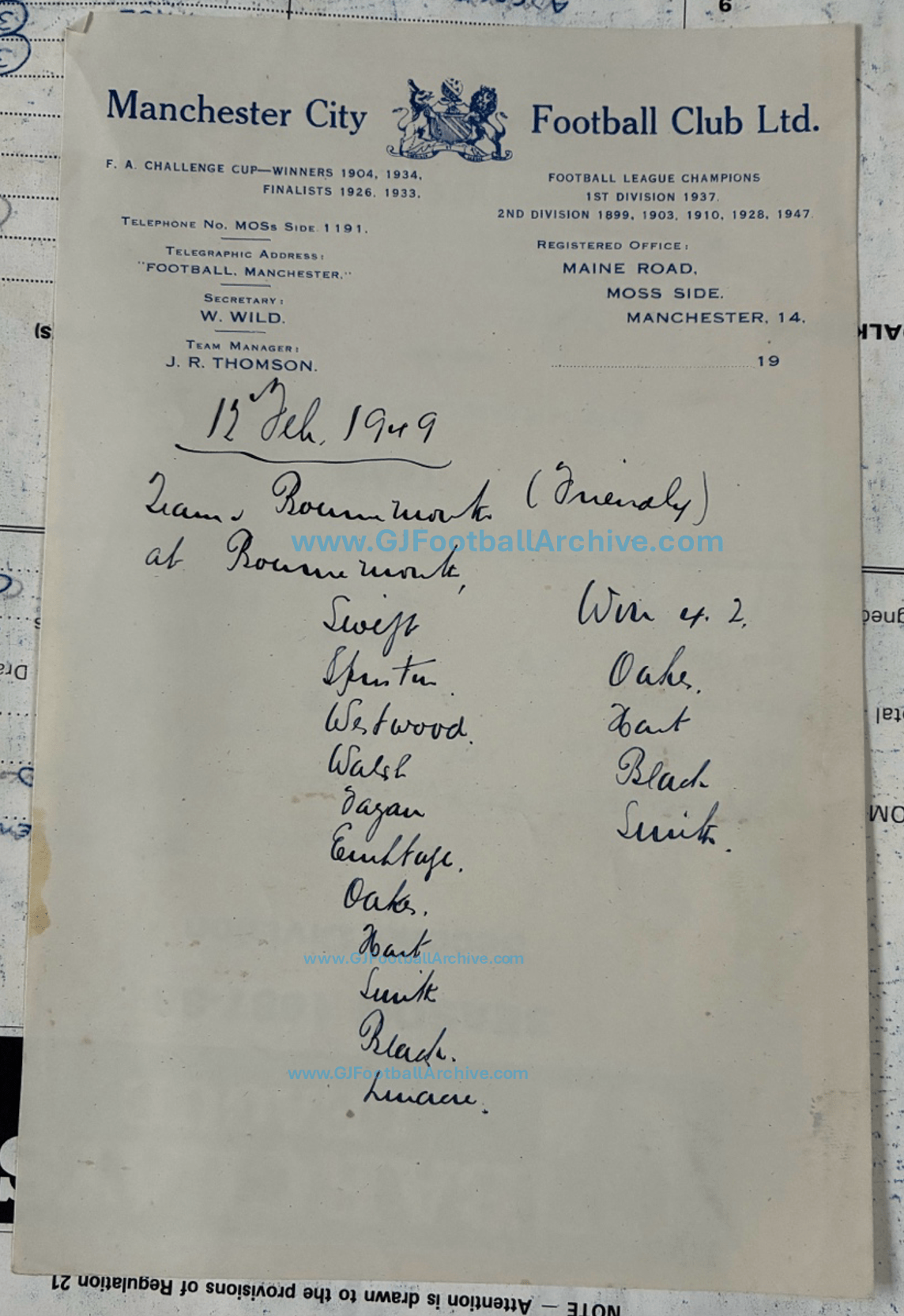
The 1940s: George Smith 5

On 14 June in 1947 Manchester City’s George Smith (on right of photo the following season playing against Manchester United) scored five as the Blues defeated Newport 5-1 in the Second Division. At the time this was City’s latest finish to a season (eclipsed by the Covid affected 2019-20 season of course!). You can read more on the 1946-47 season below. This was the first league season after the war and ended with City winning the Second Division title. There were some truly significant – and well attended – games that season and future Liverpool manager Joe Fagan made his debut this season too. This subscriber article includes comments from an interview I did with George Smith back in 2003.

This is a subscriber article and you can read it by subscribing below.

Subscribe to get access

Read more of this content when you subscribe today. It costs £3 per month or you can subscriber for the discounted annual rate of £20 per year. Each subscriber gets access to everything posted so far, including PDFs of a couple of my books.
The 1940s: Manchester City 2 Sheff Utd 1

A week after winning 3-2 at Football League North league leaders Sheffield United, Manchester’s Blues do it again on this day (27 April) in 1946. This time they beat the Blades 2-1 before 19,241 at Maine Road (although this report from the MEN suggested there were only about 15,000 there when the game started). The City scorers were Maurice Dunkley and George Smith. The image shows a Manchester Evening News report published that evening.

Although this game was played in peacetime the regional war leagues were still being played, with the Football League returning the following season.

There was FA Cup action though and you can read about that in the following feature on the 1945-46 season.

This is a subscriber article and you can read it by subscribing below.

Subscribe to get access

Read more of this content when you subscribe today. It costs £3 per month or you can subscriber for the discounted annual rate of £20 per year. Each subscriber gets access to everything posted so far, including PDFs of a couple of my books.
The 1940s: George Smith

Continuing the series on Manchester City in the 1940s here’s an article I wrote back in 2013 about George Smith, a City star of the 1940s, who passed away that year. This is free to read and well worth taking the time to read it too. George’s story was a remarkable one.

In July 2013 City lost one of the club’s stars from the 1940s, the popular goalscorer George Smith.  Smith, who was 92, had a remarkable life and career.  He joined the Blues in 1938 from Salford Adelphi and quickly proved his value in City’s A team as an inside-forward. He seemed to be getting close to a first team call up but then war broke out and naturally the world changed considerably for all, especially young, fit, agile men.

Inevitably he joined the armed forces but before he left Manchester he did manage to make two first team appearances in the war league.  Both games were score draws with Stockport (the first ended 6-6 on 2nd December 1939!).  Then active service took over and Smith went on to serve in Africa.  There was nothing unusual about young men serving overseas, however Smith’s life changed significantly when he was under attack from the air.  A bullet entered his right arm above his elbow, travelled down his arm, past his elbow and came out again after travelling a good six or so inches through his arm.  Smith was in a great deal of pain, but the most shocking aspect in many ways was that the plane that fired at him was actually from the South African Air Force, Britain’s allies.  This meant that Smith was on the receiving end of what years later would be described as ‘friendly fire’.  

Smith was lucky the bullet had only entered his arm, but he was desperately unlucky to have been fired at by servicemen fighting on the same side.  He spent some time recovering in Africa before being able to return to England. 

Why the South African Air Force chose to shoot at him remained a mystery and was not investigated.  In fact the whole incident was hushed up and George was encouraged not to talk about the specific events.  When he eventually returned to Manchester few knew the truth of what happened and, as with so many injured men, it wasn’t a subject openly discussed.  Even when the war was over the City football guide for 1945 simply stated:  “Smith was one of the first casualties when he suffered a permanent injury to his hand sustained in manoeuvres somewhere in South Africa.”

The permanent injury affected George for the rest of his life.  Ever since that terrible incident seventy years ago, George’s hand and fingers were permanently rigid in a clasping fashion, while his arm had two large indentations where the bullet entered and exited his flesh.  In addition, the path of the bullet down his arm was still clear throughout his remaining years.

Despite the injury, George determined to return to football, but even then he experienced difficulties with the City management and football authorities.  Initially, it was felt his injury may have prevented him from playing.  Clearly, his arm would present some difficulties, but as a forward it was his feet and head that provided the main aspect of his play, not his arm, but the City management insisted on George performing a number of trials.  He passed them all and on 26th August 1944 he celebrated his return to the first team with a hat-trick against Tranmere in the opening match of the new wartime season.  This was his first appearance in since 25thApril 1942.

By the end of the war George was a key member of City’s side, although he continued to remain self-conscious about his arm.  Usually he would cover it up with the sleeve of his shirt, a sock, a glove, or he would bandage it up.  For team photos and the like the arm was usually hidden either behind his back or carefully positioned behind another player.

Some supporters and reporters thought his arm had been amputated, while others wanted to ask him but wouldn’t.  Understandably, George wanted his football to do all the talking and when City faced United on 6th April 1946 he netted all four goals as the Blues trounced the Reds 4-1.  The match, attended by over 62,000, does not form part of competitive football statistics due to the fact that wartime games are not viewed as of the same stature as regular League matches, however for every one attending or playing that day this was a full blooded Manchester derby of the highest order. It should always be remembered and, for George, scoring four goals – three in seven minutes – made him the undisputed star. When I interviewed him in 2003 he remembered: “I wasn’t much of a drinker…  I never went wild or anything… but beating United in that manner and by scoring four goals was a wonderful moment.  I enjoyed the day and enjoyed most of the games against them during this period.  It was nice for the landlords to put one over the tenants.”

The following season saw the return of League football and George was a key factor behind City’s promotion:  “The season ended in June and on the last day Roy Clarke made his debut and I scored all five goals when we beat Newport County.  It was another great day and I was given the match ball.  I’ve still got it because something like that is special, but it didn’t matter so much that I scored five.  It was good that we won.  I ended the season as top scorer but promotion was the main aim.”

George continued to perform exceptionally well for the Blues over the following seasons.  At one point he was on the verge of an England cap, and it is known that he had been mentioned by officials at the FA, however it seems his arm injury may have proved a factor.  In the end, to the amazement of most Mancunians, George was not selected for his national side.

In October 1951 he moved on to Chesterfield (scoring 97 in 250 League appearances), and later was player-manager at Mossley and Hyde United.  He also managed Prestwich Heys.

George continued to live in the Prestwich area and watch City in his later life, though ill health did affect his final years.  He loved his time at the club and for fans who remember seeing George play do so with great affection. Now he has passed away it is important supporters remember the difficulties he had to overcome before making his name as a star in City’s immediate post-war period.

You can read more on the 1945-46 season, when George was a City star below.

This is a subscriber article and you can read it by subscribing below.

Subscribe to get access

Read more of this content when you subscribe today. It costs £3 per month or you can subscriber for the discounted annual rate of £20 per year. Each subscriber gets access to everything posted so far, including PDFs of a couple of my books.

The 1940s: The 1947-48 Season

The new series on Manchester City in the 1940s continues with this feature on the 1947-48 season. This 1000 word subscriber article can be read by subscribing below.

Subscribe to get access

Read more of this content when you subscribe today. It costs £3 per month or you can subscriber for the discounted annual rate of £20 per year. Each subscriber gets access to everything posted so far, including PDFs of a couple of my books.

The 1940s: The 1946-47 Season

The new series on Manchester City in the 1940s continues with this feature on the 1946-47 season. This was the first league season after the war and ended with City winning the Second Division title. There were some truly significant – and well attended – games that season and future Liverpool manager Joe Fagan (photograph) made his debut this season too. This subscriber article includes comments from an interview I did with George Smith back in 2003.

This is a subscriber article and you can read it by subscribing below.

Subscribe to get access

Read more of this content when you subscribe today. It costs £3 per month or you can subscriber for the discounted annual rate of £20 per year. Each subscriber gets access to everything posted so far, including PDFs of a couple of my books.

The 1940s: Sheff Utd 2 Manchester City 3

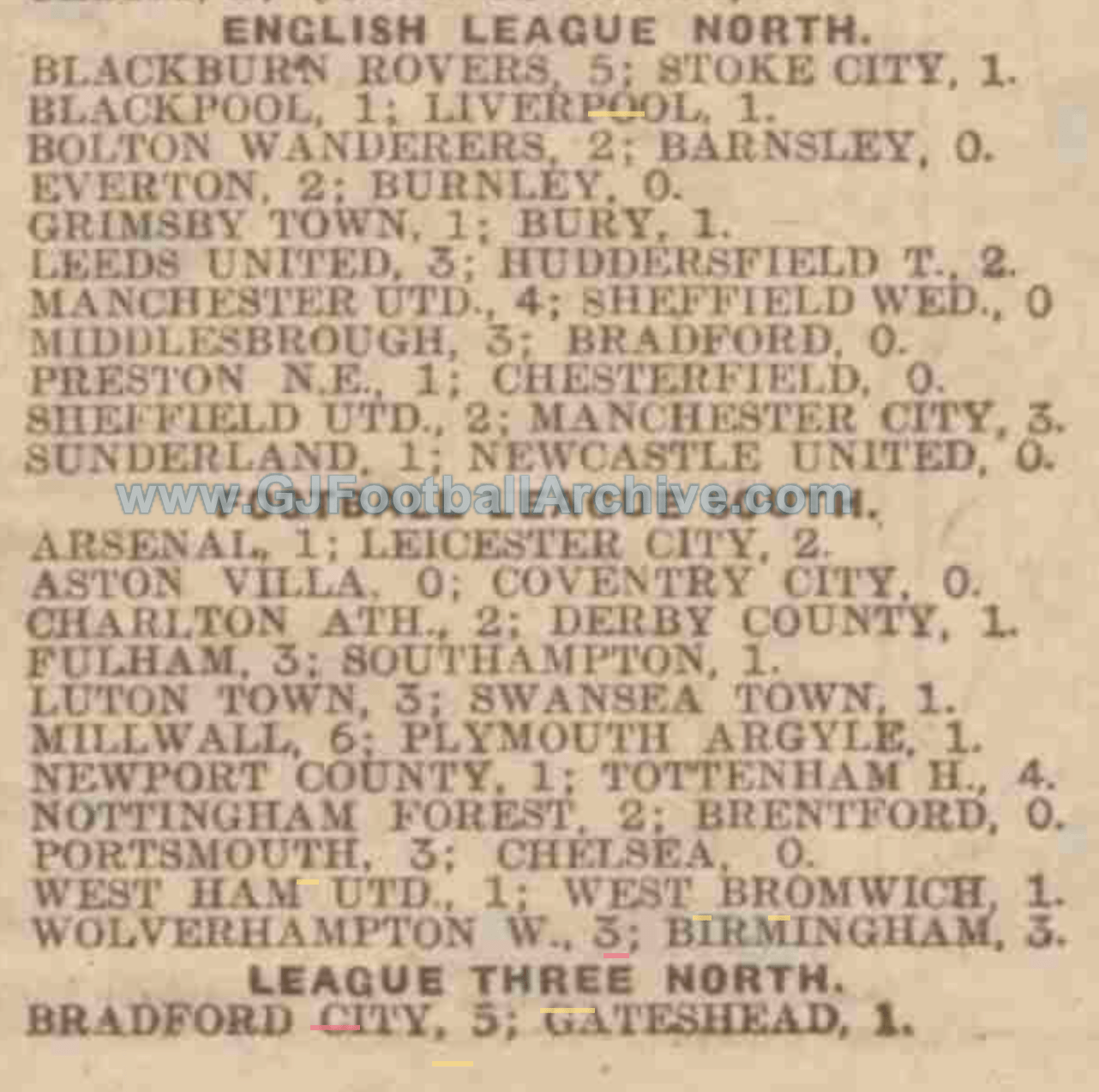
On this day (20 April) in 1946 Manchester City defeated the Football League North league leaders Sheffield United 3-2 at Bramall Lane. The City scorers were Lew Woodroffe, Jimmy Constantine and George Smith. The image shows the results from that day.

A crowd recorded as 40,000 watched this match. Although this game was played in peacetime the regional war leagues were still being played, with the Football League returning the following season.

There was FA Cup action though and you can read about that in the following feature on the 1945-46 season.

This is a subscriber article and you can read it by subscribing below.

Subscribe to get access

Read more of this content when you subscribe today. It costs £3 per month or you can subscriber for the discounted annual rate of £20 per year. Each subscriber gets access to everything posted so far, including PDFs of a couple of my books.
The 1940s: The 1945-46 Season

The new series on Manchester City in the 1940s continues with this feature on the 1945-46 season. This feature includes comments from George Smith (photographed against United a few years later), who I interviewed in 2003.

This is a subscriber article and you can read it by subscribing below.

Subscribe to get access

Read more of this content when you subscribe today. It costs £3 per month or you can subscriber for the discounted annual rate of £20 per year. Each subscriber gets access to everything posted so far, including PDFs of a couple of my books.

The 1940s: The 1944-45 Season

The new series on Manchester City in the 1940s continues with this feature on the 1944-45 season. This includes some quotes from Johnny Hart (photographed a few years later).

This is a subscriber article and you can read it by subscribing below.

Subscribe to get access

Read more of this content when you subscribe today. It costs £3 per month or you can subscriber for the discounted annual rate of £20 per year. Each subscriber gets access to everything posted so far, including PDFs of a couple of my books.