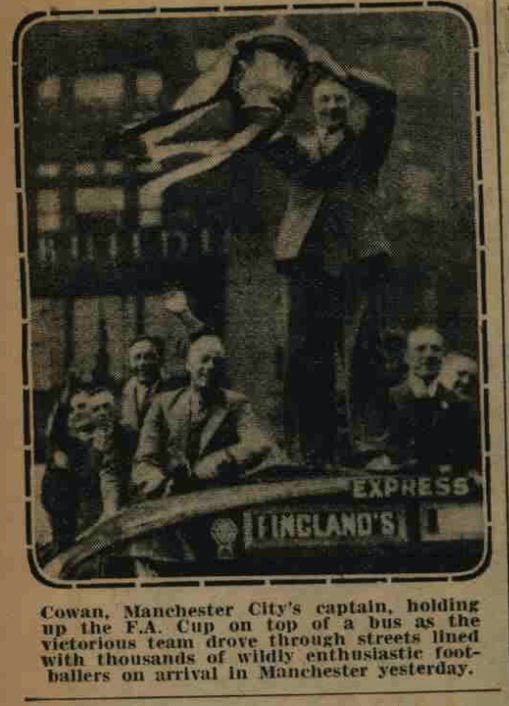
Video of my online talk on history of MCFC Support/Match Day at Maine Road

Earlier today (Saturday March 5 at 3pm UK time) I did an online talk/presentation on the history of Manchester City’s support and match day at Maine Road. It was a celebration of fans and a reminder of Maine Road. I’ve now posted below a free to view video of the talk for anyone to watch…

The online talk lasted over 1 hour and was recorded live, so you should able to access it anywhere.The talk covered the history of Manchester City’s support with particular reference to:

•Match day ritual at Maine Road

•The Viking Call

•The ‘Boys Stand’

•Record crowds

•Songs & chants

•Fancy dress, bananas & bells

•Fanzines

•The Supporters Club

I had a couple of technical issues but you can watch it now here:

I’m keen to hear thoughts on the idea of doing other talks like this for subscribers to my site. If you’re interested then please get in touch and let me know what you’d like me to talk on. I have quite a few ideas I’m keen to do and am also open to suggestions. Thanks.

If you enjoy the talk then please subscribe to my site. I am a self employed historian and spend all my working week writing, researching and publishing my work. I am not an employee of any organisation (I know some think I’m employed by a football club but I’m not an employee of any club). I am independent of any organisation and care passionately about the quality and accuracy of my work.

A limited amount of content will always be free for anyone to read but those subscribing will have access to everything on this site for as long as they subscribe. For subscribers I guarantee to post a minimum of 4 articles alongside adding material from my archives each month (in practice it’s been much more than this!). To subscribe costs £3 a month or £20 a year (a reminder that the 2010 edition of Manchester A Football History cost £24.95 when published and is now out of print but available to subscribers as a downloadable pdf as part of their subscription.).

If you’re uncertain whether to subscribe or not then why not subscribe for a month at £3 and see if you’re getting value for money. The £20 annual subscription works out about £1.67 a month for a guaranteed 4 new articles per month and access to everything else posted in the archive.

You can subscribe here:

Subscribe to get access

Read more of this content when you subscribe today.

The League Cup: The First Major Trophy

Today (March 5 2022) Manchester City’s women’s team takes on Chelsea in the 11th final of the FA Women’s League Cup. This is a hugely important trophy to Manchester’s Blues and to commemorate today’s final, here’s a piece looking at the history of the competition from Manchester City’s view point. The League Cup, sponsored by Continental during the seasons Manchester City have won the competition and therefore known as the Continental Cup, was the first national competition won after the relaunch. As such it became highly significant.

City supporter David Sheel explains how the first final was viewed: “The club put on some coaches for us. It was night match – that doesn’t help. It was played at Adams Park, Wycombe Wanderers’ ground. There were two coaches. The first was full of parents and young academy girls and a few supporters with the second just supporters. All free. We went – sadly a lot couldn’t go because it was a week night – and we played against Arsenal. A team full of established top players who had beat us 4-0 at City in the League. But, like semi final win over Chelsea at Hyde, there was just something about that night. Arsenal were all over us at times and did everything but score. Our defence was outstanding but we also had a few chances at the other end. Got to half-time nil-nil and you’re thinking ‘just one chance, please.’ I can remember the goal… Joey Johnston went down the line, whipped the ball in and Izzy Christiansen, the smallest player on the pitch, headed it in. There were four of us sat together – the coaches had arrived just before kick off so we’d had to leg it in and grab the first spaces you could find. The four of us jumped up but we were surrounded by Arsenal fans. They started giving us some abuse. The goal was in the 73rd minute and we hung on. 

“When the final whistle went I was as proud of that achievement as I was in 2011 when the men won the FA Cup. To me personally it was the same. I never ever felt I’d see the men win anything in my life and then the same was true with the women. I was so proud of the club. After that they did the trophy presentation and I picked up some of the tinsel that got fired out of the cannons when they did the presentation. All the players came over to the side afterwards. Jill Scott was showing me her medal. They shared it with the fans. They even let me put my hands on the trophy. We were all there together. A bit like the men and their success in 2011 I think this told the outside world that City were here to do business. Inside the club the ambition was there but until you win a major trophy the other clubs may not take you seriously.”

When I interviewed her in 2018-19 player Abbie McManus remembered: “That feeling of beating Arsenal, who have dominated women’s football for years and years. At the time we were perceived to be a bunch of nobodies that have just thrown a team together and everyone was saying you’re just throwing money at it. I didn’t actually play that game. I got sent off the game before so I missed it! But watching the game and the feeling of that win. Being the underdog. I don’t think that feeling will ever come back.”

Izzy Christiansen scored in the final and told me how she felt: “An amazing feeling to score in that game. There’s no other words to describe it. It was just probably one of the best days of my life, the fact that the ball hit the back of the net. The fact that it meant that we, as a team, and a club, got our first trophy. That kind of set us off on our journey really.  We had a taste of success at the start and that’s where we’ve stayed, wanting success.”

The Blues went on to win the Continental Cup in 2014, 2016 and 2019. City’s finals:

2014 City 1 Arsenal 0

Goalscorer: Christiansen (73)

Attendance: 3,697 (Adams Park, High Wycombe).

Referee Nigel Lugg (Surrey)

2016 City 1 Birmingham City 0 (aet)

Goalscorer: Bronze (105)

Attendance: 4,214  (Academy Stadium, Manchester). 

Referee Rebecca Welch (Durham)

2019 Arsenal 0 City 0 (City won 4-2 on penalties)

Attendance: 2,424  (Bramall Lane, Sheffield). 

Referee Lucy Oliver (Newcastle)

Let’s hope the Blues can add another piece of silverware today. Thanks to Dave Coop for the photo at the top of this page.

You can find out more about the history of City Women in my book Manchester City Women: An Oral History. Follow the link for details of how to buy:

Last Chance to Book: Free Online Talk on History of MCFC Support/Match Day at Maine Road

Tomorrow (Saturday March 5 at 3pm UK time) I will be doing an online talk/presentation on the history of Manchester City’s support and match day at Maine Road. It will be a celebration of fans and a reminder of Maine Road. If you want to watch/listen you’ll need to register by noon tomorrow (UK time; Saturday 5th March 2022). Details of how to do that are below…

The talk will last about 1 hour and will be online, so you should able to access it anywhere. It will cover the history of Manchester City’s support with particular reference to:

•Match day ritual at Maine Road

•The Viking Call

•The ‘Boys Stand’

•Record crowds

•Songs & chants

•Fancy dress, bananas & bells

•Fanzines

•The Supporters Club

This presentation and talk is based on my popular 2019 talk at the Dancehouse Theatre in Manchester (if you attended that you will already have seen it!). I go into detail about the history of City’s support and celebrate some of the unique aspects of over 125 years of Manchester City FC.

This is a free event but there are a limited number of tickets. These must be ordered in advance. There is a limited capacity and no one will be able to join the event without first registering. If you want to participate. Book here:

San Francisco Blues

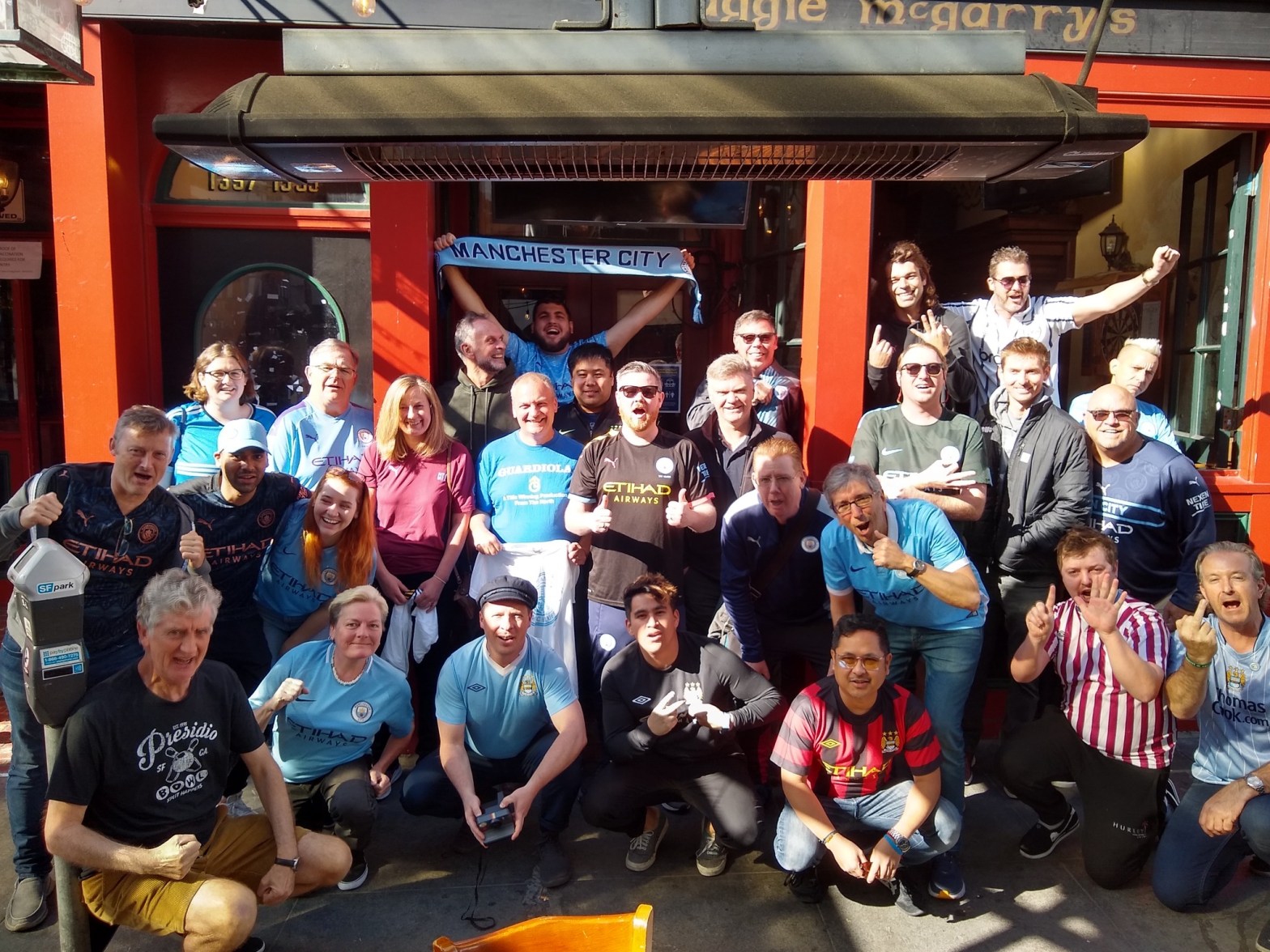
Recently I’ve been in San Francisco and was there when Manchester City played Spurs. I was invited to watch the game at Maggie McGarry’s with the San Francisco Blues. It was a great experience (we’ll ignore the result!) and here are a few thoughts and a bit of film from the day….

Firstly, I want to pay tribute to ALL the City fans who were there and who made us feel so welcome. It’s clearly a great supporters club and we really enjoyed our time there.

I’ve always been proud of the fact that MCFC has been a welcoming club over the decades and fans of the Blues have tended to be welcomed no matter where they are from or who they are. The San Francisco Blues are just as welcoming with wonderful hospitality too.

The branch contained several exiled Mancs, British and Irish members, as well as many, many US born City fans. This was great to see and I enjoyed listening to their stories of how they became City fans, or of how they came together to watch games at the bar. Two Mancs actually went to the same school (1 year apart) but didn’t know each other until they met in San Francisco through their City support. One was a history teacher in the States and asked me ’Was Billy Meredith guilty of the bribery charge?’ Hopefully, US children will now hear the rights and wrongs of FA investigations into perceived nouveau riche clubs, as City were called back in 1905 (I know!).

Some had travelled a couple of hours to get to the bar for the 930am kick off (California time of course!). from what I heard the same happens for earlier kick offs – some feat when you consider a regular 3pm UK kick off would be 7am local time. The landlord, who is also a Blue, opens the bar early for City games.

A few of the branch members had travelled to the Champions League final last year and others told me of their plans to get to the away games at Everton and Peterborough. The atmosphere on Manchester Derby Day is always special there – I think we’re all looking forward to next weekend. I’ll be in my regular seat by then of course but if you are a Blue in San Francisco get yourself down to Maggie McGarry’s.

I often get angry when rival fans or some in the media criticise football supporters for their loyalty, or when some state that ALL City fans are this or that when the truth is that we’re varied and have come to support City in lots of different ways. We live all over the world and show our dedication to the cause in ways that some don’t understand. Fans spend a considerable time, amount of money or put themselves out in lots of different ways to support their club.

I could go on but I’d just like to say thanks again to the San Francisco Blues. Their facebook page is here:

Here’s the scene at the bar when City equalised:

David Humphreys from the branch is heavily involved with a football club called San Francisco Vikings, formed in 1922. They focus on bringing kids through from age 3 onwards to adult leagues and to sponsor kids who can’t pay to play.

It may be some time before I’m in San Francisco again, but when I do make it I’ll aim to get back to the San Francisco Blues. Thanks again for making us so welcome.

Free Online Talk on History of MCFC Support

On Saturday March 5 at 3pm (UK time) I will be doing a talk/presentation on the history of Manchester City’s support. If you want to watch/listen you’ll need to register. Details of how to do that below…

The talk will last about 1 hour and will be online, so you should able to access it anywhere. It will cover the history of Manchester City’s support with particular reference to:

•Match day ritual at Maine Road

•The Viking Call

•The ‘Boys Stand’

•Record crowds

•Songs & chants

•Fancy dress, bananas & bells

•Fanzines

•The Supporters Club

This presentation and talk is based on my popular 2019 talk at the Dancehouse Theatre in Manchester (if you attended that you will already have seen it!). I go into detail about the history of City’s support and celebrate some of the unique aspects of over 125 years of Manchester City FC.

This is a free event but there are a limited number of tickets. These must be ordered in advance. There is a limited capacity so please book early if you want to participate. Book here:

Free Online Talk on History of MCFC Support – Register Now

On Saturday March 5 at 3pm (UK time) I will be doing a talk/presentation on the history of Manchester City’s support.

The talk will last about 1 hour and will be online, so you should able to access it anywhere. It will cover the history of Manchester City’s support with particular reference to:

•Match day ritual at Maine Road

•The Viking Call

•The ‘Boys Stand’

•Record crowds

•Songs & chants

•Fancy dress, bananas & bells

•Fanzines

•The Supporters Club

This presentation and talk is based on my popular 2019 talk at the Dancehouse Theatre in Manchester (if you attended that you will already have seen it!). I go into detail about the history of City’s support and celebrate some of the unique aspects of over 125 years of Manchester City FC.

This is a free event but there are a limited number of tickets. These must be ordered in advance. Subscribers can order their tickets now. There is a limited capacity so please book early if you want to participate. If any tickets are left I will open this up for non-subscribers at a later day (though this cannot be guaranteed of course). Further details below for subscribers:

Subscribe to get access

Book your ticket for the talk and access all the articles, interviews and archive material on this site when you subscribe today.

City Voices Project: More MCFC Fans’ Views Needed

An update on the City Voices project… It’s been over a year since I announced the project which will capture and archive the memories, stories and views of MCFC fans but, due to COVID, I’ve not been able to interview many fans. I’m still keen to gather these stories, which will be archived at MCFC for future generations too! Read on for more information…

Following on from my successful project capturing the stories of the women who played for and the people involved with Manchester City’s women’s team throughout its 30+ years of existence, a similar project was launched more than a year ago to capture the stories of Manchester City’s fans.

I will be capturing the stories of the club’s fans over the next year and you can help contribute to this great project. I’m keen to hear from and interview fans to ensure their stories and experiences are captured and retained for ever.

If you would like to help the project and provide your stories then please complete the questionnaire below and send it to gary@GJFootballArchive.com as soon as you can. Unfortunately, due to time constraints at the moment I will not be able to reply to all emails. I will certainly be reading every questionnaire and those stories will be captured for posterity. 

In addition, I will be interviewing some fans during 2022. Hopefully, this will be via face-to-face interviews may follow. If you would like to be considered for interview then please complete the relevant section on the questionnaire.

Updates on the project will follow over the coming months, including details of how these stories will contribute to our knowledge and understanding of what it has been like to support Manchester City over the decades. 

One important point to note is that I am keen to hear from fans of all ages based in Manchester, the United Kingdom and around the world. The greater the number that respond the better the archive of fans stories will become.

Please help this project and ensure the memories, stories and lives of City fans are captured for posterity. Thanks to those who have already completed the questionnaire – some of you are still on my list for potential interviews (apologies for the delays – COVID has been a bit of an issue for us all of course!).

Here’s the questionnaire:

https://gjfootballarchive.com/wp-content/uploads/2021/02/city-voices-modelconsent.docx

Thanks,

Gary

Gary James and Peter Barnes Talks – Nov & Dec

Over the coming weeks Peter Barnes and I will be talking at various locations about the biography I have written on Peter. Here’s a brief rundown of the locations and dates, starting with tomorrow night (Tuesday 2nd November 2021):

Tuesday 2nd November – West Yorkshire MCFC Supporters Club (8pm; Morley Cricket Club, Scatcherd Lane Morley, Leeds LS27 0JJ)

Thursday 4th November – Castleton MCFC Supporters Club (7pm; Royle Bowling Club, 958 Manchester Road, Castleton, OL11 2TL)

Monday 8th November – Denton, plus Haughton Green, branches of the MCFC Supporters Club (Denton Conservative Club, 45 Manchester Rd, Denton, M34 2AF)

Thursday 11th November – Abbey Hey MCFC Supporters Club

Tuesday 16th November – Orrell MCFC Supporters Club (7.30pm)

Friday 19th November – Ashton under Lyne MCFC Supporters Club

Friday 26th November – Stretford & Urmston MCFC Supporters Club

Thursday 2nd December – Warrington MCFC Supporters Club

Monday 13th December – Wilmslow MCFC Supporters Club

Monday 20th December – Irlam MCFC Supporters Club

At each talk/evening we’ll be selling the book at a discounted price of £15 (cash only) and we will, of course, sign copies for those in attendance. Obviously, our diaries are pretty full with events and other activities but if you are interested in myself and where possible Peter talking about the book at your event then please contact me with details and we’ll see what we can do: gary@GJFootballArchive.com

This 372 page, colour paperback book is £16.95 (including UK postage). For those interested in buying the book but unable to attend you can order it here:

The Peter Barnes Authorised Biography – UNITED KINGDOM

Order today for £16.95 (incl UK Postage and Packaging).

£16.95

UK postage included; outside UK contact me for additional postage costs. You do not need to have a PayPal account to order – use the ‘Pay with PayPal’ button above and it will give you the option to pay by credit/debit card without creating a PayPal account.

City Voices Project – Champions League Memories

Following on from the successful project capturing the stories of the women who played for and the people involved with Manchester City’s women’s team throughout its 30+ years of existence, a similar project was launched earlier this year to capture the stories of Manchester City’s fans.

As we have now faced a true historical first for the club, I.e. a Champions League final, I’m keen to capture the fan experiences and stories from that.

I’m keen to hear from and interview fans to ensure their stories and experiences are captured and retained for ever.

If you would like to help the project and provide your stories then please complete the questionnaire below (a general questionnaire but please add your memories or key points from Porto) and send it to gary@GJFootballArchive.com as soon as you can. Unfortunately, due to time constraints at the moment I will not be able to reply to all emails. I will certainly be reading every questionnaire and those stories will be captured for posterity. 

In addition, I will be interviewing some fans later this year (sadly, this may have to be over a video service or telephone, although later in the year face-to-face interviews may follow). If you would like to be considered for interview then please complete the relevant section on the questionnaire.

Updates on the project will follow over the coming months, including details of how these stories will contribute to our knowledge and understanding of what it has been like to support Manchester City over the decades. 

One important point to note is that I am keen to hear from fans of all ages based in Manchester, the United Kingdom and around the world. The greater the number that respond the better the archive of fans stories will become.

Please help this project and ensure the memories, stories and lives of City fans are captured for posterity.

Here’s the questionnaire:

https://gjfootballarchive.com/wp-content/uploads/2021/02/city-voices-modelconsent.docx

Thanks,

Gary

Parallels – MUFC 2021 and MCFC 1993?

Some people say that history repeats. I’m not so certain about that but I do think we can learn a lot from history about modern society and how things develop. Actions are often similar decades apart and, unless we learn from what’s gone before, we do often make similar mistakes or not consider how things could turn out. Parallels should be looked for and considered.

This weekend (May 2 2021) has seen the postponement of the Manchester United – Liverpool Premier League game due to concerns over the safety of players and staff. Whether it should have been or whether there had been any potential for players to be injured is debateable but postponed it was.

United fans had been protesting on the forecourt outside Old Trafford a few hours before the match and some managed to find their way into the stadium. Footage of some smashing a door down and others seemingly walking straight into the stadium at a door manned by stewards have circulated, causing various conflicting views as to how fans managed to get into a stadium that should be impenetrable (if a few hundred fans can get in to a closed and secure stadium what does this say about the general security of the venue?).

The fans that made it in to the stadium found their way on to the pitch and television broadcast the scenes. Eventually the stadium was cleared, although Sky TV told us of a second group of fans who had got into the stadium through the second tier. Ultimately, all fans were cleared but the game was postponed. Fans were also positioned outside the Lowry Hotel where the United team were and television told us that there were concerns as to whether the team would be able to safely travel to Old Trafford. 

Similar views were expressed about Liverpool (don’t get me started on the safety of teams arriving at Anfield!).

Whether any player was in actual danger or not didn’t seem to matter. This was the view being expressed by those paid to describe the scene.

So, what should we make of all this? Well, we have been told that the protests were against the owners of Manchester United, the Glazer family, and the birth of the European Super League. The Super League plan has been halted (I’m sure it will keep coming back as the birth of the Premier League did) but the Glazers still own United.

I opened this post by saying how parallels should be looked for and considered and, as a historian, I cannot help but compare what’s happened this weekend with events at Manchester City in 1993. Back then the Blues were run by chairman Peter Swales.

Swales had mismanaged the club for two decades and had taken a hugely profitable and successful club, piled it with debt and seen it lose pace with some of its traditional rivals. Fans had been angry about his chairmanship for years and had demonstrated regularly. Swales Out was often the most popular chant at Maine Road and the pre and post-match demonstrations were an everyday part of life as a City supporter. Fans loved City but hated Swales.

Inevitably, when City were successful the Swales Out protests were not as visible as they were at times of failure – and this has been true at United. There have been many, many United fans who have constantly highlighted the faults of the club’s ownership and they have campaigned, but the wider fan base has been quiet when the successes have occurred. This was true at City (though successes were less frequent at City during Swales’ chairmanship).

Frustrations at Manchester City continued, even when the club had relatively successful seasons. For example, the Blues finished fifth two years running in 1991 & 1992 – poor by 1970s standards but better than the 80s – but fans still wanted Swales out. Part of the reason lay in his support for the proposed Premier League, which began in 1992-93 but had been discussed for several years before that (it was initially planned as a complete breakaway from the Football League by the biggest clubs who were determined to reduce the money they passed down to the rest of football – hmm, parallels here that often get forgotten!).

The Premier League was anticipated to make the rich richer and clubs that had lost their way, like City because of Swales and his supporting directors who had placed the club in enormous debt (for the time) which meant they struggled to compete for the best, were going to make up the numbers to some extent.

The first season of the Premier League went okay for Manchester City. They finished ninth which was a little disappointing but in itself was not the main concern. That was still Swales’ chairmanship and the general mood was poor. Fans had had enough. 

City’s chance of glory that season faded in a FA Cup quarter final with Tottenham and fans’ frustrations at their chairman and directors spilled out. It was a day when Swales’ new stand was opened – the Umbro Stand – and this was small-time compared to the club’s history and heritage. The stand it had replaced held over 9,000 seated. The new stand was basically two rows of executive boxes with about 4,500 seats in front. The ordinary fan felt that with that stand and the birth of the Premier League they were no longer relevant. Hospitality, money and TV deals seemed to matter most to club owners. 

The frustrations that had been bubbling for years (and we must NEVER underestimate the efforts City fans made demonstrating against their directors and for how many years they did this) bubbled on to the pitch. Live television captured the scenes as City fans invaded the pitch and the FA Cup quarter final was halted.

The media criticised the couple of hundred fans who made it on to the pitch. They didn’t ask why they’d done it, they just assumed City fans were unhappy at losing a FA Cup game. Had they bothered to ask fans – I was there and knew the situation and have over the years discussed this extensively with people who were on the pitch – they would have realised that they climbed on to the pitch out of frustration. Frustration at the way football was developing and frustration at Peter Swales and his supporting directors. 

Fans were right to be frustrated and history has shown that their predictions (covered extensively in City fanzines at the time) about the way football was developing to create an elite and more money for certain clubs was right.

I interviewed Peter Swales about two years after that pitch invasion and he told me that he should have listened to the fans and resigned that night. I agree – things would have been different for him and for City. Maybe in a few years the Glazers will say the same about this weekend?

That 1992-93 season saw Manchester United win the top flight for the first time in 26 years and United’s success brought added pressure to those in charge at Maine Road. The frustration of seeing your nearest rival achieve something that you’ve not done for years (City had been the last Manchester team to win the League prior to 1992-93 as they’d won it in 1967-68) gave fans further ammunition. Fans could point out to Swales that he became chairman of a club that had been hugely successful (four major trophies in the previous 5 seasons before his chairmanship) and profitable (previous chairman Eric Alexander was proud of the profitability of the Blues in the years before Swales). They could also ask ‘where did the money go’, ‘Why were we mismanaged?’ etc.

That event in City’s history is similar to some extent to what’s happened at United. Years of frustration at the owners/directors; the recognition that a rich club had been placed in significant debt; the proposed birth of a new league; the resurrection of a neighbour who seems destined to have a bright future just at a time when your directors don’t seem able or willing to compete etc. 

The proposed change of structure to football, where greed of club owners seemed more important than what the fans wanted, was the catalyst to the demonstrations at United this weekend.

Please don’t be fooled into thinking this is a demonstration against the European Super League – that’s the catalyst but United fan dissatisfaction runs much deeper than that. As with City’s 1993 FAC quarter final defeat and the birth of the Premier League that season, these are catalysts that bring the wider fan base on board (and often the media attention), but they are not solely the cause. 

In 1993 the media claimed City fans were unhappy because they’d lost the FAC tie. Well, yes, but they’d lost plenty of other FAC ties over the years and never invaded the pitch. That tie became the visible outpouring of dissatisfaction, just like the European Super League has created a situation which has allowed United fans to bring more visibility to their longstanding protests against the club’s owners. 

So where do we go from here? Well, there’s one major change since 1993 and that is that the majority of media coverage seems to have sympathy with fans this time. But those working in the media should ensure they go and talk to the fans who were actually on the Old Trafford pitch and ask them why they were there. That would help frame the discussions about what it all actually meant. Some media coverages has said in rather simple terms that United fans were campaigning against the European Super League – no, it’s part of a long standing dissatisfaction with the club’s owners, but I’m not a fan who went on the pitch (that’s my interpretation but best way to find out is to ask those who were in Old Trafford).  

In 1993 the media didn’t ask City fans why and they made assumptions which painted football fans extremely negatively. Instead of showing them as people who cared about how their club was developing they were presented as hooligans.

If we’re thinking about parallels then it’s worth considering what happened next in 1993 so that United fans can shape things differently or prepare for the worst! Back in 93 the momentum at Maine Road continued but, as with the widespread protest of the 1980s at City, nothing could change while the majority shareholders supported Swales. Put simply, if you own the club no amount of fan pressure can force you to sell. You only sell when you want to.

Swales felt the protests would die down (he explained all of this to me in an interview) but this time, as protests continued in 1993-94, former player Francis Lee decided to mount a takeover. That was eventually what forced Swales to stand down.

Sadly, for City the damage was done though and financially Lee’s City couldn’t compete with clubs who were able to spend freely like Blackburn (a major benefactor at the time) and those who were already benefitting financially from Premier League success. City ended up dropping to their worst ever position in the late 1990s and were financially adrift of many of their traditional rivals. Only the takeovers of 2007 and 2008 could help the club regain its position as a serious trophy challenger.

If we consider the City situation as an example, then it seems that the best chance United fans have got to change the ownership of the club is if someone like Gary Neville came in to front a major takeover of the club. Even then, as with City, it may well be that the damage done to the Reds and the debt placed on the club limits its future.

It does make you wonder what would have happened had Alex Ferguson, who had spoken out against the Glazers before the takeover, opposed the Glazers when they took over his club. Had Ferguson stood down back then maybe the protests against the Glazers would have been immense?

Football owners have never been properly policed and there are examples throughout the English league system of clubs whose futures were jeopardised by owners who have gambled on future success by borrowing to fund purchases, or who have sold club assets or placed a club in debt for their own personal gain. Change in football’s governance is needed. Simply changing owners is not the answer because football is a business and any owner wants his/her business to be profitable for him/her and shareholders.

Fans views, whether in the 1980s or 1990s campaigning against the Premier League and football chairmen, or in the 2020s campaigning against the Super League and football owners need to be listened to. Understand us and work with us – you might help make football an even greater spectacle.

Subscribe to get access

This is a taster of the material on this site. If you would like to read everything (including the entire Manchester A Football History book) then please subscriber. It’s £20 a year (works out about £1.67 a month) and you’ll have access to all 340+ articles/interviews etc. posted so far and the others coming during your subscription.

Don’t forget if you order The Peter Barnes Authorised Biography before publication you can get your name printed in it and your copy will be signed by Peter and myself. Details here: