Newton Heath/MUFC’s First Game and Their Colours

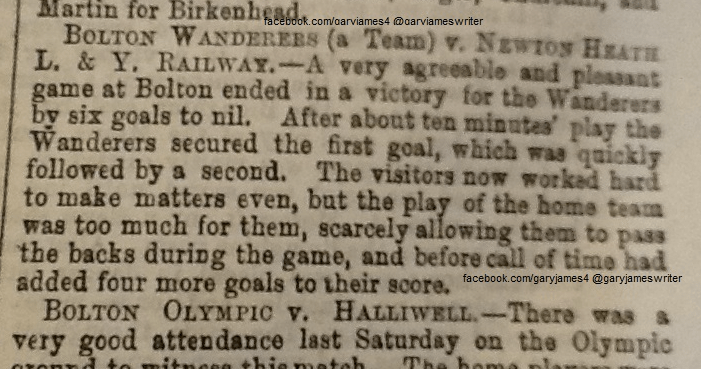
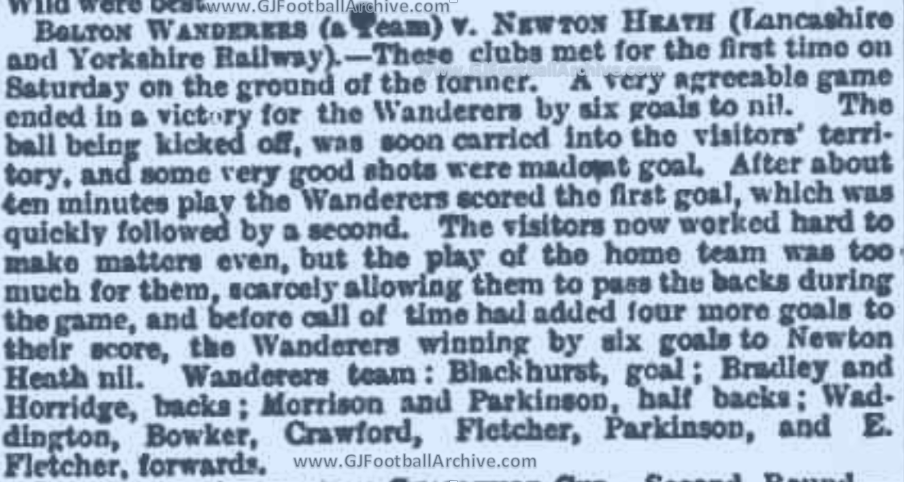
On this day (20 November) in 1880 as Newton Heath L&Y Railway Manchester United played their earliest known game. It was against Bolton Wanderers 2nd team and United lost 6-0. In the years that have followed some have claimed they wore green and gold at this game but the contemporary references given do not say anything of the sort.

It is still repeated often that a newspaper report in the Bolton Evening News mentioned the colours of green and gold were worn for Newton Heath’s first reported match. The origin of this is unclear but the Manchester United Pictorial History and Club Record (Charles Zahra, Joseph Muscat, Iain McCartney and Keith Mellor; Nottingham: Temple Press, 1986) specifically refers to the match report on page 11 as being published on 24 November 1880 and implies it stated the team colours. It also suggests that Bolton wore scarlet shirts. 

My research over the decades has included a review of every Bolton newspaper for that period and I did discover a match report in the Bolton Evening News on the date mentioned in the above book but this did not include any reference to the colours worn.  This is actually the report that gets quoted. You can see there’s no mention of colours:

Like so many football clubs the early history of Newton Heath has lots of myths associated with it. The facts are that at the railway works in Newton Heath various sporting activities were established during the 1870s. In 1922 Herbert Dale, a railway worker who played football for a decade from the formation of what became Newton Heath, was asked how football became established at the works. He explained that the club when initially formed had been a cricket team (suggesting it was established in 1878), and that after some time a member of the committee bought a football from a shop on Market Street in the city centre. This appears to be in 1880 and, according to Dale, the instigator of the club was Sam Black and that the original colours were red and white quartered shirts (NOT green and gold; quartered shirts meant 2 panels on front and 2 on back with a red and a white panel on both the front and the back). Those colours may surprise some but I do provide references and explain more in a book The Emergence of Footballing Cultures: Manchester 1840-1919 published by Manchester University Press. In that I talk about all the early clubs of the Manchester area such as Hulme Athenaeum, Manchester Association and Hurst.

Black was seventeen when the club played its earliest known game on 20 November 1880 and his age then seems consistent with others, such as those at St Mark’s (Manchester City) who are known to have played in November 1880.

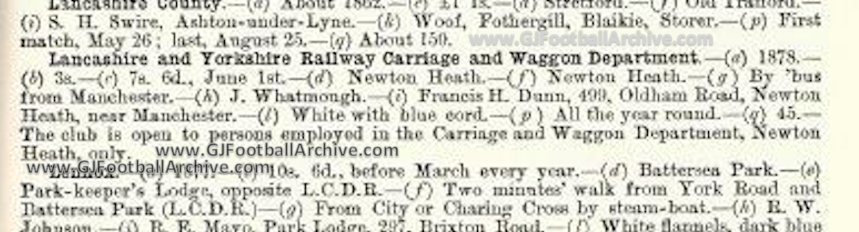
The was a Sportsman’s Yearbook for 1880 produced which the Newton Heath club was mentioned in. It appeared in both the cricket and football sections. Here are the details published in the cricket section:

Sportsman’s year book 1880 Newton Heath cricket section

You’ll notice mention there of the cricket whites/kit to be worn: white with a blue cord. Typically, this is believed to mean ‘white cricket shirts and trousers’ with a blue cord as belt (to differentiate between opponents). Some cricket clubs wore different coloured belts/cords; some wore specific caps with their whites and some wore badges (or even different colours).

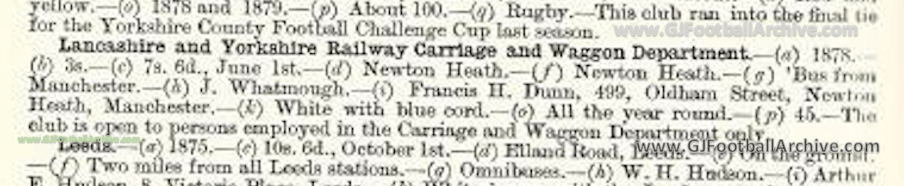
In that same yearbook the following appeared in the football section (back then a football section had rugby and association football clubs alongside each other):

Sportsman’s year book 1880 Newton Heath football section

You’ll notice the details are simply a repeat of the cricket section and it may well be that the club had decided to be listed in both sections without thinking specifically about football, or it could even be that it was a mistake to publish in both sections. For me it does seem that having the club’s details in both sections was deliberate, afterall it says the club is all year around and not specific to the cricket or football/rugby season. But I don’t believe the colours can be trusted for the association football team, especially as Dale talks of red and white being the club’s earliest football colours. Whatever is true it is important to recognise that to date no contemporary evidence has been found saying the club wore green and gold when they played their earliest games. They did wear those colours at times later on though.

Newton Heath reformed as Manchester United in 1902, winning the club’s first major trophy in 1908 (the League).

Incidentally Bolton Wanderers’ first team beat Irwell Spring (Bacup) 7-1 in the Lancashire Cup on the same day as the earliest known game for the Heathens. A good day all round for the Wanderers it seems.

For those wondering the earliest known MCFC game took place one week earlier (St Mark’s v Macclesfield Baptists).

Bobby Charlton

There have been many wonderful tributes and there are definitely people who can talk better than I can about the great Bobby Charlton. However, I do want to mark this sad time with a brief story about him which I think shows the character of the man. It’s a personal story from 30 years ago.

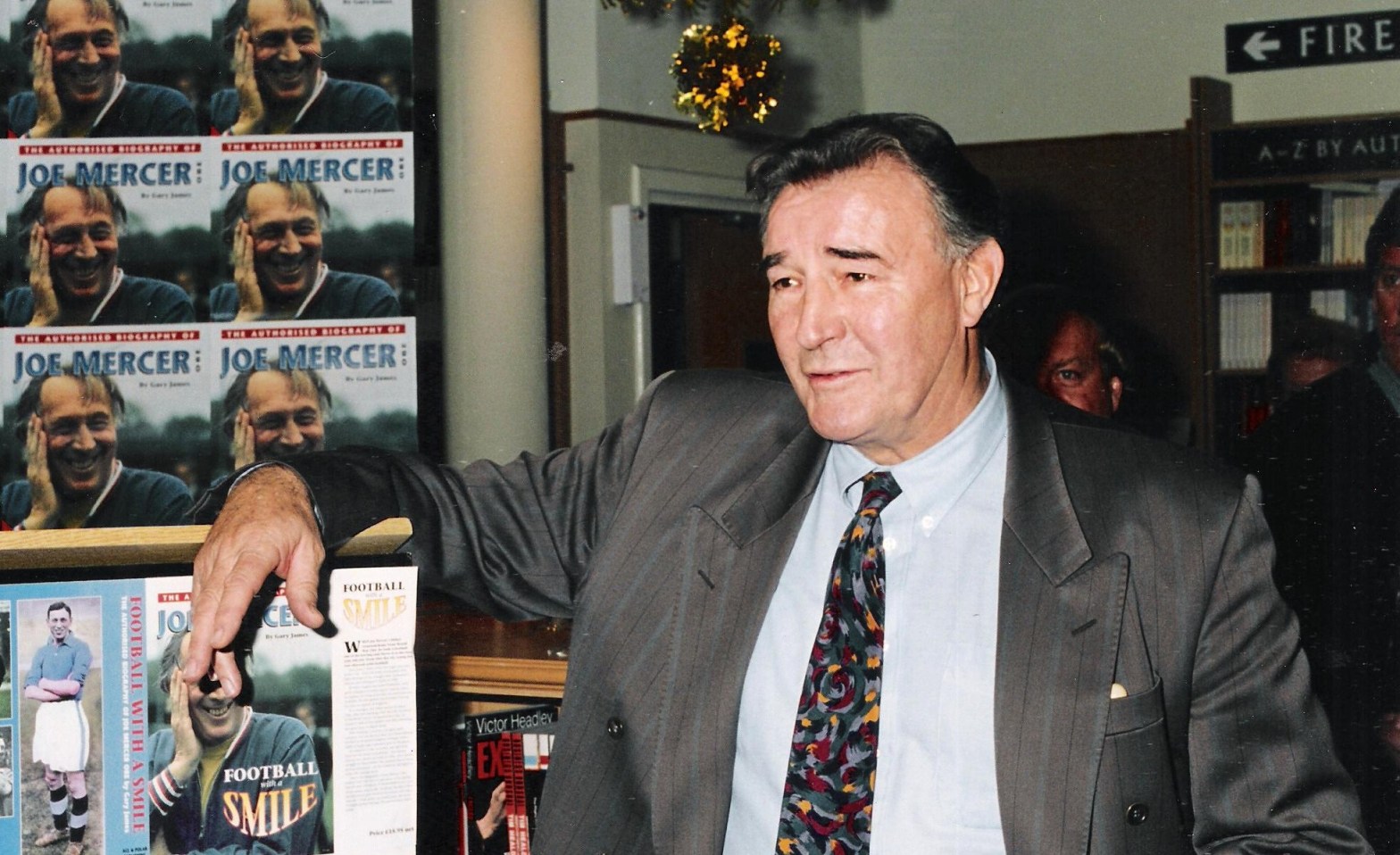
Back in November 1993 we were preparing for the book launch of my biography of Joe Mercer, which was to take place at the start of December. As well as those that had been interviewed for the book, such as Colin Bell, Tom Finney, Francis Lee etc. Norah Mercer asked me if she could invite a few others. Obviously she could but I didn’t know who she was inviting. I just left it to her.

About a week before the launch I received a phone call at home. I answered it and the voice on the other end said: ‘Hello Gary. It’s Bobby Charlton here. I’ve just spoken with Norah Mercer and told her I can’t make it to your book launch because I’ll be in Kuala Lumpur. She said I should let you know. Sorry I can’t make it. Is that okay? I really am sorry and would be there if I could.’

I was absolutely stunned. Bobby really didn’t need to phone either of us but he certainly didn’t need to call me. He was so polite and apologetic too. It was appreciated and added to the high esteem that I already held him in.

Often it’s the simplest of things that make the biggest impression. There were several people who had been invited who didn’t come to the launch and hadn’t let us know – I don’t expect everyone to be interested or to call – so when Bobby took the time and trouble to phone us both it really was something I treasured (and still do).

I did meet him a few times in the years that followed but it’s the 1993 phone call that remains my strongest non-footballing memory of Bobby.

Without doubt Bobby was a wonderful England international and a major global footballing figure. He was also a wonderful ambassador for Manchester (the reason he was going to Kuala Lumpur too) but most significantly he was a humble, nice man.

Tommy Booth Return

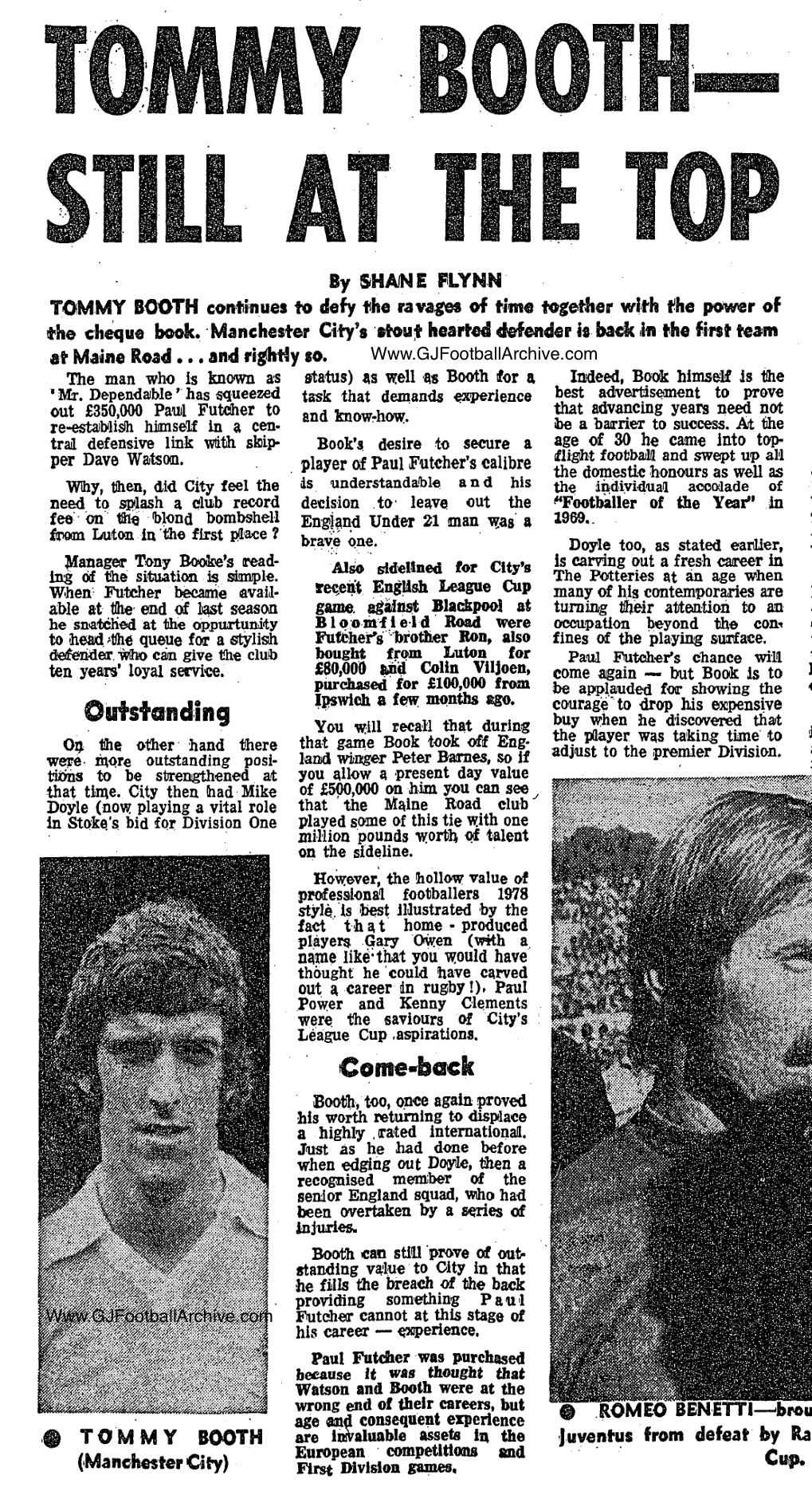
Here’s an interesting article about Tommy Booth and Manchester City from 14 October 1978. It talks about him being ‘Mr Dependable and back in the City first team despite the big spending of the Blues. Actually it’s really interesting how the City spend. spend, spend view exists in this article from all those years ago. Anyway, enjoy this flashback to a time when Tommy Booth remained a key member of City’s first team.

Manchester City 2 Newcastle Utd 0

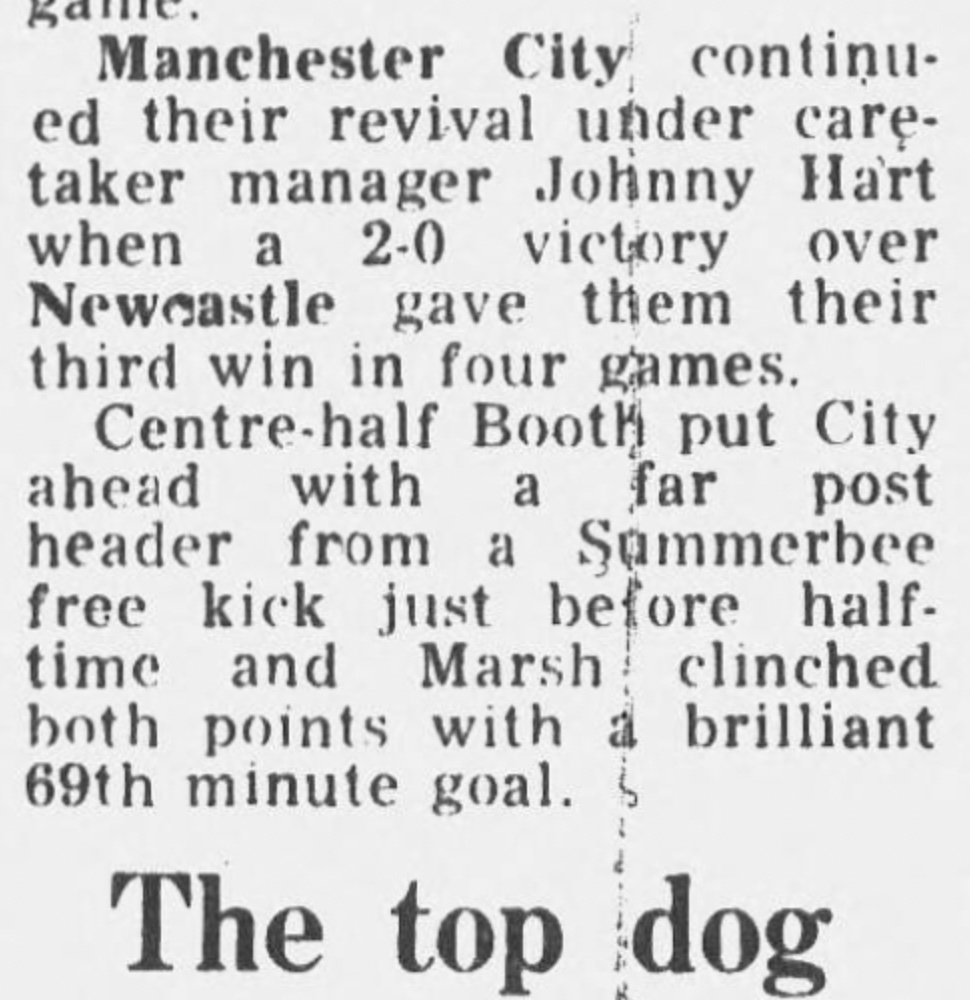
Fifty years ago today (18 April 1973) City defeated Newcastle 2-0 with goals from Tommy Booth (a header) and a brilliant effort from Rodney Marsh (in 69th minute). City’s boss at the time was Johnny Hart. You can read his frank views (from an interview I did with him several years ago) here:

MCFC & LFC: Attendance Malarky

For some reason whenever Manchester City and Liverpool are due to meet at the Etihad there’s quite a lot of nonsense said about attendances so I thought I’d best get some analysis done and post it here. It’s always nice to post the facts not the fiction, so here goes (some of this may surprise those who only listen to the negativity about Etihad crowds and the positivity about Anfield attendances, not the facts).

The general criticism City get is often about ’empty seats’. No club can boast that every single season ticket holder or fan who has bought a ticket attends every game for which they’ve bought the ticket, so inevitably there are ’empty seats’ at most games for all clubs. Family tragedy, illness, emergency, work commitments, travel problems etc. all contribute to missing fans. As we don’t have a system whereby you have to get a note from a family member to pass on to the club’s manager (it seems some think you do need to get permission!) if you’re going to miss a game it is impossible to have an accurate record of who simply cannot be bothered to attend, rather than a specific reason that stops them attending.

Personally, I think it’s all nonsense and I’d much rather focus on tickets sold as that is something that can be compared. So, here are some facts based on attendances at Anfield and the Etihad since City’s new stadium was built in 2003:

Since 2003 City have attracted a higher average attendance than Liverpool in all but 5 seasons. Some will say ‘ah, but the Etihad’s capacity has been larger than Anfield for most of that time’ and that is true, but that’s only significant if Anfield is a sell out every game. So it’s also worth looking at those seasons to see if Liverpool attendances show a full stadium or not.

Well, Anfield was not full every game. In fact Liverpool’s lowest home League crowd of the season has been lower than City’s in every season except five since 2003. Add to that that City’s lowest PL crowd at the Etihad since 2003 is higher than three of Liverpool’s home PL attendances. The four lowest individual League crowds experienced at either Anfield or the Etihad since 2003 are:

34,663 Liverpool v Portsmouth, 17/3/04 (ended the season 4th)

35,064 Liverpool v Portsmouth, 14/12/04 (ended the season 5th & Champions League winners)

35,400 Liverpool v Bolton, 1/1/11 (ended the season 6th)

35,776 City v Fulham, 18/11/06 (ended the season 14th)

That 34,663 Liverpool crowd was some 10,699 below capacity. Had the crowd been 44,163 (still less than season’s highest of 44,374) that would have added another 500 to Liverpool’s average attendance that season.

Away allocations and segregation impact on whether a stadium is full of course, but we can assume that an away allocation is approximately 3,000 for Premier League games. As Anfield’s stated capacity in 2003 was 45,362 (it was reported as 45,522 by 2010), it is fair to assume that the actual maximum number of tickets available to Liverpool fans is about 42,100. So any crowd less than that figure is not a sell out (assuming zero away fans – of course there could be a full away allocation and spaces elsewhere but for the purpose of this let us give Liverpool the benefit of the doubt and assume there are zero away fans).

In 2003-04 there were 6 League games at Anfield that attracted less than 42,100. As we’ve already seen Liverpool’s average could have increased by 500 had their lowest crowd been closer to the season’s highest, so imagine what the increase would have been had all these games been full.

That pattern is repeated in other seasons. In 2004-05 the average crowd at City was less than Liverpool’s stated capacity, and that season Anfield again officially had over 10,000 empty seats for their lowest League crowd of the season. Had they filled Anfield every game then they’d have attracted a higher average than City, but they didn’t.

In 2010-11 there were 6 games attracting less than 42,100 at Anfield with the lowest again officially having over 10,000 empty seats.

Of course City have also had over 10,000 empty seats for some games, though not since 24/8/2008 when 36,635 watched City v West Ham at a time when there were rumours of players’ wages not being paid and even the existence of the club was in doubt.

Anfield last officially had over 10,000 empty seats for a Premier League game in 2011 for the visit of Bolton.

Over the last decade both clubs have tended to enjoy capacity crowds for every game, subject to away allocations and segregation, but that is definitely not true for either club prior to that. I find it ridiculous that City receive so much inaccurate reporting of crowds when actual official figures paint a different picture.

Some will try to make out that official figures are incorrect but of course these things are audited and, in any case, when rival fans criticise City they tend to imply its attendances in recent years that are inaccurate. Yet when comparing Liverpool and City’s crowds it is clear that City were attracting better crowds than Liverpool twenty years ago and that Liverpool’s lowest official crowds were lower than City’s.

Oh, it’s all a load of codswallop. Those who attend games know the truth and the facts and evidence paint a picture somewhat different to those ‘Emptyhad’ and ‘Anfield’s always been full’ jibes aimed at City fans.

Allison’s Dismal Derby

On this day (10th February) in 1979…

Attendance: 46,151; City 0 United 3

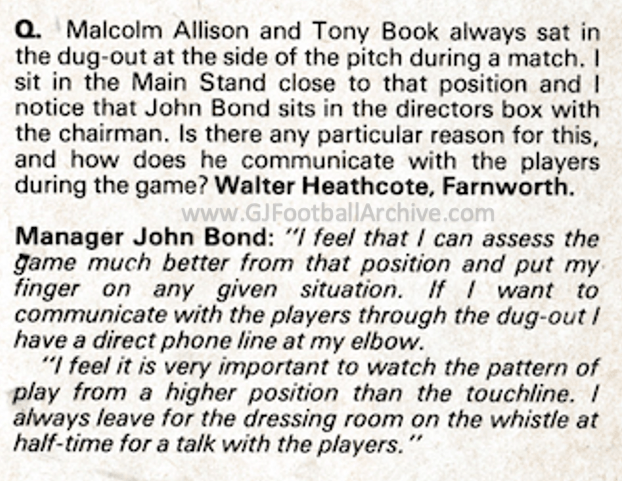
Malcolm Allison’s bold prediction of how great City’s victory will be is ridiculed as the Blues are heavily defeated by a Steve Coppell inspired United.  City are a well-beaten side while United win at a canter with Andy Ritchie comfortably netting the third twenty minutes from time.

Fightback!

Manchester City’s amazing fight back against Tottenham on this day (4 February) in 2004 was the inspiration for a winning play (written by a female Spurs fan) in the Radio Five Live Short Story competition of 2005.  The Blues had been losing 3-0 at half time in this FA Cup 4th round replay and down to ten men but an amazing fight back saw City win 4-3.  The play was a story of commitment (it was clearly fiction – the City fan had walked out at half time!). Here’s the story of that game, with exclusive quotes from interviews I have performed, and highlights of the FAC replay:

Subscribe to get access

Read more of this content when you subscribe today. It costs £20 a year (access to everything on the site) or £3 per month (see below).

Subscribe to get access

Read more of this content when you subscribe today. It costs £20 a year (see above) or £3 per month (cancel anytime; access everything since 1st October 2022).

Franny’s First

Tony Coleman was Manchester City’s regular penalty taker before Francis Lee. Lee later gained somewhat of a reputation at Manchester City for his penalties but it wasn’t until he’d been with the club for over three months that he netted his first at Maine Road.  On this day (20 January) in 1968 Coleman’s substitution meant that Lee’s first City penalty was scored V Sheffield United (see photo of the goal).

City won that game 3-0 and, of course, ended the season as League champions.

I was 3 months old then and doubt I was at this game (although my parents used to take me as a baby). Were you at this match? If you were why not leave your memory as a comment or email it to me for possible future use on this website?

Colin Bell’s Injury

On this day (12th November) in 1975…

Attendance: 50,182; City 4 United 0 (League Cup 4th round)

A 35 second opener from Tueart and a world-class performance by Hartford give City total control of this tie.  However few at Maine Road are able to celebrate as a fifth minute tackle by Buchan on Bell causes the influential City star to be stretchered away.  City deserve the victory, but the cost is high.

I’ve written lots on Colin Bell over the years and I was fortunate to interview him a few times too. You can read some of the articles I’ve written here:

You can watch highlights of the game here:

A Classic Derby

On this day (6th November) in 1971…

Attendance: 63,326; City 3 United 3

In one of the great derbies more than 63,000 fans thrill to an all-action display of attack that epitomises all that is good about Manchester football.  United take a two goal lead but the Blues keep fighting back.  In the final minute Summerbee makes it 3-3 to end a classic match.