The 1940s: The 1947-48 Season

The new series on Manchester City in the 1940s continues with this feature on the 1947-48 season. This 1000 word subscriber article can be read by subscribing below.

Subscribe to get access

Read more of this content when you subscribe today. It costs £3 per month or you can subscriber for the discounted annual rate of £20 per year. Each subscriber gets access to everything posted so far, including PDFs of a couple of my books.

Programme Flashback City V United, 20 September 1947

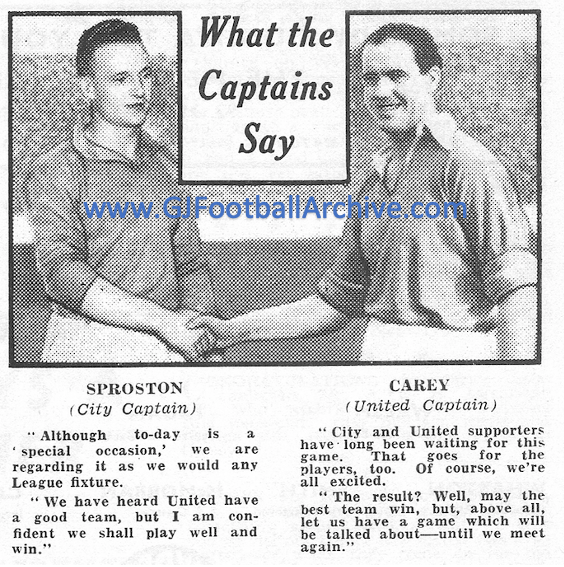
On this day in 1947 Manchester City faced Manchester United at Maine Road. This was a home game for City against their tenants United.

Here for subscribers is a flashback piece detailing what features were in the MCFC match programme that day:

Subscribe to get access

Read more of this content when you subscribe today. It costs £3 per month or sign up for a year at the discount price of £20 per year. Why not subscribe for a month and see what you think?

Maine Road 100 – Day 82

It’s post 82 of my 100 Maine Road countdown and today a reminder of the largest ever Manchester derby crowd for a game at City or United. On 20 September 1947 a crowd of approximately 78,000 witnessed the first post-war Manchester derby.  A tense match ended goalless before the derby’s record crowd on a club ground. This attendance remained the highest for a Manchester derby until the 2011 FA Cup semi-final at Wembley Stadium. The return fixture, also played at Maine Road, was watched by 71,690.

Subscribers can read the story of the 1947 game (background, match report, statistics etc.) below:

Subscribe to get access – Annual

You can read this detailed article when you subscriber (plus all other material on the site). It costs £20 a year (£1.67 per month) to subscribe or you can subscribe a month at a time (see below).

Subscribe to get access – Monthly

You can read this detailed article when you subscribe (plus all other material on the site). It costs £20 a year (above) to subscribe annually or you can subscribe a month at a time for £3 per month (cancel anytime; monthly subscribers get access to everything posted since 1 October 2022).

Wembley Finals

The FA Cup helped establish Manchester’s footballing identity – more on that in a minute. On this day in 1948 Manchester United appeared at Wembley for the first time to win the FA Cup. Manchester’s 1st FAC success came in 1904 (City). Before 1948 the Blues had appeared in 3 Wembley finals. Utd’s 1948 success meant 2 FA Cups each.

More on 1904 here:

United beat Blackpool 4-2 in the 1948 final wearing blue.

A Manchester Derby Record Crowd

On this day (20 September) in 1947 a crowd of approximately 78,000 witnessed the first post-war Manchester derby.  A tense match ended goalless before the derby’s record crowd on a club ground. This attendance remained the highest for a Manchester derby until the 2011 FA Cup semi-final at Wembley Stadium. The return fixture, also played at Maine Road, was watched by 71,690. Subscribers can read the story of the 1947 game (background, match report, statistics etc.) below:

Subscribe to get access

You can read this detailed article when you subscriber (plus all other material on the site). It costs £20 a year (£1.67 per month) to subscribe

Football Funeral Cards: 1948 FA Cup Final

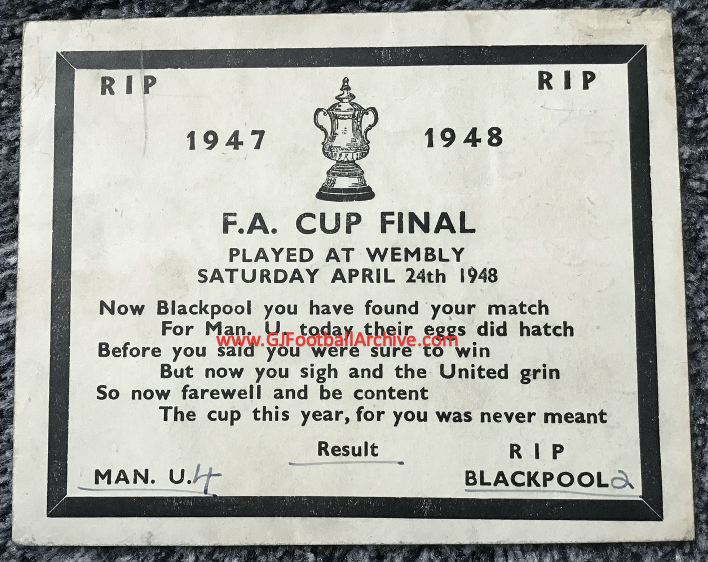
Recently this card was shown to me. It’s a memorial card commemorating Manchester United’s victory over Blackpool in the FA Cup final. The football funeral card business was huge at one point and, in the days of football half-half friendship scarves, was a somewhat macabre way of providing a souvenir of a game. I’ve written a lot on these in recent years and here’s an article I posted a short while ago:

It’s great to see the 1948 card pictured above and it adds to the view that these continued into the 1950s. People have written that the trend for doing football memorial cards died out after World War One but in my article I explain how it continued for decades. It was also a prominent activity with a variety of people profiting from it. Manchester was one of a number of centres for the activity and cards were printed in the city for distribution at games across England.