Together with Fiona Skillen, Helena Byrne and John Carrier I have co-authored an article on women’s football and the impact of the 1921 #FABan. The reason we wrote this academic article was to highlight that too often we assume that what happened in England is what happened across Great Britain and Ireland. It isn’t and in this piece you can read an overview of each nation and what occurred. The article is open access/free to read here:
I hope you enjoy that. We do see this article as a means of highlighting the differences and we see this as a call for more detailed research, properly triangulated, to ensure we uncover the true development of women’s football across England, Scotland, Wales, Northern Ireland and Ireland. No book has yet been published that comes anywhere close to telling the development of women’s football across each of these nations with some making assumptions that are simply not valid across each nation. Our article cannot cover everything but I hope it gives a taster for the topic.
Special thanks to Glasgow Caledonian University for making this open access. It really is appreciated.
It is worth reading the piece (well, it’s free so you may as well have a look!) to see what happened in your part of the UK and Ireland. For those with a Greater Manchester interest you’ll see mention of Manchester United, Bolton Wanderers, Manchester Corinthians and Manchester Ladies. Some interesting stuff on crowds. Also, if you’re a fan of Stoke City, Manchester City, Manchester United, Oldham Athletic or Everton you can see what happened to their former player Jimmy Broad when he tried to train a women’s football team in the 1950s!
I have written other academic articles on women’s football but these tend to be behind a publisher’s paywall. If you have access via a library or university here’s one that may be of interest:
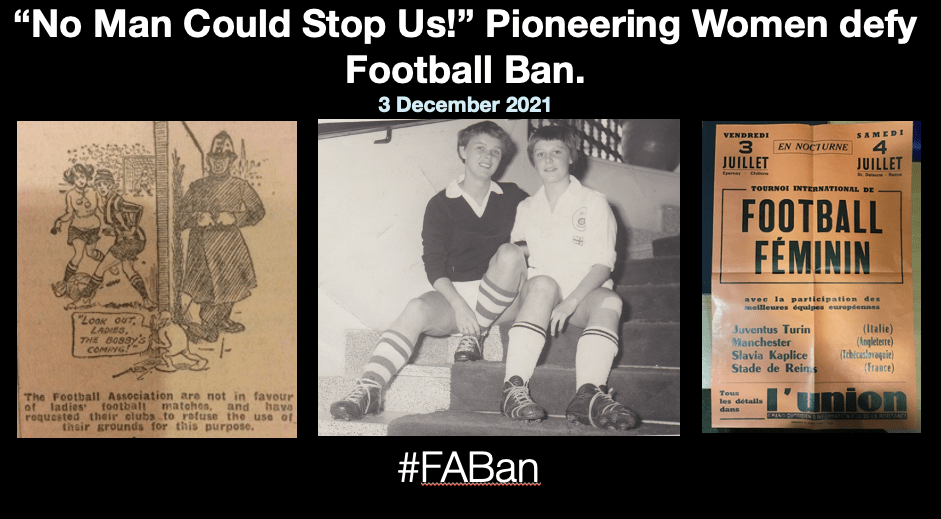
On Friday December 3 2021 I staged an event at Hebden Bridge Town Hall to mark the centenary of the FA Ban of women’s football being played on FA affiliated grounds. The ban, which also meant that those working for FA affiliated clubs could be punished if they were involved in coaching or organising women’s football teams, lasted until 1970. The event included a presentation on the history of women’s football and interviews with former players from Manchester Corinthians, Manchester City, Manchester United, Doncaster Belles and England. Here’s a few details about the night.
Firstly I’d like to thank Margaret Whitworth, Margaret Shepherd, Lesley Wright, Jane Morley, Gail Redston and Issy Pollard for their contribution to the night. I’d also like to thank Geoff Matthews and his company Cansquared for sponsoring the evening.
Over eighty people came to Hebden Bridge Town Hall for this important event. During the evening I walked through the history of the women’s game, highlighting the development of the sport during the period from 1880 to 1914 – a time which saw high profile games and clubs become established in a number of locations (including Manchester and Liverpool).
The presentation moved on to talk about the developments during World War One and the establishment of several prominent teams, including Dick, Kerr Ladies of course and Huddersfield Atalanta. I also explained the extent of the game by 1921. Some often talk about a few high profile games and they are important but, for me, it’s the extent to which the sport penetrates down the levels that is most important. At the talk I explained about events in Hebden Bridge and other places where women’s football was openly discussed or promoted in 1921.
I discussed the ridiculous reasons the FA claimed for banning women’s football – health and financial mismanagement – and how they could easily have been challenged or investigated properly if the FA had actually wanted to promote the sport.
During the evening I also gave examples of men who were punished for coaching women’s teams – including a groundsman from the 1950s! This for me is important as it demonstrates that the FA did punish people and did want to kill off female participation.
The presentation saw the story of women’s football brought into the 21st Century but the best part of the evening for me was without doubt the interviews with the former players who were our guests that night. These interviews were with Margaret Whitworth (Manchester Corinthians), Margaret Shepherd (Manchester Corinthians), Lesley Wright (Manchester Corinthians, Manchester City & more), Jane Morley (Manchester United, Redstar & more), Gail Redston (Manchester City, Oldham & more) and Issy Pollard (Bronte, Doncaster Belles & England).
In the audience were several other footballers including Stacey Copeland and others who played for Manchester City, Redstar and other teams from Greater Manchester and Yorkshire.
Hopefully, I’ll get to post some of the interviews from the night here one day, but in the meantime follow the links below to read other features on the Manchester Corinthians, Manchester City etc. Don’t forget there are also a limited number of copies of my Manchester City Women: An Oral History book available via my shop page here:
I’m really looking forward to tonight’s ‘No Man Could Stop Us!’ show at Hebden Bridge Town Hall. If you are coming then feel free to use the hashtag #FABan when mentioning it on social media. We have some excellent guests and I’ll be highlighting the history of women’s football from the nineteenth century through to the 1921 FA ban. I’ll then explain what happened to the sport over the following 50 years, until it was officially lifted in January 1970. We’ll be hearing from players who had lengthy careers with Manchester Corinthians, Manchester City, Manchester United, Redstar, Bronte, Doncaster Belles and England. It promises to be an excellent night.
Late next week I’ll post an article here on the evening’s events for those unable to make it. The evening has been sponsored by Geoff Matthews and his company Cansquared – thank you for all your support and enthusiasm.
On Friday 3 I’ll be talking about the FA ban on women playing on FA affiliated grounds. It will be the centenary of the ban on December 5 2021 and ill be talking with women who played during the ban in the 50s and 60s and others who played in the 70s onwards. Incredibly the FA ban wasn’t lifted until 1970 and even then the FA did nothing to promote female participation. Details of the talk below (follow the link):
Aware of when England beat Germany in the final of a European tournament in 1957? No, well here’s the story of when they did…
The match saw the pioneering women’s team, Manchester Corinthians, play as England. They won 4-0 in the final of a European championship in 1957, played in Berlin. This game, like so many others when the Corinthians played as England, are not officially recognised as internationals unfortunately, but no one should underestimate the achievements of the Manchester women who took part. At the time they occurred these were full-blooded affairs with some moments caught on film.
For an article I wrote some time ago on the Germany game follow this link:
Today (8th March 2021) is International Women’s Day and so I thought I’d post a few links to great content about pioneering women connected to Manchester football on this website.
My intention over the coming months and years is to make http://www.GJFootballArchive.com an archive of my past writing and new material on all aspects of football in the Manchester region (and material on activity beyond Manchester or involving national figures connected with the region). To subscriber to my site then please see the details below.
This includes material on the women’s teams of Manchester, such as the pioneering Wythenshawe/Manchester Ladies of the 1940s & 1950s; the Manchester Corinthians (globe trotting pioneering team of the 1940s to 1980s); Manchester City; Manchester United and the other clubs, such as FC Redstar, that have existed in our region. It also includes profiles and interviews with footballers; those working in football and the media; footballers’ partners; supporters and more.
All of this is based on my detailed research and writing on football in the region. I attended my first women’s game in 1988 (home team was F.C. Redstar) and was a regular at their games and Manchester City Ladies (now Women) during their formative years, including brief details on their first ever game in my first book published in 1989. Since then I’ve also written Manchester City Women: An Oral History (see https://gjfootballarchive.com/shop/ to order copies) and am researching for a detailed history on women and football in Manchester at the moment.
Listed here are a few links to articles connected with women, football and Manchester that may be of interest:
I did an interview with Premier League World on Manchester City Women. It’s episode 38 and can be viewed here (if you have Amazon Prime): https://www.amazon.co.uk/Premier-League-World/dp/B08HDGSNZN Or it can be viewed on the following channels:
BT Sport 1 Monday 12pm
BT Sport 1 Tuesday 12:30am
Sky Sports Premier League Thursday 5pm
Sky Sports Premier League Friday 3pm
Sky Sports Premier League Saturday 8am
The feature is the last one shown in the programme, so please keep watching to the end. The piece starts after about 18 minutes.
To access all of the above and everything else on this site please subscribe:
Subscribe to get access
If you would like to read all the in-depth articles on this site (including the entire Manchester A Football History book and the audio interview with John Bond) then please subscribe. It works out about £1.67 a month if you take out an annual subscription (£20 per year) or £3 a month if you’d like to sign up for a month at a time. Each subscriber gets full access to the 270+ articles posted so far and the hundreds scheduled to be posted in the coming weeks.
Today’s guest blog follows on from last week’s guest blog in which Steve Bolton talked of the Manchester Ladies (who also went under the name Wythenshawe Ladies, City of Manchester Ladies, Manchester City Ladies the 1940s & 1950s) and their early years. Today is part two of Steve’s research into this pioneering women’s club (part one can be viewed here: https://gjfootballarchive.com/?p=1863 ).
Over the last few years much has been written about pioneering women’s football teams and Steve’s research is certainly adding to that. I’m sure anyone reading this already knows about my book on Manchester City Women (available here: https://gjfootballarchive.com/shop/ ) and about the other articles on this blog discussing other leading women’s clubs, including the Manchester Corinthians (see: https://gjfootballarchive.com/category/womens-football-2/ ).
If you played for a women’s team in the Manchester region during the 1940s to 1960s then please get in touch. I’m writing a detailed history of the Manchester Corinthians to be published in 2024 and your information may help both mine and Steve Bolton’s research. For more on the Corinthians book see:
If you played an active part in developing women’s football prior to the FA ban then please get in touch by emailing gary@GJFootballArchive.com or follow me on twitter: @garyjameswriter or facebook.com/garyjames4
Over the last few years much has been written about pioneering women’s football teams and I’m delighted to say that Manchester has had several of these over the years. I’m sure anyone reading this knows about my book on Manchester City Women (available here: https://gjfootballarchive.com/shop/ ) and about the other articles on this blog discussing other clubs, including the Manchester Corinthians (see: https://gjfootballarchive.com/category/womens-football-2/ ).
Thanks to the Manchester Corinthians the story of pioneering Mancunian female footballers has received some decent coverage in recent years but it would be wrong to think that the women who played for Corinthians were the first women who played football in our region. There are games staged in Manchester going back to the 1880s of course. However, following the 1921 ban (which saw the FA ban women’s football games from FA affiliated pitches) opportunities were restricted significantly.
In Preston the famous Dick Kerr Ladies have been heralded for their efforts and in the 1950s & 1960s Manchester Corinthians found global fame for their exploits, but football tends to overlook many other clubs and in 1940s Manchester, before the Corinthians became established there was another female football club that promoted the sport, charity work and female prowess.
For today’s guest blog researcher Steve Bolton provides the first part of his research into the stories, facts and evidence of this Manchester team:
If you played for a women’s team in the Manchester region during the 1940s to 1960s then please get in touch. I’m writing a detailed history of the Manchester Corinthians to be published in 2024 and your information may help both mine and Steve Bolton’s research. For more on the Corinthians book see:
If you played an active part in developing women’s football prior to the FA ban then please get in touch by emailing gary@GJFootballArchive.com or follow me on twitter: @garyjameswriter or facebook.com/garyjames4
2019 marked the 70th anniversary of the establishment of Manchester Corinthians – a pioneering women’s team that toured the globe promoting women’s football and Manchester.
The Manchester Corinthians were a team of local women who were brought together under the management of Percy Ashley at a time when the FA banned women from playing on FA affiliated grounds. Established in 1949, Ashley’s team toured the world promoting the sport and demonstrating what a dedicated group of players the club possessed. This was at a time when FA affiliated clubs were banned from allowing women’s games on their grounds.
Many of the Corinthians are now in their seventies and eighties but they still get together from time to time to talk of their exploits. In September 2019 I managed to arrange with Manchester City for some of the women who played for the Corinthians to be guests of City at a women’s game at the Academy Stadium. While there I chatted with a few of the women. Margaret Hilton, who now lives in Australia, told me her memories of a groundbreaking tour in 1957: “Bert Trautmann, the City ‘keeper, joined us on a tour of Germany. He acted as an ambassador and watched some of our games. We saw him around but I was too shy to chat to him. It was great having that recognition and support.”
Corinthians, representing England, won a major competition in Germany which was, at the time, regarded as a women’s European Cup – these were the early days of cross-continent football and UEFA were not involved with organising competitions for the women’s game. Anne Grimes felt that winning that competition in 1957 encouraged the club to make further trips abroad and to play in major stadia. 50,000 watched them in a game at Benfica and then in 1960 the Corinthians ventured outside of Europe for a tour of South America. It was supposed to be a six week tour but such was the popularity of the games that the women were asked to stay for three months. Margaret ‘Whitty’ Whitworth told me: “We stayed in all the best hotels and it was quite glamourous. There were lots of scrapes along the way. We were young women and loved every minute of it. We didn’t care about the FA ban, we just got on and played.”
Whitty had joined the club as an eleven year old in 1958 and was fourteen when she travelled to South America. Her parents had to give permission but some of the women also gave up their jobs for the opportunity of representing Manchester – and England – on the tour. Whitty: “What a great experience for us all! The stadiums… the reception from the crowd… it was all incredible but we all just took it in our stride. It’s only afterwards that you look back and realise how significant it all was.”
A second team was established by Percy Ashley as time progressed called the Nomads – it’s no coincidence that Ashley chose the names Corinthians and Nomads. Both these names had been used by prominent amateur male football clubs that had toured promoting the game and this is exactly what he sought from his women’s teams. He wanted them to promote all that was positive about female participation in football and they certainly achieved that over the decades. The Nomads and Corinthians would face each other regularly, raising money for charity and, to ensure fairness and quality, the teams would be balanced when appropriate.
The Corinthians and Nomads won a host of tournaments and trophies over the years and in 1970 Whitty was player of the tournament when they found trophy success at Reims in France. Margaret Shepherd, nicknamed Tiny due to her height (she was a tall central defender!), remembers the excitement of that trip and the celebrations that followed the victory over Juventus in the final: “It was a great experience and the celebrations were so special.”
The experience of playing against leading European teams was to have a major impact on the lives of the women. In fact, Jan Lyons, decided to move to Italy to spend more time playing football and ended up playing for Juventus for two seasons in the Italian women’s league of the period.
Manchester Corinthians survived into the modern era and continued to play once the FA ban was lifted – a ban they had challenged. The club was still going strong in 1982 but, due to ground changes and related issues it soon officially changed its name to Woodley Ladies, though was often still known as Corinthians. Some of the 1980s team members became players with Manchester City’s women’s team in its inaugural season of 1988-89. By that time the volume of women’s clubs, leagues and competitions had grown.
The club was resurrected for a period in the late 1980s, playing in Tameside, but it was during the period between 1949 and 1975 that Corinthians were true pioneers. They promoted the sport globally at a time when many refused to accept that women could play football.
Hopefully, over the coming years, we’ll be able to promote the club, its achievements and these pioneering women further in Manchester.
I’m writing a detailed history of women and football in Manchester. If you played an active part in developing women’s football prior to the FA ban then please get in touch by emailing gary@GJFootballArchive.com or follow me on twitter: @garyjameswriter or facebook.com/garyjames4
My book on Manchester City Women (which talks of the evolution of women’s football since the late 70s and the Corinthians women who played for City) can be ordered here (all copies will be signed by me): https://gjfootballarchive.com/shop/
This paper provides an overview of an oral history project focusing on the experiences of female footballers, in particular those playing for Manchester City Women since its formation as a community initiative in 1988, through to its modern-day position as a leading Women’s Super League club. It discusses the development of the project, analysis of the methodology employed and provides high-level findings on the club’s history, the participants and the research process. For too long female participation, even at England’s most famous clubs, has not been widely recognised, reported on or understood. This project, supported by a professional football club, begins to address these omissions. It does so by focusing on personal testimonies, together with archive material to generate an historical account of how a team, established as a community initiative, developed into a major trophy-winning club.
If you would like to read the full article and other pieces like this then please subscribe below. It works out about £1.67 a month if you take out an annual subscription (£20 per year) or £3 a month if you’d like to sign up for a month at a time. Each subscriber gets full access to the 100+ articles posted so far and the hundreds scheduled to be posted in the coming weeks.
Subscribe to get access
Read more of this content when you subscribe today.