Manchester’s First Women’s League Derby

Last Wednesday an article I wrote on the first women’s Manchester Derby in a league between City and United was published in the Mirror’s Women’s Football News. For those that think competitive league derbies are a recent thing, it’s worth noting that the game occurred more than three decades ago. It also made reference to my research into Manchester Corinthians. You can read it here:

You can also read about the new Corinthians book here:

The 1990s: The Super League!

The series of features covering Manchester City in the 1990s continues today with this reminder of the days when the creation of a Super League was leaked to the press. The Super League eventually became the Premier League and the key clubs behind the move were Arsenal, Tottenham, Liverpool, Everton and Manchester United. Much of the coverage from this period in 1991 focused on these clubs wanting to exert greater control on football’s finances, i.e. to carve up the game’s riches for the biggest clubs of the era. These cuttings are all from the start of April 1991.

Back then the Football League had four divisions and voting rights were equal for all clubs in the top two divisions (the ‘full members’ of the League, hence the Full Members Cup). The bottom two divisions were classed as associate members and they still had voting rights which many in the top division objected to. They felt the clubs outside the top flight should not control the League’s finances and direction.

It wasn’t the first time the establishment of a Super League had been discussed (usually it involved the idea of bringing leading Scottish clubs into a British league system) but it does appear to be the first time the leading clubs in the top division wanted to limit the influence of the others.

You can see from these articles who the leading architects were and how fans reacted. This piece quotes Frank Horrocks from the MCFC Supporters Club. Many of his concerns have proved to be true in the 30+ years that have followed:

All these years on there have been multiple attempts by certain clubs to limit the opportunities for others and create an environment where they can prosper without necessarily investing. Many of the financial issues between the rich and the rest in football that people talk of today were created as a result of the greed of several clubs in the early 1990s.

For Manchester City the 1990-91 season saw a shock managerial departure could have disrupted the club but ultimately they finished 5th, 3 points ahead of Manchester United. Here’s a 2,700 word article on that season:

Subscribe to get access – Monthly

Read more of this content when you subscribe today. It costs £3 per month (cancel anytime) to access everything posted since 1 October 2022 or there’s a special annual rate below which gives greater access and works out much cheaper.

Subscribe to get access – Annual

Read more of this content when you subscribe today. It costs £3 per month (above) or £20 a year (here) to access everything posted since the site was created in December 2020. This special rate works out about £1.67 a week and gives access to everything posted, including PDFs of 3 of my books.

This series of articles and features will run throughout March with indepth articles some days and smaller ‘on this day’ style posts on others. There will be flashbacks to great games, players and more. Every day in March will offer something to enjoy.

Subscribers will get access to everything, while some on this day material will be free for all to view.

If you want to know more on this incredible decade for Manchester City Football Club then why not subscribe and read it all? If you’d like to know more about subscribing then see:

The 1990s: The First Women’s Manchester League Derby

The latest City in the 1990s flashback feature is about the women’s Manchester derby. This weekend marks the latest Manchester derby in the Women’s Super League and it will be played at the Etihad Stadium (City currently hold the record attendance for a women’s club game in Manchester – you can find details of that elsewhere on the website). There’s a long history of competition between teams representing the women of Manchester City and Manchester United.

City’s team has been in existence continually since November 1988 when Donna Haynes and Heidi Ward both scored two goals in their first game (v Oldham Athletic at Boundary Park).

I was at the City Ladies (as they were then known) first game and I was also at their first league derby in September 1990 when City defeated United 4-3. It was a fantastic day, watched by around 150 people.

City’s goals came from Rhoda Taylor (8 min), Rachel O’Shaughnessy (43 mins), Jenny Newton (50 mins) and Lesley Peters. City’s manager Neil Mather told me as part of my research for the Manchester City Women book: ‘United were the top side, you know, and beating them was so good for morale. The men’s team were a good side in the early 90s when City Ladies carried on developing, you know. This was the Howard Kendall era, and City had top five finishes. City were one of the top five or six teams in the country at the time, so it was fabulous for women’s football to have Man City, you know.’

Helen Hempenstall played for City that day and she described her memory of the day for my book: I remember when we played United (30/9/90) and Neil (Helen’s boyfriend, now husband) and all his mates came to watch us. There were a lot of people there that day. United had a decent team then. It was always a difficult game against United. They had a right-winger… We never got on. Every time we played each other we were at each other all the way through the game. Me and Carol Woodall were having a go at her. The referee told Lesley Wright “Tell both your full backs to shut their mouths otherwise they’ll both be off!” We just didn’t get along and before every game I thought I’ll get in their first. ‘I’m having her.’ Neil Mather still talks about it.

‘I think Lesley Wright kept the team together. She kept it all tight at the back. I played at the back with her and I learnt a lot from her. Because I was next to her I knew how important she was. If I missed something she always got it. She always encouraged me and kept shouting ‘different class, different class’. You learn from the people around you and I listened to her. Before every game she came to speak to me. She’d put her arm around me and reassure me. She’d tell me not to worry about anything. Most of the time travelling to away games I’d go with Lesley in the car. We used to have a laugh. I remember one day we were travelling to an away game some distance away and we stopped for petrol and all got out. I lit up a fag and everyone else jumped back in the car screaming! I didn’t even think! When we got to the ground they all told Neil Mather and I think he worried that he could’ve lost half his team. At another game I was sat in the middle and as we got out the person before me slammed the door back. It hit my head and I had a big lump for the game.’

Lesley Wright was one of several women who had first played for the pioneering Manchester Corinthians team. I’ve been researching their remarkable story for years and this summer (2024) my work will be published. It will tell the story of the Corinthians from its formation in 1949 through to its final days forty years later. For more information on that club and the book see:

The story of the first women’s League derby and of the first 30 years or so of City Women’s existence can be read in my book on the club. It’s called Manchester City Women: An Oral History and is basically the women telling their stories of playing for the club and how they got into football, plus statistics covering the journey from friendlies in 1988-89 through to competition and the modern day successes.

You can buy the book via this link (every copy is signed by me):

The 1990s: Prince at Maine Road

Alongside all the football at Maine Road the 1990s saw a series of major concerts held at Manchester City’s old stadium. On this day (9 March) in 1990 tickets for the following August’s concert by Prince were advertised.

You can find out more about Maine Road and its first concerts here:

The 1990s: City 3 Luton 0

The series of articles covering Manchester City in the 1990s continues today with an on this day (5 March) from 1991 when the Blues defeated Luton 3-0 with goals from Niall Quinn (2) and a penalty from Clive Allen. Here’s an interesting clip from the old Saint and Greavsie show which showed the action as part of their preview of the City v Liverpool game. It’s interesting as it’s clear from this that City WERE seen as a potential challenger that season (so many people try to claim otherwise!). The 1990s was not all bad!

Here’s the clip:

The 1990-91 season had included a shock managerial departure which could have disrupted the club but ultimately the Blues finished 5th, 3 points ahead of Manchester United. Here’s a 2,700 word article on that season:

Subscribe to get access – Monthly

Read more of this content when you subscribe today. It costs £3 per month (cancel anytime) to access everything posted since 1 October 2022 or there’s a special annual rate below which gives greater access and works out much cheaper.

Subscribe to get access – Annual

Read more of this content when you subscribe today. It costs £3 per month (above) or £20 a year (here) to access everything posted since the site was created in December 2020. This special rate works out about £1.67 a week and gives access to everything posted, including PDFs of 3 of my books.

This series of articles and features will run throughout March with indepth articles some days and smaller ‘on this day’ style posts on others. There will be flashbacks to great games, players and more. Every day in March will offer something to enjoy.

Subscribers will get access to everything, while some on this day material will be free for all to view.

If you want to know more on this incredible decade for Manchester City Football Club then why not subscribe and read it all? If you’d like to know more about subscribing then see:

The 1990s: 1990-1991 End Of The Affair

The series of articles covering Manchester City in the 1990s continues today with the 1990-91 season when a shock managerial departure could have disrupted the club but ultimately they finished 5th, 3 points ahead of Manchester United. Here’s a 2,700 word article on that season:

Subscribe to get access – Monthly

Read more of this content when you subscribe today. It costs £3 per month (cancel anytime) to access everything posted since 1 October 2022 or there’s a special annual rate below which gives greater access and works out much cheaper.

Subscribe to get access – Annual

Read more of this content when you subscribe today. It costs £3 per month (above) or £20 a year (here) to access everything posted since the site was created in December 2020. This special rate works out about £1.67 a week and gives access to everything posted, including PDFs of 3 of my books.

This series of articles and features will run throughout March with indepth articles some days and smaller ‘on this day’ style posts on others. There will be flashbacks to great games, players and more. Every day in March will offer something to enjoy.

Subscribers will get access to everything, while some on this day material will be free for all to view.

If you want to know more on this incredible decade for Manchester City Football Club then why not subscribe and read it all? If you’d like to know more about subscribing then see:

Starting Tomorrow: The 1990s

A new series of articles starts tomorrow on Manchester City in the 1990s. There will be a seasonal journey through a truly important decade when Manchester City began the decade hoping to challenge for the Premier League. People often forget how things changed that decade. A giant of a club at the start of the decade and one that the whole football world recognised as being part of English football’s aristocracy. By the end of the decade it was the loyalty of fans that most recognised the club for.

Those that claim City has ‘no history’ may learn something about a decade that is often highlighted for its failings but which actually had some wonderful, incredible, positive moments too. This series of features will show how that decade actually went and will hopefully help to explain why the narrative of ‘third tier club that got lucky’ is so wrong! For the entire month of March there will be features to make every Blue proud, while also recognising the true nature of football – some times it’s great being a fan and sometimes it’s awful. That’s football!

Re-live the highs and lows of the 1990s decade from tomorrow onwards.

If you’d like to read everything in this series then please subscribe. Details below:

Manchester City in the 1990s

Following on from the series of articles and features on the 1970s and 1980s over the last few months a new series on Manchester City in the 1990s will be starting in March. As with the 1970s & 1980s there will be different content posted each day from indepth articles on each of the seasons through to on this day reminders of games, players and more.

Some of the material will be available for subscribers only and some will be free for anyone to read. If you’d like to know how to subscribe and read all the incredible content on here then see:

Feel free to send in ideas or areas that you’d like me to discuss on 1990s Manchester City. I’m always open to adapting stories or content based on feedback. Thanks for reading.

1990s Football Banter

The departure of Howard Kendall from Manchester City in November 1990 led to a number of fan related chants, banners and more as fans tried to make their feelings known. United fans got in on the act and started to sing a version of Blue Moon that laughed at Kendall’s departure (which in itself shows how much everyone believed Kendall would bring success City’s way). City fans retaliated with a version that reminded United that only a year or so earlier City’s bargain basement Blues had defeated Ferguson’s Reds 5-1 – at that time the United team assembled by Ferguson was the most expensive British team ever created (and he still had further spending to make).

Banter between the Blues and Reds continues, with Kendall’s departure at the centre of it all but, demonstrating the self-deprecating sense of humour the Blues were known for at this time, Kendall started to be blamed for almost everything that was going wrong in Manchester. Unemployment rises – that’ll be Kendall’s fault. Buses are late – Kendall did that… and so on. Even a storyline in Coronation Street triggered a banner. In the soap opera Mavis and Derek Wilton’s house had been broken into. Who was to blame? Howard Kendall of course if a banner in the North Stand at Maine Road was to be believed.

This Manchester Evening News cutting mentions the chants and the banner. The banner appeared at the City-Leeds game played on this day (11 November) in 1990. It ended in a 3-2 Leeds win (bizarrely Alan Harper took a City penalty) and you can see the highlights here:

Kendall’s Departure

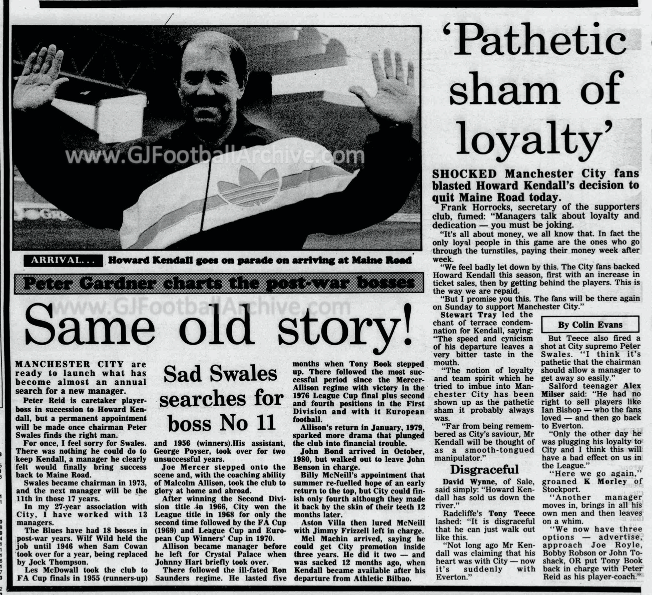
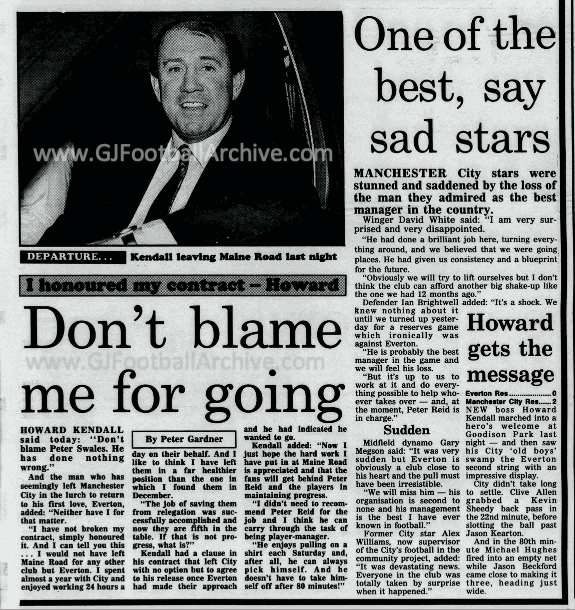
On this day (7 November) newspapers were full of the previous day’s news that had stunned Manchester City and that was the resignation of manager Howard Kendall. Kendall had decided to return to his former club Everton.

The move absolutely stunned City fans (though we did get the blame in some newspapers who claimed we’d never actually taken to him – absolute rubbish and demonstrates the typical attitude of the period which was if anything went wrong blame the fans!). Fans had voiced concern over Kendall’s signing of many, many former Evertonians but overall they were satisfied (more than satisfied) with the manager’s approach at City.

The bottom line with Kendall leaving is that chairman Peter Swales and his supporting directors had given him a contract that allowed him to walk out on the job whenever he chose. It was a strange situation and the belief at the time was that the City board had believed the ONLY job Kendall would be tempted to leave City for was the England job and, with Peter Swales in charge of the international selection committee, the chance of that happening was extremely slim.

Ah well! Here are some newspaper articles from this day back in 1990.