I’ve recently been asked about two players who were on Manchester City’s books, so thought I’d post a few details about them here, along with the Reserve line-ups for both 1958-59 and 1959-60. These make interesting reading, especially when attendances are checked.
I don’t have much on them but the players were Sand Wann and George Greenall. Wann joined City on 25/6/58 from Luncarty Juniors (Dave Ewing’s old team too!) and left City on 9/5/1960, joining St Mirren. George Greenall left City on 4/4/1960. My notes are not clear but George either went to Oldham or Southampton.
These images show the starting 11 for every MCFC Central League game in 1958-59 and 1959-60:
1958-59 Manchester City Reserves, Central League Starting 111959-60 Manchester City Reserves, Central League Starting 11
In 1959-60 George made 5 Central League appearances and Wann made 8. In 1958-59 Greenall played 2 and Wann 4.
Wann’s Central League games over both seasons were:
21/3/59 v Blackpool
11/4/59 v Barnsley
18/4/59 v Huddersfield
25/4/59 v Wolves
22/8/59 v Wolves
29/8/59 v Sheff Wed
31/8/59 v Chesterfield
5/8/59 v Aston Villa
19/3/60 v WBA
6/4/60 v Blackburn
15/4/60 v Bolton
23/4/60 v PNE
If you would like to support this website then why not subscribe or donate to keep it running? Details on how to subscribe appear lower down this page.
If you enjoy all the free material on my website and would like to support my research and keep this website going (but don’t want to subscribe) then why not make a one-time donation (or buy me a coffee). All support for my research is valued and welcome. It allows me to keep some free material available for all. Thanks.
Last Wednesday an article I wrote on the first women’s Manchester Derby in a league between City and United was published in the Mirror’s Women’s Football News. For those that think competitive league derbies are a recent thing, it’s worth noting that the game occurred more than three decades ago. It also made reference to my research into Manchester Corinthians. You can read it here:
On this day in 1904 (23 April) Manchester City won its first major trophy a mere decade after being established as MCFC. The captain and goalscorer was, of course, the great Billy Meredith.
A few years back, following the purchase of the oldest surviving FA Cup by Sheikh Mansour (to loan to the National Football Museum) I helped Manchester City with the story of the cup and its significance to Manchester. They’ve produced a video telling the story and it can be viewed here:
Interviews and research has been continuing for Manchester Corinthians: The Authorised History and one of these interviews helped confirm something that has been a bit of a ‘Holy Grail’ for my investigations. I’ll provide details in the book of course but it does mean that I can state with real accuracy that I have captured voices from every season of the club’s history from 1948-49 through to its final game. I’m really pleased with that.
Thanks to all those who have subscribed to the book – it helps enormously as the book and the years of research that have gone into this is all self-funded.
For those who haven’t subscribed or would like to know more on what the book will entail, here’s the latest information:
The book will tell the story via the voices of those involved from beginning to end (and beyond!), backed up with detailed archival research.
Myths, including some connected with the formation of the club, persist and still get promoted. For the first time, this Authorised History will highlight the key steps and people involved with the formation of the club, dispelling myths and properly acknowledging those who ensured the team had a life.
Hundreds of games have been identified with official – and unofficial – match reports adding flavour and supporting the words of the women who played.
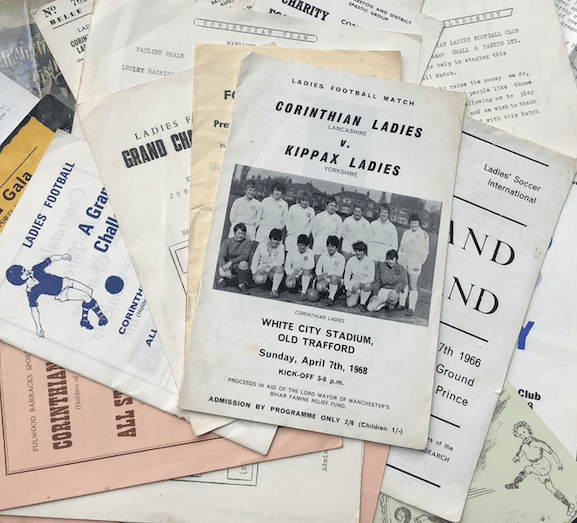
Rare objects, cuttings, match programmes, trophies and more have been located for this book, with many of the players lending their collections to help ensure this is a wonderful record of the club’s full life.
The Manchester Corinthians’ tours across the globe will be featured extensively within the book, while the key managers (especially the club’s manager and guiding figure from 1948-49 until his death in 1967, Percy Ashley) and other personalities will be profiled.
Dozens of interviews have been performed for the book and include women who played in the club’s first ever game in 1948-49 and others who played in the last ever game, decades later. It’s a wonderful period of football history.
Voices from every season of the club’s existence have been captured. There are some truly remarkable stories gathered in interviews performed across the country. These wonderful women have provided their memories of every period of the club’s development. Every season is covered.
Over 300 players have been identified as playing for the Corinthians to date. These women come from every era of the club’s existence (but the search continues for other names – please get in touch: Gary@GJFootballArchive.com). Every player identified will be listed within the book.
Every person ordering the book before publication will not only have the book posted to them before it appears in any shop, but they will also have their name (or another name of their choosing) published within a special roll of honour at the back of the book.
The book will consist of over 320 pages and will include hundreds of images from every era of the Corinthians, alongside the story of the club and its players.
As with Gary’s book on Manchester City Women this book is destined to be a landmark history on a true Manchester institution and pioneering football club. In some ways this new Corinthians’ history will be a prequel to the City Women book.
This book is being self funded by Gary and so every pre-publication order helps the research enormously. Thanks for your support. It is appreciated.
UK readers can subscribe to the book here (If you live outside the UK then please contact for details of additional postage costs):
Manchester Corinthians: The Authorised History
The story of a pioneering women’s club as told to Gary James by those who were there
£19.95
You do not need to have a PayPal account to order – use the ‘Pay with PayPal’ button above and it will give you the option to pay by credit/debit card without creating a PayPal account.
Here’s one of the TV reports that covered our plaque unveiling back in October. This is from ITV National News:
Here are a few words from a review of the Manchester City Women book the Corinthians will be based on (this is from a review by Fiona Cosson, for the Oral History Society):
ABOUT THE AUTHOR
Manchester football historian Dr Gary James has been researching and writing about football for around forty years, with his first book published in 1989. By that time Gary was a regular at women’s football games in the region and already knew several Corinthians featured in the Corinthians’ book. His connections with the team go way back, in fact his sister was taught PE in the 1980s by a prominent player with the club, while his mum once told him about an older girl being brought to the front in her school assembly during the 1950s to talk about travelling abroad as a Manchester Corinthian.
Gary was on the steering committee for the National Football Museum project Unlocking the Hidden History of Women’s Football and was the Trafford lead for the UEFA/FA project on the history of women’s football for the Women’s Euros in 2022. He has performed various talks and written many significant articles on the Manchester Corinthians throughout the last six years. He established the campaign to create a blue plaque and other tributes for the women who played for the club, working tirelessly to ensure the Corinthians’ receive the accolades they so richly deserve.
Gary’s research and writing is recognised for his quality and depth, and he has written several landmark publications on Manchester football (both men’s and women’s), as well as being historical consultant with films, such as The Keeper, and TV (including researching and producing a 6 part TV series). Gary is the founder of the International Football History Conference and in 2023 was appointed Visiting Research Professor at New York University. He is also an Honorary Research Fellow at De Montfort University.
You can watch a one hour talk Gary did at the National Football Museum on the history of women’s football in the Manchester region here:
The cover is still in development but the two cover images are draft proposals which will be worked up further. If you’d like to purchase Gary James’ earlier book on Manchester City Women’s team then a limited number of copies, signed by me, are still available. You can order here:
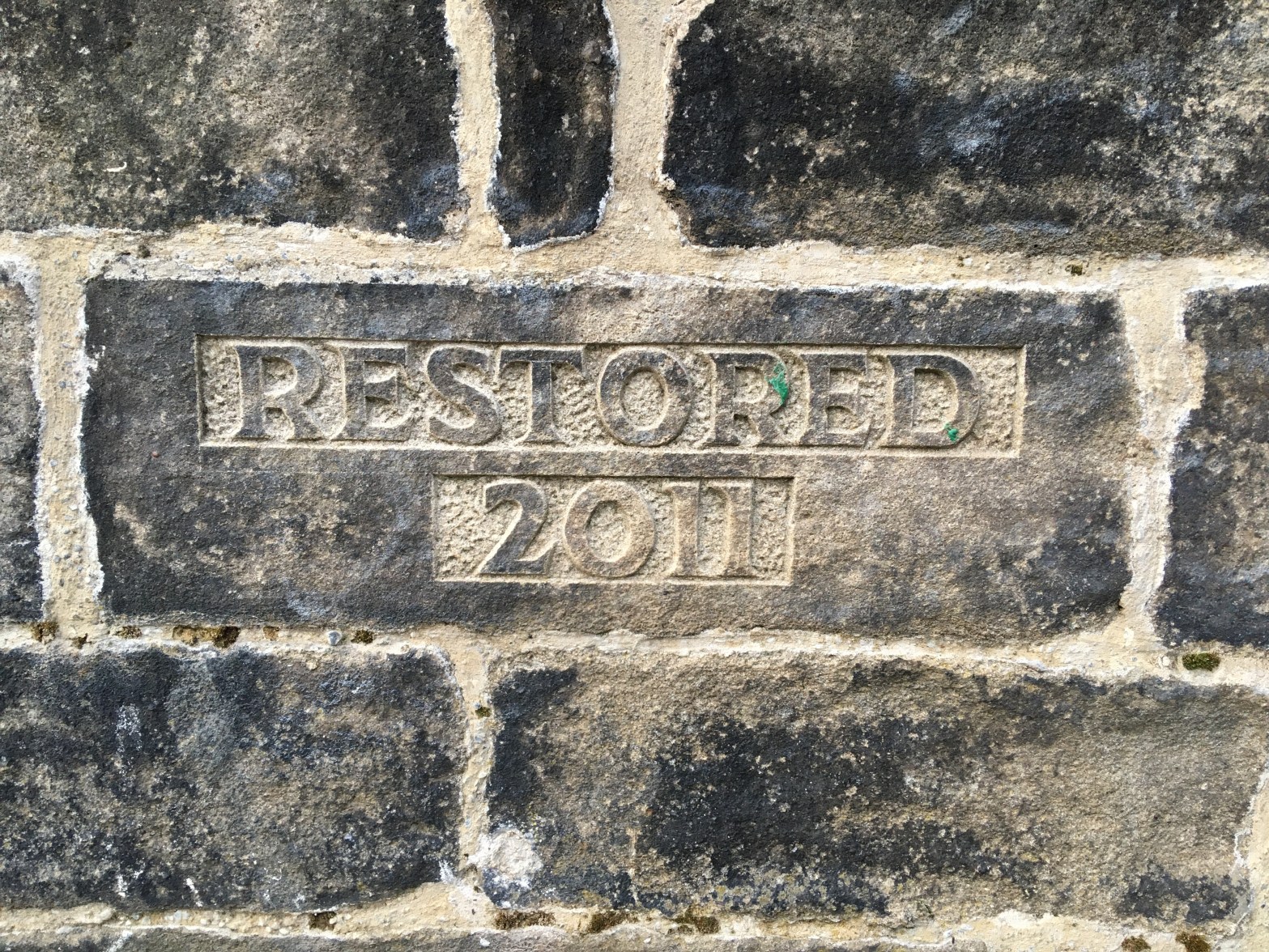
On 16 April 2011 Manchester City faced Manchester United in the FA Cup semi final. A few years back I produced Restored 2011: The All-Manchester FA Cup Semi Final and as we build up to another FA Cup semi final weekend involving both Manchester clubs it’s well worth reminding ourselves of this time.
This special 1 hour audio recording looks at the game and the years between City’s 1976 League Cup success and the FA Cup glory of 2011. The 2011 semi-final was a crucial step in City’s journey since the 2008 takeover and I felt it was vital to do a special marking this.
So what’s in this special recording? Well, I’ve included exclusive material from interviews and recordings I’ve done over the years with Garry Cook, Brian Marwood, Roberto Mancini, Peter Barnes and Peter Swales. Why Swales? Well, have a listen and you’ll hear why. Basically though I’m trying to set the tone for why the 2011 FA Cup semi final victory and overcoming Manchester United was so significant.
On Mancini… I include a few words from him recorded in 2011 and at one point he talks about the view that was then being expressed that City were ‘trying’ to buy success (now they say City ‘have’ bought success!). His words are a reminder that City have been having that particular criticism thrown at them for over a decade! Oh well, I wonder how long those criticisms were laid at other clubs who had seen major investment which propelled them forward?
Anyway, get yourself a brew and be prepared to be transported back in time. Here’s the recording:
If you enjoy the recording then please let me know, comment or subscribe to the site. If it’s of interest then, over the coming months and years, I’ll produce others like this highlighting key points in Manchester City – and Manchester’s – footballing history. It costs £20 a year to subscribe (it works out £1.67 a month) or £3 if you’d like to sign up a month at a time to get full access for as long as you subscribe (you can always try it for a month). It’s worth bearing in mind that the 2010 Manchester A Football History cost £24.95 and all subscribers will be able to access all of that for as long as they are a subscriber (plus all the other stuff of course). You can subscribe below.
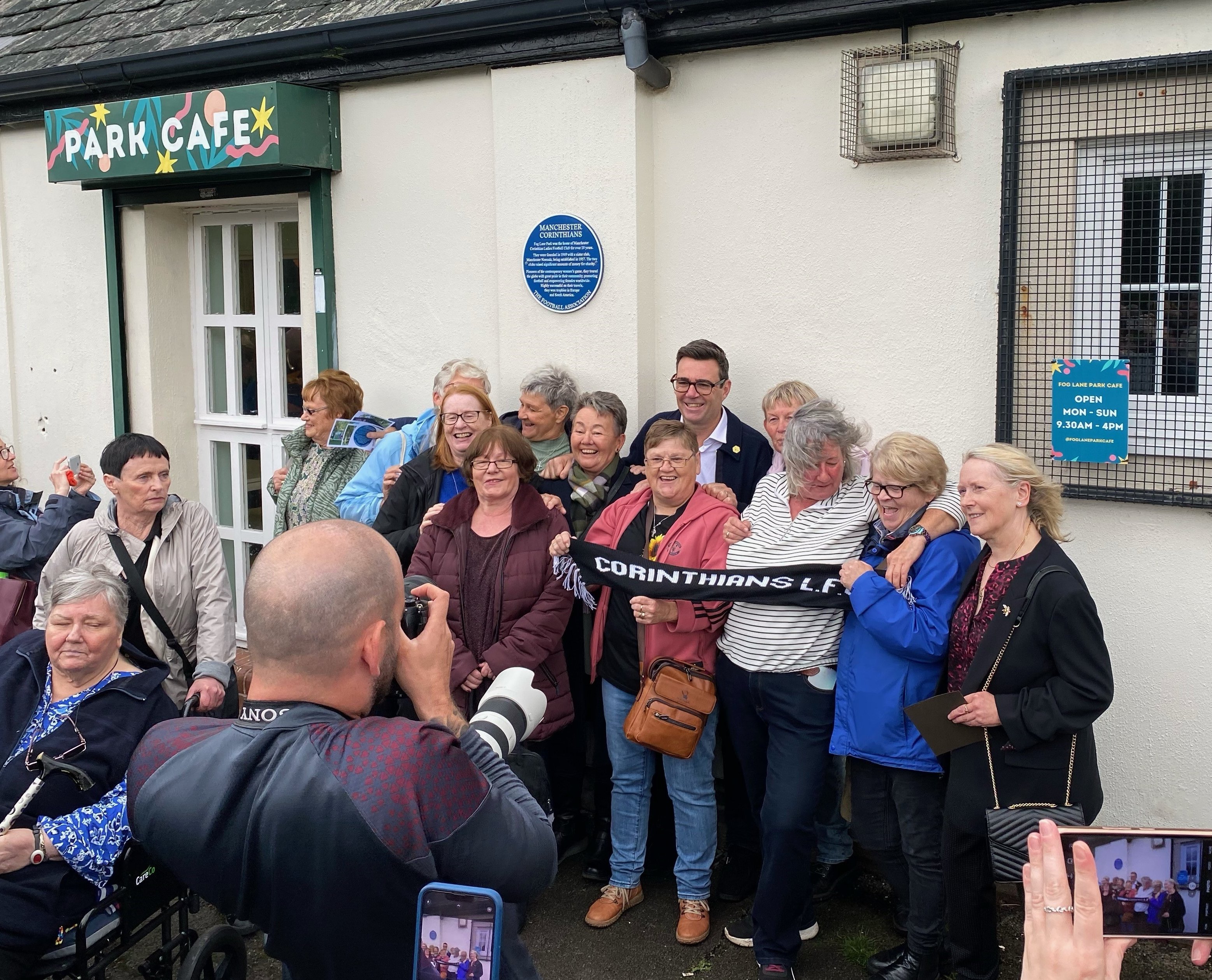
It’s hard to believe but April marks six months since an amazing day when Manchester came together, along with a wonderful community of former footballers, to recognise the pioneering women’s team the Manchester Corinthians. It was an incredible day made possible with the support of so many individuals, groups and community leaders. So often we highlight issues, problems or moments where communities separate or fail but the long running campaign to bring recognition to the Corinthians has seen so many come together for something extremely positive.
Personally, I was touched by the support received for this campaign and the plaque unveiling was the biggest visible sign that it was succeeding with huge TV audiences tuning in. One news broadcast alone featuring the Corinthians’ plaque unveiling had 2.7 million live viewers. Add to that downloads and all the news features experienced on TV and radio that day and the number rockets significantly. There were also newspaper articles and more.
The aim, back in 2019 when the idea of erecting permanent tributes was first raised publicly in an article I wrote, had been to bring recognition and wider public awareness to the exploits of these remarkable footballers. The media coverage certainly did that and also other Corinthians came forward who had seen the coverage.
I’d particularly like to pay tribute to Jam Williams-Thomas from ITV Granada who promised me he’d ensure Granada Reports would have a camera crew there many, many months before the exact date had been finalised. That support was vital. In the end David Chisnall came from Granada Reports and did a wonderful feature on the plaque and recognising the Corinthians. Thanks to you, Jam and all at Granada Reports. It really helped (there are links to some of the TV coverage at the bottom of this article).
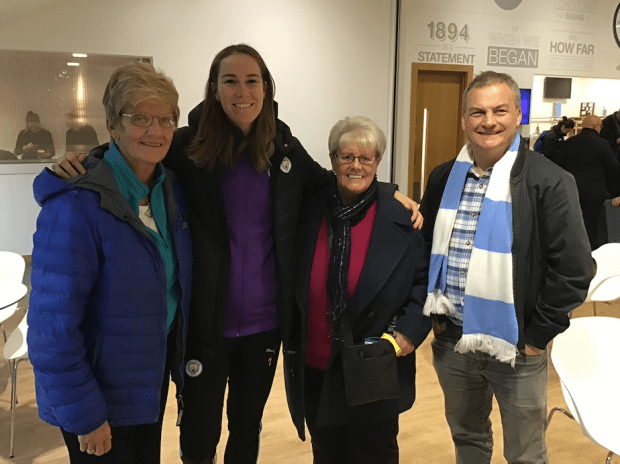
2019 was the year when the campaign received a lot of support. Back then I contacted many key Manchester and national institutions with the concept. Manchester City FC immediately supported the idea and that year several Corinthians, plus myself, were invited to City to attend a WSL game, where they met England international Karen Bardsley and England women manager Phil Neville. The Blues also included features in their match programme and on their website on the history of the Corinthians.
Margaret Whitworth, Karen Bardsley, Margaret Shepherd & Gary James. Several Corinthians were guests of Manchester City for a WSL game.
They’ve continued to support and promote the Corinthians’ story ever since. I don’t know how many millions read their website today but again, like the national news coverage, this level of readership is significant. I’m not daft enough to think everyone reading the stories or watching the news will want to know more about the Corinthians, but if just 1% do then that in itself is an incredible number of people who previously may not have known or understood how the Corinthians toured the globe promoting Manchester, football and female endeavour.
Simon Mullock at the Sunday Mirror helped with an excellent feature too back in the early days. That support from a national tabloid was so important in widening the news and soon, in general conversation, people were mentioning the Corinthians and their achievements. I loved that! We were getting somewhere and Simon, together with later features by renowned journalists focusing on women’s football in other newspapers, was a big part of that.
Another major supporter since the start has been the Manchester FA’s Colin Bridgford. Again in 2019 we met up to talk about what we could do to promote the Corinthians’ story and I wrote several articles for the Manchester FA’s website. That support was important and helped raise the profile of what we were trying to achieve. We also arranged a meeting with Manchester FA staff and several of the Corinthians, including Margaret Whitworth, Margaret Shepherd and Jan Lyons – three of the Corinthian stalwarts who have worked tirelessly to rightly highlight the story of their team. Plans were put in place to do other activities with the Manchester FA but sadly Covid hit and plans had to be abandoned. Colin and his team did, of course, support the plaque unveiling last October.
The FA have helped too. In fact they have not only helped promote the story but also provided significant funding to ensure permanent tributes could be made. My connection with Rachel Pavlou at The FA came via Caterina Loriggio. Cat led a major project in partnership with the Women’s Euros the other year and I acted as the Heritage Lead for Trafford Council. Via the UEFA & FA project a series of activities were established in each host city/borough and the Corinthians inevitably became part of that. I performed interviews with several Corinthians (borrowing some of their trophies and kit too for an exhibition) in Trafford and others were interviewed at Wigan & Leigh. These were filmed and are still available here:
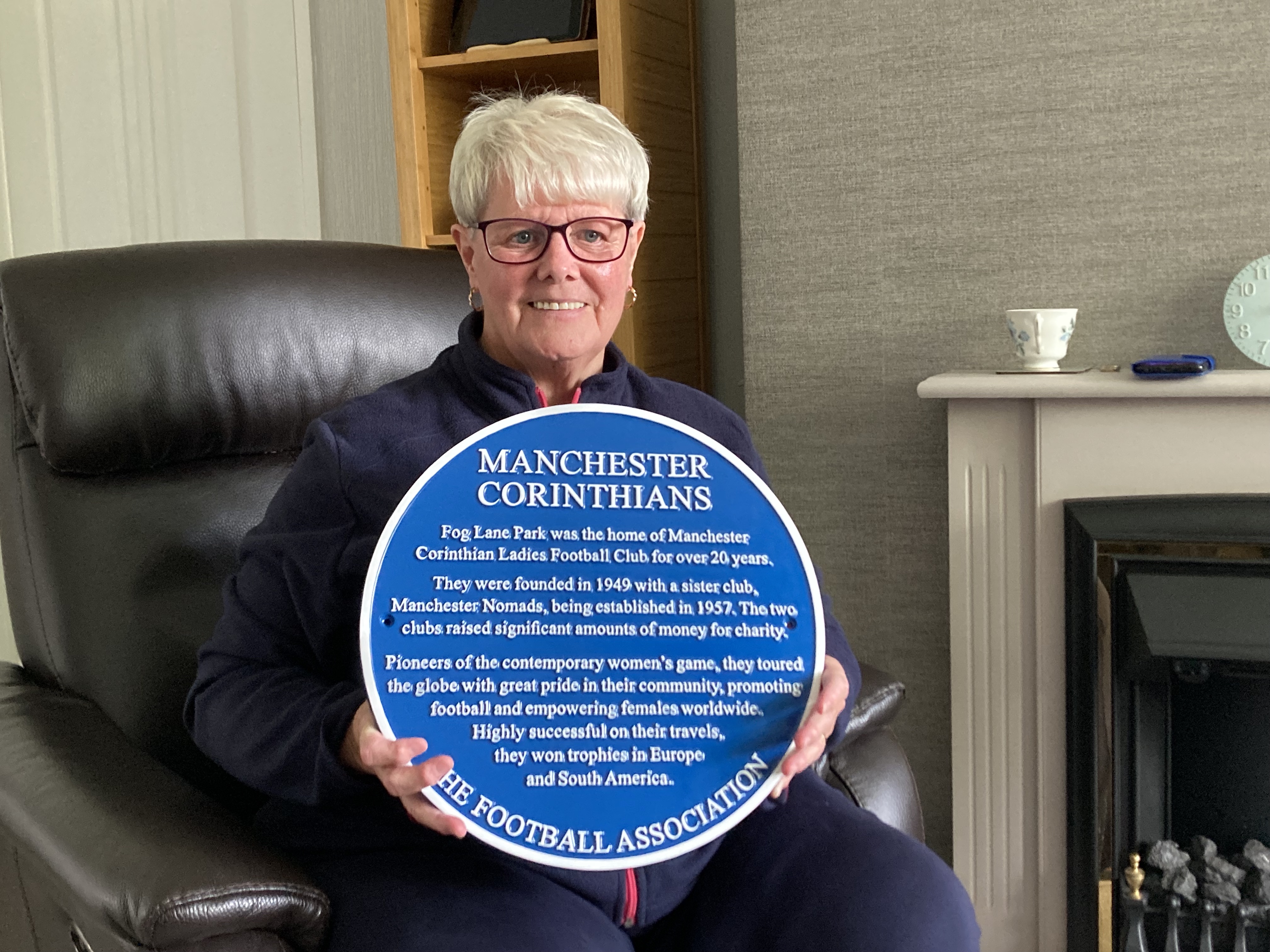
When I discussed the idea of erecting permanent tributes with Rachel she immediately offered funds and other support to ensure the Corinthians were recognised. The FA and Cat also approved the wording for the plaque. For me this had to recognise all the Corinthians, not one person or individual moments (I knew we could pay appropriate tribute to all of that via the book I’ve been working on for several years, which will be published this summer).
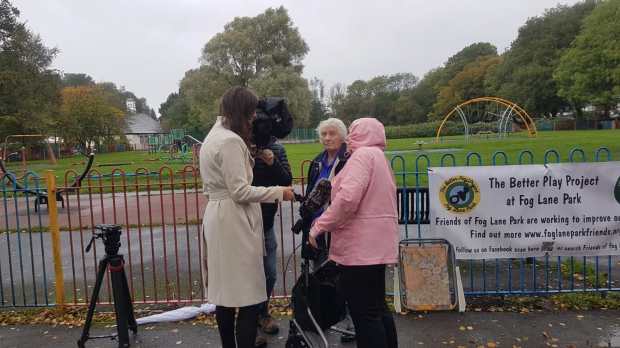
The FA were not the only ones to get involved of course as the campaign brought together a wide range of people… as with every project like this there are many, unsung heroes who work tirelessly without seeking or receiving financial reward. In that category are the Friends of Fog Lane Park. They deserve immense praise, especially Pamela & Alice and the others who attended various meetings along the way and performed many tasks that made the unveiling day such a success.
Some of the Friends of Fog Lane Park at the last meeting before the Corinthians plaque unveiling
I’d been introduced to the Friends by Manchester City Council, in particular Paul Hulme. Jan Lyons and I had met Paul at an early meeting we’d arranged. We’d hoped there would be support from the Council and sure enough Paul was interested, particularly when Jan told some of the Corinthians’ story. Her words and experiences brought it all to life and demonstrated perfectly why we needed to get this story out there. Paul immediately set up a meeting with the Friends of Fog Lane Park and other council officials and employees.
At that meeting in the Fog Lane Park Café me, Margaret Whitworth, Margaret Shepherd and Jan Lyons, explained about the Corinthians with the former players telling their stories while the Friends were enthralled. I put it all into context in terms of the wider football and Manchester stories, then explained about the attempts to raise public awareness and how we wanted to get a Blue Plaque erected. We agreed that the Blue Plaque appeal would be established in the name of the Friends of Fog Lane Park – they had a dedicated committee of passionate individuals and the opportunity to publicly recognise the Corinthians in the park that had been their home for over two decades was wonderful.
One of the Friends of Fog Lane Park meetings where we discussed the erecting of permanent tributes, 20 May 2022
Those who donated to the appeal to erect permanent tributes to the Corinthians were: Pam Barnes, Dan Mooney, Adam Turgoose, ‘Ben’, ‘Jean J’, Jonathan Kaye, Megan Riley, Helena Byrne, Dawn Burrows, Clare Wilkins, Linda Foley, Debbie Enever, John Carrier, Jacqui McAssey, Michael Cottam, Karen Phanco, David Hoyle, Daniel Rubin, Heidi James, Gary James and the Dick, Kerr Ladies Foundation. There were a couple of anonymous donations too. It was gratifying that many of those listed were not from Manchester but were connected with women’s football in other parts of the world. That was wonderful to see. It was also fantastic that via Gail Newsham the Dick, Kerr Ladies Foundation supported the campaign with a significant donation too, proving what a great community of women’s football enthusiasts and researchers we have.
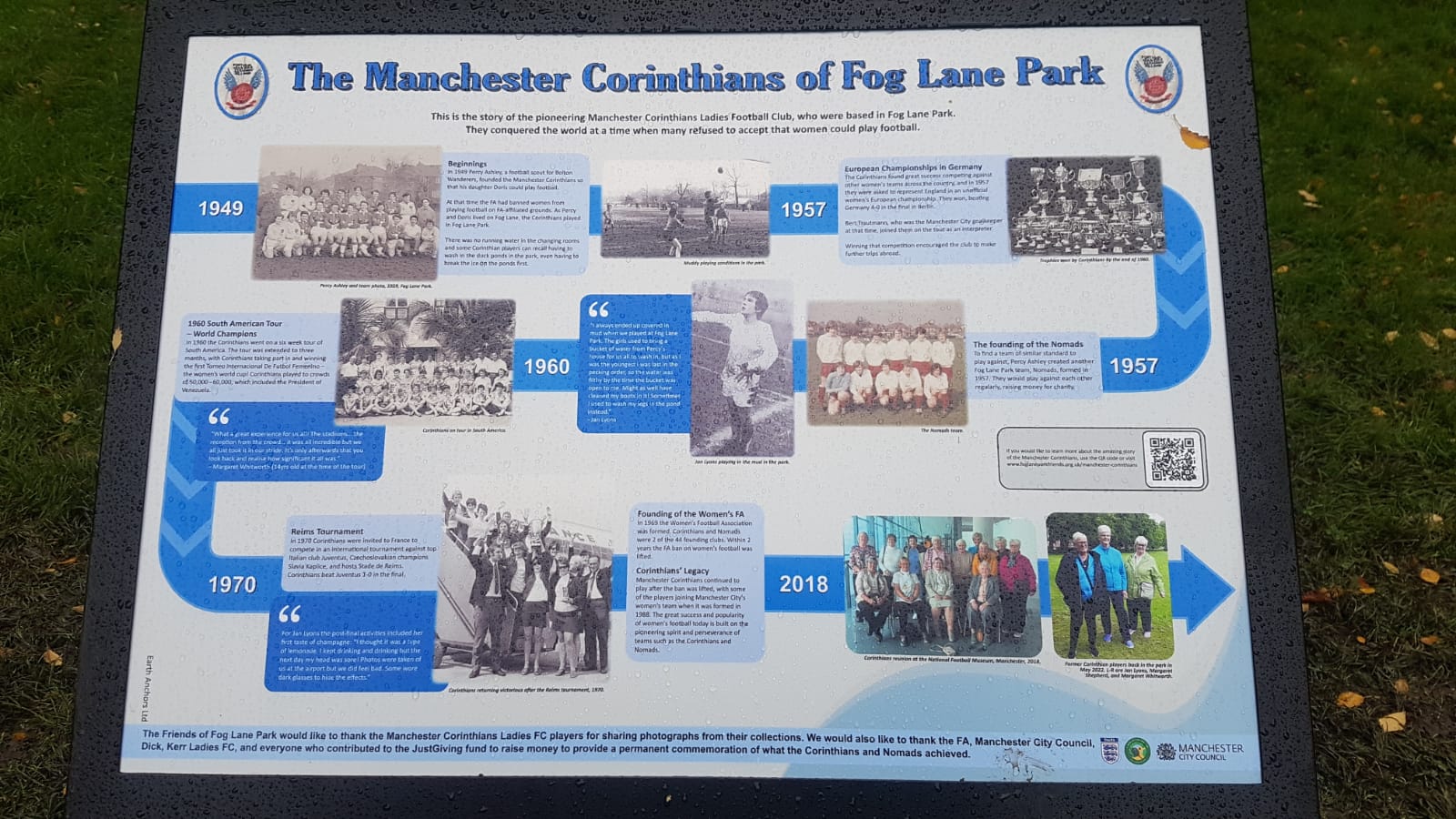
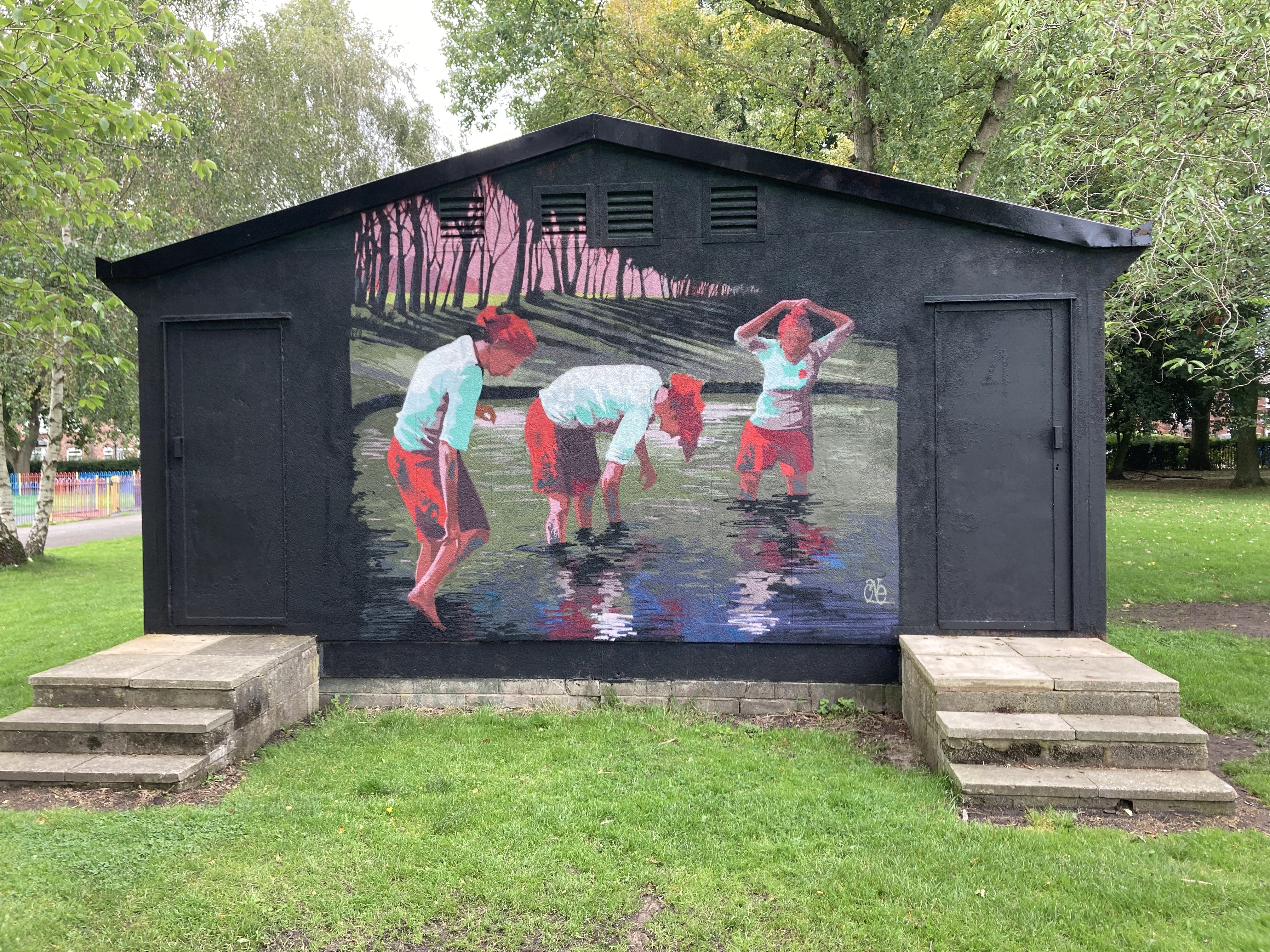
The Friends of Fog Lane Park managed to get matching funds from Manchester City Council too and the Friends had some wonderful ideas to really improve the park and tributes further. As well as the hoped for plaque and a lectern providing a Corinthians’ timeline, the Friends organised for some of the funds raised via the appeal and The FA to be spent on two impressive murals painted by artist Gavin Renshaw and for a handout to be produced for park visitors on the Corinthians. Now everybody who visits the park gets to see wonderful artwork (on a former graffiti covered building), the plaque, a lectern, an information board inside the café and the leaflet. All of this is helping get the story out there again and, for those young girls and boys kicking a ball around the park, is inspiring.
In the weeks building up to the unveiling day the Friends spent considerable time and effort tidying up the park, arranging some of the logistics, erecting the plaque itself, overseeing the mural work, organising sandwiches, baking cakes and more. It was a real community effort and all deserve thanking again.
Various media companies helped promote the plaque appeal with myself, Friends of Fog Lane Park, Margaret Whitworth, Margaret Shepherd, Jan Lyons and other Corinthians being interviewed on a fairly regular basis. Contacts I had with various stations helped enormously (you know who you are – thanks for your support) and brought airtime we couldn’t have managed with cold calls.
When it came to the plaque itself another who helped was Mark Metcalf. Mark had instigated footballing plaques at various locations and I’d been fortunate to be involved with a couple. Mark provided contacts with plaque manufacturers and helped ensure we got a decent price too.
There was also a wonderful night in Hebden Bridge in December 2021 where several Corinthians were interviewed publicly and I gave a talk on the history of women’s football. At the end of that event I announced publicly for the first time the campaign to erect a blue plaque and that brought significant interest from the people of West Yorkshire. Local businessman Geoff Matthews had funded the talk and event and that support was wonderful too.
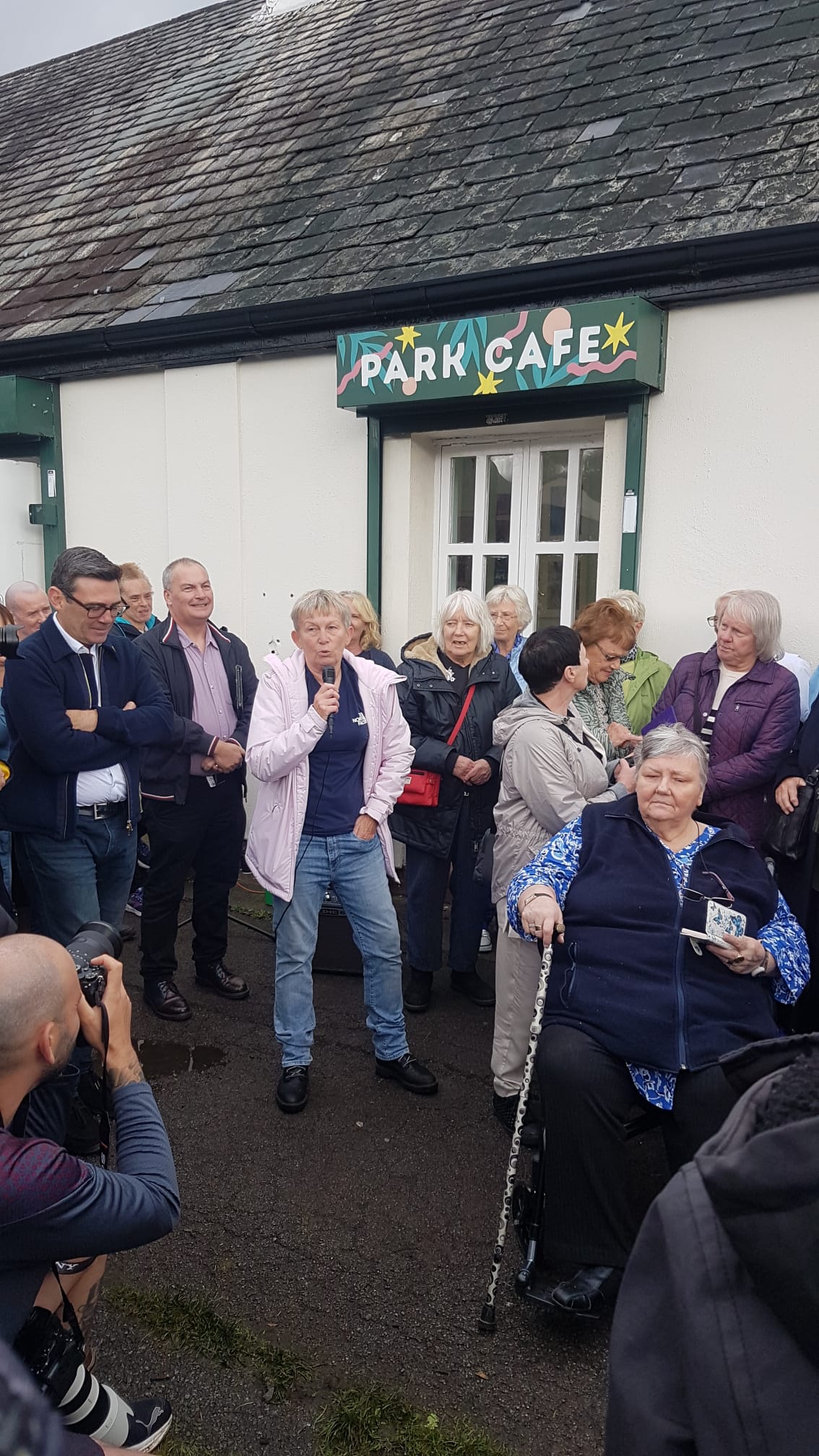
The plaque unveiling was supported on the day by Greater Manchester Mayor Andy Burnham, who spoke about the Corinthians as the suffragettes of football, and former England international Kerry Davis. She had actually played against many of the Corinthians in attendance that day too. Hundreds of people attended with strong support from fans of women’s football, including several key members of the Manchester City Women Supporters Club. Former City player Stacey Copeland was a key supporter that day (as she has been at other events, including the one at Hebden Bridge) and she has made efforts herself to promote the story and help the Corinthians frequently.
It really was quite remarkable the amount of interest demonstrated that day and how the story of the Corinthians has continued to receive attention.
I know this has been a lengthy piece but I think it’s both necessary and valuable to remember what a remarkable day the plaque unveiling was and to remember all those who contributed along the way. All of those involved, especially the Friends of Fog Lane Park, put considerable effort into that day and they quite rightly stood back to ensure the Corinthians’ achievements were recognised first and foremost. That day – and in the months leading up to it – a great community came together to ensure the Corinthians were thanked for all they had done for football and Manchester and the media support ensured that story was spread loud and clear.
I am really pleased and proud with the way it developed and how such a huge community has helped along the way.
This summer the events of the plaque unveiling and the campaign leading up to it will be included within the Authorised History I am writing. The book will detail every season of the Corinthians, plus their legacy, and will pay tribute to these remarkable players, their managers, coaches and supporting family and friends. Community again, working together. Dozens of players covering every single season from January 1949 through to the club’s demise have been interviewed, while archives have been researched extensively to correct myths and add facts to the memories of those who were there.
Over the last five years or so contemporary articles and film of the Corinthians has been found and I’ve written for a variety of footballing and non-footballing national, regional & local publications and websites. Some have inspired others and some have helped re-unite former players.
I think, out of everything that has been achieved over the last five years or so it’s the re-uniting of players that is most satisfying, along with the support of a wide community of organisations, volunteers, footballers and more. Thanks.
Manchester Corinthians: The Authorised History is available to order pre-publication:
Dr Gary James’ new book “Manchester Corinthians: The Authorised History” is available to order pre-publication for £19.95. Everyone ordering before publication will get their name published in the book.
ITV’s national news coverage of the plaque unveiling can be seen here:
There are some excellent books on women’s football out there but we still need more. There are many long forgotten clubs who deserve to be remembered and it’s up to those of us who research football history to ensure they are remembered, with their efforts properly recorded. There are people like Gail Newsham and her decades’ (many decades) worth of research into Dick, Kerr Ladies, that have helped us understand some of the achievements of women’s clubs over the years. Gail has been researching because it matters to her personally – it’s something I totally understand. Those of us who focus on our clubs or on teams from our towns or on people we’ve known over the decades, tend to research because it’s our passion. It matters to us personally – and it’s often clear when people jump on a bandwagon and mistakenly think there’s money to be made or it’ll give them some form of reflected glory.
For myself, I’ve been researching and writing about football in Manchester throughout my adult life. In my first book, published when I was 21 (but started when I was 19), I managed to include something on the newly formed Manchester City Ladies FC. I was at their first game (in fact I was a regular for the first 4 years of the club’s existence) and my girlfriend (now wife) played for them, scoring twice in the club’s first match. She’d previously played for another Manchester team and during this period we got to know several former Manchester Corinthians players.
The relaunch of Manchester City’s women’s team, 2014
Since that time in the 1980s I have been fortunate to meet so many fascinating former footballers – men and women – and have always been fascinated by their stories. I’ve also written lots of books and articles over the last 35 years or so, covering a variety of topics but predominantly focusing on the history of football in Manchester. Publishers have often tried to push me down particular pathways (or said there isn’t enough space for something I felt needed covering) and I understand that. Nevertheless, my motivation has always been to uncover the history of the region’s football clubs and to ensure it is recorded as accurately as possible – no matter how much space it takes. Facts not fiction, dispelling myths (and believe me there are a lot of myths out there!).
If you want to research a topic then do it. Don’t let anybody put you off.
In terms of women’s football in particular I’ve written dozens of articles for Sport in History, Soccer & Society, Manchester FA, Manchester Evening News, She Kicks, Trafford Council, When Saturday Comes, the FA, UEFA, Manchester City, Manchester United and many others, including various fanzines.
Research by Dr Gary James led to the history of Manchester United Ladies FC being documented as part of the UEFA Women’s EURO 2022 Arts and Heritage programme
There has also been Manchester City Women: An Oral History – the first detailed history of a WSL club. Many of these articles have been about the Manchester Corinthians and I have heard stories recently which talk about one of my articles on the Corinthians providing inspiration. That’s wonderful.
2024 will see the publication of two books I’ve been working on for several years. There’s a book for the publisher Peter Lang, co-edited with Fiona Skillen and Helena Byrne, on the history of women’s football in Britain and Ireland which includes contributions from several leading historians of women’s football. That will be an excellent historical analysis of women’s football.
Then there’s my labour of love – Manchester Corinthians: The Authorised History which I’ve self-funded. This will be of the same quality and size as my book on Manchester City Women and in many ways is a sort of prequel.
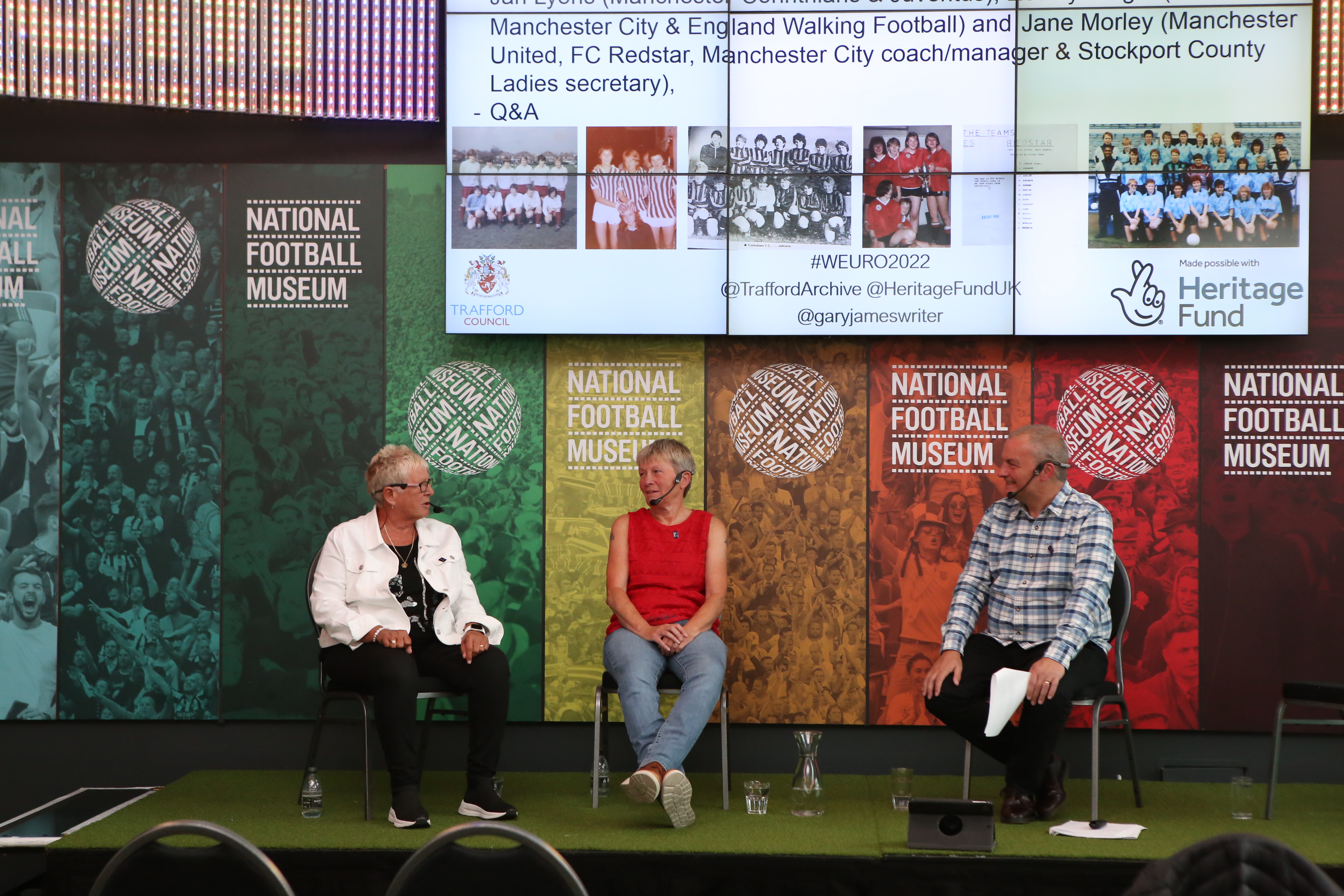
One of Gary James’ history of women’s football in Manchester talks at the National Football Museum, including interviews with Jan Lyons and Lesley Wright.
Why the Corinthians? Well, you’ll see from reading the book that I regard the club as the most significant women’s club in the region (possibly nationally) prior to the WSL era (and therefore of huge significance to football, Manchester and nationally!). There have been several prominent trophy winning women’s clubs in Greater Manchester and there have been many that have toured outside the UK, but the Corinthians did all of that and more. There are many myths out there about the club (and some have been promoted a lot recently) but the history of this club is truly significant – and I really do mean ‘truly significant’ as you’ll see in the book. We do not need myths because the facts are remarkable.
Rather than focus on one angle or era, the book covers every season from its formation in 1949 to its demise four decades later. This year marks the 75th anniversary of the Manchester Corinthians’ formation and over the last decade I have interviewed dozens of women involved with the club. I’ve captured stories and voices from women who played in games during EVERY season of the club’s long history. It’s been a shattering but utterly worthwhile experience.
Anyone who has bought my previous books, whether they be on the wider history of men’s football in Manchester, biographies on Mercer or Barnes, Maine Road, or Manchester City Women, will know the lengths I go to make sure the story is interesting, entertaining and factually correct, quoting those that experienced it at the time and supporting players’ memories with detailed archival research. My research into the Manchester Corinthians has been a labour of love. The women who played, and those who were involved but are sadly no longer with us, deserve to be remembered and celebrated.
My hope for the book is that long after we’ve all gone there will be people visiting the library or picking up the book who can learn more about this remarkable club and the people involved with it. Thanks.
You can find out more on the Manchester Corinthians book here:
Before the Corinthians there were the Manchester Ladies (and other clubs in the region – some will be mentioned in the Corinthians book of course!). Steve Bolton wrote a guest blog on Manchester Ladies which can still be read here:
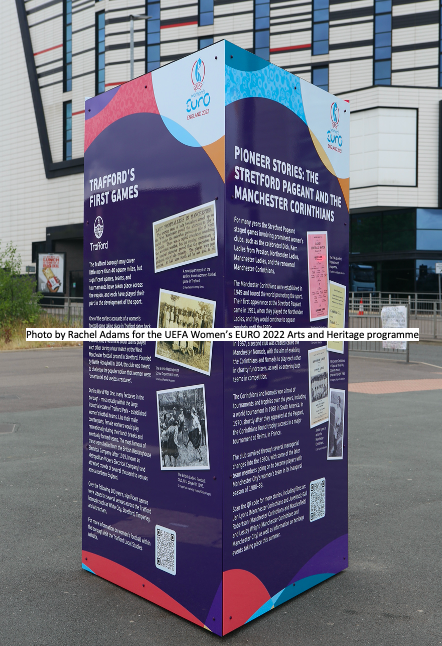
Margaret Whitworth, Karen Bardsley, Margaret Shepherd & Gary James. Several Corinthians were guests of Manchester City for a WSL game.Research by Dr Gary James led to the history of women’s football in Trafford being documented as part of the UEFA Women’s EURO 2022 Arts and Heritage programme
I’ve been delighted with some of the media coverage on the research into the history of Manchester Corinthians recently. Yesterday Manchester City posted a website story on the club and the research while earlier this month I was interviewed for Tameside Radio too. You can listen to that interview here (it starts about 35 minutes into the programme):
If you’re interested in finding out more on the Corinthians then why not subscribe to Manchester Corinthians: The Authorised History. Here’s the latest information on the book:
Dozens of interviews have been performed for the book and include women who played in the club’s first ever game in the 1940s and others who played in the last ever game, over forty years later. It’s a wonderful period of football history.
Voices from every season of the club’s existence have been captured. There are some truly remarkable stories gathered in interviews performed across the country. These wonderful women have provided their memories of every period of the club’s development. Every season is covered.
Myths, including some connected with the formation of the club, persist and still get promoted. For the first time, this Authorised History will highlight the key steps and people involved with the formation of the club, dispelling myths and properly acknowledging those who ensured the team had a life.
Over 300 players have been identified as playing for the Corinthians to date. These women come from every era of the club’s existence (but the search continues for other names – please get in touch: Gary@GJFootballArchive.com). Every player identified will be listed within the book.
The book will tell the story via the voices of those involved from beginning to end (and beyond!), backed up with detailed archival research.
The Manchester Corinthians’ tours across the globe will be featured extensively within the book, while the key managers (especially the club’s manager and guiding figure from 1949 until his death in 1967, Percy Ashley) and other personalities will be profiled.
Hundreds of games have been identified with official – and unofficial – match reports adding flavour and supporting the words of the women who played.
Rare objects, cuttings, match programmes, trophies and more have been located for this book, with many of the players lending their collections to help ensure this is a wonderful record of the club’s full life.
Every person ordering the book before publication will not only have the book posted to them before it appears in any shop, but they will also have their name (or another name of their choosing) published within a special roll of honour at the back of the book.
The book will consist of over 320 pages and will include hundreds of images from every era of the Corinthians, alongside the story of the club and its players.
As with Gary’s book on Manchester City Women this book is destined to be a landmark history on a true Manchester institution and pioneering football club. In some ways this new Corinthians’ history will be a prequel to the City Women book.
This book is being self funded by Gary and so every pre-publication order helps the research enormously. Thanks for your support. It is appreciated.
UK readers can subscribe to the book here (If you live outside the UK then please contact for details of additional postage costs):
Manchester Corinthians: The Authorised History
The story of a pioneering women’s club as told to Gary James by those who were there
£19.95
You do not need to have a PayPal account to order – use the ‘Pay with PayPal’ button above and it will give you the option to pay by credit/debit card without creating a PayPal account.
Here’s one of the TV reports that covered our plaque unveiling back in October. This is from ITV National News:
Here are a few words from a review of the Manchester City Women book the Corinthians will be based on (this is from a review by Fiona Cosson, for the Oral History Society):
ABOUT THE AUTHOR
Manchester football historian Dr Gary James has been researching and writing about football for around forty years, with his first book published in 1989. By that time Gary was a regular at women’s football games in the region and already knew several Corinthians featured in the Corinthians’ book. His connections with the team go way back, in fact his sister was taught PE in the 1980s by a prominent player with the club, while his mum once told him about an older girl being brought to the front in her school assembly during the 1950s to talk about travelling abroad as a Manchester Corinthian.
Gary was on the steering committee for the National Football Museum project Unlocking the Hidden History of Women’s Football and was the Trafford lead for the UEFA/FA project on the history of women’s football for the Women’s Euros in 2022. He has performed various talks and written many significant articles on the Manchester Corinthians throughout the last six years. He established the campaign to create a blue plaque and other tributes for the women who played for the club, working tirelessly to ensure the Corinthians’ receive the accolades they so richly deserve.
Gary’s research and writing is recognised for his quality and depth, and he has written several landmark publications on Manchester football (both men’s and women’s), as well as being historical consultant with films, such as The Keeper, and TV (including researching and producing a 6 part TV series). Gary is the founder of the International Football History Conference and in 2023 was appointed Visiting Research Professor at New York University. He is also an Honorary Research Fellow at De Montfort University.
You can watch a one hour talk Gary did at the National Football Museum on the history of women’s football in the Manchester region here:
The cover is still in development but the two cover images are draft proposals which will be worked up further. If you’d like to purchase Gary James’ earlier book on Manchester City Women’s team then a limited number of copies, signed by me, are still available. You can order here:
The latest City in the 1990s flashback feature is about the women’s Manchester derby. This weekend marks the latest Manchester derby in the Women’s Super League and it will be played at the Etihad Stadium (City currently hold the record attendance for a women’s club game in Manchester – you can find details of that elsewhere on the website). There’s a long history of competition between teams representing the women of Manchester City and Manchester United.
City’s team has been in existence continually since November 1988 when Donna Haynes and Heidi Ward both scored two goals in their first game (v Oldham Athletic at Boundary Park).
I was at the City Ladies (as they were then known) first game and I was also at their first league derby in September 1990 when City defeated United 4-3. It was a fantastic day, watched by around 150 people.
City’s goals came from Rhoda Taylor (8 min), Rachel O’Shaughnessy (43 mins), Jenny Newton (50 mins) and Lesley Peters. City’s manager Neil Mather told me as part of my research for the Manchester City Women book: ‘United were the top side, you know, and beating them was so good for morale. The men’s team were a good side in the early 90s when City Ladies carried on developing, you know. This was the Howard Kendall era, and City had top five finishes. City were one of the top five or six teams in the country at the time, so it was fabulous for women’s football to have Man City, you know.’
Helen Hempenstall played for City that day and she described her memory of the day for my book: I remember when we played United (30/9/90) and Neil (Helen’s boyfriend, now husband) and all his mates came to watch us. There were a lot of people there that day. United had a decent team then. It was always a difficult game against United. They had a right-winger… We never got on. Every time we played each other we were at each other all the way through the game. Me and Carol Woodall were having a go at her. The referee told Lesley Wright “Tell both your full backs to shut their mouths otherwise they’ll both be off!” We just didn’t get along and before every game I thought I’ll get in their first. ‘I’m having her.’ Neil Mather still talks about it.
‘I think Lesley Wright kept the team together. She kept it all tight at the back. I played at the back with her and I learnt a lot from her. Because I was next to her I knew how important she was. If I missed something she always got it. She always encouraged me and kept shouting ‘different class, different class’. You learn from the people around you and I listened to her. Before every game she came to speak to me. She’d put her arm around me and reassure me. She’d tell me not to worry about anything. Most of the time travelling to away games I’d go with Lesley in the car. We used to have a laugh. I remember one day we were travelling to an away game some distance away and we stopped for petrol and all got out. I lit up a fag and everyone else jumped back in the car screaming! I didn’t even think! When we got to the ground they all told Neil Mather and I think he worried that he could’ve lost half his team. At another game I was sat in the middle and as we got out the person before me slammed the door back. It hit my head and I had a big lump for the game.’
Lesley Wright was one of several women who had first played for the pioneering Manchester Corinthians team. I’ve been researching their remarkable story for years and this summer (2024) my work will be published. It will tell the story of the Corinthians from its formation in 1949 through to its final days forty years later. For more information on that club and the book see:
The story of the first women’s League derby and of the first 30 years or so of City Women’s existence can be read in my book on the club. It’s called Manchester City Women: An Oral History and is basically the women telling their stories of playing for the club and how they got into football, plus statistics covering the journey from friendlies in 1988-89 through to competition and the modern day successes.
You can buy the book via this link (every copy is signed by me):
Thanks to all those who have subscribed to Manchester Corinthians: The Authorised History. It means a great deal. For those who haven’t or would like to know more on what the book will entail, here’s the latest information:
Dozens of interviews have been performed for the book and include women who played in the club’s first ever game in the 1940s and others who played in the last ever game, over forty years later. It’s a wonderful period of football history.
Voices from every season of the club’s existence have been captured. There are some truly remarkable stories gathered in interviews performed across the country. These wonderful women have provided their memories of every period of the club’s development. Every season is covered.
Myths, including some connected with the formation of the club, persist and still get promoted. For the first time, this Authorised History will highlight the key steps and people involved with the formation of the club, dispelling myths and properly acknowledging those who ensured the team had a life.
Over 300 players have been identified as playing for the Corinthians to date. These women come from every era of the club’s existence (but the search continues for other names – please get in touch: Gary@GJFootballArchive.com). Every player identified will be listed within the book.
The book will tell the story via the voices of those involved from beginning to end (and beyond!), backed up with detailed archival research.
The Manchester Corinthians’ tours across the globe will be featured extensively within the book, while the key managers (especially the club’s manager and guiding figure from 1949 until his death in 1967, Percy Ashley) and other personalities will be profiled.
Hundreds of games have been identified with official – and unofficial – match reports adding flavour and supporting the words of the women who played.
Rare objects, cuttings, match programmes, trophies and more have been located for this book, with many of the players lending their collections to help ensure this is a wonderful record of the club’s full life.
Every person ordering the book before publication will not only have the book posted to them before it appears in any shop, but they will also have their name (or another name of their choosing) published within a special roll of honour at the back of the book.
The book will consist of over 320 pages and will include hundreds of images from every era of the Corinthians, alongside the story of the club and its players.
As with Gary’s book on Manchester City Women this book is destined to be a landmark history on a true Manchester institution and pioneering football club. In some ways this new Corinthians’ history will be a prequel to the City Women book.
This book is being self funded by Gary and so every pre-publication order helps the research enormously. Thanks for your support. It is appreciated.
UK readers can subscribe to the book here (If you live outside the UK then please contact for details of additional postage costs):
Manchester Corinthians: The Authorised History
The story of a pioneering women’s club as told to Gary James by those who were there
£19.95
You do not need to have a PayPal account to order – use the ‘Pay with PayPal’ button above and it will give you the option to pay by credit/debit card without creating a PayPal account.
Here’s one of the TV reports that covered our plaque unveiling back in October. This is from ITV National News:
Here are a few words from a review of the Manchester City Women book the Corinthians will be based on (this is from a review by Fiona Cosson, for the Oral History Society):
ABOUT THE AUTHOR
Manchester football historian Dr Gary James has been researching and writing about football for around forty years, with his first book published in 1989. By that time Gary was a regular at women’s football games in the region and already knew several Corinthians featured in the Corinthians’ book. His connections with the team go way back, in fact his sister was taught PE in the 1980s by a prominent player with the club, while his mum once told him about an older girl being brought to the front in her school assembly during the 1950s to talk about travelling abroad as a Manchester Corinthian.
Gary was on the steering committee for the National Football Museum project Unlocking the Hidden History of Women’s Football and was the Trafford lead for the UEFA/FA project on the history of women’s football for the Women’s Euros in 2022. He has performed various talks and written many significant articles on the Manchester Corinthians throughout the last six years. He established the campaign to create a blue plaque and other tributes for the women who played for the club, working tirelessly to ensure the Corinthians’ receive the accolades they so richly deserve.
Gary’s research and writing is recognised for his quality and depth, and he has written several landmark publications on Manchester football (both men’s and women’s), as well as being historical consultant with films, such as The Keeper, and TV (including researching and producing a 6 part TV series). Gary is the founder of the International Football History Conference and in 2023 was appointed Visiting Research Professor at New York University. He is also an Honorary Research Fellow at De Montfort University.
You can watch a one hour talk Gary did at the National Football Museum on the history of women’s football in the Manchester region here:
The cover is still in development but the two cover images are draft proposals which will be worked up further. If you’d like to purchase Gary James’ earlier book on Manchester City Women’s team then a limited number of copies, signed by me, are still available. You can order here:



















 Gary James' Football Archive