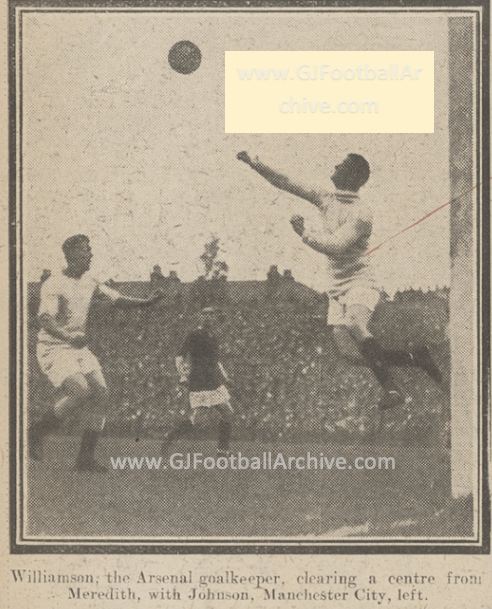
it’s one of the oldest fixtures either club has with a rich history stretching back to the 1890s. Both sides have found major success with City’s first major trophy coming in 1904 and Arsenal’s arriving 26 years later. As you’d expect with such a long history there are plenty of articles on my website about both clubs. Here’s a link to all those tagged Arsenal:
Author Archives: garyjamesfootballarchive
The 1920s: Manchester City 4 Everton 4

100 years ago today (19 September) Manchester City went a goal behind after three minutes to Everton (scored by Goodison legend William Ralph ‘Dixie’ Dean) and were losing 3-0 within 30 minutes. But this day would see a remarkable City fightback – down to ten men for most of the match too!
The fightback started when Tommy Browell made it 3-1 but Everton’s Kennedy netted again for the visitors. City’s Billy Austin went off injured (according to some reports) and, with no subs allowed, City went off for half-time 4-1 down on a miserably wet Manchester day. Some reports also suggest an Everton player went off during the second half and that City’s Sam Cookson was seriously injured and should have gone off but he stayed on the field, presumably to keep 10 City men there.
The second half began with City determined to challenge and Tommy Browell scored his and the Blues’ second after only two minutes of the second half. With twenty minutes to go the same man scored a header and then five minutes from time he scored the equaliser. The game ended 4-4.
If you’d like to know more about this season for Manchester City why not read the following 4,900 word subscriber article on the 1925-26 season. If you subscribe (see below) I hope you enjoy it. If you are not currently a subscriber then why not try it for a month (£3 per month or sign up for a year at a discounted £20 per year)?
Here’s the article:
Subscribe to get access
Read more of this content when you subscribe today. It costs £3 a month (cancel anytime) or sign up for a year at £20 per year. Subscribers have access to the 1000s of articles, features, interviews etc. posted so far and all those posted during your subscription.
Manchester City 3 Arsenal 1

On this day (18 September) in 1920 Arsenal were defeated by Manchester City 3-1 with goals from Horace Barnes, Tommy Browell and Billy Murphy. A crowd recorded as 38,000 at the time watched the match at Hyde Road.
For more on this season why not read the following 2,350 word subscriber article. If you subscribe (see below) I hope you enjoy it. If you are not currently a subscriber then why not try it for a month (£3 per month or sign up for a year at a discounted £20 per year)?
Here’s the article:
Subscribe to get access
Read more of this content when you subscribe today. It costs £3 a month (cancel anytime) or sign up for a year at £20 per year. Subscribers have access to the 1000s of articles, features, interviews etc. posted so far and all those posted during your subscription.
As well as subscriber pieces this series on the 1920s includes some free articles. Watch out for a daily post.
Arsenal 0 Manchester City 1

On this day (17 September) in 1921 Manchester City defeated Arsenal for the second time in a week. This time the Blues won 1-0 at Arsenal with a goal from Horace Barnes. You can read more on Manchester City during this season if you subscribe (see below). I hope you enjoy it. If you are not currently a subscriber then why not try it for a month (£3 per month or sign up for a year at a discounted £20 per year)?
Here’s the article:
Subscribe to get access
Read more of this content when you subscribe today. It costs £3 a month (cancel anytime) or sign up for a year at £20 per year. Subscribers have access to the 1000s of articles, features, interviews etc. posted so far and all those posted during your subscription.
As well as subscriber pieces this series on the 1920s includes some free articles. Watch out for a daily post.
South American Film on the Manchester Corinthians

It’s a bit early to say much about this but my research and book on the Manchester Corinthians has inspired the creation of a short video film aimed at a South American audience on the pioneering women’s team. The Corinthians toured South America and the West Indies in 1960 and it’s been a dream of mine to see something created specifically for South Americans to enjoy on the club.
I was approached a while back about the club’s stories and connections to South America and am delighted something is now being created on them. It’s wonderful to know that this story is spreading across continents again, just as the Corinthians did when they toured all those decades ago.
Some of the filming for the South American video occurred at Fog Lane Park, Didsbury – the club’s home for its opening couple of decades – with the Blue Plaque we unveiled in October 2023.

I’ve been told my book will appear in the film (a still below) and it’s been used for much source material too. One of the main reasons I did my research was I wanted to spread the word about these remarkable women.

Watch this space for more on the South American video. In the meantime, if you’d like to know why this club is so special take a look at the only Authorised History of the club. Details here:
The 1920s: Johnson Scores Five

On this day (15 September) in 1928 Manchester City striker Tommy Johnson scored five as Everton were trounced 6-2 in the top flight at Goodison Park. The other City scorer was Eric Brook. Subscribers can read more on that game here:
If you’d like to know more about Manchester City in the 1920s why not read this 750 word subscriber article on the 1928-29 season? If you subscribe (see below) I hope you enjoy it. If you are not currently a subscriber then why not try it for a month (£3 per month or sign up for a year at a discounted £20 per year)?
Here’s the article:
Subscribe to get access
Read more of this content when you subscribe today. It costs £3 a month (cancel anytime) or sign up for a year at £20 per year. Subscribers have access to the 1000s of articles, features, interviews etc. posted so far and all those posted during your subscription.
Ricky Hatton
I’m shocked at the devastating news that Ricky Hatton has died. I grew up on the same estate as Ricky and remember seeing him as a young boy at the New Inn. His dad Ray was the landlord and that used to be the pub I first started drinking at as a teenager. I’ve also met and chatted with Ricky as an adult. We did a joint session with City’s Academy lads a few years back where we talked about what it was like to be a supporter.
He was an important role model for so many growing up in Hattersley and, of course, Manchester.
I don’t really know what to say. Its devastating news. My thoughts are with his family and friends.
The 1920s: Manchester City 2 Bolton Wanderers 0
On this day (14 September 1929) Manchester City defeated Bolton 2-0 with both goals coming from Eric Brook (photographed) at Maine Road, watched by a crowd of 36,972. You can find out more on the 1929-30 season below in this piece for subscribers (see below). I hope you enjoy it. If you don’t subscribe then why not try it for a month (£3 per month or sign up for a year at a discounted £20 per year)?
Here’s the article:
Subscribe to get access
Read more of this content when you subscribe today. It costs £3 a month (cancel anytime) or sign up for a year at £20 per year. Subscribers have access to the 1000s of articles, features, interviews etc. posted so far and all those posted during your subscription.
As well as subscriber pieces this series on the 1930s includes some free articles.
The First Manchester Derby of the 1920s
As we’re building up to the Derby here’s the latest in the series of features on MCFC in the 1920s… The first Manchester Derby of the 1920s took place at Old Trafford on 20 November 1920. You can read background, statistics and a report on that game below:
Subscribe to get access
This article is a subscriber feature. You can read it if you subscribe. It costs £3 a month (cancel anytime) or sign up for a year at £20 per year. Subscribers have access to the 1000s of articles, features, interviews etc. posted so far and all those posted during your subscription.
For more on this season why not read the following 2,350 word subscriber article. If you subscribe (see below) I hope you enjoy it. If you are not currently a subscriber then why not try it for a month (£3 per month or sign up for a year at a discounted £20 per year)?
Here’s the article:
Subscribe to get access
Read more of this content when you subscribe today. It costs £3 a month (cancel anytime) or sign up for a year at £20 per year. Subscribers have access to the 1000s of articles, features, interviews etc. posted so far and all those posted during your subscription.
As well as subscriber pieces this series on the 1920s includes some free articles. Watch out for a daily post.
The 1920s: First Maine Road Derby

100 years ago today (12 September) Manchester City and Manchester United met in the first Manchester Derby to be played at Maine Road (United had been in the second tier for the first couple of seasons of Maine Road’s existence). Here’s the background, report and stats from that game (this is all from the book I wrote with Steve Cawley called The Pride of Manchester – the history of the Manchester Derby). Enjoy!
MANCHESTER CITY 1 (Cowan)
MANCHESTER UNITED 1 (Rennox)
Manchester City: Jim MITCHELL, Sam COOKSON, Philip McCLOY, Sammy SHARP, Sam COWAN, Charlie PRINGLE, Billy AUSTIN, John (known as Jack) WARNER, Frank ROBERTS, Tom JOHNSON, George HICKS. Manager: David Ashworth
Manchester United: Alf STEWARD, Charlie MOORE, Jack SILCOCK, Ray BENNION, Frank BARSON, Frank MANN, Joe SPENCE, Thomas SMITH, Jimmy HANSON, Clatworthy ’Clat’ RENNOX, Frank MCPHERSON. Manager: John Chapman
BACKGROUND
United had spent three seasons in the Second Division and returned as runners-up to Leicester City. Some of the old faithfuls remained, notably Silcock and Spence, but inevitably team strengthening and transitions had occurred, in particular, with the acquisition of club captain Frank Barson. Signed in 1922 for the huge sum of £5,000, United promised Barson a pub if they were promoted within three years – and he just made it! A former blacksmith, Barson was an attacking centre-half of international standard but also carried a notorious reputation as a traditional ‘hard man’ who was quick to exact retribution if a team-mate was fouled. Another useful signing was Frank McPherson, a man with reputedly the hardest shot in football. The Reds made a quite promising start to the new campaign and had looked impressive in a 3-0 home victory against Aston Villa.
City’s playing squad had changed considerably since the last derby, while manager Ernest Mangnall who had joined the Blues from United in September 1912 and played such a major role in the development of both clubs had left City in May 1924, and was replaced by David Ashworth. Meredith had also finally retired in 1924, bowing out in an FA Cup semi-final against Newcastle, although he retained a connection through his son-in-law Charlie Pringle who now played for the Blues. A number of fresh signings had been made; Frank Roberts for £3,400, Billy Austin for£2,000 and Philip McCloy for £3,000. City also had great hopes that Sam Cowan, a centre-half signed from Doncaster Rovers in December 1924 would develop into a quality player. City had moved to their magnificent purpose-built stadium at Maine Road in August 1923 and had established a provincial record crowd of 76,166 in the stadium’s first season. Now, with the derby imminent, its capacity was viewed at a possible 85,000!
BEFORE THE GAME
P W D L F A Pts
UNITED 4 1 1 2 5 4 3
CITY 3 1 0 2 3 4 2
MATCH VERDICT
The derby rivalry resumed in front of what was, at the time, City’s record League gate. City were deemed the better side in what was a rousing contest. Local born ‘keeper Alf Steward had an outstanding game keeping the lively City forwards at bay with a string of fine saves, before ’Clat’ Rennox then went down to the other end and gave the Reds the lead with a smart shot.
Sam Cowan capped a wonderful display by scoring the equaliser with a powerful far post header from a left wing corner (see photo). It was a fitting reward for Cowan, who besides being the man of the match, looked to be a player the Blues could build a future around.
“The Athletic News” reported on the resumption of the derby match after a four year break: ”The first meeting of the Manchester rivals after a lapse of four years brought the City club the largest League gate they have ever enjoyed. It was not so great as that recorded at the Cup-tie with Cardiff City in March 1924, when 76,166 spectators paid for admission, but over 62,000 people passed through the turnstiles, and, with ticket-holders, the attendance was officially returned at nearly 66,000. It was a magnificent spectacle and a game fought in a splendid spirit. That the City did not defeat their rivals was due primarily to the brilliant goal-keeping of Steward, a Manchester-born player, to whose rich promise the Athletic News referred last Monday.
It was fitting that on the only occasion he was beaten the success fell to Samuel Cowan, for these players were the outstanding figures in the contest. Cowan’s headwork was a feature of the match. More, he tackled with grim determination and effectiveness, and distributed the ball with discrimination and accuracy.
Cowan promises to be all that the City club expected when they brought him from Doncaster Rovers last season. He has all the physical requirements for a centre half-back, and, judging by his display in this match, he has the temperament for the big event. His equalising goal was a masterpiece in headwork and judgement”.
If you’d like to know more about this season for Manchester City why not read the following 4,900 word subscriber article on the 1925-26 season. If you subscribe (see below) I hope you enjoy it. If you are not currently a subscriber then why not try it for a month (£3 per month or sign up for a year at a discounted £20 per year)?
Here’s the article:
Subscribe to get access
Read more of this content when you subscribe today. It costs £3 a month (cancel anytime) or sign up for a year at £20 per year. Subscribers have access to the 1000s of articles, features, interviews etc. posted so far and all those posted during your subscription.
 Gary James' Football Archive