Happy Agueroooo Day!

On this day (May 13) in 2012 Manchester City faced QPR in a game that entered football folklore. It was the most dramatic end to a Premier League season ever experienced. For those who want to relive that day – of for those who were too young at the time to appreciate – here is a 3,400 word article on that day… Enjoy!

Subscribe to get access

Subscribers get access to this and the other 300+ articles, interviews etc. It costs £20 a year (works out about £1.67 a month).

Congratulations Champions City!

Today (May 11 2021) on the anniversary of Manchester City’s 1968 title triumph the Blues have become Premier League champions again. City have won the League after nearest rivals Manchester United lost 2-1 at home to Leicester City.

It is the Blues seventh League title with their first coming in 1937. Congratulations to Pep, the squad and everyone associated with Manchester City.

It has been an astonishing season with City already winning the League Cup this season, plus they’ve reached the Champions League final where they will face Chelsea. They also appeared in the FA Cup semi-final this season but sadly lost to Chelsea. This means that City have won six major trophies in three seasons and still have chance of another, the Champions League, of course. 

City’s trophy success today means that domestically counting the League, FA Cup and League Cup only United, Liverpool and Arsenal have won more English major trophies. Similarly, only United, Liverpool, Arsenal and Everton have won more League titles than Manchester’s Blues.

It has been an odd season with Covid and no fans in the stadium (though some clubs, including those on Merseyside, were allowed a limited number of fans in earlier this season), but the football City have played has been breathtaking. Apart from a difficult opening period and a few odd results recently as Pep has rotated his team, City have delivered week after week (or should that be weekend after midweek after weekend after midweek – it’s been a busy season!). They thoroughly deserve the title. Well done!

City have now won the following major honours:

European Cup Winners’ Cup (1)

1970

League/Premier League (7)

1937, 1968, 2012, 2014, 2018, 2019 & 2021

(runners up: 1904, 1921, 1977, 2013, 2015 & 2020)

FA Cup (6)

1904, 1934, 1956, 1969, 2011 & 2019 

(runners up: 1926, 1933, 1955, 1981 & 2013)

League Cup (8)

1970, 1976, 2014, 2016, 2018, 2019, 2020 & 2021

(runners up: 1974)

In 2019 the Blues became the first English men’s team to win a domestic treble. This season City have achieved a domestic double of the League Cup and the League (a feat they also achieved in 2014 & 2018). Back in 1970 they achieved a European and domestic cup double when they won the League Cup and the European Cup Winners’ Cup.

City’s trophy haul makes them the fifth most successful English club of all time based on major domestic and European trophies won (United, Liverpool, Arsenal and Chelsea are ahead of the Blues). In addition only Liverpool and Blackburn have a greater span between their first English trophy and their most recent. See:

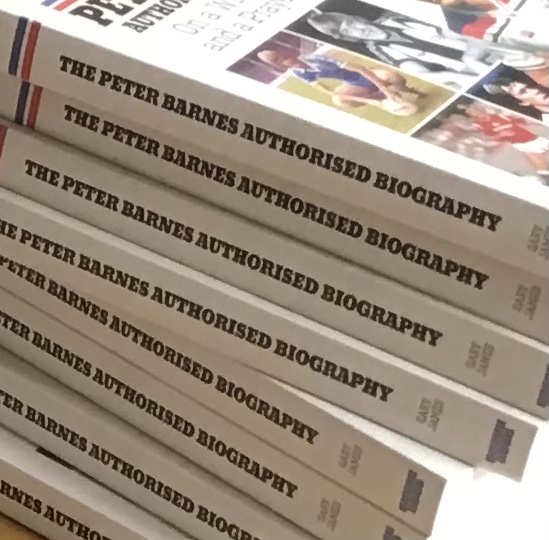
Don’t forget you still have time to subscribe to my forthcoming biography of Peter Barnes. Order before May 20th and you’ll get your name (or someone else’s if you’re buying this as a gift) plus your book will be signed by me and Peter Barnes. For details see:

Peter Barnes Biography – UPDATE

Thanks to all those who have subscribed to Peter Barnes: The Authorised Biography (especially 250 Scandinavian Manchester City fans who have ordered the book!) It really is appreciated.

Emails have started to go to all subscribers to confirm details for the book (these should all be sent by May 20th). There is still time to order the book and get your name printed in it for anyone who hasn’t managed that yet.

Subscribers will receive signed copies (signed by both Peter Barnes and myself) of the book posted out before it appears in any shop AND will get their names printed in the special subscriber section of the book. 

This is the only way to guarantee your copy of the book. All subscriber orders must be made by May 20th.

This long awaited authorised biography, written by Gary James with the memories and stories of Peter’s career throughout, tells the story of Peter’s life from his childhood in Manchester and Wrexham through to the modern day. With particular focus on his footballing career with Manchester City, West Bromwich Albion, Leeds United, Real Betis, Coventry City, Manchester United, Tampa Bay Rowdies and, of course, England.

There are quotes from people connected with Peter throughout his career plus archive material too.

Pre-publication you can order the 350+ page, colour paperback book for £16.95 (including UK postage) and have your name printed in it (or if being bought as a gift the name of another person). Those living in the European Union can now order the book for £28 including postage to an address within the EU and those in the USA for £40 including postage to the States. If you’re in Malaysia it’s £35. Sadly, we have no control over those additional postage costs (we have used the Royal Mail international standard rate).

Outside the UK, EU, Malaysia, Australia, New Zealand and USA please contact for confirmation of postage costs.

The ONLY way to order your copy and get your name printed in the book is from this site by using the order button below.

The book is expected to be published in June 2021 and all this subscriber offer will be available until May 15, 2021 (orders received after that date cannot be guaranteed to have names printed in the book, so order as early as possible).

Here’s the order button (before publication those who have subscribed to the book will be emailed to ask which name is to be printed in the book, so please make sure you include an email address, in addition to postage details, when asked at time of ordering):

United Kingdom

The Peter Barnes Authorised Biography – Subscriber Offer UNITED KINGDOM

Order today and have your name printed in the book. £16.95 (incl UK Postage and Packaging).

£16.95

European Union

The Peter Barnes Authorised Biography – Subscriber Offer EUROPEAN UNION

Order today and have your name printed in the book. £28 (incl postage and packaging within the EU).

£28.00

United States of America

The Peter Barnes Authorised Biography – Subscriber Offer USA

Order today and have your name printed in the book. £40 (incl postage and packaging to the United States).

£40.00

Malaysia

The Peter Barnes Authorised Biography – Subscriber Offer MALAYSIA

Order today and have your name printed in the book. £35 (incl postage and packaging to Malaysia).

£35.00

Australia and New Zealand

The Peter Barnes Authorised Biography – Subscriber Offer AUSTRALIA AND NEW ZEALAND

Order today and have your name printed in the book. £38.95 (incl postage and packaging to Australia or New Zealand).

£38.95

If you run a book shop and would like to know more about the book please email: accounts@manchesterfootball.org

The ISBN is 978-1-9168852-0-2 and stocks should be available for book shops after it has been distributed to all subscribers. This is anticipated to be by the end of June 2021.

You can listen to Peter in conversation with myself about the book here:

Thanks,

Gary James

The Starting Eleven – Tommy Hutchison

It’s the 40th anniversary of the 1981 FA Cup final today (May 9) and ten years ago, as we looked forward to Manchester City appearing in the 2011 FA Cup final, I was asked by the Manchester Evening News to write profiles of the eleven players who started the 1981 final.

For the last few days I have been posting these profiles, one a day, free to read here. These will only be free to view until May 16, so please take time to dig them out and read them while you can. Thanks.

Here’s the last of the eleven (appearing here as it was written in 2011)…

As we look forward to the 2011 FA Cup final, Gary James takes a look at the eleven players who made the starting line-up for City’s last FA Cup final in 1981.  Today, goalscorer Tommy Hutchison.

33 year old Scottish international Tommy Hutchison became a cult hero for the Blues.  A dedicated, consistent and skilful professional, he was also superbly fit. 

Earlier he played for Alloa and Blackpool before signing for Coventry in 1972.  It was an inspired purchase by former City boss Joe Mercer, who had been a fan of the player’s for some time, shortly after he had left Maine Road.  Hutchison was later voted the greatest Coventry player of all time.

John Bond also recognised the player’s strengths, signing him for City eight years later:  “I said I’ll give you £400 a week, which wasn’t the best wage in the world.  His attitude was good and he signed without making a demand.”

Hutchison’s arrival helped City enormously.  Bond:  “There isn’t a City supporter anywhere who says anything but good about Tommy Hutchison.  He was absolutely tremendous, and became a real star.  He made everything happen.  He was a revelation.  I know people say this kind of thing a lot but he was a different class.  I always enjoyed having him in my side.”

Hutchison of course played his part throughout the Cup campaign.  In fact frustration had seen Everton’s Kevin Ratcliffe sent off for head-butting the City man in the 85th minute of the quarter-final.  In the subsequent replay Hutchison created two goals within the space of three minutes.

In the 29th minute of the Wembley final, Hutchison dived to head a centre by Ranson.  The diving header flew past Aleksic’s left hand from some distance out.  It was the 150th goal scored in Wembley F.A. Cup finals.

As the game progressed City looked certain winners, then ten minutes from full-time Spurs had a free-kick.  Ardiles tapped the ball to Hoddle, who curled it around City’s defensive wall.  Corrigan was certain he had the shot covered but Hutchison, who had dropped back behind the wall for the free kick, somehow got in the way.  The ball hit his shoulder and was diverted across goal for the Spurs equaliser.  

Goalkeeper Joe Corrigan walked to a disconsolate Hutchison, lifted him up, patted him on the back and tried to encourage him:  “My view was that we still had a few minutes left.  We’d been on top for most of the game.  We could still win.  I also knew that what had happened to him could have happened to any one of us.  So I just told him to “get up, get on with it.  It’s only 1-1 and we are still going to win!”  He was devastated to be fair, but we did almost win it in the dying minutes.”

That own goal guaranteed Hutchison a place in Wembley history as the first player to score for both sides in a FA Cup final – it even became a question in the Board game Trivial Pursuit – but it never changed how fans viewed him.  He remains one of the Club’s biggest heroes, even though his time at City was ultimately too short.  Hutchison was one of the biggest reasons why the Blues had reached Wembley, and the goal was simply an unfortunate incident, albeit a very important one.

A year after Wembley, Hutchison’s role as a stabilising force was over and he was transferred to Bulova (Hong Kong).  

At the age of 43 he received a special merit award from the PFA to mark being the oldest player in League football while appearing for Swansea.

In 2011, Hutchison heads up Bristol City’s Football In The Community Scheme.  It’s a role he has enjoyed for over a decade:  “The great thing is seeing some young kids, who I first met 8 years ago when they were trouble waiting to happen, change.  One even pulled a knife on me once.  It’s great to see that our work has really made a difference.”  

My biography of Peter Barnes is now available to subscribe to. Order by May 15 and you will receive a copy signed by me & Peter, the book posted to your home address before it appears in any shop AND your name printed in the book. Order (and more details) here:

The 1981 FA Cup Final

On this day (May 9) in 1981 the 100th FA Cup Final took place between Manchester City and Tottenham.

Here for subscribers is a long read on the build up to that game, the final and the post-final scenes. It contains material from interviews I have performed over the years with Dennis Tueart, John Bond and Joe Corrigan. There are also a few quotes that may surprise readers of what discussions took place after the final.

Here goes….

Subscribe to get access

Read more of this content when you subscribe today.

The Starting Eleven – Tommy Caton

It’s the 40th anniversary of the 1981 FA Cup final on May 9 and ten years ago, as we looked forward to Manchester City appearing in the 2011 FA Cup final, I was asked by the Manchester Evening News to write profiles of the eleven players who started the 1981 final.

For the next few days I will post those profiles, one a day, free to read here. These will only be free to view until May 16, so please read them while you can. Thanks.

Here’s the latest (appearing here as it was written in 2011)…

As we look forward to the 2011 FA Cup final, Gary James takes a look at the eleven players who made the starting line-up for City’s last FA Cup final in 1981.  Today, centre-back Tommy Caton.

Together with Nicky Reid (aged 20), 18 year old Tommy Caton made history by forming the youngest pair of centre-backs ever seen in the FA Cup final when they played at Wembley in 1981.  Despite their age both had been playing first team football for a couple of seasons with Caton managing 12 first team appearances before his 17th birthday.  

Caton was actually the fourth ever youngest City player when he made his debut on the opening day of the 1979-80 season.  The media and most supporters thought pre-match that this was one of Malcolm Allison’s more off-the-wall selections.  In fact Allison had wanted to play the defender in the first team the previous season, but claimed he had been prevented from doing so by the school authorities because of Caton’s age.

All suggestions that the 16 year old’s debut was an Allison-gimmick were soon proved false.  Caton helped City keep a clean sheet and his assured performance proved he thoroughly deserved the chance.  The defender retained his place for the rest of the season and, together with Joe Corrigan, Caton was an ever-present in all competitions that season.

Shortly after his 17th birthday, Caton gave his view of his career to date:  “I came to City in March 1978, signing on associate schoolboy forms and then started a full time apprenticeship in July, this year.  It was a bit strange to say the least when I played in my first few games.  I think the biggest tests have been against Arsenal, at Highbury, facing Stapleton and Sunderland.  Plus the match against Forest when it was Woodcock and Birtles.”

He struggled with injury a little during 1980-81 – a chipped ankle bone caused him to miss a period of what became a crucial season – yet he recovered in time to play a major part in John Bond’s Wembley bound side.  

Although the Daily Mail described Caton as “City’s inspiring young defender” in their match report of the cup final replay, the positive aspects of his contribution were soon overlooked as Ricky Villa’s goal became the media’s defining incident.  On his way to goal the Spurs player passed the 18 year old Caton twice, as well as others, and the media proclaimed it as a truly great goal.  City Manager John Bond was not impressed:  “I bet if Keith Burkinshaw [Spurs] had been in my place he wouldn’t have said it was a good goal.  He seemed to beat six or seven people in the space of four yards or so.”

It is worth recalling that Caton had an unusual claim to fame by becoming the first man to be booked twice in one final – he was booked in both the first game and the replay.

In March 1982 he created another record when he became the youngest player ever to appear in 100 League games for any club.  He was also, by this point, regularly tipped to become a full England international, but City’s relegation in 1983 suggested Caton needed to move to progress his career. 

In November 1983 he was sold to Arsenal after rumours that he stood little chance of playing for England while playing for a northern Second Division side.  Worth noting though that the Blues desperately needed the £500,000 fee they received, and so he was encouraged to make that move.    

Caton’s move south was not the success everybody hoped.  After only 95 League and Cup appearances with the Gunners – a developing Tony Adams was challenging him – he became Oxford’s captain.  

Early in 1993 he was forced to announce his retirement after a serious foot injury while playing for Charlton required repeated surgery.  That April he died suddenly at the age of 30 of a heart-attack. 

Of all the players who appeared in the 1981 final, Caton was the one expected to have the greatest footballing career ahead of him.  Sadly, the potential was never really fulfilled.  Caton should however always be remembered as a highly talented defender who, by the age of 17 was easily able to outperform some of the game’s biggest names.

Caton had enormous talent and ability, but ultimately so little time. 

NOTE: Tommy Caton’s son Andy made 13 appearances for Swindon Town between 2004-2007 before damaging his skull in a car accident.  A spell at Bath and Weymouth (in 2009) followed.

My biography of Peter Barnes is now available to subscribe to. Order by May 15 and you will receive a copy signed by me & Peter, the book posted to your home address before it appears in any shop AND your name printed in the book. Order (and more details) here:

The Starting Eleven -Steve Mackenzie

It’s the 40th anniversary of the 1981 FA Cup final on May 9 and ten years ago, as we looked forward to Manchester City appearing in the 2011 FA Cup final, I was asked by the Manchester Evening News to write profiles of the eleven players who started the 1981 final.

For the next few days I will post those profiles, one a day, free to read here. These will only be free to view until May 16, so please read them while you can. Thanks.

Here’s the latest (appearing here as it was written in 2011)…

As we look forward to the 2011 FA Cup final, Gary James takes a look at the eleven players who made the starting line-up for City’s last FA Cup final in 1981.  Today, midfielder Steve Mackenzie

Malcolm Allison’s signing of Steve Mackenzie stunned the football world.  The 17 year old signed from Crystal Palace for an incredible £250,000 in July 1979.  The fee alone was huge – six months earlier the transfer record stood at £516,000 – but the fact that Mackenzie hadn’t even appeared in the League and was now the costliest teenager ever was astounding.

Inevitably, great pressure followed.  Mackenzie appeared in the opening 14 League games of 1979-80 but spent more time playing reserve football.  However, by the spring of 1981 Mackenzie was a permanent fixture in the side, delivering game after game.  Captain Paul Power said at the time:  “We look a different team when Steve is playing.  He has fought his way back and proved to the boss that we can’t afford to be without him.  He adds stability to our midfield.”

Mackenzie, as well as general play, contributed some significant goals such as the spectacular 25 yarder in the 4thround tie against Norwich, and the solitary goal in the February ’81 Manchester derby – “Mac The Knife” read the MEN headline. 

It was Mackenzie who rolled a free kick to Power – a move they had worked on in training – that brought the only goal of the semi-final.

In the 58th minute of the final with the Blues leading 1-0, Mackenzie came close to scoring.  John Bond remembered:  “Reeves and Mackenzie played this magnificent 1-2.  Mackenzie got behind the defence, went around the goalkeeper, went to slot the ball into the net and it hit the post and went wide.  They’d have been dead and buried!”

Three minutes after Spurs had taken an 8th minute lead in the replay, Mackenzie equalised with one of the greatest cup final goals of all time.  A Ranson free kick was met by a half clearance allowing Mackenzie to volley home from about 20 yards.  It was a tremendous goal and the type of effort that should have won the cup.  Paul Power:  “I still believe Steve Mackenzie’s strike was just as impressive as Villa’s second goal.  If that goal had been the match winner it’s possible that would have been voted the best goal of all time.”  Bond agreed:  “Steve Mackenzie’s volley was unbelievable!”

As we all know, Spurs went on to win the replay.  Mackenzie played in one further City game but was sold – to raise money for the purchase of Trevor Francis – for £600,000 to West Bromwich Albion the following August.  Considering his age and performances during 1981 it was a disappointing departure.  

Spells at Charlton and John Bond’s Shrewsbury followed.  Once his playing career came to an end Mackenzie pursued his interest in computers to gain a BA Hons degree in Interactive Multimedia Communication in 1998.  With a strong interest in teaching and learning Mackenzie gained further qualifications in teaching and e-learning.    

He also obtained the Advanced Level FA Football Coaching award and coached at West Brom’s Academy until 2000.  He also had an enjoyable two year stint in non-league management at Atherstone United.  

Since 2003 he has worked full time in Higher Education at De Montfort University primarily as a designer and developer of distance learning courses. 

In 2004 at the age of 42 he made one appearance – and scored – for Gresley Rovers.  Today he keeps in touch with the game, reporting for the Press Association, and takes a keen informal interest in football coaching and player development.

Looking back in 2011, Mackenzie’s strongest recollections from 1981 focus on his side’s endeavours: “pride in fighting so hard to win the cup, knowing if we had to lose we could not have done much more.”  The highlight remains, of course, his goal:  “the exhilaration of scoring a spectacular goal to get us back in the game – I think my beaming smile said it all.”

Janice Monk (former City Store), Glyn Pardoe and Steve Mackenzie at the launch of Manchester The City Years in 2012

My biography of Peter Barnes is now available to subscribe to. Order by May 15 and you will receive a copy signed by me & Peter, the book posted to your home address before it appears in any shop AND your name printed in the book. Order (and more details) here:

MCFC 1999-2000 LEAGUE and CUP REVIEW

On this day (7th May) in 2000 Manchester City achieved promotion by beating Blackburn 4-1 on the last day of the season. As with most things City did back then, the journey to promotion had not been as straightforward as fans hoped it would be.

“We will not be going to Blackburn to defend or looking for just one point, that would be inviting disaster.  We will be playing to take three points.  Legends are born in games like this and particularly at a massive club like City with the fan base we have.  Someone can be a hero, not just for a day but for a long time.”  These were the words Joe Royle used in the build up to City’s crucial match with Blackburn on the final day of the 1999-2000 season.  He wanted to send a strong message to the rest of football that City were determined to return to the Premier League, and return they did.  The game with Blackburn was extremely tense at times, and there were a number of occasions when everyone connected with the club felt that Blackburn would be added to the names of Luton and Liverpool in the City cock-up list.  However Royle’s City showed resilience and success followed.

Here is my review of that game and the 1999-2000 season. To read the rest of this piece then please subscribe below:

Subscribe to get access

To read this and access all other content please subscribe. It works out about £1.67 a month if you take out an annual subscription (£20 per year) or £3 a month if you’d like to sign up for a month at a time. Each subscriber gets full access to the 300+ articles posted so far (including audio interviews with John Bond, Malcolm Allison, George Graham and the entire Manchester A Football History book) and the hundreds scheduled to be posted in the coming weeks.

The Starting Eleven – Ray Ranson

It’s the 40th anniversary of the 1981 FA Cup final on May 9 and ten years ago, as we looked forward to Manchester City appearing in the 2011 FA Cup final, I was asked by the Manchester Evening News to write profiles of the eleven players who started the 1981 final.

For the next few days I will post those profiles, one a day, free to read here. These will only be free to view until May 16, so please read them while you can. Thanks.

Here’s the latest (appearing here as it was written in 2011)…

As we look forward to the 2011 FA Cup final, Gary James takes a look at the eleven players who made the starting line-up for City’s last FA Cup final in 1981.  Today, 1981’s number two Ray Ranson.

Despite being only twenty at the time of the 1981 FA Cup Final, England under-21 right back Ray Ranson had been a member of City’s first team for over two years.  After making a name with both the Merseyside and England schoolboy sides, Ranson signed as an apprentice for the Blues in July 1976.  Other sides, including Liverpool, Leeds and Arsenal, had shown interest in him, but once he arrived at Maine Road his love of the Blues developed at a pace.  The right back later admitted that he became ‘City daft’ from the moment he arrived.  

Ranson’s first team opportunity came when he was 18 following injury to Kenny Clements.  He made his debut against Nottingham Forest on 23 December 1978 and the following season, after several impressive performances both for club and at Under-21 level for England, he established himself as the Blues’ regular right-back.  This meant that he was already a very experienced defender, despite his age, when the 1981 final was staged.

The match programme for the 1981 final described him as a “player of high potential” and it is true that much was expected of him at Wembley.  In the 29th minute of the first game, Ranson didn’t disappoint as he played a huge part in ensuring the Blues took the lead.  An exciting exchange of passes between Dave Bennett and Kevin Reeves near the right corner led to a great centre by Ranson.  Tommy Hutchison dived spectacularly to head the opening goal.

Ultimately, the final went to a replay.  In the seventh minute Spurs took the lead.  Three minutes later it was Ranson’s free-kick that led to City’s equaliser.  His kick was met by a half clearance which allowed Steve Mackenzie to volley home from 20 yards – a goal that was worthy of winning any cup final.  Sadly, Spurs went on to win the final with a goal that has become one of the most repeated in television history and one that must pain Ranson every time he sees it.  During an amazing weaving run Ricky Villa seemed to pass a dozen players but he actually passed Tommy Caton twice, Ranson and then Joe Corrigan.  Ranson will forever be reminded of this.  It’s an absolute certainty that at some point on Cup Final day this year the right-back will be forced to relive the nightmare moment once again.      

After Wembley Ranson remained a City regular during a difficult period for the Blues.  Then in November 1984 the St. Helens’ born player moved to Birmingham City.  At the time it was reported he had fallen out with manager Billy McNeill.  The fee City received was a bargain £15,000 – desperately low for a FA Cup finalist who was still only 24.  At St. Andrew’s he won promotion alongside City in 1985.  

Ranson later played for Newcastle – under Kevin Keegan for a spell – and then returned to Maine Road initially on loan under Peter Reid in January 1993.  

A move to Reading came in the summer of 1993, but a serious Achilles injury in February 1994 prematurely ended his time there.  Ranson eventually became player-manager of Witton Albion, before becoming involved with the finance industry.

Shortly after City’s move to the new stadium, media reports suggested Ranson was interested in buying into the Blues, then similar stories appeared linking him with a potential takeover of Aston Villa.  Later in the decade stories suggested he had come close to taking over City, but ultimately he fronted a takeover of Coventry City.  Ray Ranson became chairman of the ‘other’ Sky Blues in December 2007 but stood down at the end of March this year (2011) taking on a football consultancy role saying:  “I am more than happy to assist the new Chairman and Board as well as the football management team to get our results back on track.”

Ranson’s City career saw him make a total of 234 (plus 2 as substitute) appearances but interestingly Ranson’s spell with the Blues in 1993 meant that he was the only member of City’s 1981 FA Cup final team to appear for the Blues in the Premier League.

My biography of Peter Barnes is now available to subscribe to. Order by May 15 and you will receive a copy signed by me & Peter, the book posted to your home address before it appears in any shop AND your name printed in the book. Order (and more details) here:

The Starting Eleven – Paul Power

It’s the 40th anniversary of the 1981 FA Cup final on May 9 and ten years ago, as we looked forward to Manchester City appearing in the 2011 FA Cup final, I was asked by the Manchester Evening News to write profiles of the eleven players who started the 1981 final.

For the next few days I will post those profiles, one a day, free to read here. These will only be free to view until May 16, so please read them while you can. Thanks.

Here’s the latest (appearing here as it was written in 2011)…

As we look forward to the 2011 FA Cup final, Gary James takes a look at the eleven players who made the starting line-up for City’s last FA Cup final in 1981.  Today, captain Paul Power.

The scorer of the only goal in the semi-final victory over Bobby Robson’s treble-chasing Ipswich Town, Mancunian Paul Power was a wonderful choice as captain during the early eighties.  He was given the responsibility in October 1979 but his first year came at a time of struggle for the Blues.  However, the atmosphere improved considerably with the arrival of manager John Bond.  Power later recalled:  “By the time we reached Wembley in 1981 the captaincy was relatively easy.  The other experienced players were able to marshal their areas of the pitch well, and the mix between inexperience and experience was good.”

Reaching the final – and it should be remembered the semi-final of the League Cup – was ultimately a great achievement for City but, inevitably, the replay defeat remains a painful memory:  “I’m still very disappointed about the final result,” he admitted when I interviewed him in 2004.   “But it was a major honour to be there and to captain the side.”

“Everybody knows the story of the own goal and of the replay, but I still believe that had the game been played to a conclusion on the Saturday then we’d have won.  We were still going strong and were still confident.  Some of the Spurs players were suffering with cramp and we definitely had the game under our control.”

In the years that followed Wembley City’s fortunes took a spectacular nosedive and in 1983 the Blues were relegated: “Looking back I realise that experiencing the bad times helps you appreciate the good times more, but back then I didn’t feel like that at all.  A very, very low moment.”

Power could easily have moved on but he vowed to help City return to the top flight.  Bargain basement signings were made due to the club’s poor financial state but, despite a gallant effort, the Blues missed out on promotion.  Power, perhaps because he was a reminder of what City had been only a few years earlier, did receive some minor abuse at times:  “I had a great relationship with supporters overall, but I guess for that one season we all felt the frustration.  Funnily, twelve months later we won promotion and I was voted player of the year.”   

In 1986 Power captained City to the Full Members Cup final against Chelsea.  It was a fairly short-lived tournament, with the final watched by 68,000, and at the end of that season the 32 year old captain was transferred to Everton as cover for Pat Van Den Hauwe.  He astounded almost everyone – including himself – when he went on to appear in all but two games as Everton won the League title:  “I suppose in many ways it was like being dropped into City’s Championship team of 1968.  Every member of the side was of the right quality and all I had to do was pass the ball on.” 

Despite his modesty, Power thoroughly deserved his title medal, it was just a pity he was wearing Everton’s blue and not City’s.  That season he also scored a memorable goal against his former side:  “I kicked the ball and remember thinking ‘save it, save it’, but he didn’t and I scored!  I felt awful.  I couldn’t celebrate.  I knew City were struggling and I couldn’t bear inflicting any pain.  Awful!”

Power did ultimately return to City to take on a role with the Blues highly successful Academy.  Worth recalling that when he was first spotted by City, Chief Scout Harry Godwin’s view was that the 13 year old Power needed development himself:  “His left foot was a beauty, but there was nothing on the lad.  No flesh, no height.  Paul was the tiniest of tots, he made Ronnie Corbett look like a giant!”  

After much effort on the young player’s part Godwin took a second look:  “He’d grown, the stride had lengthened and the delicate left foot was still there.  I’d seen all I needed to in the first half hour of the game.”

In 2011 Power now helps some of the Academy’s youngest and brightest prospects develop, but he will always be remembered fondly for his unwavering dedication to the Blue cause during the highs and lows of the early 1980s.

My biography of Peter Barnes is now available to subscribe to. Order by May 15 and you will receive a copy signed by me & Peter, the book posted to your home address before it appears in any shop AND your name printed in the book. Order (and more details) here: