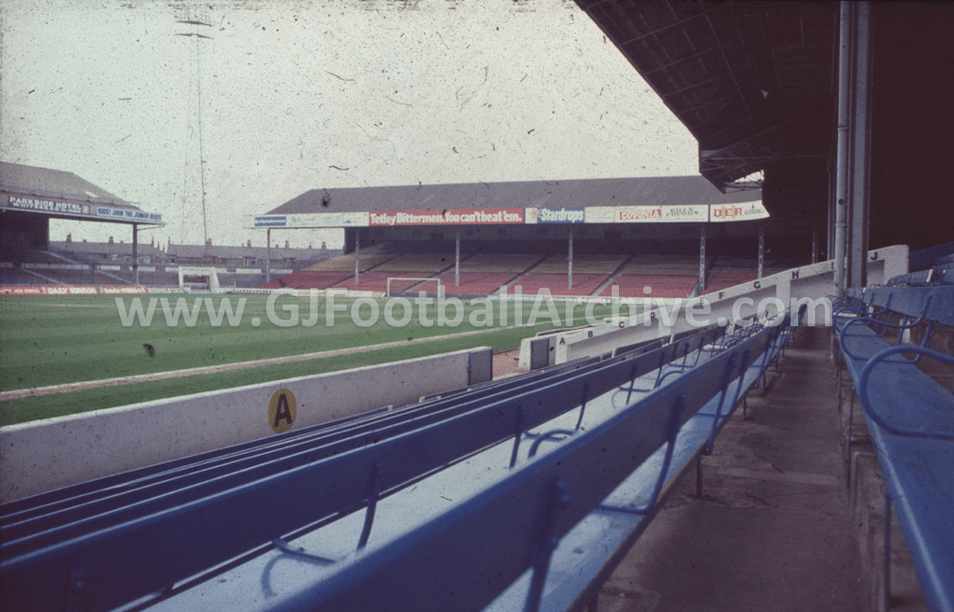
It’s day 27 of my posts counting down to the centenary of Maine Road’s opening game. Today – the wooden benches! Many a fan’s first experience of Maine Road was sitting on the benches in the old Platt Lane Stand.
These images may bring back a few memories. The Platt Lane benches were painted maroon and yellow for many years – I’m not certain if they were originally that colour. Older fans may know the answer but if they were maybe it was because they were installed at a time, the early 1960s, when those two colours had been used as City’s second choice kit?
Maroon is City’s traditional away colour but in 1959 a yellow shirt with maroon cuffs and V was used. If there was a link then that was not obvious by the time my Dad was taking me on to the Platt Lane as a young boy.
For me it seemed so odd, but then again the new North Stand had grey seats, and back in 1923 much of Maine Road was painted green. So I suppose there was never much logic around football grounds.
City used to paint on to the seats whether they were for season ticket holders, ‘invalids’ (obviously the wording back then, not today’s wording!) or if they were just numbered you could either sit there if it was an unreserved seating game or the number would match a ticket holder.
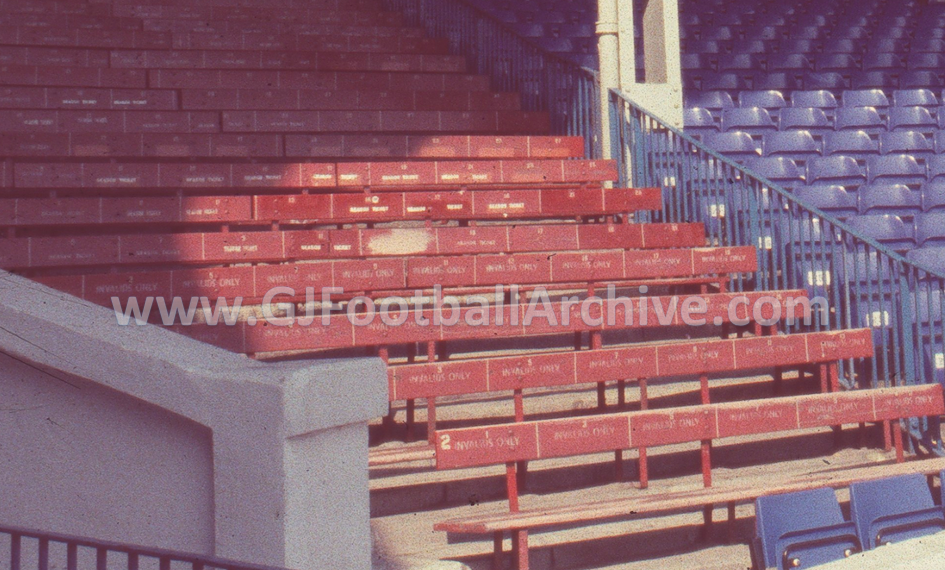
Most of the benches lasted about 40 years, but some were destroyed when Leeds United fans visited in November 1990 and were replaced for the stand’s final season or so with blue plastic seats. The stand was demolished in 1992.

The Main Stand also had benches for much of its existence. These were painted blue and in some cases had arm rests. They had been part of the original build in 1923 and were replaced in phases during the 1970s and 1980s.

For those unfamiliar with Maine Road this photo may help. This shows the original Platt Lane Stand corner (number 3) where the maroon seating with ‘invalid’ wording image was taken. The benches damaged by Leeds fans were near the front of the stand under number 5. The Main Stand bench image is taken to the left of number 2 looking towards the floodlight near 5 and 6.

If you’d like to read more on the history of Maine Road, take a look at Farewell To Maine Road, which can be downloaded from this page:
If you enjoy all the free material on my website and would like to support my research and keep this website going (but don’t want to subscribe) then why not make a one-time donation (or buy me a coffee). All support for my research is valued and welcome. It allows me to keep some free material available for all. Thanks.
Choose an amount
Or enter a custom amount
Your contribution is appreciated.
Donate
 Gary James' Football Archive
1 Comment