A FA Ban

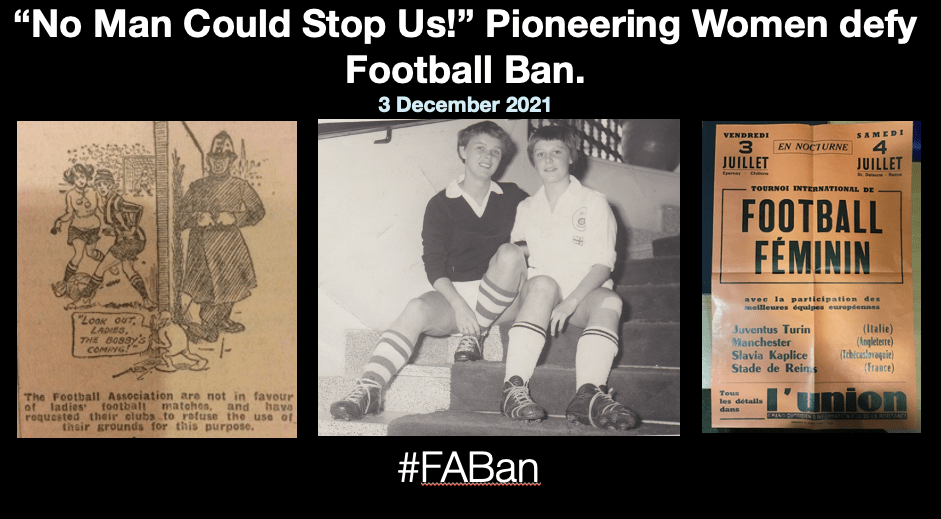
On this day in 1921 the FA banned women from playing football on FA affiliated grounds. A century later, in December 2021, I staged a talk at Hebden Bridge on this ban. The night was sponsored and supported by Geoff Matthews and his company Cansquared Ltd. It was a wonderful night and lots of attendees asked about the future and what they could do to help promote the stories of the women who played at a time when the FA tried to kill female participation in the sport. Well, after that night a lot has happened to recognise the Manchester Corinthians.

As part of my longstanding project into female participation and involvement in football in Manchester I have been researching and writing Manchester Corinthians: The Authorised History. This hardback book will be out soon (it’s at the printers).

Margaret Shepherd and Margaret Whitworth with me prior to the Hebden Bridge event

A lot has been written on the Corinthians (see the section on women’s football on this site for a few examples) but not nearly enough, plus there are some inaccuracies out there that the book will correct (even now there are some that keep on being repeated – including both the start and end points for the Corinthians!). Basically, this team possessed a talented group of players who toured Europe and South America promoting football, female endeavour and Manchester.

I talked quite a bit about Corinthians at Hebden Bridge that night in 2021 and we were fortunate to have four Corinthians as guests that night. Margaret Whitworth, Margaret Shepherd, Lesley Wright and Gail Redston between them covered around 42 seasons of activity at the club.

I’ve been tracking down the names of other Corinthians to include in the book. It is now being printed with over 350 names. Earlier this year I had found 230 names, so a lot has been achieved. See:

The Hebden Bridge night was significant.That night I mentioned my idea of having a plaque erected for the Corinthians in a significant/related location in Manchester. Several members of the audience thought this was a wonderful idea and asked if they could support the wider promotion of the Corinthians – one more or less suggested we should march on Downing Street to persuade them to do something about it!

In 2019 I’d written articles for a variety of publications suggesting the same and urging the FA and others to recognise the Corinthians. In the Manchester City men’s match programme as well I highlighted my desire to get a plaque erected about their achievements.

The talk at Hebden Bridge


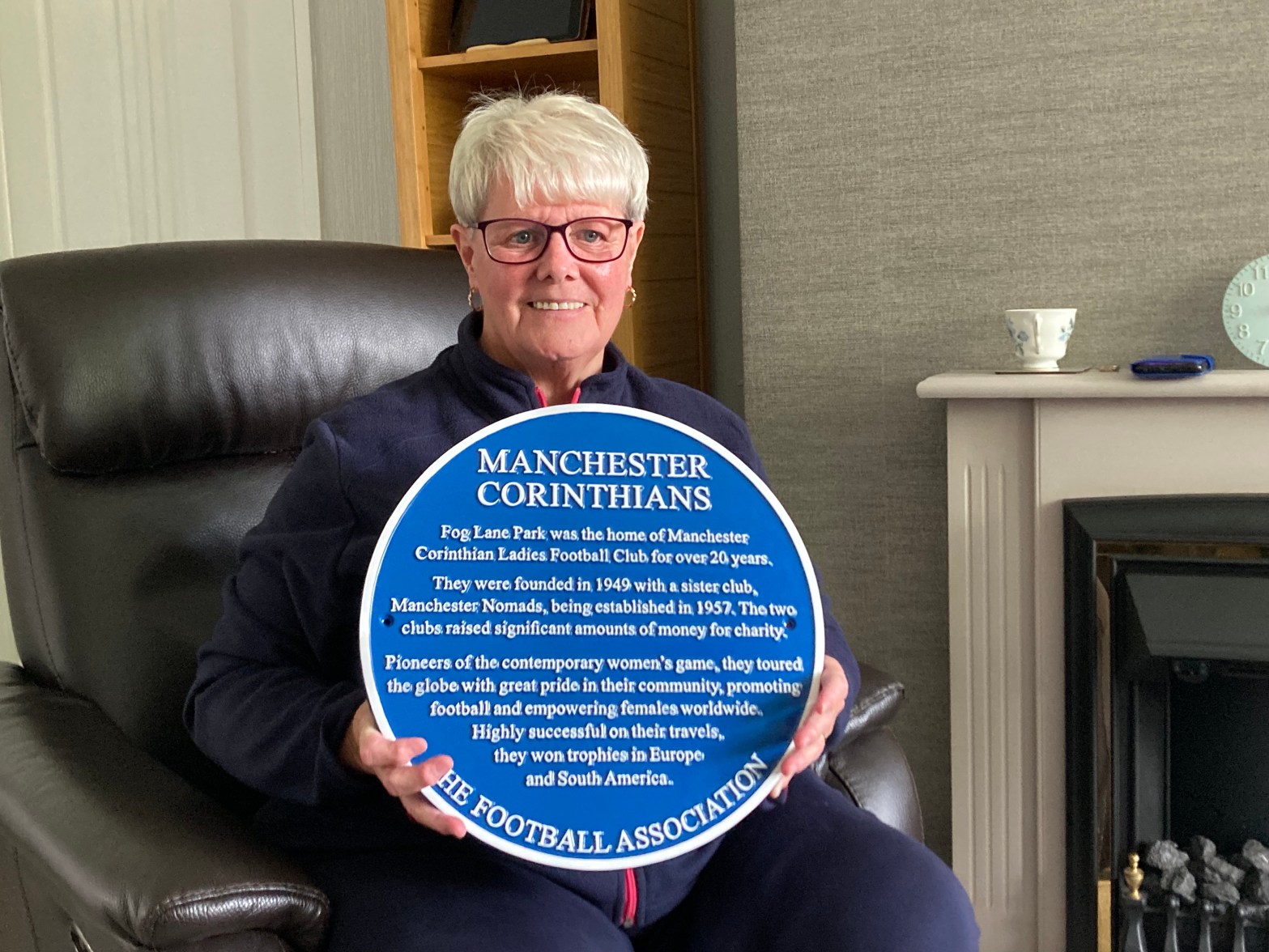
Via Manchester Council I was put in contact with the Friends of Fog Lane Park and we ultimately set up a successful appeal in their name. The FA made a significant donation which funded the plaque and our fundraising efforts raised enough to allow the Friends to commission 2 murals and other tributes to the Corinthians as well.

Those present at Hebden Bridge in December 2021 helped raise the profile and that event was significant in highlighting the incredible achievements of its female footballers. Now, the authorised history of the Corinthians will tell the story of the club from its birth right through to the blue plaque appeal. It will use the voices of the women who represented Manchester and England in a positive manner and who won trophies in South America & Europe and who toured North Africa. They won a significant European competition before either Manchester men’s team yet their achievements were not recognised by the city until the blue plaque appeal started.

I am immensely proud of how this has all happened. The event at Hebden Bridge was free to attend and was made possible by the support of a locally based business, Cansquared (Geoff Matthews – who co-hosted the evening). We felt it was vital we made this free to attend to spread the word.

If anyone runs a bookshop, library or key Manchester venue and would like a Corinthians event then please get in touch. I’d be happy to promote the club and the book of course. The more we can do to promote their story the better.

Thanks for reading this. If you would like to find out more about the Corinthians then follow the tabs on this site or use the search function. If you’d like to know more about the FA Ban then you can download for free an article I co-wrote here:

https://www.tandfonline.com/doi/full/10.1080/17460263.2021.2025415

You can find out more on the Corinthians book here:

A few copies of my book on Manchester City Women are still available. This tells the history of City Women via the voices of the women (and some men) involved. The book has been heralded as a model for oral histories by the Oral History Society.

Here’s a link you can follow to order a signed copy of the City Women book:

The 1990s: Manchester City v Manchester United

Yesterday (23 March 2024) saw another Manchester City victory over United in the WSL Manchester derby. It’s always impressive seeing the Blues win and this City team has been in existence since 1988. The history of women’s football in Manchester does not always get the attention it deserves and many of us have been determined to change that for years (this year I’ll be publishing the Authorised History of the Manchester Corinthians after years of research – see below). So hopefully the following will be of interest. It includes a few quotes from those involved in previous decades and I’ve included it as part of my series on the 1990s as the first City-Utd women’s league derby took place in 1990.

While the perception will always exist that Manchester United’s women’s team has always been City’s rivals and vice versa, for both clubs the real rivals have varied over the years. Derby matches have been played against Manchester Belle Vue and other prominent local clubs. There were even derbies in the 1940s when Manchester Ladies and Manchester Corinthians played each other.


However, any game between City and United takes on extra significance. United fans established a Manchester United Ladies team in the 1970s with close ties to the men’s club. This eventually was closed down by the men’s club before re-emerging in 2018 as a WSL 2 club. In September 2019 the first WSL Manchester derby between City and United occurred at the Etihad following United’s move into the top flight. This was a truly special day for both clubs and for those of us present.

The first competitive derby between City and United was actually in September 1990 in the North West Women’s Regional Football League Second Division when Neil Mather was City’s manager: “I was nervous for weeks on end, and it was coming and coming and coming. I thought ‘we’ve got to beat United in the first competitive Derby.’ Being a big blue it was like ‘whatever we do we’ve got to beat them.’ We were 4-1 up with about five minutes to go and then had a five minute collapse where I thought we’re going to blow this. At one point it had looked like we were going to get five or six and annihilate them and then we nearly lost it! Thank God we hung on for a 4-3 win, but I’ll never forget that game. We had a girl called Jenny Newton who was a manic City fan and scored and I don’t think I’ve ever seen anything like it. When she scored her eyes were bulging and it meant the world and a lot of our girls were City fans. It meant the world to beat them.”

Lesley Wright: “The first time we played United in a competitive game there was about 150 there. They were a really strong team. Better than us at the time and they’d been established a lot longer.”

Rita Howard: “Despite being a United fan I loved playing as City Ladies against United. I absolutely loved it. Even though I’m a United fan I never contemplated joining them because the support from City, even when it waned a little, was far superior to anything United got. At best they’d get a kit and then it was ‘on your way.’ I know our closeness to City came from that beginning with Neil. His enthusiasm got us the kit, the tracksuits, the minibus…. All sorts of things. I know that wasn’t happening at United and at that time I don’t think any club connected in any way to a Football League side were as close as we were then. I think we got a lot more recognition from the beginning and that has carried on to today. Look at what City have done.”

Jane Morley: “I’m a season ticket holder at Manchester United but I was a manager at City Ladies. One day I’d been with City at a tournament and then went straight to Old Trafford for a men’s game. I was sat there when the bloke next to me – who I didn’t know – said ‘what you doing with that on!’ I realised I still had my City jacket on. I had to explain to him that I managed City Ladies.”

Bev Harrop was a Manchester United fan playing for City: “I had a United shirt underneath my City shirt! (laughs) Most of the time.  Not later on, I grew out of it eventually, but at first, I did.”

Jane Morley: “It angers me when people say that Manchester United now have their first women’s team. As with City when the relaunch happened that implies the stuff we did for the club years before doesn’t count. I played for United in the 70s and 80s before a few of us broke away to set up FC Redstar. We left United because we wanted to test ourselves. We had some great players and wanted to progress but those who ran United wanted to stay in a Manchester League and not join the North West League. So we broke away in 1985 and formed FC Redstar.

“Many of the teams we know today as WSL clubs are actually men’s clubs that have taken over established women’s clubs. Teams like Leasowe Pacific became Everton. I have to bite my lip sometimes when some clubs claim they created a women’s team… no, you took and rebranded a team. There were quite a few big teams around the time City Ladies started such as Broadoak with Tracey Wheeldon.” 

These snippets are from my book on Manchester City’s women’s team. Copies (signed by me) can be ordered here: https://gjfootballarchive.com/shop/

For more on the book on the Manchester Corinthians (who started in 1949) see:

If you’d like to read more on women’s football in Manchester then take a look at: 

https://gjfootballarchive.com/category/womens-football-2

Subscribe to get access

If you would like to read all the in-depth articles on this site (including the entire Manchester A Football History book) then please subscribe. It works out about £1.67 a month if you take out an annual subscription (£20 per year) or £3 a month if you’d like to sign up for a month at a time. Each subscriber gets full access to the 500+ articles posted so far and the hundreds scheduled to be posted in the coming weeks.

The 1990s: The First Women’s Manchester League Derby

The latest City in the 1990s flashback feature is about the women’s Manchester derby. This weekend marks the latest Manchester derby in the Women’s Super League and it will be played at the Etihad Stadium (City currently hold the record attendance for a women’s club game in Manchester – you can find details of that elsewhere on the website). There’s a long history of competition between teams representing the women of Manchester City and Manchester United.

City’s team has been in existence continually since November 1988 when Donna Haynes and Heidi Ward both scored two goals in their first game (v Oldham Athletic at Boundary Park).

I was at the City Ladies (as they were then known) first game and I was also at their first league derby in September 1990 when City defeated United 4-3. It was a fantastic day, watched by around 150 people.

City’s goals came from Rhoda Taylor (8 min), Rachel O’Shaughnessy (43 mins), Jenny Newton (50 mins) and Lesley Peters. City’s manager Neil Mather told me as part of my research for the Manchester City Women book: ‘United were the top side, you know, and beating them was so good for morale. The men’s team were a good side in the early 90s when City Ladies carried on developing, you know. This was the Howard Kendall era, and City had top five finishes. City were one of the top five or six teams in the country at the time, so it was fabulous for women’s football to have Man City, you know.’

Helen Hempenstall played for City that day and she described her memory of the day for my book: I remember when we played United (30/9/90) and Neil (Helen’s boyfriend, now husband) and all his mates came to watch us. There were a lot of people there that day. United had a decent team then. It was always a difficult game against United. They had a right-winger… We never got on. Every time we played each other we were at each other all the way through the game. Me and Carol Woodall were having a go at her. The referee told Lesley Wright “Tell both your full backs to shut their mouths otherwise they’ll both be off!” We just didn’t get along and before every game I thought I’ll get in their first. ‘I’m having her.’ Neil Mather still talks about it.

‘I think Lesley Wright kept the team together. She kept it all tight at the back. I played at the back with her and I learnt a lot from her. Because I was next to her I knew how important she was. If I missed something she always got it. She always encouraged me and kept shouting ‘different class, different class’. You learn from the people around you and I listened to her. Before every game she came to speak to me. She’d put her arm around me and reassure me. She’d tell me not to worry about anything. Most of the time travelling to away games I’d go with Lesley in the car. We used to have a laugh. I remember one day we were travelling to an away game some distance away and we stopped for petrol and all got out. I lit up a fag and everyone else jumped back in the car screaming! I didn’t even think! When we got to the ground they all told Neil Mather and I think he worried that he could’ve lost half his team. At another game I was sat in the middle and as we got out the person before me slammed the door back. It hit my head and I had a big lump for the game.’

Lesley Wright was one of several women who had first played for the pioneering Manchester Corinthians team. I’ve been researching their remarkable story for years and this summer (2024) my work will be published. It will tell the story of the Corinthians from its formation in 1949 through to its final days forty years later. For more information on that club and the book see:

The story of the first women’s League derby and of the first 30 years or so of City Women’s existence can be read in my book on the club. It’s called Manchester City Women: An Oral History and is basically the women telling their stories of playing for the club and how they got into football, plus statistics covering the journey from friendlies in 1988-89 through to competition and the modern day successes.

You can buy the book via this link (every copy is signed by me):

#IWD: Women’s Football Interviews and Videos

If you’re interested in women’s football or in football in Trafford or Manchester here are some video interviews we did as part of the work on the #WEuro2022 Heritage Lottery funded project for Trafford. These interviews are with women who played for Manchester Corinthians, Manchester City, Manchester United, FC Redstar, & Macclesfield:

We start with Jan Lyons:

https://www.youtube.com/watch?v=iHkt5rGOJ5E

Now Gail Robertson:

https://www.youtube.com/watch?v=9TO4nnHtp-U&feature=emb_logo

Next Lesley Wright:

https://www.youtube.com/watch?v=oPgjj84gHfw&feature=emb_imp_woyt

Finally, Jane Morley:

https://www.youtube.com/watch?v=9tbzsOIpO7I&feature=emb_imp_woyt

Here’s an interesting clip of the Corinthians playing in 1960:

https://bbcrewind.co.uk/asset/60bf2dbfc69ade0020ef3021?q=ladies%20football%20international%201972u0026amp%3Bsize%3D30

Margaret Shepherd and Margaret Whitworth were also filmed as part of the wider project (they were interviewed by Wigan & Leigh). Here they are:

Margaret Whitworth actually appears on this BBC clip from 1960 playing:

https://bbcrewind.co.uk/asset/60bf2dbfc69ade0020ef3021?q=ladies%20football%20international%201972&size=30

Also, here’s my talk explaining about the history of women’s football:

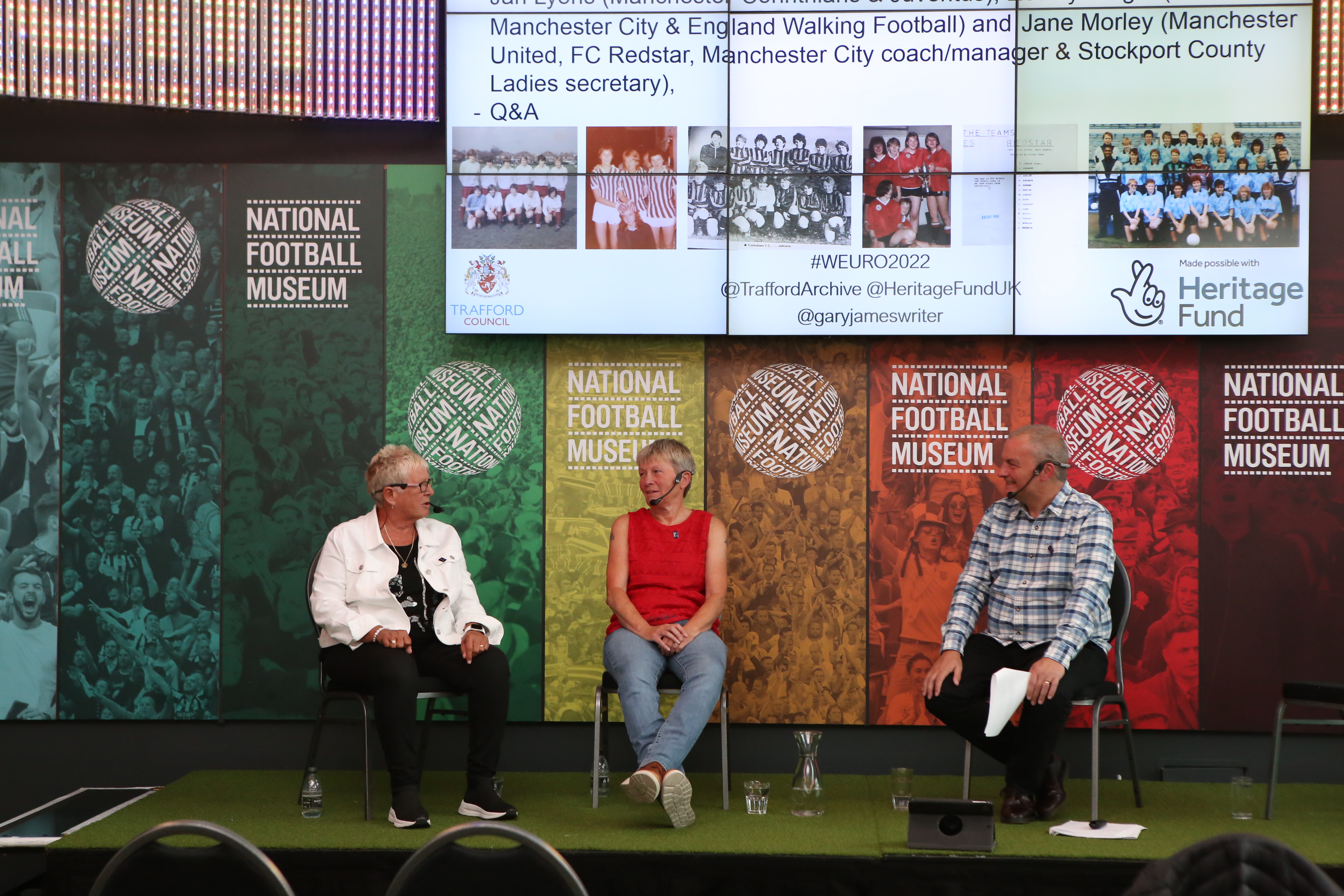
This talk on the history of women’s football was staged at the National Football Museum on 1st July as part of my work on a consultancy basis with Trafford local archives. The talk lasts about 47 mins. Enjoy!

There will be a video of the panel discussion mentioned in this talk that will appear as a part 2 later. Maybe next week?

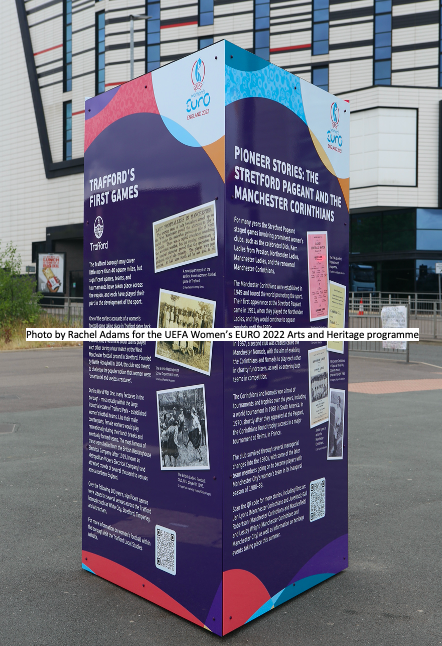
The Trafford Archive website I mention during my talk is available here:

https://exploringtraffordsheritage.omeka.net/exhibits/show/traffordwomensfootball

Corinthians’ Influence on Modern Day Success

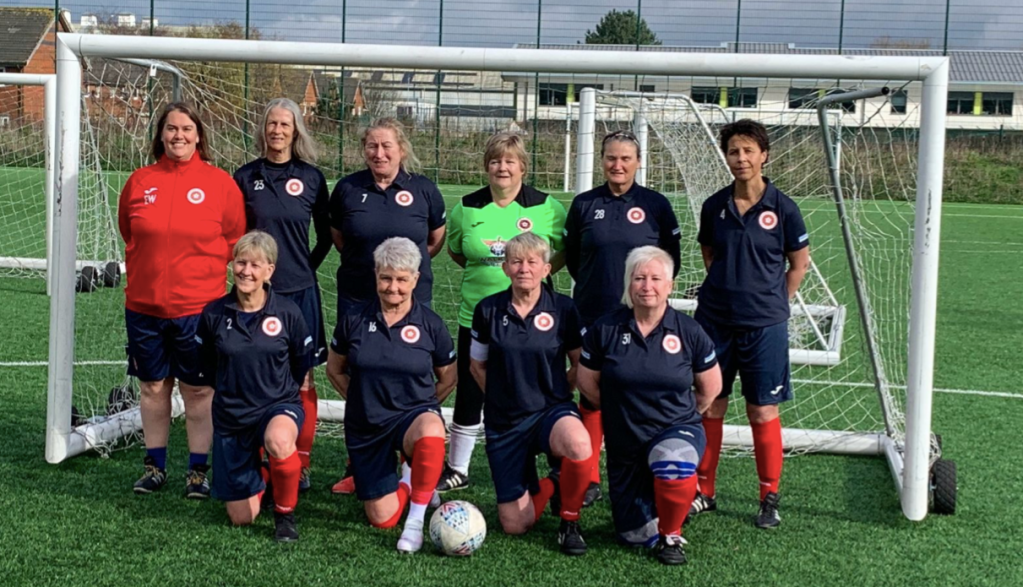
This Saturday just gone (24 February 2024) I was down in Cardiff watching the Tri-Nations Cup (a women’s international walking football tournament). The England over 55s team was captained by former Manchester Corinthian and Manchester City player Lesley Wright. Ultimately, England were successful in a tournament involving Wales and Ireland.

It was great to see England (EWFC over 55s pictured above; photo from @Eilis1979) find success, led by a former Corinthian, in a sport that promotes health, exercise and activities. Another Corinthian, Gail Redston, also played for England and it was wonderful to see the Corinthian influence still there in trophy winning teams.

There were players appearing in the tournament who had played for leading clubs across Great Britain and Ireland. This included Mac Barlow, who netted most of England’s goals. Mac’s previous eleven-a-side clubs included Preston.

The whole tournament was a positive example of walking football and supporters came from across the UK too. There was even a group of Crystal Palace season ticket holders who had sacrificed watching their Premier League match to support England.

Lesley Wright and Gail Redston both feature in my new book on Manchester Corinthians. Details here:

Hebden Bridge & the Manchester Corinthians

In December 2021 I staged a talk at Hebden Bridge on the FA ban of women’s football. The night was sponsored and supported by Geoff Matthews and his company Cansquared Ltd. It was a wonderful night and lots of attendees asked about the future and what they could do to help promote the stories of the women who played at a time when the FA tried to kill female participation in the sport. Well, after that night a lot has happened to recognise the Manchester Corinthians.

As part of my longstanding project into female participation and involvement in football in Manchester I have been researching and writing Manchester Corinthians: The Authorised History. The book will be of a similar scope to my Manchester City Women: An Oral History on City’s women’s team.

Margaret Shepherd and Margaret Whitworth with me prior to the Hebden Bridge event

A lot has been written on the Corinthians (see the section on women’s football on this site for a few examples) but not nearly enough, plus there are some inaccuracies out there that need to be corrected (even now there are some that keep on being repeated). Basically, this team possessed a talented group of players who toured Europe and South America promoting football, female endeavour and Manchester.

I talked quite a bit about Corinthians at Hebden Bridge and we were fortunate to have three Corinthians as guests that night. Margaret Whitworth, Margaret Shepherd and Lesley Wright between them covered every season of the club’s life from the 1950s through to its demise. Since that night I’ve also tracked down a player from the club’s very first season of 1948-49 who, together with detailed archival research, has helped me piece together for the first time several people who were instrumental in the birth of the club. Again, this is not something that has appeared in any of the articles or films connected with the club in recent years. This will be explained properly for the first time in my book.

I’m still trying to track down other Corinthians to include in the book. To date I’ve identified over 230 players. See:

After the Hebden Bridge night it was clear that we needed to recognise the Corinthian players further. On that night I mentioned my idea of having a plaque erected for the Corinthians in a significant/related location in Manchester. Several members of the audience thought this was a wonderful idea and asked if they could support the wider promotion of the Corinthians – one more or less suggested we should march on Downing Street to persuade them to do something about it!

In 2019 I’d written articles for a variety of publications suggesting the same and urging the FA and others to recognise the Corinthians. In the Manchester City men’s match programme as well I highlighted my desire to get a plaque erected about their achievements.

The talk at Hebden Bridge


Via Manchester Council I was put in contact with the Friends of Fog Lane Park and we ultimately set up a successful appeal in their name. The FA made a significant donation which funded the plaque and our fundraising efforts raised enough to allow the Friends to commission 2 murals and other tributes to the Corinthians as well.

Those present at Hebden Bridge in December 2021 helped raise the profile and that event was significant in highlighting the incredible achievements of its female footballers. Now, the authorised history of the Corinthians will tell the story of the club from its birth right through to the blue plaque appeal. It will use the voices of the women who represented Manchester and England in a positive manner and who won trophies in South America & Europe and who toured North Africa. They won a significant European competition before either Manchester men’s team yet their achievements were not recognised by the city until the blue plaque appeal started.

I am immensely proud of how this has all happened. The event at Hebden Bridge was free to attend and was made possible by the support of a locally based business, Cansquared (Geoff Matthews – who co-hosted the evening). We felt it was vital we made this free to attend to spread the word.

If anyone runs a key Manchester venue and would like a Corinthians celebration event then please get in touch. The more we can do to promote their story the better.

Thanks for reading this. If you would like to find out more about the Corinthians then follow the tabs on this site or use the search function. If you’d like to know more about the FA Ban then you can download for free an article I’ve recently co-written here:

https://www.tandfonline.com/doi/full/10.1080/17460263.2021.2025415

You can find out more on the Corinthians book here:

Copies of my book on Manchester City Women are still available. This tells the history of City Women via the voices of the women (and some men) involved. The book has been heralded as a model for oral histories by the Oral History Society.

Here’s a link you can follow to order a signed copy of the City Women book:

Watch this space for more on the Corinthians and women’s football over the coming months. Thanks – now use the tabs and search to learn more on women’s football in Manchester. Ta!

Plaque Unveiling Now!

PIONEERING WOMEN’S FOOTBALL TEAM TO BE RECOGNISED WITH A BLUE PLAQUE

  • Manchester Corinthian Ladies Football Club to be recognised with a blue plaque
  • Unveiling will take place at Fog Lane Park, Didsbury, their home for over 20 years from formation in 1949
  • The plaque, two murals of the team and other tributes will be unveiled at the park on Friday 6 October at noon
  • The plaque and murals were funded by an appeal which included significant donations from the Football Association and Manchester City Council, alongside dozens of individual donations
  • Over 20 players, including a 92 year old who joined the team at formation, will be in attendance

A Blue plaque and other tributes to the pioneering women’s football team Manchester Corinthians will be unveiled on Friday 6 October at noon at the site of their formation, Fog Lane Park, Didsbury, Manchester. In attendance will be over 20 women who played for the club between 1949 and 1983 and representatives from the Football Association, Manchester Football Association, Manchester City Council, football fans, members of the public and former England international Kerry Davis.

One of the former players in attendance will be 92 year old, Dorothy Alcock, who first joined the team at formation in 1949. Others present on the day participated in trophy winning tours across Europe and South America during the fifties, sixties and seventies.

Dorothy Alcock, Manchester Corinthian from formation in 1949

The Corinthians raised significant amounts of money for charity during their existence while also promoting football and female endeavour at a time when participation in the sport was often frowned upon.

During the 1950s, playing as an unofficial England side, the Corinthians won a major European tournament in Germany and were supported on their travels by legendary Manchester City men’s goalkeeper Bert Trautmann.

In 1960 they found success in an unofficial ‘World Cup’ (officially the first ‘Torneo Internacional De Futbol Femenino’) in Venezuela as part of a significant tour of the West Indies and South America. Former player (outside right) Margaret Whitworth recalls: ‘We were treated like film stars. There were crowds everywhere we went. Playing in front of 56,000 was thrilling and the way women’s football was treated was so different to how it was back in England at the time. Here we had to play on park pitches or at other sports grounds, but there we played in major football stadiums.’

During the late 1960s the club’s management played a leading role in the creation of the Women’s Football Association. Both the Corinthians and their sister club the Nomads were founder members but their manager Gladys Aikin became a member of the governing body’s committee. By this time their determination was to see the growth of the game and lifting of all barriers.

The Corinthians continued to play and by the end of the 1970s they were frequently coached by the Manchester City 1956 FA Cup winner Dave Ewing at City’s Platt Lane training complex.

During the 1980s a ground move led to the club being renamed Woodley Ladies, and that club ceased to exist by the end of the decade. Many of the Corinthians from the late 1970s and 1980s became players with Manchester City’s women’s team during its inaugural season of 1988-89.

Today at least one former Corinthian, Lesley Wright, plays walking football at the highest level possible and continues to coach women’s football, continuing the Corinthian influence through to the modern day development of the sport.

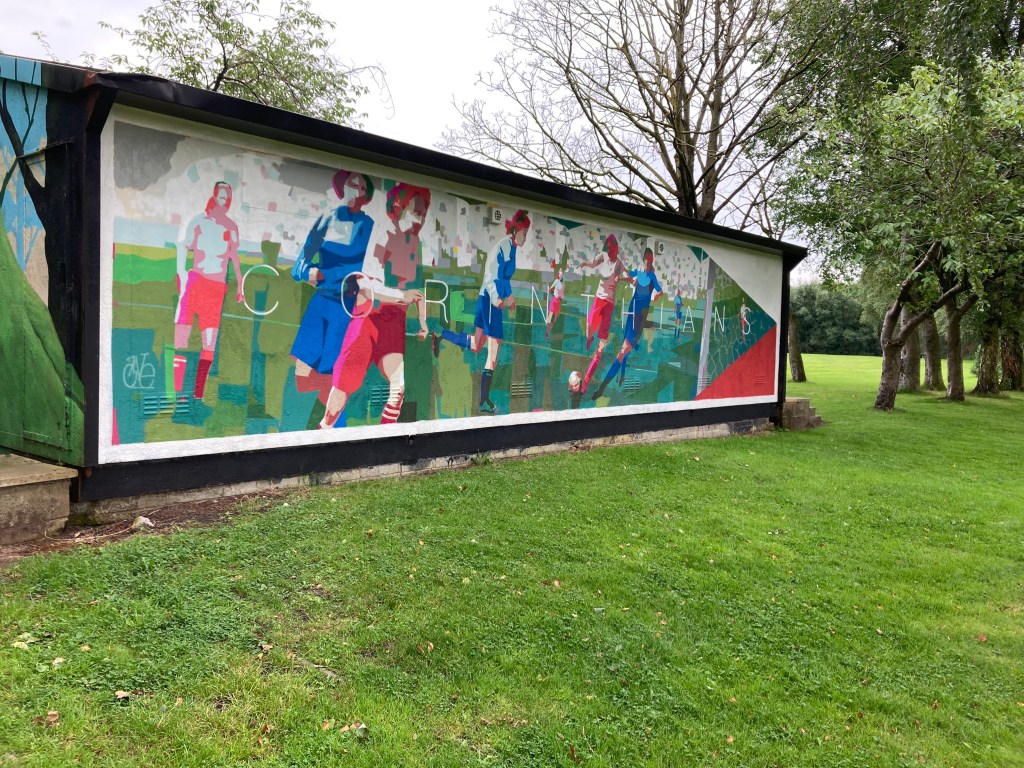
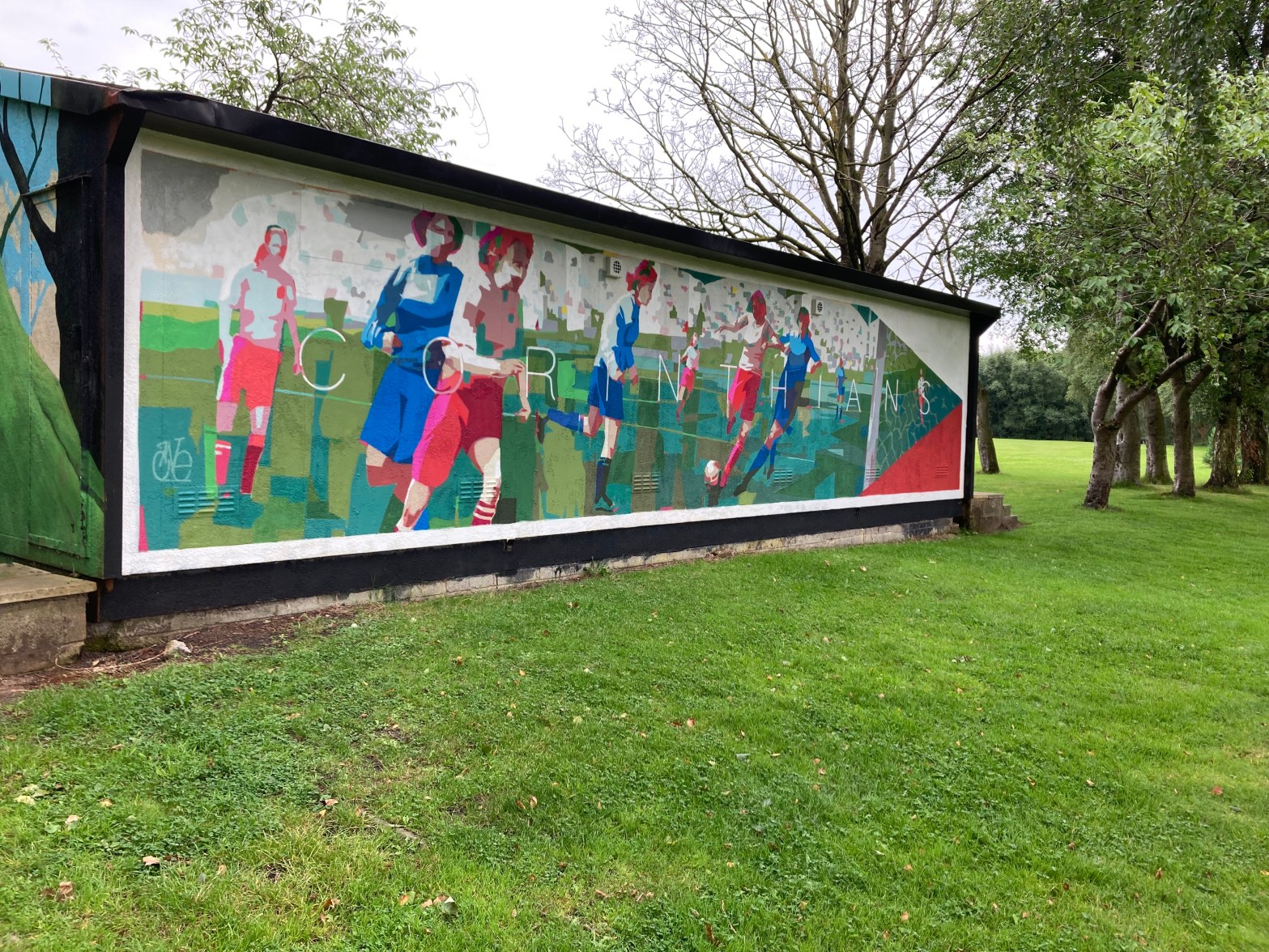
The plaque and murals were funded by an appeal which included significant donations from the Football Association and Manchester City Council, alongside dozens of individual donations. The community group, the Friends of Fog Lane Park, have been instrumental in ensuring the Corinthians are remembered and that this aspect of the park’s life is properly recorded and acknowledged. The murals were designed and painted by artist Gavin Renshaw.

Manchester Corinthians mural by artist Gavin Renshaw
Washing in the duck pond, Manchester Corinthians by Artist Gavin Renshaw

About Manchester Corinthian Ladies Football Club

Manchester Corinthian Ladies FC was an English football club founded in 1949 by Percy Ashley. He established the club because his daughter Doris wanted to play football but couldn’t find a team. At this time The FA ban on women’s football using FA affiliated grounds was in place (from 1921; lifted in 1970). During the inaugural seasons the Corinthians played friendlies and in small scale competitions in the UK, but during the mid to late 1950s they embarked on a series of European tours.

Their fame grew and they received invites to play across Europe, in Africa and in South America. Occasionally playing as an unofficial England side in tournaments (these were the days before there was an official England team), they found success often, becoming the most successful women’s team by some distance.

Under the management of Percy Ashley, followed by Gladys Aikin and then George Aikin, the Corinthians were important representatives of women’s football, both internationally and domestically, always contributing to the game’s growth and development.

Plaque Unveiling at 12

A Blue plaque and other tributes to the pioneering women’s football team Manchester Corinthians will be unveiled at noon today (6 October 2023) at the site of their formation, Fog Lane Park, Didsbury, Manchester. In attendance will be over 20 women who played for the club between 1949 and 1983 and representatives from the Football Association, Manchester Football Association, Manchester City Council, football fans, members of the public and former England international Kerry Davis.

I’ve talked about the women often and what they achieved but here are several interviews with a few of the women who played for Corinthians. This link includes filmed interviews we did with Gail Robertson, Jan Lyons and Lesley Wright (all Corinthians) plus there’s an interview with Jane Morley who played for United Ladies and went on to coach City Ladies too:

https://www.thefa.com/competitions/uefa-womens-euro-2022/heritage/trafford-heritage

And the last film on the following web page is of an interview with Margaret Shepherd and Margaret Whitworth. Enjoy:

https://www.thefa.com/competitions/uefa-womens-euro-2022/heritage/wigan-and-leigh-heritage

About Manchester Corinthian Ladies Football Club

Manchester Corinthian Ladies FC was an English football club founded in 1949 by Percy Ashley. He established the club because his daughter Doris wanted to play football but couldn’t find a team. At this time The FA ban on women’s football using FA affiliated grounds was in place (from 1921; lifted in 1970). During the inaugural seasons the Corinthians played friendlies and in small scale competitions in the UK, but during the mid to late 1950s they embarked on a series of European tours.

Manchester Corinthians mural by artist Gavin Renshaw

Their fame grew and they received invites to play across Europe, in Africa and in South America. Occasionally playing as an unofficial England side in tournaments (these were the days before there was an official England team), they found success often, becoming the most successful women’s team by some distance.

Under the management of Percy Ashley, followed by Gladys Aikin and then George Aikin, the Corinthians were important representatives of women’s football, both internationally and domestically, always contributing to the game’s growth and development.

Washing in the duck pond, Manchester Corinthians by Artist Gavin Renshaw

Plaque Unveiling Tomorrow!

PIONEERING WOMEN’S FOOTBALL TEAM TO BE RECOGNISED WITH A BLUE PLAQUE TOMORROW!

  • Manchester Corinthian Ladies Football Club to be recognised with a blue plaque
  • Unveiling will take place at Fog Lane Park, Didsbury, their home for over 20 years from formation in 1949
  • The plaque, two murals of the team and other tributes will be unveiled at the park tomorrow (Friday 6 October) at noon
  • The plaque and murals were funded by an appeal which included significant donations from the Football Association and Manchester City Council, alongside dozens of individual donations including one from the Dick, Kerr Ladies Foundation, demonstrating the great community of women’s football that existed in North West England
  • Over 20 players, including a 92 year old who joined the team at formation, will be in attendance

A Blue plaque and other tributes to the pioneering women’s football team Manchester Corinthians will be unveiled on Friday 6 October at noon at the site of their formation, Fog Lane Park, Didsbury, Manchester. In attendance will be over 20 women who played for the club between 1949 and 1983 and representatives from the Football Association, Manchester Football Association, Manchester City Council, football fans, members of the public and former England international Kerry Davis.

One of the former players in attendance will be 92 year old, Dorothy Alcock, who first joined the team at formation in 1949. Others present on the day participated in trophy winning tours across Europe and South America during the fifties, sixties and seventies.

The Corinthians raised significant amounts of money for charity during their existence while also promoting football and female endeavour at a time when participation in the sport was often frowned upon.

During the 1950s, playing as an unofficial England side, the Corinthians won a major European tournament in Germany and were supported on their travels by legendary Manchester City men’s goalkeeper Bert Trautmann.

In 1960 they found success in an unofficial ‘World Cup’ (officially the first ‘Torneo Internacional De Futbol Femenino’) in Venezuela as part of a significant tour of the West Indies and South America. Former player (outside right) Margaret Whitworth recalls: ‘We were treated like film stars. There were crowds everywhere we went. Playing in front of 56,000 was thrilling and the way women’s football was treated was so different to how it was back in England at the time. Here we had to play on park pitches or at other sports grounds, but there we played in major football stadiums.’

During the late 1960s the club’s management played a leading role in the creation of the Women’s Football Association. Both the Corinthians and their sister club the Nomads were founder members but their manager Gladys Aikin became a member of the governing body’s committee. By this time their determination was to see the growth of the game and lifting of all barriers.

The Corinthians continued to play and by the end of the 1970s they were frequently coached by the Manchester City 1956 FA Cup winner Dave Ewing at City’s Platt Lane training complex.

During the 1980s a ground move led to the club being renamed Woodley Ladies, and that club ceased to exist by the end of the decade. Many of the Corinthians from the late 1970s and 1980s became players with Manchester City’s women’s team during its inaugural season of 1988-89.

Today at least one former Corinthian, Lesley Wright, plays walking football at the highest level possible and continues to coach women’s football, continuing the Corinthian influence through to the modern day development of the sport.

The plaque and murals were funded by an appeal which included significant donations from the Football Association and Manchester City Council, alongside dozens of individual donations. The community group, the Friends of Fog Lane Park, have been instrumental in ensuring the Corinthians are remembered and that this aspect of the park’s life is properly recorded and acknowledged. The murals were designed and painted by artist Gavin Renshaw.

Manchester Corinthians mural by artist Gavin Renshaw
Washing in the duck pond, Manchester Corinthians by Artist Gavin Renshaw

About Manchester Corinthian Ladies Football Club

Manchester Corinthian Ladies FC was an English football club founded in 1949 by Percy Ashley. He established the club because his daughter Doris wanted to play football but couldn’t find a team. At this time The FA ban on women’s football using FA affiliated grounds was in place (from 1921; lifted in 1970). During the inaugural seasons the Corinthians played friendlies and in small scale competitions in the UK, but during the mid to late 1950s they embarked on a series of European tours.

Their fame grew and they received invites to play across Europe, in Africa and in South America. Occasionally playing as an unofficial England side in tournaments (these were the days before there was an official England team), they found success often, becoming the most successful women’s team by some distance.

Under the management of Percy Ashley, followed by Gladys Aikin and then George Aikin, the Corinthians were important representatives of women’s football, both internationally and domestically, always contributing to the game’s growth and development.

Recognising the Manchester Corinthian Ladies Football Team

There has been some good publicity for the Manchester Corinthians blue plaque unveiling which will take place on 6 October. The latest is an article in She Kicks. Follow the link for the story and images:

For wider background on the club….

The club toured the globe representing England and promoting female endeavour, football and Manchester and now, over 70 years after they were established, their achievements have helped generate significant improvements to a park and helped foster a great community spirit. Through the dedicated work of a group of volunteers, especially the Friends of Fog Lane Park, a blue plaque, two murals and other tributes telling the Corinthians story will be erected and revealed on Friday 6 October at noon.

We all know how our public parks, particularly in cities, often suffer vandalism and other anti social activity and through the Corinthians’ story he Friends of Fog Lane Park have changed the look of a vandalised building and have built on the good work they had already performed to make Fog Lane Park, Didsbury a safe, well used and popular park.

There’s so much to say but both the Friends of Fog Lane Park and the Corinthians deserve significant praise. In total over £6000 was raised for these tributes and this came from a large number of individuals as well as the FA, Manchester Council and the Corinthians’ old friends (and on the pitch rivals) Dick, Kerr Ladies (see below for names of those who made donations).

The Corinthians won major tournaments in Germany, Venezuela, France and elsewhere. They were the link team between the world renowned Dick, Kerr Ladies and the modern era, playing a significant role in football’s development. Often they played as England in these tournaments too, adding a bit of international significance in the days when formal England teams did not exist.

Another major achievement was that at formation of the Women’s Football Association not only was Gladys Aikin, the Corinthians’ manager, playing a key role but the club joined the WFA as two clubs – Corinthians and Nomads. This demonstrated their commitment to the long term development of the sport.

A year or so ago Will McTaggart, who hosted a number of football film shows with me in the years before Covid, alerted me to a clip that’s been found by the BBC of the Manchester Corinthians women’s team of the 1960s. This clip is from March 1965. You can watch it here:

As a reminder here’s more on the story to erect the plaque:

In 2019 I wrote an article for the Manchester Evening News on the women’s achievements and hoping for FA recognition and had meetings with a variety of local organisations about promoting the Corinthians further. Covid slowed everything down but then in 2021 I publicly announced for the first time the desire to have a plaque erected to the pioneering Manchester Corinthians. This was at a celebration evening at Hebden Bridge organised with Geoff Matthews. Our guests included several former Corinthians players and the mood of the audience was encouraging and supporting, which then led on to rekindling discussions with Manchester based bodies.

Support came from Manchester City Council and we discussed erecting a plaque at Fog Lane Park, the initial home of the Corinthians. In fact the women were based there for over twenty years. Via the council the Friends of Fog Lane Park came on board and we set up an appeal under their name, as custodians of the park. I wrote to contacts at the FA and elsewhere and within next to no time donations came flooding in from a variety of former players, family, friends, journalists and the Dick, Kerr Ladies Foundation via Gail Newsham. It was gratifying to see so much support (a full list of those who donated appears below – thanks to you all!).

My discussions with the FA eventually resulted in them agreeing to fund the plaque, the unveiling and to support other tributes. This meant we’d reached our goal. The plaque is a reality and will be unveiled soon.

The Friends of Fog Lane Park managed to get matching funds from Manchester City Council too and so now, as well as the plaque and a lectern providing a Corinthians’ timeline, there will be two impressive murals painted by artist Gavin Renshaw.

On October 6 at noon the blue plaque will be unveiled with over twenty of the Manchester Corinthians present.

The club’s entire history, including its final years over 40 years after it was founded, will be documented in a book that will be published in 2024. You can find out about that here:

If you appear on the following photos then please get in touch or if you played for the Corinthians at any point between 1949 and 1982 we’d love to hear from you. I’m also keen to track down more photographs and items of memorabilia associated with the team. Please email me at gary@GJFootballArchive.com or contact via this page: https://gjfootballarchive.com/contact/

Over the next few weeks I’ll be posting further stories about the Corinthians. Recently I was fortunate to interview a 90+ year old who played for the Corinthians from formation in 1949.

Those who have donated to the appeal to erect permanent tributes to the Corinthians include:

Pam Barnes, Dan Mooney, Adam Turgoose, ‘Ben’, ‘Jean J’, Jonathan Kaye, Megan Riley, Helena Byrne, Dawn Burrows, Clare Wilkins, Linda Foley, Debbie Enever, John Carrier, Jacqui McAssey, Michael Cottam, Karen Ohanco, David Hoyle, Daniel Rubin, Heidi James, Gary James and the Dick, Kerr Ladies Foundation. There were also a small number of anonymous donations – thanks to all of you too. Everyone has contributed to this appeal. Please come along to the unveiling if you can.