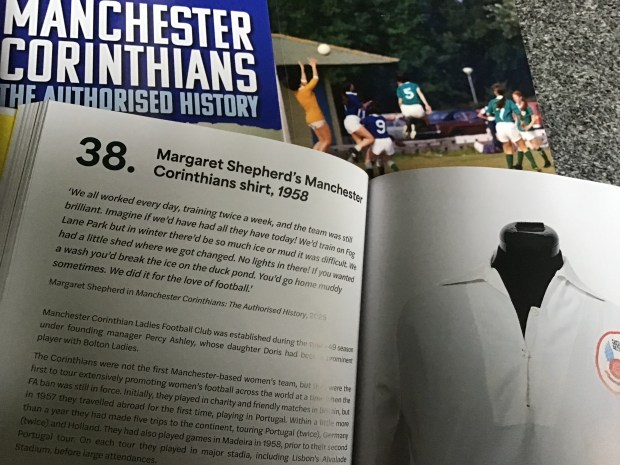
I’m delighted to say that in addition to Manchester Corinthians: The Authorised History (published at the start of the year, see below) and Histories of Women’s Football in Britain and Ireland (published last month) I’ve written a feature for another book which mentions the Corinthians. The book tells the story of football (focusing on England) in 100 objects. I’ve written a few of the features for this National Football Museum book (alongside Marek, Alex & Wiebke from the museum) and one of these is on Margaret Shepherd’s Corinthians shirt. The shirt is currently on display at the museum too.
This feature, together with mentions by myself and others in the Histories book and the Authorised History, helps spread the word about these remarkable women.
Some of you are aware of my obsession to document and promote the history of women’s football in Manchester over the last decade, but for those uncertain I’d like to post a few links and bits of information here on the remarkable stories of the Manchester Corinthians who, before the men’s teams of City & United, found international success.
Some of the Friends of Fog Lane Park at the last meeting before the Corinthians plaque unveiling
Dorothy Alcock, Manchester Corinthian from formation in 1949
Margaret Whitworth with the Manchester Corinthians blue plaque
Washing in the duck pond, Manchester Corinthians by Artist Gavin Renshaw
Some of the trophies won by the Manchester Corinthians
Over the last decade I’ve been interviewing women who played football in Manchester, or for Manchester based teams, during the 1940s to modern years. This includes Maureen Charlton, Dorothy Allcock and Flo Cloake (who played in the 1940s & 50s) and players like Steph Houghton, Karen Bardsley and Jill Scott (who of course played in more recent times). For me the stories of all are inspiring but it is those who played for the Corinthians that I’m most keen to promote at the moment. These women played prominent roles in football’s development and some are still contributing significantly today.
In 2021 the blue plaque appeal was launched to recognise the Corinthians and elsewhere on my site you can read about the success of that and the unveiling in 2023. In addition in December 2024 I staged a reunion where over 90 attended (most Corinthians with some in their 90s). You can watch scenes from that here:
I gave a speech explaining why the Corinthians matter that day:
There were some wonderful words from Margaret Shepherd which I am truly grateful for. Margaret has been one of the key figures promoting the club’s endeavours and she certainly inspired me during my research:
We’ve also inspired Imprint Films to put together this 18 minute overview of the Corinthians’ story, including interviews with some of the players:
Of course there is the book too and I’m absolutely delighted with this from Matt Williams, a longlist judge for the William Hill Sports Book of the Year 2025 award. He has posted the following video about the Manchester Corinthians book as his ‘What are we reading this week?’ post on social media. It really does please me and demonstrates why I’ve been so keen to get the Corinthians story out there. The book hasn’t won any prize but the comments mean a lot to me.
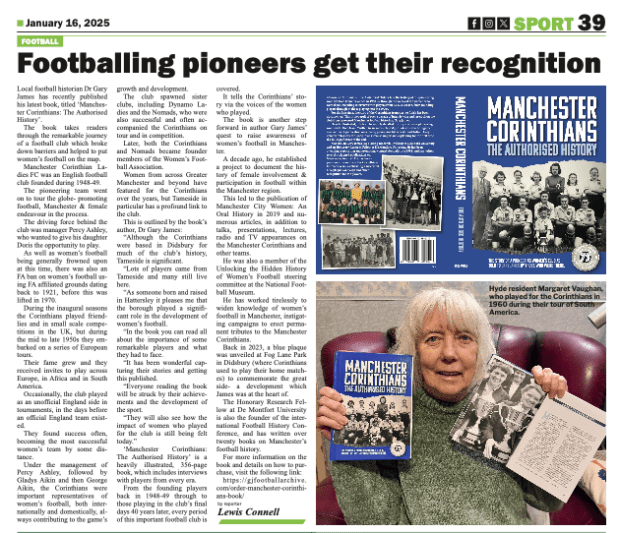
For those interested Manchester Corinthians: The Authorised History is a must for anyone interested in Manchester or women’s football and consists of 356 pages. Getting it into Manchester bookshops, particularly Waterstones, is proving difficult so if there’s anyone reading this who can help please get in touch. We can organise events if that helps?
Thanks to everyone who has helped so far to promote the Corinthians and their stories. We still need to bang the drum so please do all you can to spread the word on this remarkable team. If you need more info then there’s lots on this website, just search Corinthians. There’s also the books of course….
The Authorised History is illustrated throughout and you can order it now for £25 (including UK postage and packaging). I’ll sign all copies ordered direct from me below.
If you live outside the UK then please contact for details of additional postage costs.
You do not need to have a PayPal account to order – use the ‘Pay with PayPal’ button above and it will give you the option to pay by credit/debit card without creating a PayPal account.
UK ONLY – Manchester Corinthians: The Authorised History
The story of a pioneering women’s club as told to Gary James by those who were there. This will be published in late December 2024. This is UK only at £25 (incl UK postage and packaging). Outside UK contact for additional postage costs.
Some of you are aware of my obsession to document and promote the history of women’s football in Manchester over the last decade, but for those uncertain I’d like to post a few links and bits of information here on the remarkable stories of the Manchester Corinthians who, before the men’s teams of City & United, found international success.
Some of the Friends of Fog Lane Park at the last meeting before the Corinthians plaque unveiling
Dorothy Alcock, Manchester Corinthian from formation in 1949
Margaret Whitworth with the Manchester Corinthians blue plaque
Washing in the duck pond, Manchester Corinthians by Artist Gavin Renshaw
Some of the trophies won by the Manchester Corinthians
Over the last decade I’ve been interviewing women who played football in Manchester, or for Manchester based teams, during the 1940s to modern years. This includes Maureen Charlton, Dorothy Allcock and Flo Cloake (who played in the 1940s & 50s) and players like Steph Houghton, Karen Bardsley and Jill Scott (who of course played in more recent times). For me the stories of all are inspiring but it is those who played for the Corinthians that I’m most keen to promote at the moment. These women played prominent roles in football’s development and some are still contributing significantly today.
In 2021 the blue plaque appeal was launched to recognise the Corinthians and elsewhere on my site you can read about the success of that and the unveiling in 2023. In addition in December 2024 I staged a reunion where over 90 attended (most Corinthians with some in their 90s). You can watch scenes from that here:
I gave a speech explaining why the Corinthians matter that day:
There were some wonderful words from Margaret Shepherd which I am truly grateful for. Margaret has been one of the key figures promoting the club’s endeavours and she certainly inspired me during my research:
We’ve also inspired Imprint Films to put together this 18 minute overview of the Corinthians’ story, including interviews with some of the players:
Of course there is the book too and I’m absolutely delighted with this from Matt Williams, a longlist judge for the William Hill Sports Book of the Year 2025 award. He has posted the following video about the Manchester Corinthians book as his ‘What are we reading this week?’ post on social media. It really does please me and demonstrates why I’ve been so keen to get the Corinthians story out there.
For those interested Manchester Corinthians: The Authorised History is a must for anyone interested in Manchester or women’s football and consists of 356 pages. Getting it into Manchester bookshops, particularly Waterstones, is proving difficult so if there’s anyone reading this who can help please get in touch. We can organise events if that helps?
Thanks to everyone who has helped so far to promote the Corinthians and their stories. We still need to bang the drum so please do all you can to spread the word on this remarkable team. If you need more info then there’s lots on this website, just search Corinthians. There’s also the book of course….
The book is illustrated throughout and you can order it now for £25 (including UK postage and packaging). I’ll sign all copies ordered direct from me below.
If you live outside the UK then please contact for details of additional postage costs.
You do not need to have a PayPal account to order – use the ‘Pay with PayPal’ button above and it will give you the option to pay by credit/debit card without creating a PayPal account.
UK ONLY – Manchester Corinthians: The Authorised History
The story of a pioneering women’s club as told to Gary James by those who were there. This will be published in late December 2024. This is UK only at £25 (incl UK postage and packaging). Outside UK contact for additional postage costs.
Ten years ago today (24 January 2014) Manchester City Ladies (founded in 1988) was relaunched as Manchester City Women. To mark this anniversary the following ‘long read’ article is an excerpt from Manchester City Women: An Oral History (my book published late in 2019 telling the story of the club).
Here’s the excerpt from the book on the club’s relaunch in 2014:
Despite initially being formed as part of Manchester City’s corporate structure in 1988 the women’s team became its own entity affiliated to the parent club by the end of the 1990s. It had its own committees and structure but progression up the leagues had resulted in a need to re-establish closer ties. By the early 2010s it became clear a formal coming together was needed. This surprised some of the players and staff from the 1980s and 1990s, especially when articles appeared claiming the club had been established in 2002. Jane Morley: “It upset Lesley (Wright) that the full history had been ignored. There were stories that the club had been founded by a group of City fans and it came across that it was fairly insignificant. But that wasn’t true. These were women who wanted to play football. Some were City fans but Rita Howard wasn’t, Bev Harrop was a United season ticket holder – So was I. I went to United games with Bev.”
Louise Wakefield: “I felt a bit like we’d been forgot and I thought ‘is it just me?’ but apparently a few of us were feeling left out. We’d done everything for the club. You know, turned up, swollen ankles, and had to play, you know? We felt a bit left out with it.”
Michelle Middleton felt: “aggrieved that the media seemed to think that City had suddenly decided to have a women’s team and didn’t take the time to look into the history but I was happy that the club was still backing the women and were planning to make them as important a part of the club as the men.”
Michelle had played at the formation of the club, with Lesley arriving that same season. Lesley stayed until 2002, with Louise joining the club in 1996, but it wasn’t only players that had been involved before the 2002 date that felt aggrieved at times. Gary Moores: “The waters got muddied around this time and I think some people got a bit upset. I understood fully that what went on in the past is in the past and that it had nothing to do with the relaunched club. I know that upset a few people because some were still tying up the back end of Manchester City Ladies. Since the transfer of the club, I haven’t been to games because it took so much time out of my life. I reached the point where I felt ‘it’s in safe hands now’ and I felt that our part of the transition had been handled well and so I felt I could move away. Previously it had been like the guy spinning the plates… you couldn’t stop because the plates would come crashing down but once City were handed control someone else was able to spin the plates and I could move on.
“I didn’t pay much attention to those who suggested City were a new club because half of it was from people who had only just learned about women’s football because of the birth of the Super League. They were speaking about something that they didn’t actually know much about. They’d dipped into it occasionally. Also, there was the negativity because of the position of Doncaster Belles. That was a shame because we know what Doncaster Belles have done but then there’s these people who see the money that Manchester City as an overall club was supposed to have and then it’s suggested that City had used that money to buy their place but they hadn’t. It was built on the back of years of commitment by players and volunteers. That first season after there were about half a dozen players who had been with us for years.
“I remember being on holiday about two years after the WSL place was given and there was a woman who was a big City Women fan there. We got chatting and I told her of my connection but she didn’t believe me. She got her laptop out and started to quiz me. ‘Okay, where did Krystal Johnson come from?’ I said ‘Manchester City Ladies’ and she said that she’d played for one of the Sheffield clubs not City but that was the season when there was the transition from winter to summer football and the club had no games. The players went off to play for other clubs to keep fit but even on City’s own website the previous club line gave the impression these had all arrived from other clubs. All of that added to this view that it was a new club. There were about six or seven players like this I think.”
Inevitably there were going to be issues to resolve as the transition took place. As with the period in 2002 when some long established players and committee members felt the club was being taken from them, some of the committee and players felt similar feelings. Transformations are always difficult but with the media choosing to promote the view that ‘new club’ City were in the process of obtaining a WSL place at the expense of Doncaster Belles, it was always going to be tough to satisfy all former players and committee members. The noise, particularly in the media, did not overshadow what was actually happening however. Many current and former players were delighted with the potential for a stronger relationship. Rowena Foxwell: I think got a bit excited when City Ladies became more professional and then they changed the name to Women. I think because women’s football was on the telly more, and it was great that our Club was getting a professional team. We all thought ‘if we were 20 years younger, we could have played in that’. So we got a bit giddy about it.”
Rowena had seen some of the incorrect details of the club’s birth and decided to be proactive: “I was clicking through and there was this piece on how City Ladies started in 2002 or whatever it was! So I emailed Vicky Kloss, the Head of Communication at City, and just said to her that I was part of the original team… still in touch with a lot of them… be great if we could get involved… do you know that some of the facts on there are wrong? I think the fact that we got angry about the fact that they’d got it wrong, just shows how passionate we were.”
Debbie Darbyshire: Vicky Kloss wanted it right. Vicky’s good like that. She’s always keen to make sure things are right. She called [Gary James] in and started the process of getting it all right.”
Rowena’s email was passed on to City’s Damaris Treasure, then Head of Public Affairs. She was heavily involved with the relaunch and wanted to get the facts correct. She immediately contacted Rowena and pushed to ensure the history of the team was properly recorded and that those involved felt valued for what they had achieved. Rowena Foxwell: “Many of us were invited to the relaunch. We obviously rocked up to the Etihad. There were a few people that we hadn’t seen probably since we played. So you know that was nice, and it was nice that the City acknowledged us as the original team.”
Damaris Treasure: I started working with Don Dransfield on the then City Ladies when we announced the formalisation of the relationship with the Club in 2012. I was then part of the core team who bid for the WSL license, and led the re-launch as City Women in 2014. The day of the re-launch as Manchester City Women will forever be a highlight for me. Thinking back on all that day and all the people in the room – the original City Ladies squad, the new City Women squad, more media than we thought possible, legends of the men’s game (Patrick Vieira, Claudio Reyna), City leadership – it’s actually quite incredible that all those people came together. But it’s also indicative of just how right that moment was and how ready people were to invest in it.”
Jane Boardman: “I think you know the club went some way to recognise that this was a relaunch and not a launch, which I think was very important. A number of us got invited to the relaunch event. I think it’s important that the club continues to stay community-focused and I think that they do achieve that.”
Heidi Ward: “I think I was really pleased that the relaunch got the press coverage that it did, because it lifted the women’s game. I knew that City were going to put money in to it and they were going to make the facilities and whatever. They are now absolutely brilliant. They wanted to give women the same opportunity as men and that’s just absolutely amazing. To be fair, I didn’t think it would get to the level where it is now, so that’s incredible really. If you look at the players now, they all look like athletes. They are all similar shapes and sizes and they are all really fit and healthy. Look at Steph Houghton – her physique has changed and she’s a complete athlete now. And the skills and the level of football has just raised in the last few years as well.
“I’m used to watching men’s football and I’ve never wanted to compare it to men’s football because it felt like a different game. I think there was a bit of a gap and now, at the highest level, I don’t see that. There’s different skills and there’s different strengths, but what City have done has changed things. I think it’s amazing.”
Kate Themen was delighted that City were investing but was unhappy with the media focus on the fate of Doncaster Belles: “I thought the FA could have handled it much better. I think that was a structural issue, because it was a shame that Doncaster had lost their place, but when the FA sets up a league structure, which is essentially a franchise structure then these things happen. It wasn’t City’s issue it was the FA’s for having a structure whereby it allowed teams to do that.”
Lesley Wright: “I remember Rowena Foxwell asking if we were going to the relaunch. It was very nice and it was great to be invited. I think most of us that went to the relaunch were City fans as well as players so it meant more in some ways. Manuel Pellegrini was there. I think it was good how it was done because it showed that City were taking it seriously. It was a major step forward. It wasn’t just about using the money that Sheikh Mansour provided. It was the same as with the men. They invested in the club. They took the core of the England women’s team and they’ve brought in others. The whole point of the WSL was to create a platform to develop English talent and so I’m pleased that City have focused on bringing in and developing English players. Along the way they’ve brought in people like Carli Lloyd to help of course, but they’re developing talent the right way. It costs a lot of money and it can be difficult to sustain that but, like the men, they know what they want and they’re developing the club to achieve that. Opening the Academy and creating that ground takes it to a different level again.”
Damaris: “It was a really interesting time when we re-launched City Women, because there were teams that had been doing great things for a long time, Arsenal being the most notably successful, but we had a strong sense, which is generally how we do things anyway, of doing things well and doing things right by the highest possible standards. So, in some ways we treated this as a blank slate. Also, the way that we generally work at City is that we are all responsible for both the men’s and the women’s teams. Everyone working on City Women at that time was working in Premier League football as well as with the WSL, so there was a great range of experience being shared between the teams.
Neil Mather: “I was chuffed to bits as I still am and I still get a huge buzz going to watch them. It was always my dream that there would be a women’s professional league and that they’d get the opportunities that the men got.”
Louise Wakefield: “I’m really pleased and I’m really pleased because of where we’ve come from, you know? I hope people understand that rags to riches story. The Arsenals have always had that structure but I think the rags to riches story that City have had over all those years is remarkable. The media should push that. There could be documentaries on it. I was about two seasons away from the change. I wasn’t far away at all. If it wasn’t for an incident I had at a turning point where I was starting to progress, I’d have been in that era. I’d have been in every progression from 1996, apart from the current first team. If you’ve got that money behind you and you’ve got that training and you go training every day… and you’re not playing on pitches that are up to here, you’re going to progress. If I was 17 playing now I’d have been a lot better player.”
Lindsay Savage was delighted when the relaunch occurred: “Brilliant, City is such a big club and it is great to see them challenging for everything. They are really inspiring young girls to follow their dream and are fantastic role models.”
Rita Howard: “I was happy with the relaunch…No, I was jealous. Definitely jealous that this has happened and that I have missed out because of time. But very happy for women now and for girls coming through. They’ve now got something to aspire to. It absolutely heartens me when I see girls coming here to my school who are already in teams and it’s a given that they are going to continue to play. When I first started teaching here I was like a frontrunner of the girls football. We might have a good five-a-side team but struggle beyond that. Since then we have had a team that won a tournament.”
The need for football lower down the pyramid to receive investment is there. Jane Morley, who is still involved in promoting the sport to young girls in the regions, hopes the wider public begin supporting community clubs financially: “It is important to remember that as great as it is what’s happened to City and the other clubs in the WSL for most women’s teams it is still as it has always been. You rent a grass pitch, a referee turns up, the opposition arrive and you play a game. The pitches vary, the conditions can be poor… it’s not changed. You can still find games that have no dressing rooms…. Changing in cars and so on. I still think the women’s game has to fit in with the men’s game. Playing at 2pm on a Sunday to fit in with men’s games in the morning.”
It will take some time for benefits at the highest level to trickle down the leagues but football as played in female competition is in a much better place now than it was only a few years ago. City remain determined to see football as football, without a differentiation. Damaris Treasure: “Bringing City Women in to Manchester City formally was only the beginning of City’s relationship with women’s football. I now work for City Football Group based in Australia, and the blueprint created in Manchester was replicated with our team in Melbourne (who have since gone on to win pretty much everything going). In the same way as Manchester, the women’s team are fully integrated with the men’s team, train at the same facilities, and have been credited with raising the bar for women’s football in Australia. We’ve got a girls academy at New York City FC, and long term we would love to see more women’s teams as part of CFG.
You can buy my history of the Manchester City Women’s team here:
I’m currently writing a history of the pioneering Manchester Corinthians women’s team that was founded 75 years ago this month (January 1949). You can find out more about that book here:
If you enjoy all the free material on my website and would like to support my research and keep this website going (but don’t want to subscribe) then why not make a one-time donation (or buy me a coffee). All support for my research is valued and welcome. It allows me to keep some free material available for all. Thanks.
Manchester City Women’s (then as Manchester City Ladies) first FA Cup tie was a 7-2 defeat at Robin Park, Wigan on 17 September 1989. This was only the second competitive game ever played by the club and came less than a year after formation. Since then, apart from a couple of seasons in the 1990s when the Blues decided not to enter, City have been regular competitors in the competition. In September 1999 City achieved their record score in the competition: 26-0 v Norton, WFA Cup Extra Preliminary Round and on this day (May 13) in 2017 they reached the FA Cup final for the first time.
Here for subscribers is the story of that final as told by those involved and those who were there… as documented in Manchester City Women: An Oral History – get your copy here if you don’t want to subscribe to this site:
On this day (24 January) in 2014 Manchester City Ladies (founded in 1988) was relaunched as Manchester City Women. To mark this anniversary the following ‘long read’ article is an excerpt from Manchester City Women: An Oral History (my book published late in 2019 telling the story of the club).
Here’s the excerpt from the book on the club’s relaunch in 2014:
Despite initially being formed as part of Manchester City’s corporate structure in 1988 the women’s team became its own entity affiliated to the parent club by the end of the 1990s. It had its own committees and structure but progression up the leagues had resulted in a need to re-establish closer ties. By the early 2010s it became clear a formal coming together was needed. This surprised some of the players and staff from the 1980s and 1990s, especially when articles appeared claiming the club had been established in 2002. Jane Morley: “It upset Lesley (Wright) that the full history had been ignored. There were stories that the club had been founded by a group of City fans and it came across that it was fairly insignificant. But that wasn’t true. These were women who wanted to play football. Some were City fans but Rita Howard wasn’t, Bev Harrop was a United season ticket holder – So was I. I went to United games with Bev.”
Louise Wakefield: “I felt a bit like we’d been forgot and I thought ‘is it just me?’ but apparently a few of us were feeling left out. We’d done everything for the club. You know, turned up, swollen ankles, and had to play, you know? We felt a bit left out with it.”
Michelle Middleton felt: “aggrieved that the media seemed to think that City had suddenly decided to have a women’s team and didn’t take the time to look into the history but I was happy that the club was still backing the women and were planning to make them as important a part of the club as the men.”
Michelle had played at the formation of the club, with Lesley arriving that same season. Lesley stayed until 2002, with Louise joining the club in 1996, but it wasn’t only players that had been involved before the 2002 date that felt aggrieved at times. Gary Moores: “The waters got muddied around this time and I think some people got a bit upset. I understood fully that what went on in the past is in the past and that it had nothing to do with the relaunched club. I know that upset a few people because some were still tying up the back end of Manchester City Ladies. Since the transfer of the club, I haven’t been to games because it took so much time out of my life. I reached the point where I felt ‘it’s in safe hands now’ and I felt that our part of the transition had been handled well and so I felt I could move away. Previously it had been like the guy spinning the plates… you couldn’t stop because the plates would come crashing down but once City were handed control someone else was able to spin the plates and I could move on.
“I didn’t pay much attention to those who suggested City were a new club because half of it was from people who had only just learned about women’s football because of the birth of the Super League. They were speaking about something that they didn’t actually know much about. They’d dipped into it occasionally. Also, there was the negativity because of the position of Doncaster Belles. That was a shame because we know what Doncaster Belles have done but then there’s these people who see the money that Manchester City as an overall club was supposed to have and then it’s suggested that City had used that money to buy their place but they hadn’t. It was built on the back of years of commitment by players and volunteers. That first season after there were about half a dozen players who had been with us for years.
“I remember being on holiday about two years after the WSL place was given and there was a woman who was a big City Women fan there. We got chatting and I told her of my connection but she didn’t believe me. She got her laptop out and started to quiz me. ‘Okay, where did Krystal Johnson come from?’ I said ‘Manchester City Ladies’ and she said that she’d played for one of the Sheffield clubs not City but that was the season when there was the transition from winter to summer football and the club had no games. The players went off to play for other clubs to keep fit but even on City’s own website the previous club line gave the impression these had all arrived from other clubs. All of that added to this view that it was a new club. There were about six or seven players like this I think.”
Inevitably there were going to be issues to resolve as the transition took place. As with the period in 2002 when some long established players and committee members felt the club was being taken from them, some of the committee and players felt similar feelings. Transformations are always difficult but with the media choosing to promote the view that ‘new club’ City were in the process of obtaining a WSL place at the expense of Doncaster Belles, it was always going to be tough to satisfy all former players and committee members. The noise, particularly in the media, did not overshadow what was actually happening however. Many current and former players were delighted with the potential for a stronger relationship. Rowena Foxwell: I think got a bit excited when City Ladies became more professional and then they changed the name to Women. I think because women’s football was on the telly more, and it was great that our Club was getting a professional team. We all thought ‘if we were 20 years younger, we could have played in that’. So we got a bit giddy about it.”
Rowena had seen some of the incorrect details of the club’s birth and decided to be proactive: “I was clicking through and there was this piece on how City Ladies started in 2002 or whatever it was! So I emailed Vicky Kloss, the Head of Communication at City, and just said to her that I was part of the original team… still in touch with a lot of them… be great if we could get involved… do you know that some of the facts on there are wrong? I think the fact that we got angry about the fact that they’d got it wrong, just shows how passionate we were.”
Debbie Darbyshire: Vicky Kloss wanted it right. Vicky’s good like that. She’s always keen to make sure things are right. She called [Gary James] in and started the process of getting it all right.”
Rowena’s email was passed on to City’s Damaris Treasure, then Head of Public Affairs. She was heavily involved with the relaunch and wanted to get the facts correct. She immediately contacted Rowena and pushed to ensure the history of the team was properly recorded and that those involved felt valued for what they had achieved. Rowena Foxwell: “Many of us were invited to the relaunch. We obviously rocked up to the Etihad. There were a few people that we hadn’t seen probably since we played. So you know that was nice, and it was nice that the City acknowledged us as the original team.”
Damaris Treasure: I started working with Don Dransfield on the then City Ladies when we announced the formalisation of the relationship with the Club in 2012. I was then part of the core team who bid for the WSL license, and led the re-launch as City Women in 2014. The day of the re-launch as Manchester City Women will forever be a highlight for me. Thinking back on all that day and all the people in the room – the original City Ladies squad, the new City Women squad, more media than we thought possible, legends of the men’s game (Patrick Vieira, Claudio Reyna), City leadership – it’s actually quite incredible that all those people came together. But it’s also indicative of just how right that moment was and how ready people were to invest in it.”
Jane Boardman: “I think you know the club went some way to recognise that this was a relaunch and not a launch, which I think was very important. A number of us got invited to the relaunch event. I think it’s important that the club continues to stay community-focused and I think that they do achieve that.”
Heidi Ward: “I think I was really pleased that the relaunch got the press coverage that it did, because it lifted the women’s game. I knew that City were going to put money in to it and they were going to make the facilities and whatever. They are now absolutely brilliant. They wanted to give women the same opportunity as men and that’s just absolutely amazing. To be fair, I didn’t think it would get to the level where it is now, so that’s incredible really. If you look at the players now, they all look like athletes. They are all similar shapes and sizes and they are all really fit and healthy. Look at Steph Houghton – her physique has changed and she’s a complete athlete now. And the skills and the level of football has just raised in the last few years as well.
“I’m used to watching men’s football and I’ve never wanted to compare it to men’s football because it felt like a different game. I think there was a bit of a gap and now, at the highest level, I don’t see that. There’s different skills and there’s different strengths, but what City have done has changed things. I think it’s amazing.”
Kate Themen was delighted that City were investing but was unhappy with the media focus on the fate of Doncaster Belles: “I thought the FA could have handled it much better. I think that was a structural issue, because it was a shame that Doncaster had lost their place, but when the FA sets up a league structure, which is essentially a franchise structure then these things happen. It wasn’t City’s issue it was the FA’s for having a structure whereby it allowed teams to do that.”
Lesley Wright: “I remember Rowena Foxwell asking if we were going to the relaunch. It was very nice and it was great to be invited. I think most of us that went to the relaunch were City fans as well as players so it meant more in some ways. Manuel Pellegrini was there. I think it was good how it was done because it showed that City were taking it seriously. It was a major step forward. It wasn’t just about using the money that Sheikh Mansour provided. It was the same as with the men. They invested in the club. They took the core of the England women’s team and they’ve brought in others. The whole point of the WSL was to create a platform to develop English talent and so I’m pleased that City have focused on bringing in and developing English players. Along the way they’ve brought in people like Carli Lloyd to help of course, but they’re developing talent the right way. It costs a lot of money and it can be difficult to sustain that but, like the men, they know what they want and they’re developing the club to achieve that. Opening the Academy and creating that ground takes it to a different level again.”
Damaris: “It was a really interesting time when we re-launched City Women, because there were teams that had been doing great things for a long time, Arsenal being the most notably successful, but we had a strong sense, which is generally how we do things anyway, of doing things well and doing things right by the highest possible standards. So, in some ways we treated this as a blank slate. Also, the way that we generally work at City is that we are all responsible for both the men’s and the women’s teams. Everyone working on City Women at that time was working in Premier League football as well as with the WSL, so there was a great range of experience being shared between the teams.
Neil Mather: “I was chuffed to bits as I still am and I still get a huge buzz going to watch them. It was always my dream that there would be a women’s professional league and that they’d get the opportunities that the men got.”
Louise Wakefield: “I’m really pleased and I’m really pleased because of where we’ve come from, you know? I hope people understand that rags to riches story. The Arsenals have always had that structure but I think the rags to riches story that City have had over all those years is remarkable. The media should push that. There could be documentaries on it. I was about two seasons away from the change. I wasn’t far away at all. If it wasn’t for an incident I had at a turning point where I was starting to progress, I’d have been in that era. I’d have been in every progression from 1996, apart from the current first team. If you’ve got that money behind you and you’ve got that training and you go training every day… and you’re not playing on pitches that are up to here, you’re going to progress. If I was 17 playing now I’d have been a lot better player.”
Lindsay Savage was delighted when the relaunch occurred: “Brilliant, City is such a big club and it is great to see them challenging for everything. They are really inspiring young girls to follow their dream and are fantastic role models.”
Rita Howard: “I was happy with the relaunch…No, I was jealous. Definitely jealous that this has happened and that I have missed out because of time. But very happy for women now and for girls coming through. They’ve now got something to aspire to. It absolutely heartens me when I see girls coming here to my school who are already in teams and it’s a given that they are going to continue to play. When I first started teaching here I was like a frontrunner of the girls football. We might have a good five-a-side team but struggle beyond that. Since then we have had a team that won a tournament.”
The need for football lower down the pyramid to receive investment is there. Jane Morley, who is still involved in promoting the sport to young girls in the regions, hopes the wider public begin supporting community clubs financially: “It is important to remember that as great as it is what’s happened to City and the other clubs in the WSL for most women’s teams it is still as it has always been. You rent a grass pitch, a referee turns up, the opposition arrive and you play a game. The pitches vary, the conditions can be poor… it’s not changed. You can still find games that have no dressing rooms…. Changing in cars and so on. I still think the women’s game has to fit in with the men’s game. Playing at 2pm on a Sunday to fit in with men’s games in the morning.”
It will take some time for benefits at the highest level to trickle down the leagues but football as played in female competition is in a much better place now than it was only a few years ago. City remain determined to see football as football, without a differentiation. Damaris Treasure: “Bringing City Women in to Manchester City formally was only the beginning of City’s relationship with women’s football. I now work for City Football Group based in Australia, and the blueprint created in Manchester was replicated with our team in Melbourne (who have since gone on to win pretty much everything going). In the same way as Manchester, the women’s team are fully integrated with the men’s team, train at the same facilities, and have been credited with raising the bar for women’s football in Australia. We’ve got a girls academy at New York City FC, and long term we would love to see more women’s teams as part of CFG.
You can buy my history of the Manchester City Women’s team here:
This was a sample of the content available on GJFootballArchive.com. If you would like to view everything on this site then please subscribe below. It works out about £1.67 a month if you take out an annual subscription (£20 per year) or £3 a month if you’d like to sign up for a month at a time. Each subscriber gets full access to the 500+ articles posted so far and the hundreds scheduled to be posted in the coming weeks.
This season has seen Manchester City players win several prominent player of the year awards with Kevin De Bruyne winning the PFA player of the year award; Phil Foden the PFA young player of the year and Lauren Hemp won the women’s PFA young player of the year award. There was also Ruben Dias won the FWA footballer of the year award and the Premier League player of the year award.
This is an incredible array of awards. The following subscriber post details all the Manchester City winners of these awards since their formation:
Subscribe to get access
Read more of this content when you subscribe today.












 Gary James' Football Archive