The First Manchester Cup Final

2025 marks the 140th anniversary of the first final of the Manchester Cup (later known as the Manchester Senior cup). The Manchester Cup was the first competition either Manchester United (as Newton Heath) or Manchester City (as Ardwick) won and was a hugely significant competition at the time of their first victories. In many ways it was more important locally than the FA Cup. The final was held on 25 April 1885 and you can read a match report of the game here and then my own words on the final:

The first season of the Manchester Cup proved to be very exciting with games involving Hurst and Newton Heath grabbing much attention in the local newspapers.  In fact the two sides competed in the first Manchester Cup final.  This was played at Manchester FC’s Whalley Range ground and had an attendance of approximately 3,500.  The Ashton club won 3-0 and at the end of the match all the Hurst players were lifted shoulder high by their fans and there was tremendous excitement on the pitch.  It was perhaps the first time a Manchester side had experienced success that actually meant something.  Hurst could rightly claim to be the best in the area, and after the game finished the President of the Manchester FA, Mr. Colbert, presented the cup to J. Ingham, Hurst’s Captain.  The Reporter newspaper then described the fantastic parade that took place all the way back to Ashton:  ‘All the way from Whalley Range the victors kept cheering and the band playing, the cup being held up in front of one of the carriages in which the journey to Ashton was made.  On arriving in town their cheers were redoubled and they received a great ovation in the streets.

‘The victors crowded into the Pitt & Nelson, and Mr. Joseph Fletcher, holding in his hand the cup which was filled with liquor, and addressing the captain of the club, said he had great pleasure in presenting to Mr. Ingham the cup on behalf of the Hurst Cricket & football Club.’

Joseph Fetcher was the landlord of the Pitt & Nelson and according to the Reporter he made a speech saying that he: ‘had lately been in Blackburn and he could assure them that the fame of the Hurst club was well known in that district and he was certain that the next season they would be called upon to play with teams from that district, the Mother of the Game.’

This was undoubtedly the finest moment for any of the Manchester clubs at this stage in history, and Hurst were worthy recipients of the praise.  Hurst had done more than most to encourage the game to develop and, as well as entering the FA Cup, they also tried to arrange fixtures with teams beyond the Manchester boundaries.  In March 1885 they had welcomed Welsh side Rhyl to Hurst and the Ashton side won 8-1 before 3,000 fans, then on Good Friday they played their return match and, according to reports from the period over 750 fans travelled from Ashton for the game which Hurst won 4-0.  Considering the nature of travel, working conditions, and the state of the game at the time this was a major achievement.

You can find out more about the origins of football in Manchester in my book Manchester A Football History. The book is long out of print but PDFs of the entire 2010 edition is available to subscribers to this site.

This is the Introduction for the 2010 edition of the book Manchester A Football History (Gary James, published by James Ward). As with everything else on this site copyright laws apply. The book is published here for the personal use of subscribers to this site. For any other use please email the publishers at info@manchesterfootball.org

Subscribe to get access

Read more of this content when you subscribe today. You can subscribe for £20 a year (works out about £1.67 per month) or £3 per month (cancel any time). Why not try it for a month?
Newton Heath/MUFC’s First Game and Their Colours

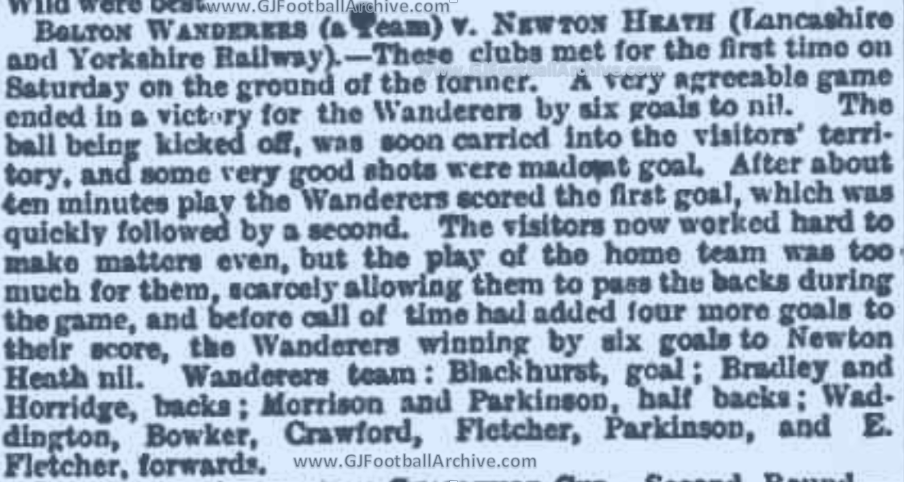
On this day (20 November) in 1880 as Newton Heath L&Y Railway Manchester United played their earliest known game. It was against Bolton Wanderers 2nd team and United lost 6-0. In the years that have followed some have claimed they wore green and gold at this game but the contemporary references given do not say anything of the sort.

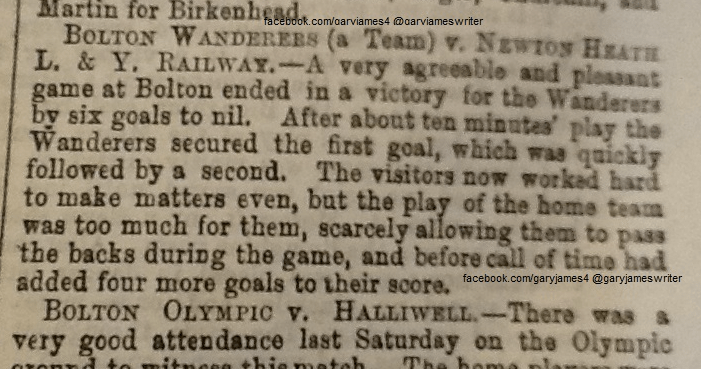
It is still repeated often that a newspaper report in the Bolton Evening News mentioned the colours of green and gold were worn for Newton Heath’s first reported match. The origin of this is unclear but the Manchester United Pictorial History and Club Record (Charles Zahra, Joseph Muscat, Iain McCartney and Keith Mellor; Nottingham: Temple Press, 1986) specifically refers to the match report on page 11 as being published on 24 November 1880 and implies it stated the team colours. It also suggests that Bolton wore scarlet shirts. 

My research over the decades has included a review of every Bolton newspaper for that period and I did discover a match report in the Bolton Evening News on the date mentioned in the above book but this did not include any reference to the colours worn.  This is actually the report that gets quoted. You can see there’s no mention of colours:

Like so many football clubs the early history of Newton Heath has lots of myths associated with it. The facts are that at the railway works in Newton Heath various sporting activities were established during the 1870s. In 1922 Herbert Dale, a railway worker who played football for a decade from the formation of what became Newton Heath, was asked how football became established at the works. He explained that the club when initially formed had been a cricket team (suggesting it was established in 1878), and that after some time a member of the committee bought a football from a shop on Market Street in the city centre. This appears to be in 1880 and, according to Dale, the instigator of the club was Sam Black and that the original colours were red and white quartered shirts (NOT green and gold; quartered shirts meant 2 panels on front and 2 on back with a red and a white panel on both the front and the back). Those colours may surprise some but I do provide references and explain more in a book The Emergence of Footballing Cultures: Manchester 1840-1919 published by Manchester University Press. In that I talk about all the early clubs of the Manchester area such as Hulme Athenaeum, Manchester Association and Hurst.

Black was seventeen when the club played its earliest known game on 20 November 1880 and his age then seems consistent with others, such as those at St Mark’s (Manchester City) who are known to have played in November 1880.

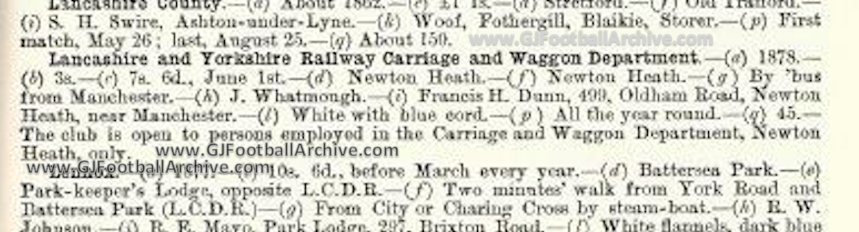
The was a Sportsman’s Yearbook for 1880 produced which the Newton Heath club was mentioned in. It appeared in both the cricket and football sections. Here are the details published in the cricket section:

Sportsman’s year book 1880 Newton Heath cricket section

You’ll notice mention there of the cricket whites/kit to be worn: white with a blue cord. Typically, this is believed to mean ‘white cricket shirts and trousers’ with a blue cord as belt (to differentiate between opponents). Some cricket clubs wore different coloured belts/cords; some wore specific caps with their whites and some wore badges (or even different colours).

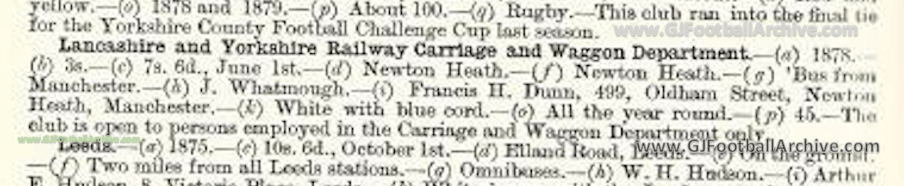
In that same yearbook the following appeared in the football section (back then a football section had rugby and association football clubs alongside each other):

Sportsman’s year book 1880 Newton Heath football section

You’ll notice the details are simply a repeat of the cricket section and it may well be that the club had decided to be listed in both sections without thinking specifically about football, or it could even be that it was a mistake to publish in both sections. For me it does seem that having the club’s details in both sections was deliberate, afterall it says the club is all year around and not specific to the cricket or football/rugby season. But I don’t believe the colours can be trusted for the association football team, especially as Dale talks of red and white being the club’s earliest football colours. Whatever is true it is important to recognise that to date no contemporary evidence has been found saying the club wore green and gold when they played their earliest games. They did wear those colours at times later on though.

Newton Heath reformed as Manchester United in 1902, winning the club’s first major trophy in 1908 (the League).

Incidentally Bolton Wanderers’ first team beat Irwell Spring (Bacup) 7-1 in the Lancashire Cup on the same day as the earliest known game for the Heathens. A good day all round for the Wanderers it seems.

For those wondering the earliest known MCFC game took place one week earlier (St Mark’s v Macclesfield Baptists).