From My Collection: King of the Kippax Issue One

I’ve been sorting out my writing area and have been going through my collection. I’ll post a few odd bits on here over the coming weeks but I spotted this earlier today and thought I’d get this posted straight away. It’s the first issue of King of the Kippax and I remember buying it when it first came out in 1988. I’d previously bought Blueprint, which had included material from Dave and Sue Wallace (the editors of King of the Kippax), and used to eagerly look for any new fanzine back then. This copy remains part of my collection and probably will do for as long as I have a collection.

Dave and Sue created something special with this fanzine and who would have thought that decades later they would still be producing it. I missed the deadline for the last print edition of King of the Kippax sadly, but here’s something I wrote back in 2013 when there was a series of football anniversaries. I hope it gives a feel of how I felt about fanzines and the role of King of the Kippax over the decades.

It’s a season of footballing anniversaries this year (2013).  The FA celebrates 150 years, the Football League 125 and King of the Kippax an amazing 25 years.  Of these three anniversaries KK is inevitably getting the least focus but in many ways its significance to football, or at least our team, has been greater during its first 25 years than the FA’s first 25. 

The FA did little to support football in Manchester for decades and it wasn’t until Manchester’s clubs started to take the FA Cup seriously that the organisation began to matter.  But even then the FA did its upmost to prevent our professional clubs from challenging properly.  In 1904 when City became Manchester’s first FA Cup winners how did the FA react?  They decided we must be doing something illegal and sent auditors to the club to determine if we had ‘bought’ success.  Okay, so they found a few irregularities with a transfer from Glossop, but for the following year or so they relentlessly pursued our club (and to be fair did something similar with Newton Heath, who became United, and with Glossop). Ultimately, we received a devastating punishment and the club could have died. I won’t go on about how unjust all of this was – City were no worse than most sides the difference being that the FA was determined to catch us out! – but if you do want to read an account of it dig out my latest book “Manchester The City Years”.

Despite all of this the FA Cup actually gave City our first success and we should ensure we celebrate 23 April 1904 (the date of the final) every year – make St George’s Day City’s day!

The Football League was more supportive of City during those early years, but prior to 1892 the League had no involvement from either Manchester side despite the League holding its first meeting in Manchester.  Our celebrations of the League should really come in 4 years’ time when it’ll be 125 years since City (as Ardwick) joined the League. Although it’s worth pointing out that Ardwick and Manchester City were two separate organisations – and stressed as such at the time – and even existed alongside each other for a short while (personally though, I see MCFC as a continuation of Ardwick in spirit if not in legal terms). From 1892 to 2002 (when City last competed in the Football League) the Football League was central to City’s life.  The competition became City’s lifeblood as far as competition was concerned.

What about KK?  Well, unlike the other two KK was significant to City and City fans from the start. It was born in an era when fans had much to say but little opportunity to be heard. Alongside the other fanzines born in the late 1980s KK gave us a voice and a shared understanding of what the issues at City and in football were.  Before the fanzines our only real outlet was the Piccadilly Radio phone-in on Saturdays which came in to its own during the time James H Reeve was at the helm.  We had no forums, blogs, tweets etc. We didn’t have phone-in shows on national radio or fan columns in newspapers. We didn’t have interaction with the club, other than via supporters clubs meetings which some fans saw as being too weak to challenge the club on key issues (I won’t get into all of that here, but it’s worth noting that some fans did feel the Supporters Club was too close to Peter Swales and, as he was often the cause of fan concerns, that caused some issues).

We did also have the Pink postbag in the Saturday sports paper, sadly no longer with us.  Unfortunately, journalists on the paper in the late 80s would contact the club to get their views before publishing a controversial or critical letter (this happened with one from me in 1987 which presented evidence about an issue that mattered to fans but was ultimately swept under the carpet). Censorship and club propaganda was an issue at a time when the game was dying and fans were being treated appallingly.

King of the Kippax helped to give us a voice and helped highlight the issues.  Staff at City would be sent out to buy the fanzine in its early days, while others would do all they could to limit the fanzine’s opportunity to question what was going on – proving the significance of the fanzine.  I don’t want to get too giddy about what KK and the other fanzines achieved but it is important that we all understand what has been achieved.  It’s a bit like the electoral system – people fought hard to get the vote in the face of adversity but today we take it all for granted.  We think it’s always been like this.  Now with social media it would be easy to forget what KK and the other fanzines have achieved.  Many fanzines have stopped being produced, which makes it all the more important to celebrate KK’s 25th anniversary and to congratulate Dave, Sue and all the contributors over the years for what they’ve achieved.  I still read KK from cover to cover and find all the regular contributors interesting.  I don’t always agree with everything I read but, I guess, that’s always been the point.  KK has promoted debate and encouraged fans to think about issues, and that’s how it should be.

I hope King Of The Kippax continues to provide a powerful outlet for fans for years to come.  It’s important that we remember that before the fanzines we didn’t have a voice. Thanks Dave & Sue, and the others, for all you’ve done and continue to do for us.

Twitter: @garyjameswriter

Facebook.com/garyjames4

My copy of the 1st King of the Kippax

If you enjoy all the free material on my website and would like to support my research and keep this website going (but don’t want to subscribe) then why not make a one-time donation (or buy me a coffee). All support for my research is valued and welcome. It allows me to keep some free material available for all. Thanks.

Choose an amount

£2.50
£5.00
£7.50

Or enter a custom amount

£

Your contribution is appreciated.

Donate

The 1980s: 1989-1990 Blue Moon Is Born

A new daily series of articles for subscribers started earlier this month covering the 1980s. This is a seasonal journey through a truly important decade in the history of Manchester City Football Club. Today’s article is a 8,000 word long read on the 1989-90 season. Enjoy!

Subscribe to get access – Monthly

Read more of this content when you subscribe today. It costs £3 per month (cancel anytime) to access everything posted since 1 October 2022 or there’s a special annual rate below which gives greater access and works out much cheaper.

Subscribe to get access – Annual

Read more of this content when you subscribe today. It costs £3 per month (above) or £20 a year (here) to access everything posted since the site was created in December 2020. This special rate works out about £1.67 a week and gives access to everything posted, including PDFs of 3 of my books.

If you’d like to know more about subscribing then see:

Today’s feature was the last on the 1980s. I hope you’ve enjoyed them. If you missed the earlier features then start here:

The 1980s: 1980-1981 Gow, Hutchison & McDonald

King of the Kippax: End of an Era

The deadline for the last ever King of the Kippax fanzine has passed and I missed it. I meant to get something sent to Dave and Sue Wallace but circumstances meant I couldn’t and I really regret that. So instead I’m posting here a piece I wrote ten years ago in 2013 when there were a series of footballing anniversaries. It’s not quite what I intended but I hope it says enough of how I feel about fanzines and the role of King of the Kippax over the decades.

It’s a season of footballing anniversaries this year (2013).  The FA celebrates 150 years, the Football League 125 and King of the Kippax an amazing 25 years.  Of these three anniversaries KK is inevitably getting the least focus but in many ways its significance to football, or at least our team, has been greater during its first 25 years than the FA’s first 25. 

The FA did little to support football in Manchester for decades and it wasn’t until Manchester’s clubs started to take the FA Cup seriously that the organisation began to matter.  But even then the FA did its upmost to prevent our professional clubs from challenging properly.  In 1904 when City became Manchester’s first FA Cup winners how did the FA react?  They decided we must be doing something illegal and sent auditors to the club to determine if we had ‘bought’ success.  Okay, so they found a few irregularities with a transfer from Glossop, but for the following year or so they relentlessly pursued our club (and to be fair did something similar with Newton Heath, who became United, and with Glossop). Ultimately, we received a devastating punishment and the club could have died. I won’t go on about how unjust all of this was – City were no worse than most sides the difference being that the FA was determined to catch us out! – but if you do want to read an account of it dig out my latest book “Manchester The City Years”.

Despite all of this the FA Cup actually gave City our first success and we should ensure we celebrate 23 April 1904 (the date of the final) every year – make St George’s Day City’s day!

The Football League was more supportive of City during those early years, but prior to 1892 the League had no involvement from either Manchester side despite the League holding its first meeting in Manchester.  Our celebrations of the League should really come in 4 years’ time when it’ll be 125 years since City (as Ardwick) joined the League. Although it’s worth pointing out that Ardwick and Manchester City were two separate organisations – and stressed as such at the time – and even existed alongside each other for a short while (personally though, I see MCFC as a continuation of Ardwick in spirit if not in legal terms). From 1892 to 2002 (when City last competed in the Football League) the Football League was central to City’s life.  The competition became City’s lifeblood as far as competition was concerned.

What about KK?  Well, unlike the other two KK was significant to City and City fans from the start. It was born in an era when fans had much to say but little opportunity to be heard. Alongside the other fanzines born in the late 1980s KK gave us a voice and a shared understanding of what the issues at City and in football were.  Before the fanzines our only real outlet was the Piccadilly Radio phone-in on Saturdays which came in to its own during the time James H Reeve was at the helm.  We had no forums, blogs, tweets etc. We didn’t have phone-in shows on national radio or fan columns in newspapers. We didn’t have interaction with the club, other than via supporters clubs meetings which some fans saw as being too weak to challenge the club on key issues (I won’t get into all of that here, but it’s worth noting that some fans did feel the Supporters Club was too close to Peter Swales and, as he was often the cause of fan concerns, that caused some issues).

We did also have the Pink postbag in the Saturday sports paper, sadly no longer with us.  Unfortunately, journalists on the paper in the late 80s would contact the club to get their views before publishing a controversial or critical letter (this happened with one from me in 1987 which presented evidence about an issue that mattered to fans but was ultimately swept under the carpet). Censorship and club propaganda was an issue at a time when the game was dying and fans were being treated appallingly.

King of the Kippax helped to give us a voice and helped highlight the issues.  Staff at City would be sent out to buy the fanzine in its early days, while others would do all they could to limit the fanzine’s opportunity to question what was going on – proving the significance of the fanzine.  I don’t want to get too giddy about what KK and the other fanzines achieved but it is important that we all understand what has been achieved.  It’s a bit like the electoral system – people fought hard to get the vote in the face of adversity but today we take it all for granted.  We think it’s always been like this.  Now with social media it would be easy to forget what KK and the other fanzines have achieved.  Many fanzines have stopped being produced, which makes it all the more important to celebrate KK’s 25th anniversary and to congratulate Dave, Sue and all the contributors over the years for what they’ve achieved.  I still read KK from cover to cover and find all the regular contributors interesting.  I don’t always agree with everything I read but, I guess, that’s always been the point.  KK has promoted debate and encouraged fans to think about issues, and that’s how it should be.

I hope King Of The Kippax continues to provide a powerful outlet for fans for years to come.  It’s important that we remember that before the fanzines we didn’t have a voice. Thanks Dave & Sue, and the others, for all you’ve done and continue to do for us.

Twitter: @garyjameswriter

Facebook.com/garyjames4

My copy of the 1st King of the Kippax

Guest Blog – Noel Bayley: To Be Retained

For my first guest blog I’m delighted to say that a writer I’ve admired for years has agreed to contribute. Noel Bayley, the editor of the Manchester City fanzine Bert Trautmann’s Helmet, tells us about the role Covid has played in him sharing the stories of his match tickets. Noel writes…

High up on a shelf in the spare room there is a shoe box. To be honest it’s a trainers’ box but that doesn’t sound quite right. Although, if I’m being pedantic, it’s a blue and white adidas Samba trainers’ box (reduced to £42.49) that has been there for the 17 years I’ve lived in this house. It came with me from the last house so it’s probably more like 20 years old. Maybe older.

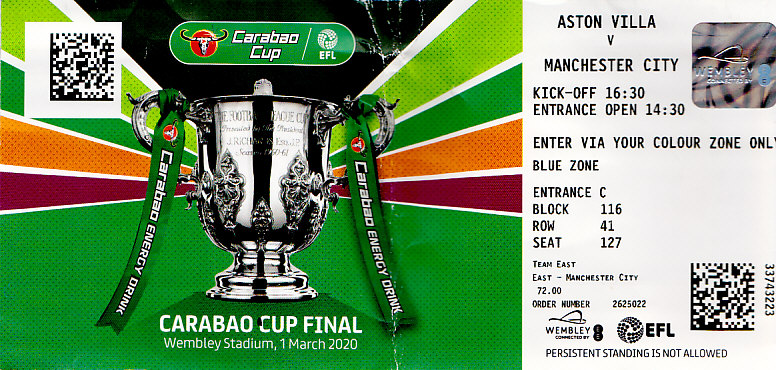
The trainers are long gone (lifespan six to 12 months in my hands… or on my feet since we’re being pedantic!) but the very thing that you’re supposed to throw away – the box – lives on. Inside are match tickets. I just throw them in there whenever I get one. But since I haven’t had one for a while (Aston Villa at Wembley on 1 March last year, since you asked) the box should have just sat there quietly doing nothing throughout lockdown.

But then I had an idea. Who hasn’t during lockdown? I’d get them all out, put them in order and, scan them. I’d had an idea to put them on my FaceBook page but as I had a City fanzine FB page, that was the obvious place to put them.  So I started doing that at the start of the season. It started off slowly and picked up momentum. Nostalgia’s big business on the internet… “Remember when…” And what might have been a meaningless game to you might have great meaning for someone else. Many of us measure out births, deaths and marriages in football matches; the ticket is the proof positive of the day when all the other details have melted away.

I’m not a ticket collector, you understand. Collectors eschew shoeboxes in favour of A4 folders with transparent pockets and dividers, all neatly arranged. Many years ago at Maine Road, a ticket collector turned up at ‘Fanzine Corner’ happy to show anyone who was even mildly interested his fantastic collection of tickets, going back years – as neat as a new pin. 

He was proudly showing someone a ticket from a pre-season friendly in Italy in 1992. “I’ve got that one too,” I told him, “only I went to the match.” That was an understatement. My mate and I had spent a week hitch-hiking to Italy only to find that this very match against Cremonese on a mountain top in the Dolomites had kicked off half an hour early. We got to see an hour of the game anyway! My mate died in the intervening years, but I still have some great memories and a tiny slip of a ticket to mark the highwater mark (literally!) of our great adventure almost three decades ago.

And that’s the thing about tickets and programmes and much of the – mainly paper – ephemera that people collect: it tells a story, and if it’s going to tell a story it might as well be your story! Not that I’m a ticket collector, you understand.  

There were several hundred tickets in the box. Easily enough for one every day of a nine/ten-month season, I thought naively. As I painstakingly scanned them I realised that there were some dates when I was spoilt for choice (Boxing Day, for example, and early January when the FA Cup Third Round kicks in) and some days when there were none at all. Not that City hadn’t played, but I’ve had a season ticket for 40 years and for many years all-ticket games were something of a rarity; pay on the gate, no questions asked. Now, of course, every game is all-ticket.  

I roped my mate Josh in for a few more – not that he’s a collector either; more of a curator – but there are still gaps. Even so, most days I can put a match ticket on FB with a story to go under it. Remember when indeed! Derby matches, important matches and games that had memorable incidents like last-gasp goals are the most popular ones I have found: Ian Brightwell’s Derby Day equaliser, York away, Blackpool away in the Cup in 1988…

The author Hunter Davies said: ““There is the serious collector, who goes out of their way and actively searches for items. Then there is the accumulator, a much more passive beast. He or she accumulates by never knowingly throwing things away.”

Davies is, without question, a serious collector. I’m more of an “accumulator.” I’m certainly not a ticket collector. No way, not me. They can be found on trains. 

Which reminds me: I’ll have to tell you about the model train collection I’ve accumulated over the years when I’ve got more time…

To see Noel’s, err um, collection (not that he’s a collector!) have a look at https://www.facebook.com/leonyelyab It’s updated every day and provides a great ephemeral record of a football goer’s life. Every ticket tells a story.

Watch this space for other guest blogs soon.