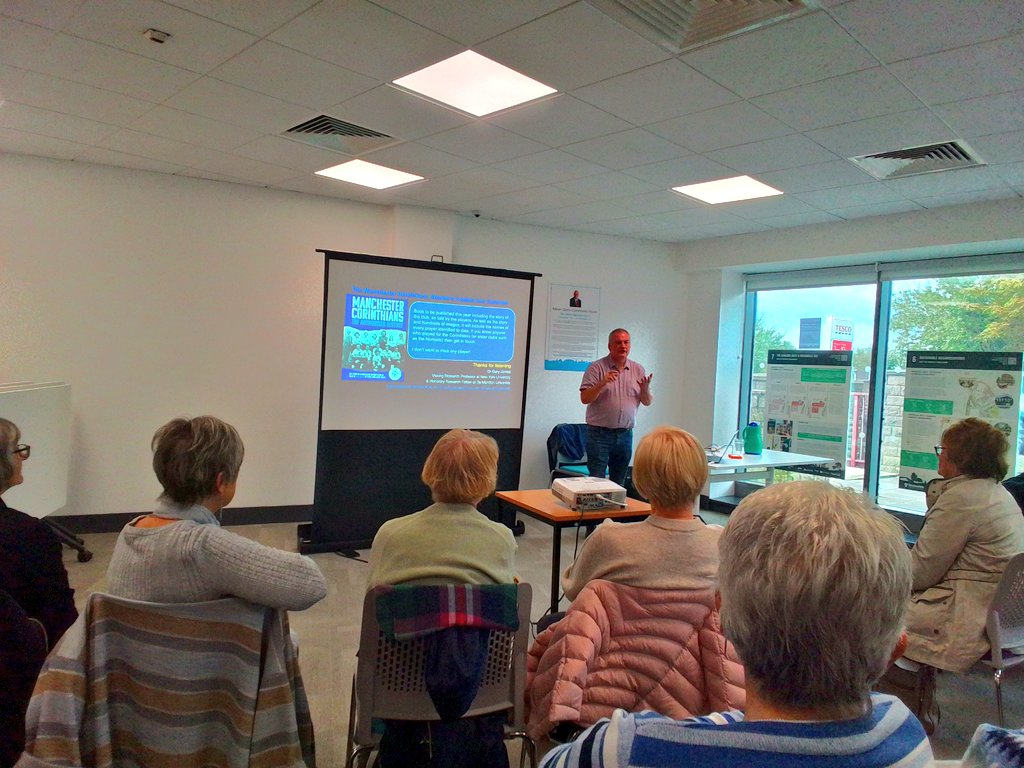
On Wednesday there was a great gathering at Droylsden for the latest talk on the Manchester Corinthians. I’d like to thank everyone who came and it was so great to see a few former players & their families at the talk. I’ve been doing talks on the Corinthians since about 2017 and have always enjoyed the reaction from audiences. Sometimes I’ve talked in the UK about them and sometimes in North America but where ever I’ve discussed their story the interest has always been high. Thanks.
Photo from @MCWFC_OSC
As well as revealing new information about the club (facts not fiction) I also gave some further information on the book. This has been delayed due to family events but will be out before the end of the year. There’s still chance to subscribe to the book. See:
Next month it will be a year since our special day when the plans I’d been working on for five years came to fruition with the unveiling of the blue plaque to recognise the pioneering Manchester Corinthians. It all came together nicely. In terms of media coverage one of the highlights was the ITV national news who did an excellent feature. You can still watch it here if you missed it:
There was also coverage on BBC North West Tonight (sadly that’s no longer visible online) and various radio stations. There was also a Channel Five News feature too.
I’ve explained frequently how I’m writing the history of the Corinthians and the plaque unveiling was all part of the longstanding project I set up years ago to highlight the incredible work of these women (and other women’s clubs in Manchester).
You can find out more on the book which will be published later this year here:
There are lots of images from the unveiling on this site, along with stories about the Corinthians. You can find out more on the appeal and on their history here:
We’re getting closer to publication of my latest book Manchester Corinthians: The Authorised History and this is possibly the last chance I’ll get to do an appeal for names of women who played for the Corinthians or any of its sister clubs (yes, there were multiple sister clubs over the years, something often overlooked). So far I have over 300 names of women who played but I know there are many more, so if you played or have a relative who played then please get in touch with details.
Also, I’m compiling a list of every game I can find so if you have a match programme, ticket, report, photo or anything else of a game that I may have missed then please let me know. Thanks again.
The book has been delayed a little due to a family bereavement & health issues, but it will be published this year. It will be the most comprehensive history ever produced on the club and it will dispel myths, correct wrongs and add significant new information to our knowledge of this pioneering Manchester women’s football club, including even the formation date and the club’s end date! Yes, myths have often been repeated about both of those (and still get repeated).
There will be a fantastic array of photographs and stories included within the book. Due to the delay there is still an opportunity to order the book in advance and get your own name published within a special roll of honour. Details via link below:
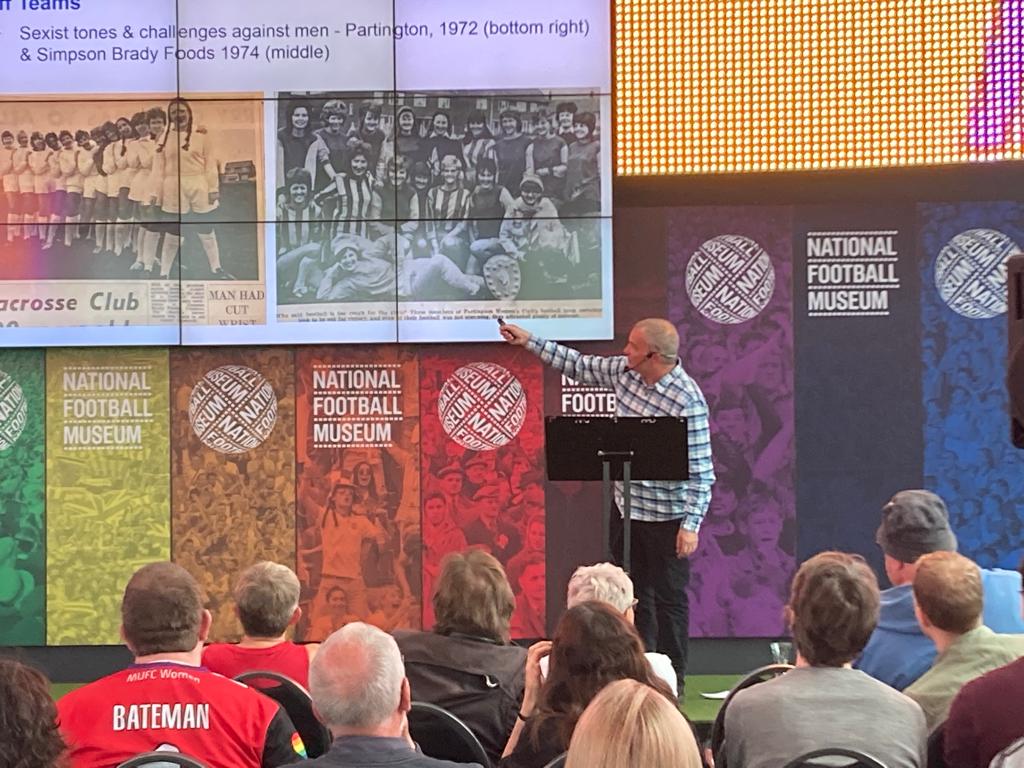
If you’re interested in women’s football or in football in Trafford or Manchester then get your self a brew, settle down and enjoy this video of my talk. It was part of my work on the #WEuro2022 Heritage Lottery funded project and my long standing project into the history of women’s football in Manchester. Here goes:
This talk on the history of women’s football was staged at the National Football Museum a few years back. The talk lasts about 47 mins. Enjoy!
The Trafford Archive website I mention during my talk is available here:
The book will be published later this year and will include material from every year of the club’s existence with dozens of former players interviewed. I’ve managed to interview women who played in EVERY season of the club’s 40+year existence and these interviews, together with some wonderful photographs, will form the basis of the book. It will also include the names of every player identified during the course of the research I’ve undertaken over the last decade – in excess of 300 names! – together with details of games played and more.
The story of the club will be told via the voices of the women who played and this will be supported by the most detailed research into the club ever performed. Newspapers, diaries and other literature have been consulted from archives in both the UK and abroad. Exclusive information on the club’s history will be documented here for the first time.
Thanks to all those who have contributed either by telling their story or by ordering the book pre-publication. This means a lot, so thanks for that support.
Nearer publication I will be emailing subscribers to ensure subscriber names, addresses etc. are correct so that no one misses out. If you’ve subscribed watch out for those emails over the coming months.
Thanks to all those who have supported the project.
One area in which you can help further is by thinking of anyone you know who may have played for the club. I will be including as comprehensive a list as possible of former players within the book and would hate to miss anyone. As some former players may not have been mentioned in newspaper reports, match programmes or elsewhere it would be great if those who were involved could think back and let me know any names who you remember who may have been missed. Every name on the list is being checked against other sources/player memories, so feel free to email me with anything you think may help.
If you’ve not subscribed to the book you can here:
The book on the Manchester Corinthians will be published later this year as planned. Research continues alongside the writing, image selection and so on. This week I’ve been in contact with a third Corinthian who played for the team in 1949 – it’s incredible! When I started this I doubted I’d find one original but now there are three from the opening weeks.
There’s still time for others too. So if you know someone who played for the Manchester Corinthians or any of its sister clubs then get in touch. There will be a list of all known players within the book so I’m keen not to miss anyone.
If you’d like to order the book pre-publication – and get your name printed in a special roll of honour – then do so here:
On this day (21 June) in 1970 the Manchester Corinthians women’s team defeated a team calling themselves Internationals in West Yorkshire. The team was actually Harry Batt’s team of players from Chiltern Valley who went on to play unofficially as England in both Copa 70 and Copa 71 (the unofficial women’s World Cups). There’s been a documentary made recently on Copa 71 which talks of what this team did.
Worth noting that Manchester Corinthians, who defeated Batt’s team 3-1 (or 4-1 depending on reports), had also played in unofficial international tournaments as England and in 1960 had won a prestigious global tournament in Venezuela.
You will be able to read more on the victory over Batt’s team and on the Corinthians’ ground-breaking international trophy successes of the 1950s, 60s & 70s in my new authorised history of the club. Written following years of painstaking research the book will be published later this year, but you can subscribe to it now and get your name published in a special roll of honour at the back. For details:
Thanks to everyone who has subscribed to Manchester Corinthians: The Authorised History. Research and interviews have been continuing for the book, which will be published later this year. I’ll keep subscribers posted with details over the coming month.
I can state with real accuracy that I have captured voices from every season of the club’s history from 1948-49 through to its final game. I’m really pleased with that and, together with the deepest research ever into the club’s history, this promises to be a fairly definitive story of the club. I say ‘fairly’ because it’s impossible for anything to be definitive but this will contain more information than any other source.
Thanks to all those who have subscribed to the book – it helps enormously as the book and the years of research that have gone into this is all self-funded.
For those who haven’t subscribed or would like to know more on what the book will entail, here’s the latest information:
The book will tell the story via the voices of those involved from beginning to end (and beyond!), backed up with detailed archival research.
Myths, including some connected with the formation of the club, persist and still get promoted. For the first time, this Authorised History will highlight the key steps and people involved with the formation of the club, dispelling myths and properly acknowledging those who ensured the team had a life.
Hundreds of games have been identified with official – and unofficial – match reports adding flavour and supporting the words of the women who played.
Rare objects, cuttings, match programmes, trophies and more have been located for this book, with many of the players lending their collections to help ensure this is a wonderful record of the club’s full life.
The Manchester Corinthians’ tours across the globe will be featured extensively within the book, while the key managers (especially the club’s manager and guiding figure from 1948-49 until his death in 1967, Percy Ashley) and other personalities will be profiled.
Dozens of interviews have been performed for the book and include women who played in the club’s first ever game in 1948-49 and others who played in the last ever game, decades later. It’s a wonderful period of football history.
Voices from every season of the club’s existence have been captured. There are some truly remarkable stories gathered in interviews performed across the country. These wonderful women have provided their memories of every period of the club’s development. Every season is covered.
Over 300 players have been identified as playing for the Corinthians to date. These women come from every era of the club’s existence (but the search continues for other names – please get in touch: Gary@GJFootballArchive.com). Every player identified will be listed within the book.
Every person ordering the book before publication will not only have the book posted to them before it appears in any shop, but they will also have their name (or another name of their choosing) published within a special roll of honour at the back of the book.
The book will consist of over 320 pages and will include hundreds of images from every era of the Corinthians, alongside the story of the club and its players.
As with Gary’s book on Manchester City Women this book is destined to be a landmark history on a true Manchester institution and pioneering football club. In some ways this new Corinthians’ history will be a prequel to the City Women book.
This book is being self funded by Gary and so every pre-publication order helps the research enormously. Thanks for your support. It is appreciated.
UK readers can subscribe to the book here (If you live outside the UK then please contact for details of additional postage costs):
Manchester Corinthians: The Authorised History
The story of a pioneering women’s club as told to Gary James by those who were there
£19.95
You do not need to have a PayPal account to order – use the ‘Pay with PayPal’ button above and it will give you the option to pay by credit/debit card without creating a PayPal account.
Here’s one of the TV reports that covered our plaque unveiling back in October. This is from ITV National News:
Here are a few words from a review of the Manchester City Women book the Corinthians will be based on (this is from a review by Fiona Cosson, for the Oral History Society):
ABOUT THE AUTHOR
Manchester football historian Dr Gary James has been researching and writing about football for around forty years, with his first book published in 1989. By that time Gary was a regular at women’s football games in the region and already knew several Corinthians featured in the Corinthians’ book. His connections with the team go way back, in fact his sister was taught PE in the 1980s by a prominent player with the club, while his mum once told him about an older girl being brought to the front in her school assembly during the 1950s to talk about travelling abroad as a Manchester Corinthian.
Gary was on the steering committee for the National Football Museum project Unlocking the Hidden History of Women’s Football and was the Trafford lead for the UEFA/FA project on the history of women’s football for the Women’s Euros in 2022. He has performed various talks and written many significant articles on the Manchester Corinthians throughout the last six years. He established the campaign to create a blue plaque and other tributes for the women who played for the club, working tirelessly to ensure the Corinthians’ receive the accolades they so richly deserve.
Gary’s research and writing is recognised for his quality and depth, and he has written several landmark publications on Manchester football (both men’s and women’s), as well as being historical consultant with films, such as The Keeper, and TV (including researching and producing a 6 part TV series). Gary is the founder of the International Football History Conference and in 2023 was appointed Visiting Research Professor at New York University. He is also an Honorary Research Fellow at De Montfort University.
You can watch a one hour talk Gary did at the National Football Museum on the history of women’s football in the Manchester region here:
The cover is still in development but the two cover images are draft proposals which will be worked up further. If you’d like to purchase Gary James’ earlier book on Manchester City Women’s team then a limited number of copies, signed by me, are still available. You can order here:
My research into women’s football in Manchester has highlighted the stories of many players and clubs over the years. I think people tend to think my research is only about City and the Corinthians but it aims to cover all teams. This includes Manchester United, whose history as a women’s team, I’ve been researching for many years. They have a fascinating story and were pioneers in many ways.
The original Manchester United Ladies team was established via the United Supporters’ Club and played its first game in October 1977, against a team from Ireland. In 1986, while looking back on this period, manager Anne Smith joked: ‘Our standard of football was not very high. It couldn’t have been as I was playing!’
Over the course of the next two years, the club played a number of friendlies until, in 1979, the team joined the long-established Three Counties League and the Women’s Football Association (FA). Anne Smith was one of the leading figures within the club, and became manager around this time. Anne was a driving force behind the club for many years and deserves to be recognised as a pioneer of women’s football, helping to establish competitions in the 1970s and 1980s.
Publicity in the men’s United match programme during the late 1970s encouraged other women to join United and in their first season of league football they finished sixth. The Three Counties League covered a large geographic area and travel to games was difficult, so Anne and the United committee worked with others to create a local league. The Women’s FA gave permission to establish the Greater Manchester Women’s Football League with its first season of operation being 1982-83 (if you have information and seasonal records of the Three Counties League then please get in touch as this will help some of my current projects – Gary@GJFootballArchive.com Thanks).
United Ladies won the competition in its first three seasons and the club remained a leading team in the region for many years. Jane Morley, who is currently the secretary of Stockport County Ladies, was a player for many years:
‘As a United men’s supporter it was great to play for the original women’s team. Wearing the red of United and training at the Cliff was really great and we were a strong team too. We were very successful in the Greater Manchester Women’s League. The two strongest clubs were ourselves and Wythenshawe and games between the two were real tests. Wythenshawe were our main rivals.’
During her time with the team Jane remembers playing at the Old Trafford stadium once: ‘There was a men’s testimonial game and we were asked to play on the pitch as part of the day’s events. That was something special for us all.’
The club continued to develop during the 1980s and 1990s, officially forming part of Manchester United by 2001. However, the club disbanded in 2005, not long after the Glazers takeover of the Reds.
In 2018, a new Manchester United women’s team was established and this team went on to win the Championship in 2019. United women have been a formidable challenger in the FA Women’s Super League ever since and reached the Women’s FA Cup final in 2023 for the first time. They’re in the final again today against Tottenham. Will this be their first major trophy success since the resurrection of the team?
Many former United players also played for the Manchester Corinthians during the 1960s, 1970s and 1980s (if you did then please get in touch). The influence of that club, established in 1949, played its part in the development of Manchester’s footballing life. This year to mark the Corinthians 75th anniversary I’m self funding a book on the club: Manchester Corinthians: The Authorised History will be published late summer and tells the story of the club via the voices of women who played from its first ever game in 1949 right the way through until its final game over 40 years later. Players from every season have been interviewed and anyone ordering the book pre-publication will be able to have their name printed in a special roll of honour at the back.
The Corinthians’ legacy is still felt strongly and their influence on both United’s and City’s women’s teams remain. You can find out more on the book here:
As for Jane Morley… she stayed with the original Manchester United women’s team for six successful years. In 1985, together with other United players, she established FC Redstar and took the team into the North West Women’s Regional Football League where they achieved promotion in 1987 to the top division – at the time the highest league competition available. Playing in Stretford, FC Redstar impressed but player recruitment issues brought a premature end to the club in 1990.
Once her playing days were over Jane coached and managed at various levels with Manchester City Ladies for many years. Always keen to promote football to young girls Jane enjoyed developing an array of talent with the club. She also brought success to the club and managed the first team for a spell when they were based in Urmston, Trafford.
After leaving City Jane continued to develop opportunities for girls and young women within both Greater Manchester and in Cheshire and is secretary of Stockport County’s women’s team, dedicating her adult life to promoting football for women and girls.
You can watch a brief interview, captured as part of a project I did for the Women’s Euros, with Jane here:




 Gary James' Football Archive