With the 2021 Champions League final looming, most City fans know that the Blues possess a great history but in recent years some of the club’s rivals have tended to play down City’s European heritage suggesting the Blues are relative newcomers to the continent’s biggest competitions. So in this article I thought I’d take the opportunity to spell out a few of City’s earliest connections with European competition:
If you would like to read the full article and other pieces like this then please subscribe below. It works out about £1.67 a month if you take out an annual subscription (£20 per year) or £3 a month if you’d like to sign up for a month at a time. Each subscriber gets full access to the 100+ articles posted so far and the hundreds scheduled to be posted in the coming weeks.
Subscribe to get access
Read this article and all other content on GJFootballArchive when you subscribe today.
Last Thursday (May 20) I interviewed Noel Gallagher about his support of Manchester City, the Champions League and more. Here is the second part of the interview. This clip lasts about 15 minutes.
In part three we discuss Garry Cook (that’s the Garry we refer to at the start of this), both of us (separately) meeting Khaldoon, earning the Champions League, earning success/buying success, opening up the Premier League, Oasis influencing support in the 90s, a Zurich based Oasis influenced band called Mania and inflatable bananas. This will run for five days with a section added each day.
Thanks to Noel and the staff at his studios & office for making this happen.
As I mentioned previously… when two Mancs of a similar age get together to chat about City, particularly when thinking about the 80s and 90s, there can be a lot of, shall we say, ‘industrial language’. As I know there are some younger listeners to my interviews I have tried to edit out certain words but, of course, a few may have slipped through. Apologies if they have and you don’t like them.
Watch this space for the rest of the interview over the next few days. The interview will be free to listen to. Use the Noel Gallagher tag to find all sections posted so far.
Subscribe to get full access to GJFootballArchive.com
Fancy subscribing to my website? Subscribers get access to all the 350+ articles, interviews etc. that have been posted so far on my site and all those posted during your subscription period. It costs £20 a year (works out about £1.67 a month) or £3 a month if subscribing a month at a time. Whichever method you choose you access everything in the archive and posted during your subscription.
Last Thursday (May 20) I interviewed Noel Gallagher about his support of Manchester City, the Champions League and more. Here is the second part of the interview. This clip lasts about 10 minutes.
As I mentioned yesterday… when two Mancs of a similar age get together to chat about City, particularly when thinking about the 80s and 90s, there can be a lot of, shall we say, ‘industrial language’. As I know there are some younger listeners to my interviews I have tried to edit out certain words but, of course, a few may have slipped through. Apologies if they have and you don’t like them.
Anyway, here’s part two where we discuss frustrating cup runs, City’s owners, jealousy, the quality of Guardiola’s team, that banner, the day the takeover happened in 2008, Garry Cook and both of us (separately) meeting Khaldoon for the first time. This will run for five days with a section added each day.
Thanks to Noel and the staff at his studios & office for making this happen.
Watch this space for the rest of the interview over the next few days. The interview will be free to listen to. Use the Noel Gallagher tag to find all sections posted so far.
Subscribe to get full access to GJFootballArchive.com
Fancy subscribing to my website? Subscribers get access to all the 350+ articles, interviews etc. that have been posted so far on my site and all those posted during your subscription period. It costs £20 a year (works out about £1.67 a month) or £3 a month if subscribing a month at a time. Whichever method you choose you access everything in the archive and posted during your subscription.
Pep Guardiola wins LMA Manager of the Year award • Pep Guardiola has been named LMA Manager of the Year for the second time in four seasons • Guardiola’s team has already completed a League and Cup double and now have their sights set on Saturday’s Champions League final • The Catalan manager acknowledged the importance of sharing his award with the players and staff who have guided City to success this season Pep Guardiola has been named Manager of the Year by the League Manager’s Association.
Adapting to the challenges posed by the Covid-19 pandemic, Guardiola guided Manchester City to a third Premier League title in four seasons and a fourth consecutive League Cup.
On Saturday, Guardiola and his players will compete in a first Champions League final in the Club’s history.
Voted for by fellow managers, it is the second time the City boss has been awarded the prize, having previously done so in recognition of the 2017/18 Centurions season.
Pep Guardiola: “I am delighted to win this award for the second time, but an award like this is only possible if a manager is surrounded by top professionals.
“My players have been fantastic – their dedication and professionalism never waver, even in a season that has been the most challenging we have ever faced.
“And my staff are also deserving of the highest praise. I am so lucky to have a team of people who give everything they have every single day to make sure Manchester City are the best we can be.
“This award is dedicated to and shared with them.”
Director of Football Txiki Begiristain added: “Pep deserves this award, absolutely. To win the Premier League and Carabao Cup, as well as reach the final Champions League final, in the most trying season we’ve ever seen, says everything about his quality as a manager.
“He has shown an outstanding ability to constantly innovate. With the challenges presented by COVID-19, he’s had to adapt to a new way of working. He’s done it brilliantly and our results say everything you need to know.
Last Thursday (May 20) I interviewed Noel Gallagher about his support of Manchester City, the Champions League and more. Here is the first part of the interview. This clip lasts about 15 minutes.
Obviously, when two Mancs of a similar age get together to chat about City, particularly when thinking about the 80s and 90s, there can be a lot of, shall we say, ‘industrial language’. As I know there are some younger listeners to my interviews I have tried to edit out certain words but, of course, a few may have slipped through. Apologies if they have and you don’t like them.
Anyway, here’s part one. This will run for five days with a section added each day.
Thanks to Noel and the staff at his studios & office for making this happen.
Watch this space for the rest of the interview over the next few days. The interview will be free to listen to.
Subscribe to get full access to GJFootballArchive.com
Fancy subscribing to my website? Subscribers get access to all the 350+ articles, interviews etc. that have been posted so far on my site and all those posted during your subscription period. It costs £20 a year (works out about £1.67 a month) or £3 a month if subscribing a month at a time. Whichever method you choose you access everything in the archive and posted during your subscription.
Last week (May 20) I interviewed Noel Gallagher about his support of Manchester City, the Champions League and more. I’ll be posting it here a section at a time over the next few days, with the first 15 minutes posted tomorrow.
Thanks to Noel and the staff at his studios & office for making this happen.
Watch this space for the interview over the next few days. The interview will be free to listen to.
Subscribe to get access
Fancy subscribing to my website? Subscribers get access to all the 350+ articles, interviews etc. that have been posted so far on my site and all those posted during your subscription period. It costs £20 a year (works out about £1.67 a month) or £3 a month if subscribing a month at a time. Whichever method you choose you access everything in the archive and posted during your subscription.
Today we formally say goodbye to a Premier League legend – Sergio Agüero. Legend is an overused word by many within football. Personally, I’m a little more restrained than most and like to compare players from every era and to think about how a player will be viewed decades from now. So, it is not hyperbole when I describe Sergio Agüero as one of Manchester City’s – and the Premier League’s (and world football) – greatest legends. He is without doubt the greatest goalscorer ever to grace Manchester City but he is also the greatest overseas goalscorer in Premier League history. He is an absolute legend!
So, the last few months since the news that Sergio Agüero will be leaving Manchester City at the end of the 2020-21 season have been highly disappointing (that’s an understatement!) to those of us who have watched his career in England since his arrival a decade ago.
In the 1960s the great City manager Joe Mercer often described Francis Lee as the ‘final piece’ of his jigsaw – and it was Lee’s goals and arrival that helped to transform the 1967-68 season in to a title winning one – and Agüero should be described in a similar fashion. City had won the FA Cup in 2011 but it was Agüero’s arrival that ultimately led to the title in 2011-12. He was the final piece of that title winning jigsaw.
To understand why Francis Lee was called the final jigsaw piece you can read an in-depth of his career here:
Personally, I’m extremely upset that Sergio is leaving City. As with Pablo Zabaleta, Vincent Kompany and David Silva, it will be a major loss. These guys became legends (as I indicated earlier I never use that term lightly!) at City and they thrilled and delighted us. As fans, we had a chance to formally say goodbye to Pablo & Vincent but, due to Covid, we haven’t yet been able to say farewell to David and today (May 23) only a limited attendance will be in the stadium to say goodbye to Sergio (there will be around 10,000 in a 54,000 capacity stadium).
Hopefully today provides Sergio with the right kind of send off despite the limited attendance.
Here’s a profile of the man who became Manchester City’s greatest ever goalscorer. Back in 1997 I researched and wrote Manchester The Greatest City, an in-depth history of the Blues containing over half a million words. Sadly, the opportunity to update that and publish an epic history of the club is now unlikely due to changes in the publishing world, cost of production and more but if I did ever get the chance then a significant section would calmly, rationally and factually, explain the significance of Sergio to Manchester City’s development.
So many major stars have appeared for, coached and managed the Blues over the last thirteen years or so that their story really deserves to be told in-depth but, as I’m denied that opportunity these days, we’ll have to make do with features appearing on this website. Hopefully, these words will do justice to Sergio and, over the coming years, his colleagues.
Sergio was born in Buenos Aires, Argentina on June 2, 1988 and was given the nickname ‘Kun’ by his grandparents due to his likeness to an anime character. In 2008 he explained to the BBC: ‘Kun actually represents a Japanese cartoon character from my favourite series that I used to watch as a child. I coined the nickname Kun because of my resemblance to the character, who was actually named Kum Kum. My grandparents were the first ones who gave me the name. I think my nickname is different in comparison to most athletes and so I have grown to appreciate it because it’s unique. It’s not every day an athlete is nicknamed after a cartoon character!’
From the moment he could walk, or toddle, football meant everything to the young Sergio: ‘Football surrounds you in Argentina and so I began playing at a very young age. The truth is that I had always lived with the ball at my feet. As soon as class ended in Quilmes in Buenos Aires, my friends and I would start up a game. In Villa Itali, the neighbourhood where I was raised, there was also a pitch where we used to gather with the local kids and organise games. At any moment of the day we could have been playing, when the sun shined or when dark fell. I would spend hours and hours out there, sometimes even coming home late.’
At the age of 15 and 35 days Sergio, playing for Independiente, becoming the youngest player to appear in Argentina’s highest league (beating Maradona’s record). Looking back he explained in 2008: ‘There were some difficult times at first. I was a lot younger and smaller than most of the players, so I had to learn how to avoid and dodge aggressive tackles. At times, especially in the beginning, I think I became a target for malicious tackles and so referees were forced to look after or protect me, or at least pay closer attention to intentional rough hits. But eventually I learned to avoid these rough tackles and improved so that I was able to anticipate and dodge injuries.’
Sergio’s form from the moment he made his debut in 2003 through to 2006 was enough for the media to suggest the 17 year old should play for Argentina in the 2006 World Cup.
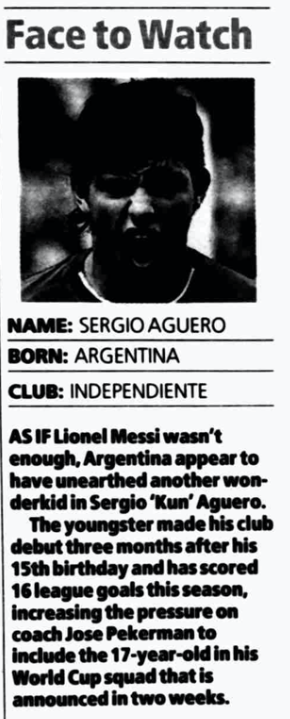
On April 29, 2006 the Irish Independent highlighted him as a face to watch and a few days later journalist Stuart Condie wrote: ‘At 15, Agüero became the youngest player in Argentina’s top league and this season has eight goals in 16 league matches for Independiente. Cesar Luis Menotti, Argentina’s 1978 World Cup-winning coach, said he has “something of Romario about him.” Romario helped Brazil win the 1994 championship in the United States.’
Condie quoted the then Argentinian coach Jose Pekerman who said: ‘Kun is playing out of his skin at the moment. There are many players who didn’t get to play at the World Cup until they were 24 or 25. I’m not saying that’s going to be the case with Agüero. I remain hopeful that he can still make it.’
Sadly, Sergio did not appear at the 2006 World Cup but he did make his international debut that year (September 3) against Brazil at Arsenal’s Emirates Stadium. A year later he netted his first international goal in a 2010 World Cup qualifier against Bolivia and was ultimately selected for the Argentinian World Cup squad of 2010. Sergio scored in his first finals game – he came on for Carlos Tevez in the 75th minute v South Korea and scored a minute later. Sergio, Sergio!
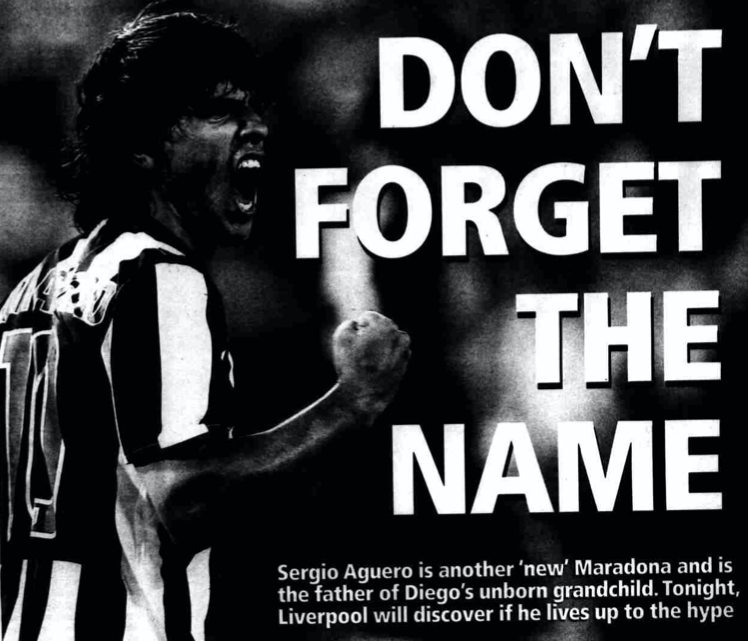
Often described as ‘the new Maradona’ around this time, Sergio had already won the World Junior Championships twice (2005 & 2007 – he won the Golden Boot as top goalscorer and the Golden Ball as player of the tournament in 2007) and an Olympic Gold Medal (2008 – Argentina won the men’s football tournament of course!). He had also joined Atlético Madrid, signing in May 2006.
When asked about why he had left Argentina and Independiente Sergio explained in 2007: ‘The reason I left Independiente is because I care for the club so much. If I hadn’t been sold for so much money there would not be an Independiente. Their debt problems were so bad they could have gone under. I couldn’t let that happen. I felt sorry for the fans and I understood their anger. But they realise now it was the only solution. It is a great feeling to know they have not forgotten me and chant my name – I will never forget them.’
It is clear that the club continues to mean a great deal for the player and that his comments, back in 2007, were sincere. His move did ensure the club could survive but it added to the focus he received.
Inevitably, delivering so much at such an early age would have put Sergio under immense pressure at times. The comparisons with Maradona (Sergio married his daughter as well); the focus in Argentina and then playing in the Spanish League… all of this could have affected him, like the pressure has so many other young footballers, but Sergio always seemed to keep level headed. When asked in 2008 he commented that he did not feel pressure, adding ‘football comes to me so naturally it’s more like having fun than a job. For me, having a kickabout with my friends is as important as playing in the final of the World Cup.’
It’s worth remembering he was still only 20 when he made those comments. The pressure of life at a top Spanish club and playing for Argentina was intense, especially after he was described by the Atlético president Enrique Cerezo as ‘the most important player to arrive in Spain since Maradona.’ There was also the small matter of Sergio punching the ball into the net – according to those who supported clubs other than Atlético of course! He didn’t, but the goal was scored off his hands. Sergio explained in January 2007: ‘The goal I’m famous for here is the one I scored against Recreativo when the ball hit off my hands and ended in the net. People say it was another Hand Of God goal but if the referee doesn’t disallow it, I’m not going to complain! I didn’t mean to punch the ball past the keeper. I just threw myself at the cross and it went in, although it was definitely off my hands. It’s forgotten now and I’m just concentrating on helping Atletico climb the table.’
In 2008 there were a number of features on Sergio in the media suggesting an English club may try to sign him. They talked of Arsenal, Chelsea, Liverpool and Manchester United with journalist Glen Moore saying ‘He would cost €60m, but that could be cheap for a talented 20-year-old.’ The following year the Irish Independent described him as ‘a player all of Europe covets and one with the skill to unlock any defence.’
The Daily Star claimed that Alex Ferguson had Sergio on his wish list behind Dimitar Berbatov in July 2008 – it’s worth remembering that Berbatov eventually signed for United on transfer deadline day that year when the Reds were seemingly in a battle over transfers with City. It’s amazing to think of what might have happened if United hadn’t made such a determined attempt at getting Berbatov and City had signed him, not Robinho, that day. Would Sergio have ended up at Old Trafford? How different could Manchester’s football story have been over the following decade?
Similarly, in July 2009 Jason Burt, writing for the Irish Independent, claimed that City were trying to lure John Terry away from Chelsea for £28m plus and if that went ahead then the London club might prepare a bid for Sergio. Fate, it seems, played its part in ensuring City’s early spending following the September 2008 takeover did not lead to a rival Premier League club capturing the Argentinian.
In February 2011 it was reported in the Telegraph that Harry Redknapp had tried to sign Sergio for Spurs – leading to Atlético extending his contract – and then on July 17 that year the same newspaper reported that Sergio’s then father-in-law, Maradona, had given his blessing to the player moving to City. Blues’ boss Roberto Mancini was quoted as saying: ‘Agüero is a player that can play for Manchester City because he is young and he is a good player like Carlos [Tevez]. He can score a lot of goals and can play with Mario, with Edin … it could be [that he joins us].’
On July 28 2011, after City chair Khaldoon Al Mubarak allegedly took the highly unusual step of getting directly involved in the transfer, Sergio officially joined City for a fee reported as £35m – an absolute bargain when you consider what he has achieved since BUT also a bargain compared to the amounts that other teams were alleged to have been prepared to spend to capture him at various times in the previous few years. It’s worth remembering Liverpool had paid Newcastle £35m for Andy Carroll in January of that year! I know which player I think offered the most value for money.
The great Argentinian former Spurs star Ossie Ardiles gave his view of Sergio at this time: ‘Agüero’s a wonderful player, only 23, and with a lot of potential. If you compare him with Tevez, I would say he is more of a proper striker, a traditional centre-forward. He is very skilful, strong, two-footed and he has the number one thing that all top frontmen have, and that is an ability to make scoring look very easy.’
Ossie was right and so were many others who recognised that Sergio was the signing City needed to push forward. There were some who, for their own personal reasons, wrote negatively about Sergio’s arrival (maybe they’d have written differently had he joined certain other clubs?), but overwhelmingly it was clear that Sergio was that ‘final jigsaw piece’.
David Maddock, writing in the Daily Mirror, correctly prophesised: ‘City are not just getting one of the most exciting strikers in the world… they are also, apparently, getting a talisman who can provide the impetus for them to take the final step into the elite… The signing ofAgüero promises a huge impact, as the crowds in Manchester last night suggested. By signing a similar player to Tevez, but one who is younger, quicker and with far more potential, City are upgrading.
‘The fact the Argentina striker has replaced Tevez in his country’s forward line and is rated more highly back home adds to that sense of moving onwards and upwards for the club’s supporters.’
Inevitably Sergio was quoted in most of the national newspapers over the days that followed with the Sun carrying several quotes, beginning with whether the weather in Manchester would cause Sergio problems: ‘Firstly I don’t like very hot weather so on that side of things I will be OK. I’m sure I am going to enjoy myself here and life will be fine.’ He added: “My style has always been to fight to the death for every ball, to give 100 per cent in every game, be concentrated to the maximum in everything I do. I think we are a team that in the future will be fighting every year to win trophies. And let’s hope that it is a quite a few major trophies.’ Well, Sergio, you certainly did challenge for trophies (quite a few) every year!
Sergio’s competitive City career began with a 59th minute substitute appearance against Swansea in the Premier League on August 15, 2011 (the first Premier League meeting with Swansea). Within nine minutes he’d scored his first goal (a tap in from a cross by Micah Richards) and in injury time he netted his second (a 30 yard strike). In addition, he also set up David Silva to score (he’d hooked the ball off the byline and passed it to Silva).
Oliver Holt, writing in the Daily Mirror, correctly reported how it felt to those of us in the stadium that day: ‘City fans should be entitled to think a forward ought to be a bit special. But to be at the Etihad Stadium last night and to witness the Manchester City debut of Sergio ‘Kun’ Agüero felt like being in on something momentous. It felt like a landmark… Of all the superstar arrivals that have happened here in the blur of transfer activity that has taken place since Sheikh Mansour bought the club three years ago, Agüero’s feels as if it has the power to transform the side. There was an electricity about the place when he came on for Nigel de Jong after an hour. There was a feeling that something special was about to occur.’
And something special did occur. We all know about the Agüeroooooooo goal that brought City the Premier League title but the player has always been something more than that goal.
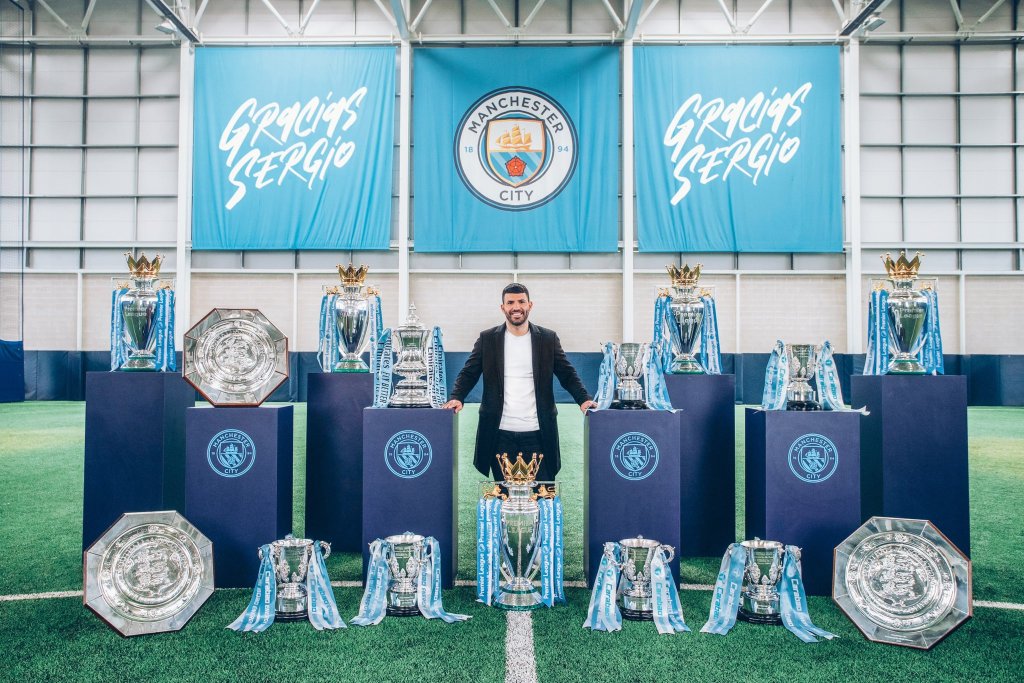
Over the near decade that has followed his arrival incredible success has come City’s way with Agüero usually playing a significant part in each glory. Surprisingly he’s never been awarded either the PFA footballer of the year or the Football Writers’ equivalent (lots of City fans have theories why!) but he has won a whole host of personal awards including the Premier League Golden Boot 2015; Manchester City Player of the Year 2012 & 2015 and the Football Supporters Federation Player of the Year 2014.
Sergio also, of course, became City’s record goalscorer of all time. In fact he holds most of the Blues goalscoring records: Overall goalscorer 257 goals (next best Eric Brook 177); League goalscorer 181 goals (next best Tommy Johnson & Eric Brook 158) and Europe 43 goals (next best Raheem Sterling 21). He’s second in the list of FA Cup goalscorers for City on 20 goals, two behind Fred Tilson – but Tilson played 28 FA Cup games and Sergio has only played 20.
At the end of March 2021 when he announced he was leaving I calculated his League record. At that time (it will have changed slightly since) his League record was incredible: 181 goals in 232 (plus 39 as sub) appearances. That’s a ratio of 0.66789 goals per game, ignoring how many minutes he’s actually been on the pitch. Johnson’s City League record was 0.4817 goals per League game and Brook’s was 0.3511. If we consider all strikers to have made 100 or more appearances in the Premier League only Thierry Henry (ratio of 0.67829) and Harry Kane (0.67510) have a better ratio and neither man has played as many games. In January 2018 I did a profile of Sergio’s goalscoring for the Manchester City match programme and in that I calculated that his record was 0.682 goals per League game. Since then injury and less actual game time has made that figure reduce, otherwise he would still have had the best goals to game ratio in the Premier League.
Of course, goals per game totally ignores how long the player was actually on the pitch and in the last year or so Sergio has often been brought on as substitute, sometimes at a stage where City have been content with a result or with too little game time for Sergio to make an impact. When analysis of goals per minute played City have rightly claimed him as ‘the competition’s most lethal goalscorer in terms of goals scored per minutes played.’
He is the highest scoring overseas player in Premier League history and holds the record for the most Premier League hat-tricks.
At present Sergio is the 16th highest appearance holder for City. As of May 23 (before the game) he is six games behind the club’s earliest legendary figure Billy Meredith.
No wonder the City chairman has said: ‘Sergio’s contribution to Manchester City over the last 10 years cannot be overstated. His legend will be indelibly etched into the memories of everyone who loves the Club and maybe even in those who simply love football.
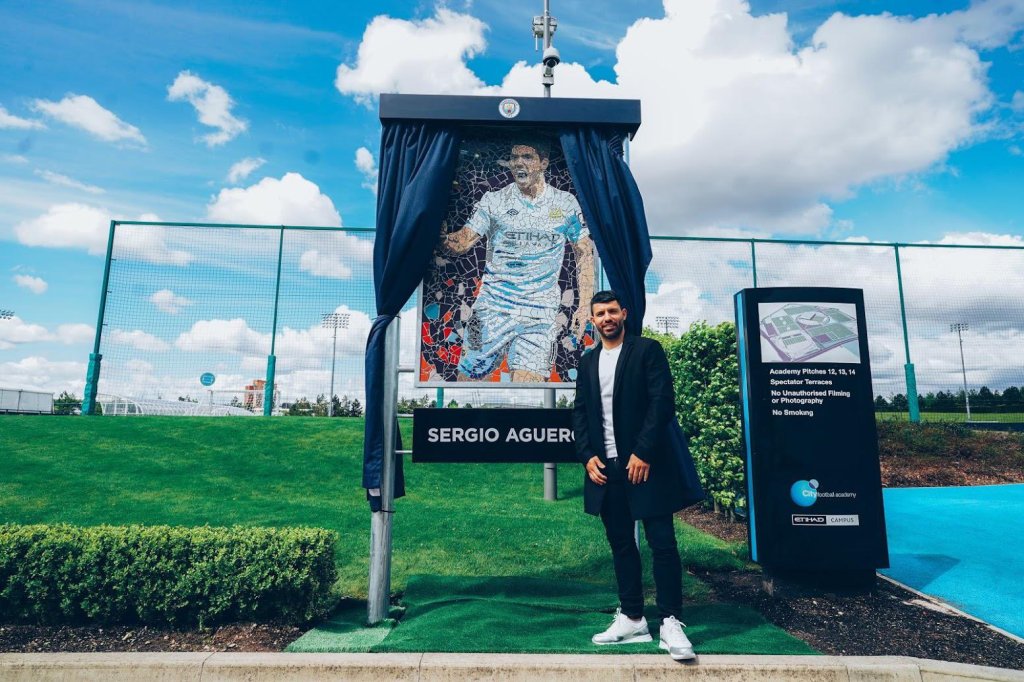
‘In the meantime, it gives me great pleasure to announce that we will be commissioning an artist to create a statue of Sergio to live at the Etihad Stadium alongside the ones under construction for Vincent and David. And we look forward to the opportunity to bid Sergio a fitting farewell at the end of the season.’
Manchester City have had many great goalscoring figures over the years, including World Cup stars and international heroes but, in terms of records, emotion and trophies, Agüero’s record eclipses all that have gone before. Inevitably it is difficult to compare heroes from one era with another, but whenever comparisons are made between Agüero and the modern era’s greatest strikers the evidence is clear. Sergio Agüero’s statistics speak for themselves with few Premier League legends able to compare to the record of City’s Argentinian star. For me Agüero is the best.
Today is going to be emotional for us all as we bid farewell to City’s – and one of the Premier League’s – greatest ever goalscorer. Sergio, we will miss you.
I hope you’ve enjoyed this profile. As I said at the start it’s unlikely I’ll ever be able to update my epic Manchester The Greatest City (last edition was Manchester The City Years published in 2012) and a profile of Sergio, alongside all the other legends, would be something I’d have sought to include. From now on material like that will make its way on to http://www.GJFootballArchive.com – some will be free to read for a period while other content will be only available to subscribers. Currently, there are almost 300 articles posted to this site including the entire Manchester A Football History and exclusive audio interviews with Trevor Sinclair, John Bond, George Graham and Malcolm Allison (it is my intention to publish some of my historic interviews alongside new content). Subscribers get full access to all of this.
Apart from occasional books, this is now my only writing outlet. My last article for a match programme was published before the first Covid lockdown and so if you want to read more content like the above or would like to access historic articles/interviews/recordings then please subscribe. It costs £20 a year (it works out about £1.67 a month) and you get full access throughout your subscription period. You can subscribe below. Thanks for reading. It is appreciated. Gary James, March 30 2021.
Subscribe to get access to the full site
This has been a sample of the content on this site. If you’d like to read more then please subscribe. Thanks
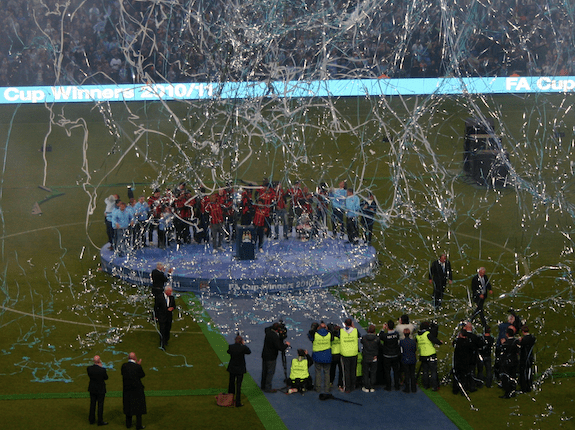
The night (May 23 2011) after beating Bolton 2-0 in the final Premier League game of the 2010-11 season, Manchester City staged their first official homecoming victory parade since 1976. Here’s the story of what happened in the stadium for fans who couldn’t be there.
Here for subscribers is the story of that parade and City’s celebrations…
Subscribe to get access
Read more of this content when you subscribe today.
Earlier today (May 20) I interviewed Noel Gallagher about his support of Manchester City, the Champions League and more. I’ll be posting it here in the next few days.
Thanks to Noel and the staff at his studios & office for making this happen.
Watch this space for details of the interview over the next few days. The interview will be free to listen to.
Subscribe to get access
Fancy subscribing to my website? Subscribers get access to all the 350+ articles, interviews etc. that have been posted so far on my site and all those posted during your subscription period. It costs £20 a year (works out about £1.67 a month) or £3 a month if subscribing a month at a time. Whichever method you choose you access everything in the archive and posted during your subscription.
This press release from MCFC has just arrived (great news)… Ruben Dias wins Football Writers’ Player of the Year award
• Ruben Dias has been named Football Writers’ Player of the Year for 2020-21. • The 24-year old becomes the first defender to win the award since Steve Nicol in 1989. • Dias also becomes one of only three players ever to win the award in their first season at a club, following Jurgen Klinsmann (1995) and Gianfranco Zola (1997). Ruben Dias has been named Player of the Year by the Football Writers’ Association. The centre-half topped the poll of a 400-strong FWA membership, following in the illustrious footsteps of team-mate Raheem Sterling who won the award in 2019.
Only the third player ever to win the prestigious honour in his first season at a club, following Jurgen Klinsmann and Gianfranco Zola, Dias has quickly established himself in the heart of a defence that has conceded fewer goals than any other in this season’s Premier League [32].
Joining from Benfica only last September, the 24-year-old has made 48 appearances for City across all competitions and played an instrumental role in the club securing the Premier League title, lifting the League Cup and in reaching a first ever UEFA Champions League final. The Portuguese international becomes the first defender to win the award since Steve Nicol, over three decades ago.
Ruben Dias said: “It’s a huge privilege. I’m very, very happy. It’s the same as always: obviously, I could not have done it without the success of the team – everyone in the team being able to deserve this award. Only by that was I – as a defender – able to be here to receive this prize.
“It means something special because normally, the ones who finish the plays are the ones getting the spotlight but me receiving this prize is a major example of our team and the way we work – the way we build our game. It reflects all the togetherness we have on the pitch, the spirit in the team and how we perform.
“With these players, for me to be receiving this award, it shows how we play like a family.”



 Gary James' Football Archive