On this day (16 November) in 1991 the Manchester derby ended goalless at Maine Road but so many, many chances went City’s way! It was a frustrating draw for the Blues and came at a time when neither side had won the League since the 1960s (City in 1967-68 if you want to know). It was felt that momentum was building at Maine Road. This is one of those periods when football history could’ve gone in a different direction.
There was pressure on United boss Alex Ferguson. He had brought the ECWC and FA Cup to United by this time but it was the League that the club craved. City had ended 1990-91 in fifth place and United were 6th. Had City had a bit of fortune around this time they may well have found some success.
Arsenal had won the League in 1991 but no team dominated the League year after year. The birth of the Premier League was coming (1992) and the new riches that came with that meant that the teams that did find League success from then on could potentially dominate in a way no club had before. With United’s title success in 1992-93, United and Arsenal became the two clubs that benefited most from the riches of the Premier League. That created a gap that only strong investment could bridge.
Ah well! Money and football is nothing new. Anyway, here are a few highlights of the derby:
This season has brought so many wonderful moments for Manchester City with goalscorers in particular getting the headlines for some outstanding performances and record-breaking achievements. Erling Haaland is, of course, attracting a lot of attention for his exploits, while Phil Foden has also continued to impress. It was particularly satisfying when they both scored hat tricks against United in the Manchester derby back in October. This was the first time two players had scored hat tricks in a Manchester derby and their lifetime of City support and connections adds a great deal to the achievement.
Haaland’s goalscoring feats have caused some to ask about club records and the players who have achieved them. So for today’s piece I’m taking a look at a few past achievements to remember some of those who have done amazingly well for City over the decades while helping to highlight seasonal records that can be aimed at.
This is available to subscribers. It costs £3 a month (paying a month at a time) or £20 a year (works out about £1.67 per month). See details below:
Subscribe to get access – Monthly
Read more of this content when you subscribe today. £3 per month allows subscribers to read all content posted since 1 October 2022 and everything posted during your subscription. Cancel anytime. Annual subscribers (see below) get access to everything posted since December 2020 as well.
Read more of this content when you subscribe today. £20 per yeas allows subscribers to read all content posted on the site and everything posted during your subscription.
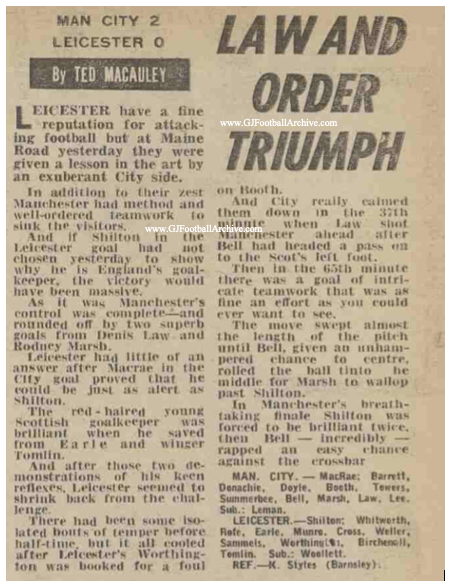
On this day (14 November) in 1959 Manchester City’s record appearance holder Alan Oakes made the first of 564 League appearances. The game ended in a 1-1 draw with Chelsea with the away team missing a penalty. Jack Dyson returned to the City team after two years out with a damaged leg. Here’s a contemporary match report from the game:
There are lots of other features on my website about Alan Oakes, why not have a read while you’re here?
On this day (13 November) in 1880 the first reported game played by St. Mark’s Church side took place in Gorton and ended in a 2-1 defeat by the Baptist Church from Macclesfield. Both sides fielded 12 players. Please note this is the first reported game and at no time is it described as the first game. There may have been earlier matches. There are lots of myths about the birth of St Mark’s (many of which will be spread today no doubt!), the club that went through various changes that led to the creation of Manchester City in 1894. I would urge everyone to read the facts, rather than the fiction, and take a look at this:
Attendance: 50,182; City 4 United 0 (League Cup 4th round)
A 35 second opener from Tueart and a world-class performance by Hartford give City total control of this tie. However few at Maine Road are able to celebrate as a fifth minute tackle by Buchan on Bell causes the influential City star to be stretchered away. City deserve the victory, but the cost is high.
I’ve written lots on Colin Bell over the years and I was fortunate to interview him a few times too. You can read some of the articles I’ve written here:
Ten years ago today (11 November 2012) League Champions Manchester City defeated Tottenham Hotspur 2-1 with goals from Sergio Aguero and Edin Dzeko. The game. was played before a sell-out 47,208 crowd at the City of Manchester Stadium (now Etihad). The City team was:
Hart; Zabaleta, Clichy, Kompany, Nastasic, Barry, Yaya Toure, Kolarov, David Silva, Tevez and Aguero with Maicon, Dzeko & Garcia coming on and Nastasic, Tevez and Aguero substituted.
On this day (10 November) in 1956 the great Don Revie left Manchester City for Sunderland. Revie had been in and out of favour with manager Les McDowall for over a year, but fans recognised his qualities. You can read more about his departure and find out about the first Manchester game without him here:
Subscribe to get access
If you’d like to support my research then why not subscribe? Every subscription directly helps support my research and provides annual subscribers with access to everything posted on this site, including the entire Manchester A Football History and From Maine Men To Banana Citizens books, plus interviews, articles and more. I am not employed by anyone and all my research is self funded or comes from subscriptions to this site.
Read more of this content when you subscribe today. You can subscribe at either £20 per year (above) or at £3 per month here (cancel any time). For those subscribing £3 per month you will be able to access all content from October 2022 onwards for as long as you are a subscriber. Those subscribing £20 a year have access to everything posted since December 2020.
The links between the blue and the red half of Manchester are many, although there are some who will quickly deny the others mere existence. Fortunately, there are others who will embrace those historic, and often welcome links between the two bitter rivals, history being more important than the colour of a football shirt.
The links, as I said, are many, but if only three were to be listed, it is arguable that these would be, in no particular order, Sir Matt Busby, Billy Meredith and Denis Law for self-explanatory reasons. There is, however, one man who should nudge all three of those legendary figures out of the way, a man from the distant past, but one whose place in the history of both City and United is assured, but sadly, often forgotten. His name? John Ernest Mangnall.
Born in Bolton in January 1866, Mangnall also stakes a claim in the history of his local club, and that of near neighbours Burnley, a proud Lancastrian, but it is in Cottonopolis that he comes to the fore and more so during his time with Manchester United.
But for the meantime, let’s push Ernest Mangnall’s footballing credentials to the side [his given first name being lost in the mists of time] and look at the man from a much different sporting angle.
It might be said that football, a game that he played with the same enthusiasm that he carried forward into his managerial positions, was not even his first love, as he was more than a keen cyclist, being a member of various clubs, entering races and most notably cycling between John O’Groats and Lands End, at a time when bicycles were certainly not built for comfort.
Having cut his managerial teeth with Burnley, although he had helped steer Bolton along the way from the boardroom, as a director, he found is way to the dull, dreary surroundings of Clayton in 1903, with many possibly correct in thinking he was a glutton for punishment, as United were little more than a struggling side and had been rescued from what could easily have been oblivion by J.H. Davies. They had also recently changed their name from Newton Heath to Manchester United.
Appointed in place of James West, who had resigned as secretary, Mangnall embraced the role of the man not simply answered the mail and carried out other menial tasks, but took on the running of the club as a whole. Purchasing postage stamps of players made little difference.
Slowly Mangnall began to blend a team together and following a handful of near but not quite near enough finishes, he guided United out of the Second Division and into the top flight at the end of the 1905-06 season where, thanks to his now neighbours City finding themselves in a spot of bother, he ‘stole’ Burgess, Meredith, Bannister and Sandy Turnbull from his rivals and with the likes of Charlie Roberts and Dick Duckworth already at United, he had a more than capable team at his finger tips, creating a team that gave Manchester United their first domestic trophies with the League championship in 1908 and the FA Cup in 1909. The former was also won in 1911, plus success in the FA Charity Shield in 1908 and 1911.
Not only was he instrumental in building a strong United team on the field, he was more than involved in dragging the club away from its slum like home at Clayton and moving to pastures new at Old Trafford.
But all good things come to an end at some point or other and having perhaps achieved as much as he could at Old Trafford, Mangnall made the surprise move across town and joined neighbours City in August 1912. What the club and manager hoped to achieve failed to materialise, but as he had done with United, he played a major part in City’s move to Maine Road.
So, that is the career of Ernest Mangnall in a nutshell, but if you want to learn more about that man then his biography is available now from Empire Publications, 229 Ayres Road, Old Trafford, Manchester, M16 0NL UK Tel: 0161 872 3319 or 1 Newton Street, Manchester M1 1HW – telephone 0161 872 3319.
As something of a postscript.
I created ‘The Manchester United Graves Society’ a couple of years or so back, whereby I am trying to locate the burial places [or cremation details] of as many former players and officials as possible and to date have found over 500. One of the early finds was John Ernest Mangnall, who died at Lytham St Annes in January 1932, and is buried in the Lytham Park Cemetery.
Upon obtaining a photograph of his grave, I was saddened to find that the headstone was broken and the grave in general was in need of some TLC. So, enquiries were made with the cemetery as regards to any red tape that would cause problems in restoring the grave to its former glory and thankfully there were none. To be honest, they were more than delighted that someone wanted to carry out restoration work on the grave.
Funds were raised, a stone mason contacted and the work was carried out. Photos of before and after are shown here.
Should anyone want to visit the grave, it can be found at – A – 512 C/E. Go in the main gate and head up to your right.
The Manchester City FC annual report is out. Record profits of £41.7m as the club continues to find trophy success and improve its financial position. That investment seems to be paying off a bit now, hey? You can read all the details here:
On this day (7 November) in 1987 Manchester City defeated Huddersfield Town 10-1. Paul Stewart, Tony Adcock, and David White each scored a hat-trick while the goal spree was started by Neil McNab. You can read the full story of the game; watch highlights and more here….
Subscribe to get access
Read more of this content when you subscribe today. If you’d like to support my research then why not subscribe? Every subscription directly helps support my research and provides annual subscribers with access to everything posted on this site, including the entire Manchester A Football History and From Maine Men To Banana Citizens books, plus interviews, articles and more. I am not employed by anyone and all my research is self funded or comes from subscriptions to this site.
Read more of this content when you subscribe today. You can subscribe at either £20 per year (above) or at £3 per month here (cancel any time). For those subscribing £3 per month you will be able to access all content from October 2022 onwards for as long as you are a subscriber. Those subscribing £20 a year have access to everything posted since December 2020.