Continuing the series of features on Manchester City in the 1980s with an on this day (12 December) from 1988… On this day Manchester City Ladies (now Women) played their first ever home game. We often focus on the first game of any kind (featured recently – a victory at Boundary Park) but rarely discuss the first home game played by the women’s team. So here goes… It was a 1-1 draw with Oldham Athletic at the Platt Lane Complex. City’s scorer was Heidi Ward and the team was managed by Neil Mather. The squad for this match was:
Michelle Flynn, Donna Davies, Kate Themen, M Hewlett, M Braddock, Paula Hinchcliffe, Tonia Slack, Michelle Mather, Louisa Felton, Donna Haynes, A Marsland, Debbie Darbyshire, Rowena Foxwell, Lisa Burnett, Heidi Ward, C Morgson, Helen Clark, J Walsh (Record of who started/subs not kept). Some of the women are on this photo,
The match report is of that game with the City equaliser described like this: ‘[City in the 2nd half] began pressing for a goal which came from H. Ward, a good drive into the bottom left hand corner of the Oldham net.’
There were other chances for City with Louisa Felton and Heidi Ward coming close to giving City a 2-1 lead but it wasn’t to be.
You can find out more on the City women’s team by following the tags or doing searches below.
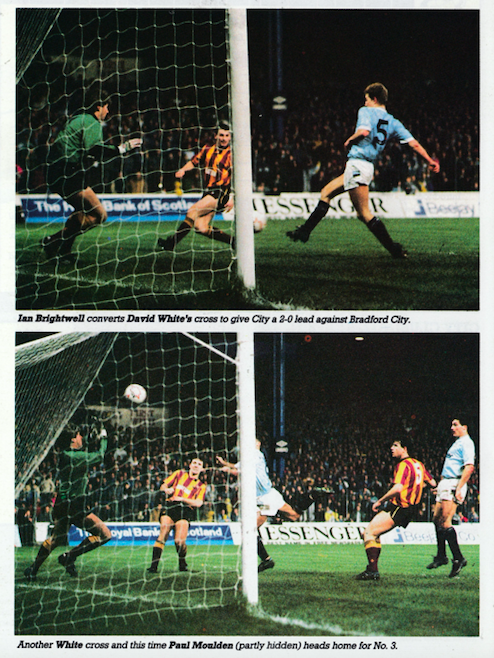
Continuing the series of articles covering Manchester City in the 1980s. Here’s a photographic reminder of a comprehensive 4-0 victory over Bradford City at Maine Road on this day (10 December) in 1988. The game saw two goals each from youngsters Ian Brightwell and Paul Moulden. David White played his part to set up several key chances (and goals) too!
If you’d like to know more about City in 1988-89 or indeed any season then why not subscribe to this site? Subscribers can read a 4,100 word feature on the 1988-89 season below. Enjoy!
Subscribe to get access – Monthly
Read more of this content when you subscribe today. It costs £3 per month (cancel anytime) to access everything posted since 1 October 2022 or there’s a special annual rate below which gives greater access and works out much cheaper.
Read more of this content when you subscribe today. It costs £3 per month (above) or £20 a year (here) to access everything posted since the site was created in December 2020. This special rate works out about £1.67 a week and gives access to everything posted, including PDFs of 3 of my books.
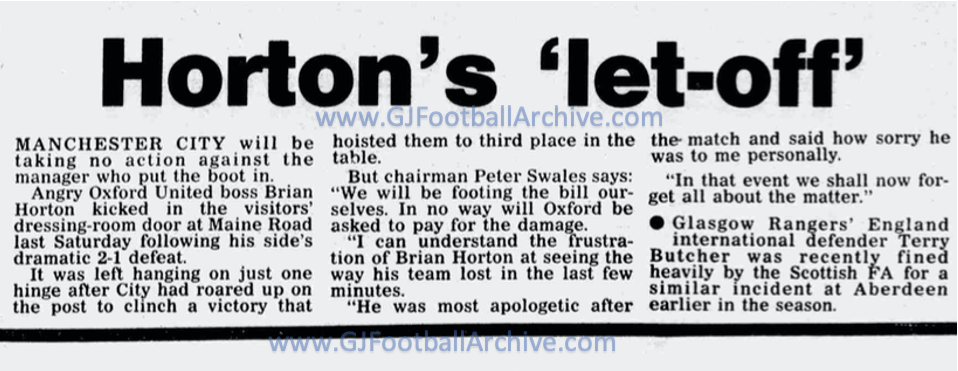
The series of articles covering Manchester City in the 1980s continues today with a reminder of the day Brian Horton damaged the Maine Road away team dressing room door. Future City boss Horton was then the manager of Oxford United. This article from this day (3 December) in 1988 explains how he was unhappy following his team’s dramatic 2-1 defeat the previous Saturday. City had been losing 1-0 with only a few minutes to go and then two dramatic late goals gave the Blues the victory. You can watch highlights here:
I think we can all understand Horton’s frustration. As part of his anger Horton left the door hanging on just one hinge! Rumours had suggested the Blues would make him pay for the damage but Peter Swales, the City chairman, said that there’d be no charge afterall.
It’s all a story about nothing really but is a nice reminder that in the days before social media these things still happened, they were just reported differently. Now this would be a major incident with apologies demanded and who knows what but back then it’s simply filling a space in the Manchester Evening News.
If you want to know more of the 1988-89 season for Manchester City Football Club then why not subscribe and read the following 4,100 word feature on the 1988-89 season. Enjoy!
Subscribe to get access – Monthly
Read more of this content when you subscribe today. It costs £3 per month (cancel anytime) to access everything posted since 1 October 2022 or there’s a special annual rate below which gives greater access and works out much cheaper.
Read more of this content when you subscribe today. It costs £3 per month (above) or £20 a year (here) to access everything posted since the site was created in December 2020. This special rate works out about £1.67 a week and gives access to everything posted, including PDFs of 3 of my books.
Today (27 November) is the 35th anniversary of the first game played by Manchester City Ladies (now Women). This was against Oldham Athletic Ladies at Boundary Park. This photo is the earliest press team photo of the club.
These are pioneering City players and many dedicated considerable time to the club for years. The first ever game ended in a 4-1 City victory with Donna Haynes scoring 2 (including the historic 1st goal). Heidi Ward also scored 2 that day. I was there watching this historic first game and I included some brief details in my first book, published in 1989.
This match report was in an Oldham newspaper & was reproduced in my 2019 Manchester City Women An Oral History book (see https://gjfootballarchive.com/shop/ for details of it).
The club was founded via City In The Community (CITC) with Neil Mather playing the lead role as manager of the club. His drive and the determination of the women involved ensured this club had a life. At the time the wider Manchester City club (in particular CITC) did something that few other clubs were doing. The achievements back then and the years of dedication by the women involved ensured this club lived for years.
When the club was relaunched as Manchester City Women some national newspapers and others in the media suggested this was a new club without a history. That was damaging and hurtful to all those involved back in 1988 and the years that followed. If anything the history of Manchester City Ladies before it became City Women was similar to the majority of women’s clubs. It had gone through the trials and tribulations most face and was kept going by a dedicated band of players and supporters. Unlike Everton and Liverpool (and many others) City did not take over an existing club, they created one back in 1988 when the others had zero interest. So today’s anniversary is important in recognising the wonderful work of these women (and of the men like Neil Mather, Godfrey Williams, Ian Lees and others who were involved over the decades) and of Manchester City itself.
The club gets criticised often for a lack of history but this is all rubbish spouted by rivals. City have delivered in men’s football longer than many rivals and they’ve delivered in women’s football longer than. many rivals too.
Later today I’ll be posting a detailed 2,200 word article on the club’s first game back in 1988.
A new daily series of articles for subscribers started earlier this month covering the 1980s. This is a seasonal journey through a truly important decade in the history of Manchester City Football Club. Today’s article is a 4,100 word feature on the 1988-89 season. Enjoy!
Subscribe to get access – Monthly
Read more of this content when you subscribe today. It costs £3 per month (cancel anytime) to access everything posted since 1 October 2022 or there’s a special annual rate below which gives greater access and works out much cheaper.
Read more of this content when you subscribe today. It costs £3 per month (above) or £20 a year (here) to access everything posted since the site was created in December 2020. This special rate works out about £1.67 a week and gives access to everything posted, including PDFs of 3 of my books.
The deadline for the last ever King of the Kippax fanzine has passed and I missed it. I meant to get something sent to Dave and Sue Wallace but circumstances meant I couldn’t and I really regret that. So instead I’m posting here a piece I wrote ten years ago in 2013 when there were a series of footballing anniversaries. It’s not quite what I intended but I hope it says enough of how I feel about fanzines and the role of King of the Kippax over the decades.
It’s a season of footballing anniversaries this year (2013). The FA celebrates 150 years, the Football League 125 and King of the Kippax an amazing 25 years. Of these three anniversaries KK is inevitably getting the least focus but in many ways its significance to football, or at least our team, has been greater during its first 25 years than the FA’s first 25.
The FA did little to support football in Manchester for decades and it wasn’t until Manchester’s clubs started to take the FA Cup seriously that the organisation began to matter. But even then the FA did its upmost to prevent our professional clubs from challenging properly. In 1904 when City became Manchester’s first FA Cup winners how did the FA react? They decided we must be doing something illegal and sent auditors to the club to determine if we had ‘bought’ success. Okay, so they found a few irregularities with a transfer from Glossop, but for the following year or so they relentlessly pursued our club (and to be fair did something similar with Newton Heath, who became United, and with Glossop). Ultimately, we received a devastating punishment and the club could have died. I won’t go on about how unjust all of this was – City were no worse than most sides the difference being that the FA was determined to catch us out! – but if you do want to read an account of it dig out my latest book “Manchester The City Years”.
Despite all of this the FA Cup actually gave City our first success and we should ensure we celebrate 23 April 1904 (the date of the final) every year – make St George’s Day City’s day!
The Football League was more supportive of City during those early years, but prior to 1892 the League had no involvement from either Manchester side despite the League holding its first meeting in Manchester. Our celebrations of the League should really come in 4 years’ time when it’ll be 125 years since City (as Ardwick) joined the League. Although it’s worth pointing out that Ardwick and Manchester City were two separate organisations – and stressed as such at the time – and even existed alongside each other for a short while (personally though, I see MCFC as a continuation of Ardwick in spirit if not in legal terms). From 1892 to 2002 (when City last competed in the Football League) the Football League was central to City’s life. The competition became City’s lifeblood as far as competition was concerned.
What about KK? Well, unlike the other two KK was significant to City and City fans from the start. It was born in an era when fans had much to say but little opportunity to be heard. Alongside the other fanzines born in the late 1980s KK gave us a voice and a shared understanding of what the issues at City and in football were. Before the fanzines our only real outlet was the Piccadilly Radio phone-in on Saturdays which came in to its own during the time James H Reeve was at the helm. We had no forums, blogs, tweets etc. We didn’t have phone-in shows on national radio or fan columns in newspapers. We didn’t have interaction with the club, other than via supporters clubs meetings which some fans saw as being too weak to challenge the club on key issues (I won’t get into all of that here, but it’s worth noting that some fans did feel the Supporters Club was too close to Peter Swales and, as he was often the cause of fan concerns, that caused some issues).
We did also have the Pink postbag in the Saturday sports paper, sadly no longer with us. Unfortunately, journalists on the paper in the late 80s would contact the club to get their views before publishing a controversial or critical letter (this happened with one from me in 1987 which presented evidence about an issue that mattered to fans but was ultimately swept under the carpet). Censorship and club propaganda was an issue at a time when the game was dying and fans were being treated appallingly.
King of the Kippax helped to give us a voice and helped highlight the issues. Staff at City would be sent out to buy the fanzine in its early days, while others would do all they could to limit the fanzine’s opportunity to question what was going on – proving the significance of the fanzine. I don’t want to get too giddy about what KK and the other fanzines achieved but it is important that we all understand what has been achieved. It’s a bit like the electoral system – people fought hard to get the vote in the face of adversity but today we take it all for granted. We think it’s always been like this. Now with social media it would be easy to forget what KK and the other fanzines have achieved. Many fanzines have stopped being produced, which makes it all the more important to celebrate KK’s 25th anniversary and to congratulate Dave, Sue and all the contributors over the years for what they’ve achieved. I still read KK from cover to cover and find all the regular contributors interesting. I don’t always agree with everything I read but, I guess, that’s always been the point. KK has promoted debate and encouraged fans to think about issues, and that’s how it should be.
I hope King Of The Kippax continues to provide a powerful outlet for fans for years to come. It’s important that we remember that before the fanzines we didn’t have a voice. Thanks Dave & Sue, and the others, for all you’ve done and continue to do for us.
On this day (2 November) in 1988 Paul Moulden scored a hat trick for Manchester City in the League Cup third round tie with Sheffield United. The Blues won 4-2 with Trevor Morley netting City’s other goal.
The 8th of October marks the anniversary of one of those ‘one game wonders’ who played for Manchester City. On this day in 1988 defender Bill Williams made his one and only appearance for City’s first team when he came on as substitute for Mark Seagraves in the Blues’ 1-0 defeat at Ipswich Town. He did make seven reserve appearances but that game at Ipswich was the only first team appearance.
It was a strange situation because City had signed him from Stockport where he had developed a good reputation in defence and as captain. Asa Hartford was the Stockport boss at the time and was sorry to see Williams leave but told the press that he couldn’t do much because of the glamour associated with City.
Williams returned to Stockport on 1 December and fans of both clubs seemed confused. At Edgeley Park County fans were delighted he’d returned but at Maine Road rumours circulated. City had sold him back to County for a discount price and had managed to get special dispensation off the League – back then a player could not be sold back to his original club within the same season.
There were rumours that Williams had a business (painting and decorating if my memory is correct – anyone remember?) and that by joining City he needed to spend more time training etc. than at County and that, ultimately, that meant he couldn’t earn as much at Maine Road as he had while working for himself and playing at Stockport. I’m not certain if that is true but that’s the rumour that circulated.
Whatever the situation, City lost money on the deal and Williams became a one hit wonder for the Blues.
If you enjoy all the free material on my website and would like to support my research and keep this website going (but don’t want to subscribe) then why not make a one-time donation (or buy me a coffee). All support for my research is valued and welcome. It allows me to keep some free material available for all. Thanks.
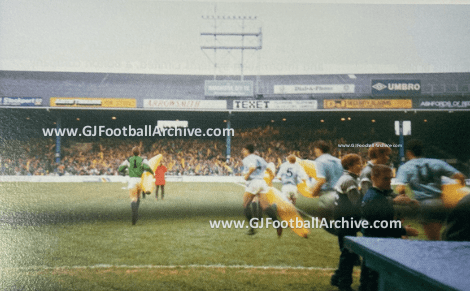
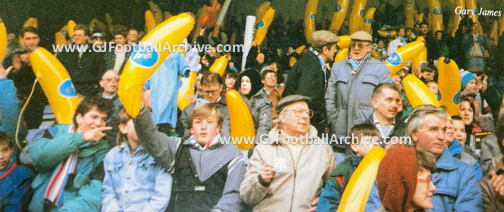
The 53rd post in my series counting down to the centenary of Maine Road’s opening game remembers the banana craze.
I’ve written a lot on the banana craze over the years and, like many other areas of football, there are already some myths that have developed. You can read about the craze here:
If you enjoy all the free material on my website and would like to support my research and keep this website going (but don’t want to subscribe) then why not make a one-time donation (or buy me a coffee). All support for my research is valued and welcome. It allows me to keep some free material available for all. Thanks.
Back in 1989 the 11 February saw goals from Wayne Biggins (2), Brian Gayle and Trevor Morley to give Manchester City a 4-0 Division Two win at home to Ipswich Town.





 Gary James' Football Archive