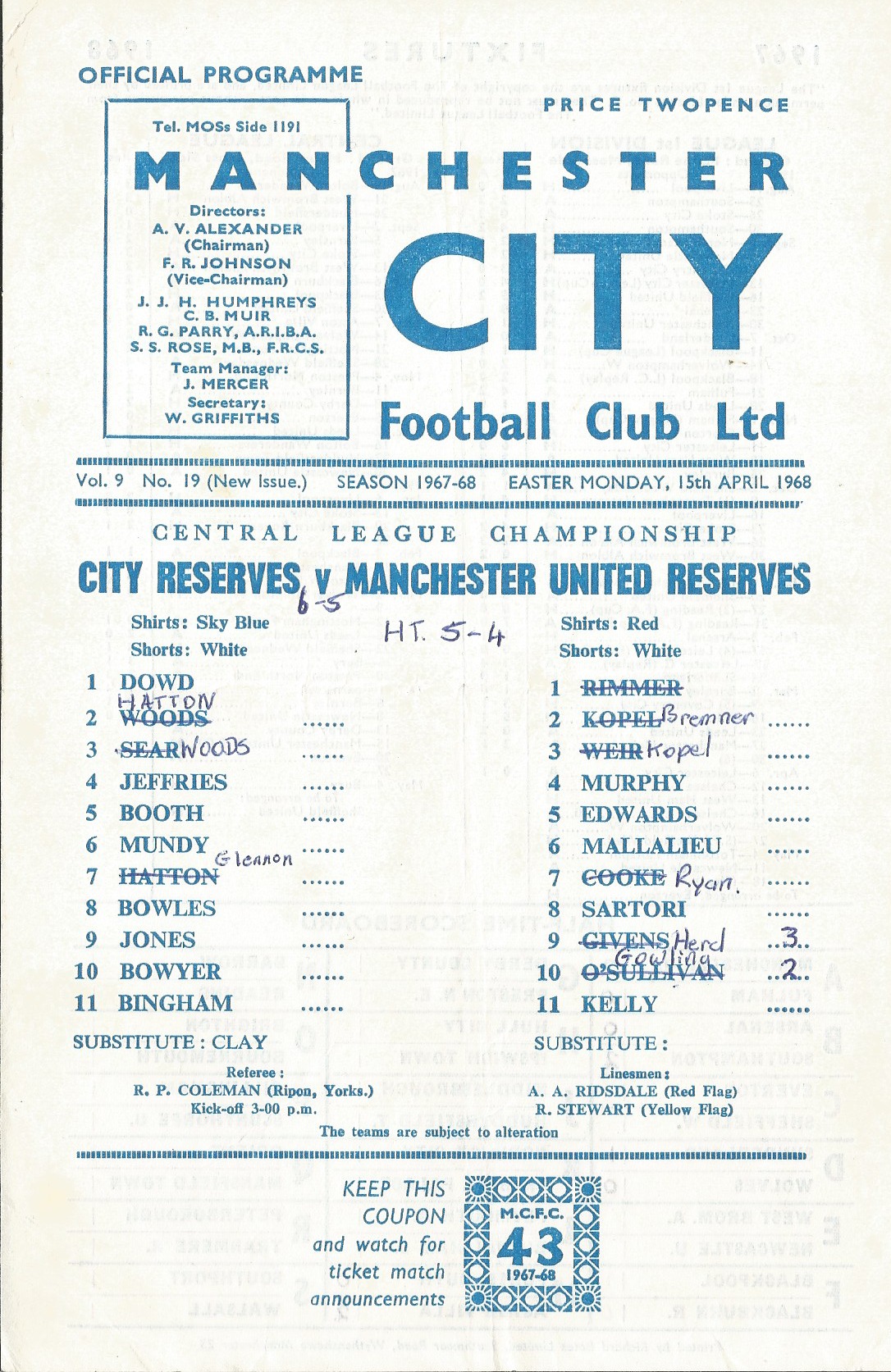
On This Day: Tommy Booth’s Last

On this day (19 September) in 1981 Tommy Booth made the last of his 382 League appearances for Manchester City in the 3-0 defeat by Birmingham City.  

On This Day: Parlane

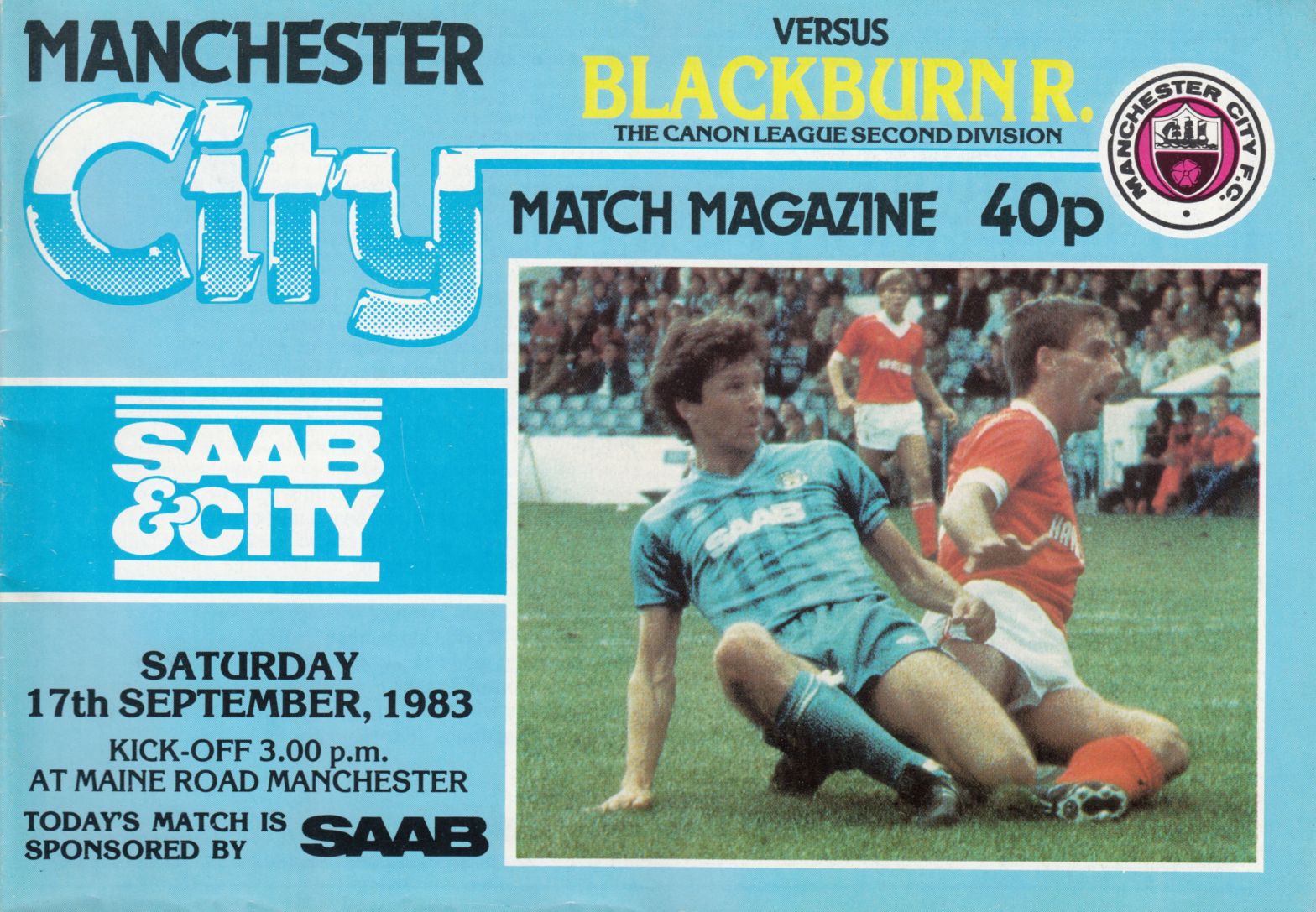
Today (17 September) in 1983 Derek Parlane limped off after scoring a hat-trick for Manchester City in the 6-0 defeat of Blackburn Rovers. He can be seen here on the cover of that day’s match programme.

Royal Reactions (part one)

I’m sure we’ve all been watching some of the television coverage following the death of Queen Elizabeth II. With so much air time to fill we’ve often had angles put forward and debated for a few minutes or hours on TV and radio. So I thought it was time I put one (or two – part two will go into detail about royal visits to Manchester City) of my own on my website. Here goes… Someone asked me the other day about how Manchester City reacted in terms of performance in the days/weeks/months after a monarch’s death. So, if you’ve been desperate to find out, or are more likely to think ‘go on then, I’ll stick with it a bit longer’, here’s the answer:

Since Manchester City was established in the 19th Century there have been two British Queens and now five Kings. Detailed below are a few snippets from each of their reigns which may or may not be of interest. I’ll start with Queen Victoria.

Queen Victoria was on the throne throughout the birth of League football until her death in January 1901. These were the years when professional football developed and Victoria died only 9 years after the club had joined the League as Ardwick.

Major Trophies Won: No major trophies were won by City during Victoria’s reign but they did win the Second Division title in 1899 – the first national success of either Manchester club. The last complete season of her life saw City compete in the top flight for the first time. the first game after her death was a 2-1 defeat at Stoke.

King Edward VII was on the throne from January 1901 through to May 1910. He died in the close season as City were about to go on tour to Germany and Denmark. During Edward’s life City won the FA Cup in 1904 (Manchester’s first major trophy) and were runners up in the League that season.

King George V was the first monarch to visit a Manchester City game when he attended a 1920 League game between City and Liverpool at Hyde Road. During his reign City won the FA Cup in 1934 and George was present for that final. City had also appeared in two other finals and had finished 2nd in the League in 1920. He died in January 1936 and the following weekend’s FA Cup games went ahead as scheduled. Over 65,000 watched City defeat Luton 2-1 at Maine Road.

King Edward VIII was only on the throne for about nine months and abdicated in December 1936. City had finished ninth in the only season completed during his reign but the 1936-37 was to be a spectacular one, though the part of the season before his abdication was not so great for the Blues.

King George VI became King on the abdication of his brother and City were to go on an incredible run shortly afterwards. A couple of defeats came within a fortnight of him taking on the role but other than those City were undefeated for the rest of the season. An incredible run of 22 games unbeaten brought City the League title in 1937.

As the Duke of York George had attended the 1933 FA Cup final and had also attended a game at Maine Road that year too. George died in February 1952. The following weekend’s games were not postponed and City drew a goalless match with Blackpool.

Queen Elizabeth II became Queen in 1952 and during her reign City have found major success time and time again. Within 3 years of her becoming Queen she attended Wembley to watch City face Newcastle in the 1955 FAC final. Newcastle won that (their last major domestic trophy) but the year after she was at Wembley again to see City beat Birmingham in the Trautmann Final. Since then City have found major glory in the League and in Europe. Their trophy haul under Elizabeth includes:

1 European Cup Winners’ Cup

7 League titles

4 FA Cups

8 League Cups

City have won 1 trophy approximately every 3.5 years of her reign. When she died games were postponed the following weekend.

King Charles III – Of course it’s too early to say what success arrives during his reign.

I hope you’ve enjoyed this slightly odd football article. There’ll be a second part published next week. Watch this space. While you’re here why not explore the rest of the website. Thanks

On This Day: Bowles

Stan Bowles scored twice on his League debut as Manchester City beat Sheffield United 5-2 on this day (16 September) in 1967.  Three days earlier he also scored twice as the Blues defeated Leicester 4-0 in the League Cup – Bowles came on as substitute in his debut game.  Despite this tremendous start, Bowles never scored again for City and only made a total of 16 (plus 4 sub) appearances.

All Star Games

This week the new Chelsea owner Todd Boehly has been roundly criticised by former footballers, managers and the media for suggesting that the Premier League introduces an ‘All-Star’ game. His suggestion was based on similar games in the States and he hinted that a North v South All-Star game could raise money for the football pyramid. He suggested that English football could learn a lot from America and came up with other ideas too. His views were presented across the media in a way that implied ‘here’s an American coming over here to tell us how to run our sport that’s done okay for the last 150 years.’ However, had he framed his All-Star game along the lines of English tradition rather than along the lines of American pizzazz then he may have been listened to.

As a historian it irks me when people talk of a new idea, or bringing something different, when the truth is that these things have existed for decades – or even centuries! It frustrates me even more when ideas are then criticised with people commenting along the lines of ‘you can’t do that here. You and your American ways. We’d never do that’ and so on when we have actually done that – and done it well too!

Personally, I’m not in favour of representative All-Star games as a regular fixture. We have Soccer Aid and that’s well-established and a great piece of entertainment, but representative League games are something else. There isn’t really room in the football calendar and so I’d worry about that but, as a historian, I know that these types of games have existed in English football since the 1890s and I also know they were immensely popular at times. 

Had Boehly done a bit of football research or talked to a football historian they may well have helped him present the same sort of idea in a more sensible, traditional manner. Likewise, had Jamie Carragher or any of the others criticising him done some research or consultation with a historian they may also have been able to talk about how these things existed in the past. 

So what am I going on about? I’m talking about the original ‘All-Star’ games that existed in English football – The Football League representative teams. These were established in 1891 to raise money for the Football League to carry out its duties – in effect similar aims to Boehly’s. The first representative game was the League against the Alliance League – so not a geographical All-Star match but certainly along similar lines. That was played on 20 April 1891 at Sheffield and the Football League side contained six Scottish players and one Welshman, plus English players. 

The year after the Football League played the Scottish League for the first in a long series of games between the leagues. Four Scottish players played for the League against Scotland.

Another game was played that year that is even more closely aligned with what Boehly has suggested – The Midlands v The North. There have been other representative games, such as the North v the South, some organised by the League some by other bodies such as the FA. A North v South representative game had been in existence from 1880. There’s lots more history to discuss, including the role of some of these type of fixtures in the selection of the English national team, but suffice to say these types of games have been in existence for a long time. Here’s a report of North v South from 1891:

So, again, had Boehly been aware of the history his suggestion could easily have been framed in a different manner. I wonder how people would have reacted had he said something like: ‘I’ve been studying English football and am fascinated by the representative and inter-league games that saw footballers from multiple clubs with varying nationalities play together. These began in the 1890s and were immensely popular with fans, raising money for the management of the game and helping ease the burden on less fortunate clubs. I’d like to bring back that tradition and believe they’d be popular again. Imagine De Bruyne playing alongside Salah and Ronaldo?’ 

From the 1890s these representative League fixtures grew in frequency and, as well as the Scottish League, other leagues were added. The Irish League became a regular opponent and there were games against the Southern League, the Army, Glasgow and the national leagues of Belgium, Italy and the Republic of Ireland (as well as the Irish Football League). There were combined Wales & Ireland teams, British league opponents and a Rest of the World game. The Football League representative team played their Italian equivalents on no less than 13 occasions.

There were also representative games between regions, including a series of Third Division North v Third Division South in the 1950s, though these were separate divisions of the League so more like inter-League games, nevertheless they are another precedent.

Over the decades these inter-league games faded, mainly due to fixture congestion, but one-offs appeared such as against a World XI to mark the centenary of the League in 1988. 

So there are historical precedents within English league football. Personally, I’d still worry about fixture congestion if something like this was re-introduced but I have to say that the criticism of the idea really should have been framed differently. Criticise the idea because of fixture congestion or worries about players, but don’t criticise it as a ‘coming over here telling us to introduce something American into our game’ when it’s actually an English concept that goes back to the early days of League football in our country. 

The great German goalkeeper Bert Trautmann often talked of his pride of playing for the Football League in one of these representative games in 1960. He had been prevented from playing for his national team due to football politics of the era but appearing for the Football League in what would now be termed an ‘All-Star’ game was a major honour. By the way, the game was described as ‘a star-studded’ match, so similar wording to Boehly too! No doubt there are many players today who would feel the same as Trautmann did if they don’t ordinarily get the chance to play for a national team in a high profile match.

Another German Jurgen Klopp, the manager of Liverpool, was dismissive of Boehly’s idea and seemed to suggest that players from rival teams like United, Liverpool and Everton couldn’t play in the same team, which is odd considering they can and do play in international matches together when they are supposed to be representing their country. Here’s what Klopp said:

https://www.bbc.co.uk/sport/av/football/62900364

I don’t agree with Boehly’s ideas but dismissing them, in the manner some have is wrong too. His idea is not a new one, it was a part and parcel of league football for over a century. I also can’t help feeling that a modern generation of fans may actually enjoy seeing the best of the Premier League against the best of the Italian/Spanish/German Leagues if these fixtures occurred. Maybe some would prefer to see representative League teams instead of international games? If Boehly had suggested that he’d be condemned further but they’ve happened in the past.

Here’s film of a 1905 inter-league game played at Manchester City’s Hyde Road ground in 1905:

https://player.bfi.org.uk/free/film/watch-england-v-ireland-at-manchester-1905-1905-online

As a final word I’d like to say that if you’re a football director, official, manager, player or a member of the media please consult a football historian if you have an idea or want to criticised an idea. Most things in football are not new. We pretend they are to gain headlines or to present ourselves as forward thinking, or as guardians of the game. The truth is that knowing and understanding football history, whether that be our own clubs or the game in general, allows us to make informed decisions and comments. Most football historians are keen to help so please call on this resource and let’s have sensible discussion or let’s make informed suggestions of how to improve the sport we love.

On This Day in 2003: Anelka

On this day (14 September) in 2003 two penalties from Nicolas Anelka helped Manchester City to their first League victory at the City Of Manchester Stadium (now Etihad Stadium).  The match with Aston Villa ended 4-1 and it also saw Anelka score the first hat-trick at the new stadium and the first penalty.

You can watch about ten minutes of highlights here:

Stan Gibson Obituary (former MCFC groundsman)

Born on this day (10th September) in 1925, Stan Gibson was one of the unsung heroes of Manchester football.  He was City’s groundsman for forty years and created a playing surface worthy of the club’s stature, particularly during the sixties and seventies when the pitch was possibly in its best ever state.  

Stan worked as a stoker during the war for the Navy.  Always a keen sportsman – he was a Naval boxing champion and had football trials with Burnley – but by his 30s was becoming well known as a groundsman.  He arrived at Maine Road from Chorlton Cricket Club in 1959 after a recommendation by City ‘keeper Steve Fleet, and in the years that followed he worked hard to create a perfect pitch.  

By the time of City’s promotion in 1966 Stan had made the surface one the club could be proud of.  Both Joe Mercer and Malcolm Allison were keen to use Stan’s expertise to develop the pitch further, and thereby increase City’s chance of success.  Working with Allison, Stan made the pitch the biggest  – and many would say the best – in the League.  

Both Mercer and Allison recognised his contribution to City’s success.  It’s a little known fact that Stan was trusted with the job of looking after the FA Cup following City’s homecoming in 1969.  He chose to put the prized possession in the safest place he could think of, and the trophy spent its first night in Manchester locked in his toilet!

Stan loved City – he was even on the club’s books for a while in his youth – and felt the pitch was his own.  He could never relax during a match though:  “I watch the pitch rather than the game!  I shouldn’t really, because I get very upset if I see a divot, especially if it is the opposing side who have churned it up.”

Inevitably, the pop concerts in the 80s and 90s brought him a few headaches, but he welcomed other innovations, such as the undersoil heating implemented in 1979.

Stan was always an important influence and others often sought his views.  At one stage Rod Stewart tried to lure him away to tend his own turf, while Ken Bates was desperate for him to join Chelsea.  Stan would have none of it:  “I know I’m biased, but to me there’s nowhere better than Maine Road, and there’s nothing nicer than someone coming up to me on a Saturday and saying how great the pitch looks.  Makes all the toil worthwhile.”

His love for the club and Maine Road was never in doubt, and was perfectly summed up in 1994:  “City is my life.  That pitch out there is my baby.  I can’t keep away from it, and I couldn’t imagine my life without it.”

He leaves his Australian-based son Stuart and his daughter Janice – another popular face around Maine Road.

Stan passed away on Christmas Eve 2001 and this written by me as an obituary for him at the time. It was first published shortly after his death.

While you’re here I’d like to thank you for taking the time and trouble to visit my website. I have been researching and writing about Manchester football for a long time (no wonder I’m going grey!) with my first book published in 1989. I am not employed by anyone and I do not have sponsorship either and so I’ve set up this website to help share my 32 years plus writing and research. The intention is to develop the archive and to provide access to as much of my material as possible over the coming weeks, months & years. Subscribers can already access hundreds of articles/posts including the entire Manchester A Football History book and audio interviews with several people, including former City bosses John Bond and Malcolm Allison.  

It costs £20 a year (it works out £1.67 a month) to get full access for as long as you subscribe. See below. Thanks for the support, Gary.

Subscribe to get access to the full site

£20 per year or £3 per month

Manchester’s 1920s Derby Day Rivals

Here’s an interesting clip from this day (9 September) in 1977 featuring two Manchester football fans. This was shown on the BBC north west regional news programme on the eve of the Manchester Derby and originally would’ve included a voiceover which, sadly, has not survived.

The BBC’s David Davies talks with Nellie Walker, a supporter of Manchester City since the mid 1920s and Charlie Swinchatt, who had supported Manchester United since that time too.

The derby the following day ended in a 3-1 City win with Brian Kidd netting a couple. You can view highlights here:

Finally

On this day (7 September) in 1949 – Despite announcing his retirement the previous season, ever-popular goalkeeper Frank Swift finally played his last match for Manchester City.  Appropriately, he kept a clean sheet as City drew with Everton on. Here for subscribers is a 1400 word profile of Swift…

Subscribe to get access

Read more of this content when you subscribe today.

Happy 80th Alan Oakes (Interview Feature)

Happy 80th birthday Alan Oakes. Alan has made more appearances for Manchester City than any other player but more significantly he’s an absolute gent. Here to commemorate his birthday is an interview I did with Alan.

This interview occurred in February 2005 and we discussed his life and career. This appears here as it was originally published.

Alan Oakes joined the Blues at the age of 15 in 1958 and made his first team debut in November 1959 when he was 17 years and 2 months.  He stayed at Maine Road until July 1976 by which time he had made a staggering 564 League appearances.  In February 2005 he was inducted into City’s Hall of Fame, and author Gary James met up with him to discuss his career.

To begin with let’s talk about your childhood, did you come from a sporting background?

We were all very sporty and my father and others played local football – nothing professional – and as a boy I’d play cricket in the summer and football in the winter.  The usual sort of thing – coats as goalposts – and I loved playing.  I progressed into the Mid-Cheshire Boys side and then one day I got the shock of my life when City’s scout Albert Kavanagh knocked on the door and asked me to join the groundstaff.  He’d watched me play at Broughton, Salford, and seemed to like what he saw.  I was astounded and delighted at the same time.  This was a dream moment.

Coming from a Cheshire village like Winsford in the 50s to a big city like Manchester must have been a bit daunting, how did you and your family feel about the move?

It was an opportunity I couldn’t miss.  Other teams showed interest but City meant so much to me.  I’d been to Maine Road a few times – I stood on the old Kippax before it had a roof – and loved the Club.  I wasn’t blinkered though because I also went to Maine Road to watch some of United’s first games in Europe.  Remember they used City’s ground because they didn’t have floodlights and a lot of Blues went to watch the European sides.

Clearly, you saw a wealth of talent during this period, but who were your heroes?

Ken Barnes was a brilliant player and by far the best in his position, and Bobby Johnstone had an amazing footballing brain.  They were great players to watch and later I was fortunate to play with Ken, but my boyhood hero was always Billy Wright from Wolves.  There was something special about Wolves.  They brought over several top European sides for friendlies – I guess they paved the way for the European Cup – and they won so many fans.  They were a great, entertaining side and Billy Wright was their star.  I was still a City fan, but I recognised the quality of Wright and Wolves.

Still only 17 you made your debut in a 1-1 draw with Chelsea, how did you feel about your performance?

I felt okay, but I gave away a penalty!  Fortunately for me Bert Trautmann – the greatest ever keeper – was in nets and he saved the day.  As a member of the groundstaff I’d clean Bert’s boots and even that felt like a great honour, so you can imagine how grateful I felt when he saved the penalty.  The Chelsea game was a one off – I think Ken Barnes was injured – and so it was a few weeks before my chance came again.  I felt a lot of satisfaction that I was in the reckoning though.  When I arrived at City there were 55 professionals and about five teams to progress through to reach the first team.

How did you find the management and coaching staff in those days?

They were all ex-City players and so that was important.  Fred Tilson and Laurie Barnett had played in the 30s finals and coached us, and manager Les McDowall had been a good player in his day.  Clearly the coaching techniques they used were not a patch on Malcolm Allison, but they did what was right for the period.  They also treated me well and looked after me.  I found it difficult adjusting to life in a big city.  I lived in digs for a while, and then moved back home and travelled by train and, eventually, car.  

By 1963 you were a regular but City were entering a difficult period, did that come across to you?

We had a lot of quality in the side but seemed to be conceding too many goals.  We knew we were struggling but we always gave it our best.  After we were relegated in ’63 Derek Kevan and Jimmy Murray arrived.  We were doing really well, then Jimmy did his cartilage in – that was a major blow – and we tailed off.  We missed promotion (6th place) and we couldn’t get it going again until Joe and Malcolm arrived in ’65.  

Although you were still relatively young, you were one of the more experienced players, how did the arrival of Mercer & Allison go down?

It was a great lift of course, but I know we were wary of Malcolm at first.  He had all these ideas and it seemed so different to what we were used to, but within a week or so he’d won everybody over.  The transformation by the two men was so fast – before we’d completed our pre-season games we were convinced we would win promotion.  We couldn’t wait to get started.  The confidence flowed and then Malcolm tackled our fitness.  Of course we won promotion easily, and then held our own in 1966-7.  Don’t forget we had faced a couple of big tests in those first two seasons – We took a strong Everton side to 2 replays in the FA Cup while we were still in Division Two and narrowly lost to Revie’s Leeds the following year.  We lost 1-0 to Leeds with a Jack Charlton goal that should have been disallowed.  So we came away from those games confident we could face any side.  There was nothing for us to fear.

Of course, the Championship followed in ’68 and all the other successes of that great period, which one means most to you?

The Championship and European successes were both very important.  This is a difficult one really, but because I was there during the dark days, I think the most important one had to be the promotion in 1966.  My reason is that without that none of the rest would have followed.  Joe and Malcolm didn’t just get us promoted, they first stopped the rot.  We were going downhill fast and they stopped that, changed gear and pushed us forward quickly, and it wasn’t done with negative play.  A lot of teams pack the defence and try to ensure they don’t lose, we always went out to win and never contemplated holding out for a point.

Throughout your City career people commented that you were a quiet, unassuming, perhaps shy player, was that fair?

I think I was a good professional.  I used to simply get on with it.  I was dedicated and tried to give everything for the Club.  I believe I was a good, honest pro.  If I was asked to do an interview, I’d do it, but I never sought the headlines.  Media coverage was not as it is today, so it was easier in many ways, but I would do it when needed.  More than anything I wanted to make sure my role on the pitch spoke for me.  

By 1973 the Mercer-Allison partnership had ended and some of the other players started to move on, did you contemplate leaving?

Never.  You were worried that you’d be dropped or the next one out, but I never thought about choosing to leave.  Why would anyone want to leave the best club in the country?  I remember thinking that somebody would take my place and that I had to keep performing at the highest level.  In some ways I liked to push myself by thinking of all the people who could take my place, but I never, ever thought about leaving until after the League Cup final of 1976.

The team had changed significantly by 1976, and you were clearly one of the elder statesmen of the team, how did you find that period?

I enjoyed it all, and I remember playing a few games with Peter Barnes in front of me.  I loved that.  He was such a gifted player and it was great for me to play behind someone that exciting at that stage in my career and in his.  I know this came a couple of years after I’d moved on, but it irritated me when Peter Barnes was sold because I believe he could have helped City to real success.  He was the sort of player you built a team around.

While I’m thinking about this, I also believe Mike Summerbee and Francis Lee were sold far too early.  Francis had so much more left in him – he proved that at Derby – and so the break up of the Mercer-Allison team came too rapid.

In July 1976 you moved to Chester, why did you make the move?

I’d had a great season.  I’d played 39 League games and won the League Cup and so there was no pressure to leave, but I did think that I may have blocked some other gifted players coming through.  I was also aware that I’d be 34 when the new season starts and that I may not be up to it in the way I would normally expect.  Chester City were just up the road and for me it was a nice move.  I do remember thinking ‘what have I done?’ because I’d gone from a First Division palace to play at Third Division grounds, but the move was a good one.  Looking back though I was perhaps wrong to leave when I did.  My advice to any player now is to remain playing at the highest level for as long as you physically can.  Those days are precious and should not be cut short.  

I also missed Maine Road a lot when I left and I miss it even more now.  I regret the fact City have left that ground.

At Chester you moved into management, was this something you’d always wanted?

It was part of the attraction of joining Chester that I could become player-manager and I think in the six years I was there we had a great time.  Success is different for a team like Chester, it’s all about survival and so I had to do a lot of work in the transfer market.  I had another ex-City star, Cliff Sear, with me and we worked well together, and I loved every minute at Sealand Road.  Often I’d be trying to negotiate good transfer fees and working hard to sell a couple of players to keep us afloat, and so I got satisfaction from that when it all came right.  I still got a lot of satisfaction from playing as well, so it was a perfect role.

Ian Rush was one of your players.  Is it true he almost came to City?

Yes it is.  Whenever anybody with talent was due to leave Chester I would want them to move to a bigger, better club.  I still love City and so I wanted Rushie to go to Maine Road.  We were having a great cup run and Tony Book and Malcolm Allison came to watch him.  Rush scored twice and I met up with Tony and Malcolm afterwards.  Tony was keen to sign him but Malcolm didn’t rate him for some reason and it all collapsed.  He later went to Liverpool and the rest is history, but I wanted him to go to Maine Road and I wish that deal had occurred.  Of course, you never know how these things would have worked out.

Did you ever consider moving into a higher division as a manager?

Definitely – with City!  It must have been 1983 because I know Billy McNeill was given the job in the end, but I applied for the City job.  I desperately wanted the role because I loved the Club and because I believed I knew exactly what the Club needed.  I’d also served what I thought was a good apprenticeship – six years at Chester taught me a great deal about survival and transfer negotiations.  I knew City had financial problems and that someone with the right experience was needed – the last thing the Club could cope with was someone who needed to spend – and so I felt I was ideal for the role.  Don’t forget what I’d experienced as a player at Maine Road as well.  Most importantly, I understood the Club and all about Manchester football fans and their expectations and needs.   This remains the greatest club in my eyes.

I got an interview at Peter Swales’ house.  A few directors were there and I thought I gave a very good interview.  Unfortunately, I didn’t get the job.  I still wonder what might have happened.

Moving on to today, your son Michael has become a Premier League goalkeeper, is this something you’ve encouraged?

I didn’t push him but I did encourage him.  It’s a great game to be a part of and I love the fact he’s involved.  Joe Corrigan helped him a lot when he was young and so I’m grateful for that, and when he joined Aston Villa I was delighted.  Now he’s at Wolves and I do try to watch him but I find it very difficult.  I’m always in two minds as to whether I want the ball to be at his end of the field or not.  If Wolves are attacking I know he’s safe, but I also know he can’t demonstrate his abilities.  If Wolves are on the defensive I want him to have to make a great save but I’m also worried he’s going to be caught out.  I think he’s doing really well though.  

I once replaced Bert Trautmann in nets – it was against West Ham and he was sent off, so I deputised.  I can’t remember much about it now, but I don’t think Michael would have learnt much if he’d seen it!

Finally, you have made a total of 672 first team appearances for City (including 3 Charity Shield games), how did you feel when you first broke Bert Trautmann’s appearance record?

I was a little bit sad that I took the record off Bert because to me there was no finer ‘keeper and player for the Club, but obviously I felt pleased to have the record.  Personally, I’m looking forward to the day when the record’s beaten.  I know it will take a lot to beat but I hope somebody does it, and if the person who beats it has the same sort of career and enjoyment at City that I have had then he will have had a fantastic career.  This is a great club with terrific fans and I have enjoyed every minute of my time with the Club.