On this day (January 20) in 1900 the attendance stats (see image) seen here were published in various newspapers. Of course, as a historian who researches these sorts of things it does not surprise me at all that Manchester City were the best supported club at this stage. However, I can understand why some may have been surprised back then. City had only just been promoted for the first time the previous season.
In the end Manchester’s Blues ended the season as the third best supported club with an average of 16,000 (League champions Aston Villa attracted 19,825 and 5th placed Newcastle 16,725). City ended the season 7th in the top division.
For those wondering Newton Heath (Manchester United) averaged 6,225 and were the 16th best supported club. Liverpool averaged 11,325 and were 5th best supported club.
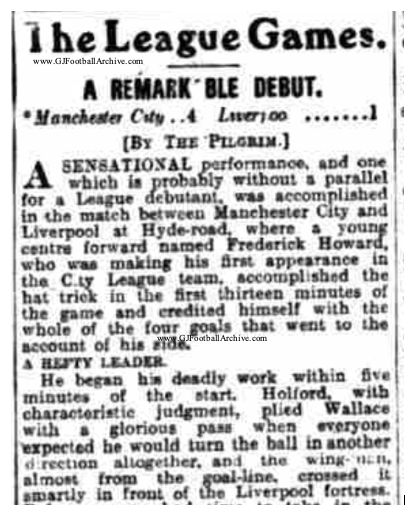
On this day (18th January) in 1913 Manchester City’s Fred Howard scored four goals on his debut against Liverpool at Hyde Road. I love the description of Howard in one report of this game: ‘Howard, a hefty individual who apparently does not believe in allowing the full backs free kicks, had pounced on the ball’. I think we’ve all seen a few ‘hefty individuals’ who did not ‘believe in allowing the full backs free kicks’ over the years!
A report also warns that Howard: ‘would do well to remember that he will not always be served as he was on this occasion. Nor will he have a much easier task’. I’m pretty sure Howard did not expect to score four goals in every game.
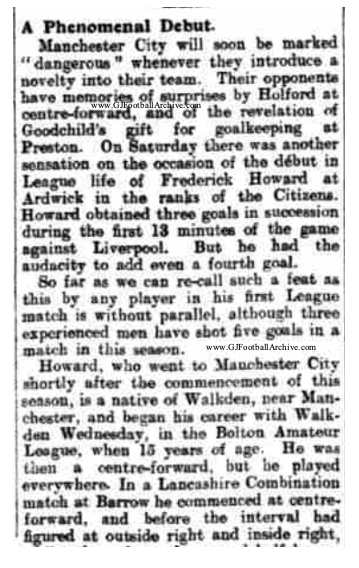
Howard, from Walkden, ended his City career after scoring 43 goals in 90 first team competitive games. Note in this article (below) the use of the nickname Citizens to describe the Blues. Maybe one day I’ll do a piece on club nicknames but I do know that many fans didn’t feel the word Citizens (or Cityzens as it is usually written these days at the club) had much to do with the club when City re-adopted it a few years back. It was certainly used a lot when talking of the club from 1894 through to perhaps the inter-war period.
Three of Howard’s goals came in a 13 minute spell as the Blues won 4-1. It was regarded as the greatest debut feat by any player at the time. Even now, over a century later, it’s hard to think of any player having a better debut.
Over the years plenty have talked of players scoring hat-tricks on debuts around the globe but how often do you hear of a player scoring four in the top flight of a major League against a team that is regarded as one of your main rivals? After this game Liverpool had dropped to 13th in the First Division, while City were fifth.
This was just a brief taster of the content in GJFootballArchive.com. If you would like to read the in-depth, longer articles (including the entire Manchester A Football History book) then please subscribe below. It works out about £1.67 a month if you take out an annual subscription (£20 per year) or £3 a month if you’d like to sign up for a month at a time. Each subscriber gets full access to the 500+ articles posted so far and the hundreds scheduled to be posted in the coming weeks.
Subscribe to get access
Sign up today to ensure you can access all the content on GJFootballArchive.com
This is week 31 of Historic Name That Ground. As always, please leave your comments in the comments area at the bottom of this website page. Do you recognise this ground? On Friday I’ll post the answer. Here are a few clues…
Can you name the ground featured in the image above? This is a 1950s photo of this ground which during that decade underwent some major changes. The ground remains a League venue today and Manchester City have played there in a prominent game. Much of the area will still be recognisable to those who visit the ground.
Post your answer below in the comments field and I’ll give the answer on Friday.
While you’re here why not subscribe to my site and you can then access every article, interview, audio recording etc. already posted and those that will be posted during your subscription. It costs £20 per year (about £1.67 a month) or you can sign up on a monthly basis at £3 per month (you can cancel at any time, so you could sign sign up for a month, access everything you want and then cancel). You can subscribe below:
Subscribe to get access
Read more of this content when you subscribe today.
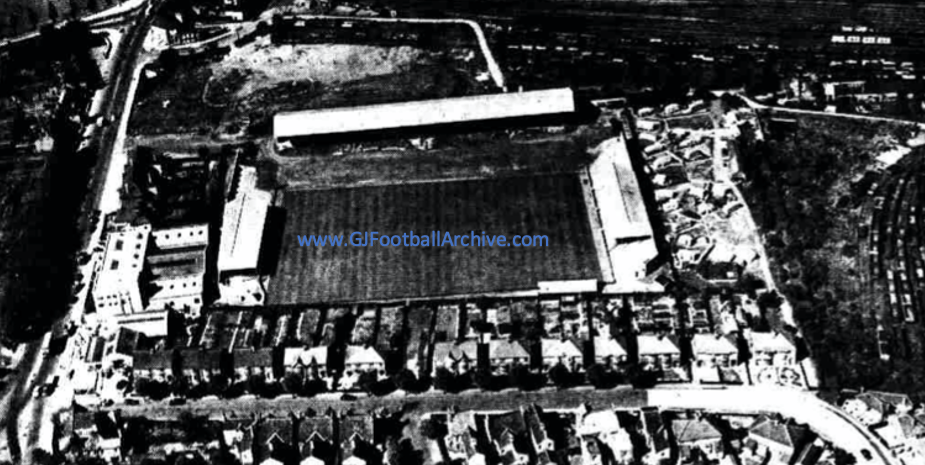
Did you recognise this ground? This is a 1920s photo of this ground which, at the time was fairly new. The ground remains a prominent venue today and has staged Premier League games. The curved road still exists, as does much of the housing. In fact even the stand that’s clear on this photo existed last time I went to this ground, though plans were made in recent years to replace it (work should have started and be progressing well but I’ve not checked). Here’s the answer…
It’s Crystal Palace’s Selhurst Park.
While you’re here why not subscribe to my site and you can then access every article, interview, audio recording etc. already posted and those that will be posted during your subscription. It costs £20 per year (about £1.67 a month) or you can sign up on a monthly basis at £3 per month (you can cancel at any time, so you could sign sign up for a month, access everything you want and then cancel). You can subscribe below:
Subscribe to get access
Read more of this content when you subscribe today.
I had planned to run ‘Historic Name That Ground’ only during the close season 2021 as in previous years, but it’s proving of interest so I’ll keep it going for a little while yet. If you have an old image of a ground that you think it’d be worth including in this weekly quiz then please get in touch. They don’t have to be from the 1900s to 1960s – even ground images from the 70s and 80s may prove a challenge to identify these days. You can email me at gary@GJFootballArchive.com Thanks.
The latest ground to identify… Do you recognise this ground? On Friday I’ll post the answer. Here are a few clues…
Can you name the ground featured in the image above? This is a 1920s photo of this ground which, at the time was fairly new. The ground remains a prominent venue today and has staged Premier League games. The curved road still exists, as does much of the housing. In fact even the stand that’s clear on this photo existed last time I went to this ground, though plans were made in recent years to replace it (work should have started and be progressing well but I’ve not checked).
Post your answer below in the comments field and I’ll give the answer on Friday.
While you’re here why not subscribe to my site and you can then access every article, interview, audio recording etc. already posted and those that will be posted during your subscription. It costs £20 per year (about £1.67 a month) or you can sign up on a monthly basis at £3 per month (you can cancel at any time, so you could sign sign up for a month, access everything you want and then cancel). You can subscribe below:
Subscribe to get access
Read more of this content when you subscribe today.
I had planned to run ‘Historic Name That Ground’ only during the close season 2021 as in previous years, but it’s proving of interest so I’ll keep it going for a little while yet. If you have an old image of a ground that you think it’d be worth including in this weekly quiz then please get in touch. They don’t have to be from the 1900s to 1960s – even ground images from the 70s and 80s may prove a challenge to identify these days. You can email me at gary@GJFootballArchive.com Thanks.
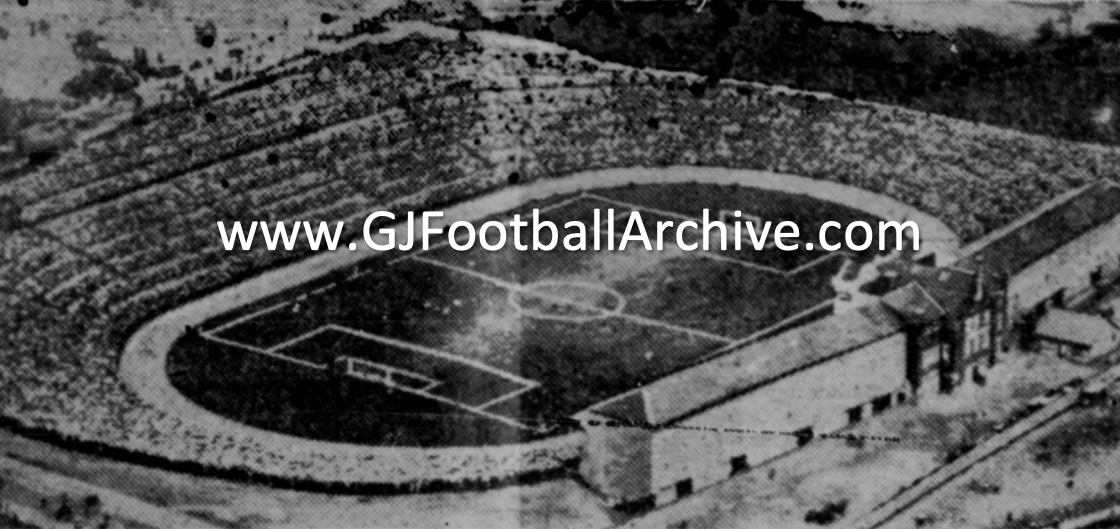
Did you recognise this ground? Believe it or not five years before this photo was taken Manchester City’s new ground at Maine Road was described as being designed to emulate this venue. This image is from the 1920s. Did you recognise it? The answer is…
Hampden Park
When Maine Road was being built it was described as ‘The English Hampden’ as City’s new venue was perceived as of equal status to Hampden, perceived as the greatest British ground at the time. People today incorrectly claim Maine Road was built as the Wembley of the North but that is absolute rubbish. Both Maine Rd and Wembley were being built at the same time and when Wembley opened a few months before City’s ground, it received negative press. The view when Maine Rd opened in August 1923 that Wembley may never stage a prominent game again.
You can read a variety of articles about Maine Road here:
While you’re here why not subscribe to my site and you can then access every article, interview, audio recording etc. already posted and those that will be posted during your subscription. It costs £20 per year (about £1.67 a month) or you can sign up on a monthly basis at £3 per month (you can cancel at any time, so you could sign sign up for a month, access everything you want and then cancel). You can subscribe below:
Subscribe to get access
Read more of this content when you subscribe today.
I had planned to run ‘Historic Name That Ground’ only during the close season 2021 as in previous years, but it’s proving of interest so I’ll keep it going for a little while yet. If you have an old image of a ground that you think it’d be worth including in this weekly quiz then please get in touch. They don’t have to be from the 1900s to 1960s – even ground images from the 70s and 80s may prove a challenge to identify these days. You can email me at gary@GJFootballArchive.com Thanks.
On 7th January 1956, with the score at 1-1 Manchester City’s cup tie with Blackpool was abandoned in the 56th minute after fog enveloped the ground. The game was an extraordinary one with City fans angry that it had ever started. In thick fog the referee H Webb (no not that one!) of Leeds said the game should go ahead because, although those in the stands could see little, he claimed he could see both ends of the pitch.
Blackpool kicked off to start the game but City were unable to see what was going on unless they were close up to the ball. Within 13 seconds Ernie Taylor, who later signed for Manchester United of course, scored without a single City man touching the ball (or even seeing it it seems).
After 37 minutes the players left the field and it looked like the game would be abandoned but, to the shock of the City players (who seemed to want it abandoning according to some reports, though we all know how things can be incorrectly reported), the match restarted.
A longer half-time than usual followed but still the game went on. After eight minutes City’s Jack Dyson was fouled in the area – although only the referee, Dyson and the man who committed the foul seemed to know this at the time. Dyson scored the resulting penalty and then a couple of minutes later referee H Webb abandoned the game (maybe it was that H Webb after all!).
Amazingly one newspaper photograph of the game did appear, but apart from that it seems the public didn’t see anything. A cartoon appeared in one ‘paper suggesting that fans only found out what happened when they went home and turned on their radios.
Four days later 42,517 attended Maine Road for a 2.15pm kick off on a Wednesday afternoon to see City win 2-1.
If you would like to read more pieces like this then please subscribe below. It works out about £1.67 a month if you take out an annual subscription (£20 per year) or £3 a month if you’d like to sign up for a month at a time. Each subscriber gets full access to the 100+ articles posted so far and the hundreds scheduled to be posted in the coming weeks.
Subscribe to get access
Read the exclusive content in gjfootballarchive.com when you subscribe
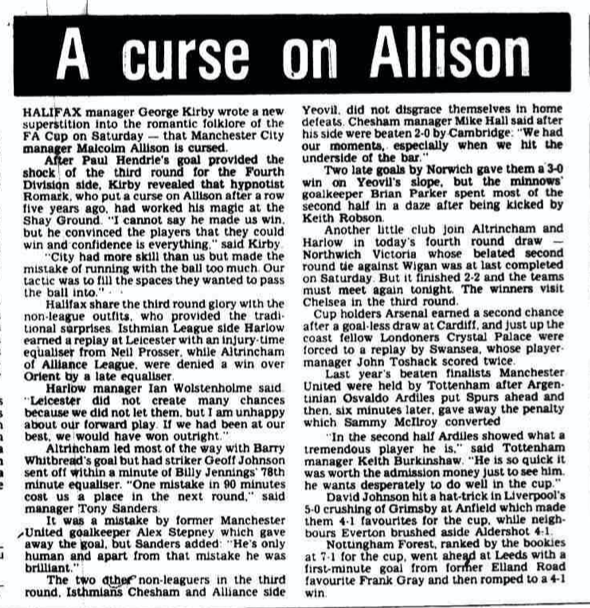
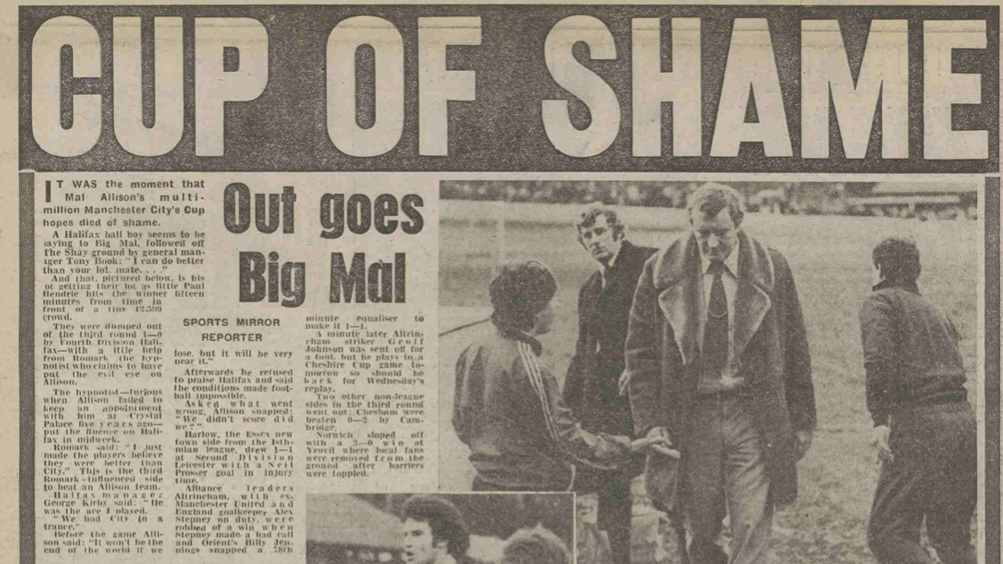
Malcolm Allison’s multi-million pound Manchester City side were humbled 1-0 at Fourth Division Halifax Town in the FAC.
At Christmas 1979 big spending Manchester City were 12th in the League. Malcolm Allison was in charge of the most expensive British team ever assembled up to that point and 12th was disappointing but it wasn’t the end of the world. In those days a decent run in the League could easily lift a team (similar to the 2020-21 season in terms of the number of clubs capable of winning the League at Christmas). Sadly, City collapsed in the weeks that followed.
A 1-1 draw at Stoke on Boxing Day was disappointing, but it wasn’t the end of the world. Then a 4-1 defeat at First Division newcomers Brighton knocked confidence at an important time. The next game was the third round F.A. Cup clash against Fourth Division Halifax Town at the Shay.
In his programme notes for the match Halifax Manager George Kirby predicted a shock: “In today’s F.A. Cup 3rd round the only certainty is that there are going to be some surprises, especially with the wintry conditions underfoot. I like to think that we are among one of the possible giant killers. This is because we are playing against one of the certain to be ‘top teams’ of the 80s. A 4th Div side at home to a 1st Div outfit with such stars as Joe Corrigan, Steve Daley, and Mike Robinson is a possible shock result. It only needs an off day by a key player and Halifax are in the hunt.”
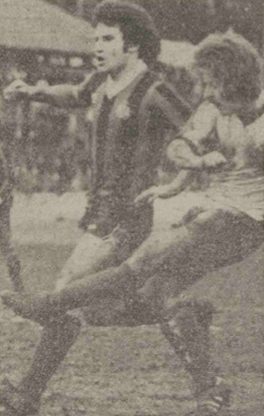
Kirby was determined to defeat football’s biggest spenders and even brought in an hypnotist, Romark (who had previously ‘cursed’ Allison while the City boss had been manager of Crystal Palace – a really interesting story which will be covered in my biography of Peter Barnes to be published in 2021), to get his players in the right frame of mind. The game itself was played in horrendous conditions, with multi-million pound City struggling to achieve anything. In the 75th minute it was all over as the ex-Birmingham City player Paul Hendrie converted a cross from former City schoolboy Andy Stafford to give Halifax a 1-0 victory. It was the biggest result in Halifax history, and the most embarrassing City defeat of the Allison period. Even today the name of Halifax and the sight of the Shay brings back nightmares for a large number of Blues.
Subscribe to get access
If you have enjoyed this then why not subscribe and read content like this plus more in-depth material. It’s £3 per month or £20 a year with access to every post so far and many hundreds to come.
Here’s a guest blog written by Morten Olesen , who is a Danish Manchester City supporter. Morten has written about a famous Manchester City goalkeeper who went on to become a major coach. This piece is of interest to City fans; those interested in Danish sport and anyone who wants to learn more about early footballing coaches. Morten has written this blog to add context and detail to goalkeeper Charlie Williams’ life.
Introduction
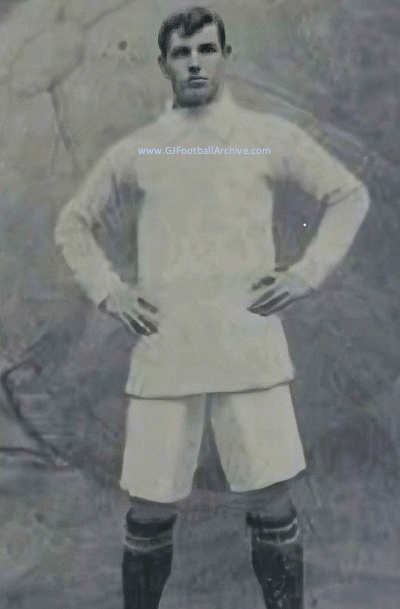
Manchester City has always had a tradition of having talented goalkeepers. The club’s first ever goalkeeper, Charles Albert Williams, set a high standard from the beginning – and to that extent became a pioneer in both Manchester, Denmark and Brazil, at a time when the game of football was still in its childhood
Charles Albert Williams was born in Welling, Kent just outside London, on 19 November 1873. Incidentally, only a few miles from where Arsenal struck their first fold. Back then a small football club struggling to find a foothold in a growing football sport. It would later become crucial to Williams’ career. We will return to that. Hang on. This is going to be a long story.
The early years
From the time Charlie Williams was a kid, he knew he wanted to be a goalkeeper. So already at the age of 16 he left Welling to try his hand at the game. It took over two years for goalkeeper positions at small clubs such as Phoenix in Yorkshire, Clarence in Belfast before returning to Welling, where the small club Erith welcomed the returning son. Returning home turned out to be the best career choice that the then still just 18-year-old Williams could make. For he was quickly noticed by Erith’s neighbouring club, which was very ambitious, and which today goes by the name “Arsenal”.
However, the club was then called Royal Arsenal and was based in south London. Arsenal players came mainly from the nearby arms factory, Woolwich. Despite the fact that the club at the time was still of amateur status, they were London’s leading football team. It should be noted here that the football game in London in the early 1890s was virtually unknown. This is strongly illustrated by the fact that the big city did not have a single team represented in the nationwide 1st division. The epicentre of the football game was at that time north of England’s capital.
But as I said, Royal Arsenal were ambitious. As early as 1891, the club became professional, although they did not play in any division. The London Football Association took that choice badly and froze Royal Arsenal out. Arsenal were thus excluded from participating in the regional London amateur league, and they therefore had to settle for friendly matches and qualification for the F.A Cup.
The 18-year-old Charlie Williams was one of the first to get a contract with Royal Arsenal. From 1891-1893 he took part in their struggle to establish themselves as a professional football club.
In 1893 the club’s name was changed to Woolwich Arsenal. The name change came in connection with the formation of a limited company to be able to buy the home ground, the then Manor Ground in Plumstead. This move paid off, because in the same year Woolwich Arsenal were included in the newly created and nationwide 2nd division. A huge achievement for the club, which could now see a future. However, the relegation to the 2nd division was the beginning of the end for Charlie Williams’ time at Arsenal.
Arrival at the “new” Manchester City
However, Charlie Williams started out as Woolwich’s first goalkeeper in the club’s debut season as a league club. On September 2, 1893, Williams played in Arsenal’s historic first league game. Unfortunately, it turned into a 2-0 defeat to Newcastle. It heralded difficult times for the young professional club – and not least Williams. The season ended with an honourable 9th place out of 15 teams, but Arsenal’s management saw Williams as one of the team’s weak links. It is described that the goalkeeper’s often “unorthodox style” brought him in troubles and it cost Arsenal a couple of big defeats along the way. Williams was put up for sale in the spring of 1894.
The buyer was Manchester City, who had just been founded by the bankrupt Ardwick F.C, who had finished third in the very 2nd division in which Arsenal had become 9th.
Ardwick had had major financial problems throughout the season and had reportedly played several matches with just 10 men! In the final season, Ardwick was declared bankrupt, and out of the ashes of Ardwick, the idea of a Manchester City was conceived.
One man who became crucial to Manchester City’s creation that year was Joshua Parlby (b. 1855). He worked hard to make Manchester City a reality. Parlby could see that football was becoming more and more popular. He therefore believed that a club that called itself “Manchester City” would reach far wider in the region than simply naming itself after the “suburb” in which one has an address.
Hyde Road Hotel (notice the Oldham v City advert and the turnstiles down the entry).
Parlby succeeded in having Manchester City founded on 16 April 1894 through an assembly at the Hyde Road Hotel (pictured above). More importantly, Parlby was successful in getting Manchester City re-elected to the 2nd division via Ardwick’s license, so Manchester City could line up in the league in 1894/95, and not just be relegated to an uninteresting regional league.
Parlby was busy. He should manage to gather a team up for the start of the season on 1 September. This is where our main character, Charlie Williams, comes into the picture again. Along with almost 10 other debutants, 20-year-old Williams lined up for Manchester City’s very first league game, which was unfortunately lost 2-4 in Bury. Manager Parlby, however, could quickly breathe a sigh of relief as City subsequently picked up 5 points in the next three games (2 points for victory at the time). The new City was competitive.
But that it was a new team with large fluctuations can be clearly read in the results from the season. They show a great instability: For example, City won 11-3 over Lincoln (Still club record for most goals in the same match) but there was also a 0-8 defeat to Burton Wanderers. Williams appeared in 23 of the season’s 30 games. Despite City conceding a large number of goals (72), the management of Manchester City must have been happy with their goalkeeper – allegedly because City scored many goals at the other end (82). The mantra has clearly been that as long as more goals are scored than the opponents – then it will work!
Charlie Williams was to guard the goal for the light blues for 8 seasons. He was listed for 232 games, keeping him solid in the top 100 of players with the most games for Manchester City. Williams’ greatest achievement with City is undoubtedly that he was part of the team that won the 2nd division in 1899, thereby securing Manchester City a place in England’s top division – incidentally as the first Manchester based team eve
First goalkeeper to score in open play
On a personal level, Williams City’s career is best remembered for becoming the first goalkeeper in history to score in open play. This occurred on 14 April 1900 in a 1st division match at Roker Park against Sunderland. The event is described in Gary James’ book Manchester: The City Years:
The match was played at Roker Park in a strong windy weather. City defender Bert Read, who always kept an extra eye on Williams because it was often difficult to predict what the unorthodox goalkeeper could come up with, had a perfect view of how the goal was scored. He often told this version of Williams ‘goal: “I put the ball back in Williams’ hands and he kicked it far – to the middle of the pitch. The ball hit the ground and bounced – and bounced – and for each bounce it seemed to gain more and more speed. The two Sunderland defenders, Porteous and Gow, were totally surprised, got in each other’s way, and the ball now sailed against Doig, Sunderland’s famous Scottish national team goalkeeper, Ned Doig, who seemed to be in control. “But: a sudden gust of wind did that Doig only got his fingertips on it – and the ball went into the net”.
There must have been a strong wind that day. The balls back then were really heavy. Despite Williams’ sensational goal City lost 3-1, which was not surprising. Sunderland was one of the great teams of that time (4 championships between 1892 and 1902)
Williams was at the peak of his career in those years, and he was an important part of City’s team. It was only because of his unorthodox style that he never got elected to the national team.
In 1902 Charlie Williams’ career at City ended, when the blues somewhat surprisingly moved out of the 1st division in a last place. City got off to a bad start in the 1901/02 season, with just 3 wins and 1 draw in the first 15 games of the season. Manager Sam Ormerod therefore decided to bring in a new goalkeeper, Jack Hillman from Burnley. Williams’ last match for City was a 0-3 defeat on 4 January 1902 – to the club he had celebrated his personal triumph of scoring against – Sunderland.
Ned Doig, Sunderland’s goalkeeper
He went back to London, where the now almost 30-year-old Williams had short careers at Tottenham, Norwich and Brentford respectively. However, his career had undoubtedly culminated. The three mentioned clubs all played in the regional “Southern League First Division” which can best be described as the level just below the 2nd Division. In 1907, Williams stopped his career – but he was not yet finished with football. Far from it!
Denmark’s first national coach
In Denmark, as in England, the football game was on the rise. The game became more and more popular. In the early 1900s, no country in the world took the game of football more seriously than Denmark. Dansk Boldspil Union – DBU – (The Danish F.A ) was inspired by British football, which they wanted to emulate in both style and expression. Therefore, English teams often visited Copenhagen to play exhibition matches against selected Danish (read Copenhagen) teams. At that time, football in Denmark was centred on Copenhagen. The big clubs were K.B, Frem, B. 93 and AB.
International matches did not yet exist. But in 1903, something happened on that front. Again, with eyes on the British Isles. DBU hired the Scottish David Mitchell to coach a selected Danish team in the weeks leading up to a couple of exhibition matches (so-called “Staevnekampe”) against the then big football team, Scottish Queens Park – and Southampton. However, it was still a committee in the DBU that selected the players for the matches. Not a definite coach.
Three years later, in 1906, Denmark was invited to the unofficial anniversary Olympics in Athens. the so-called “intermediate games” specially arranged to save the Olympics, after two scandalously games in 1900 and 1904. The DBU reluctantly sent a team assembled by the players themselves. They all came from B. 93, K.B, Frem and A.B.
Denmark won a parody of an Olympic tournament, which mostly consisted of small Greek club teams, in the otherwise registered national team from France, England, Germany, Holland and Austria, among others, never showed up! In the final against Athens, it was 9-0 to the Danes at the break. The Greeks never came out to the 2nd half … A farce
Despite the DBU’s reluctance to take part in the 1906 Games, the victory must still have given some blood on its teeth to play national matches. For now, the DBU was betting on having to take part in the official London Olympics in 1908. And this is where our main character, Charlie Williams, comes into the picture again. For DBU was in close dialogue with the English Football Association for help in hiring a decided coach who was to prepare Denmark for the Olympics. and the team’s first official internationals. And of course, it should still be with British inspiration. DBU got recommended Charlie Williams.
Denmark’s Olympic team in 1906
Denmark’s national team thus became the mere 35 – year – old Williams’ first coaching job – and even though it sounds like a bad decision these days, it turned out to be ingenious.
The then magazine “Sportsbladet” wrote about the employment:
“The union has probably been lucky in the election of Mr. Williams, he takes care of the players with great interest and with much care, and has an excellent understanding of what football is about. Mr. Williams undoubtedly has a lot of experience and accurate knowledge of the game of football both in theory and practice. There is a lot to learn for our players if they follow his advice and instructions”.
the writer above is John Gandil, one of the Danish football stars of the time (from B. 93) so he must have known what he was talking about.
Williams joined Denmark in August 1908, where he trained a squad of 26 Danish players four times a week at B. 93’s training ground, located where the danish national stadium, “Parken” is today. Twice a week it was match training – and the remaining two training sessions were exclusively running training – something that at that time was completely unheard of in Danish football circles. To that Williams himself said – again to “Sportsbladet”:
“Here is excellent material for a good team, but the players greatly miss training and do not really seem to understand the significance of this; they would rather just practice kicking towards the goal and neglecting the training in sprints. This view is extremely unfortunate, because when you have the skill in ball handling that is the case with the Danish players, they must first and foremost place emphasis on getting the body in shape and achieving the necessary speed”
The 35-year-old Englishman clearly enjoyed his life in Denmark. The training conditions were good, and the player material as promised. However, it turned into a bit of linguistic confusion. A story reads:
“When I first came here and asked for lunch, the lady did not understand at all why I was trying to make a pantomime with an imaginary knife and fork. The lady now seemed to be aware of what I meant, she disappeared, but came back a little later, not with lunch, but with a box of cigarettes “
A touched Williams
The Danish national football team’s participation in the Olympics in Williams’ hometown, London, was a resounding success, and has gone down in Danish football history. Williams became the man who led Denmark when they played their very first official football international match on October 19, 1908 at White City Stadium – (built in 1907 for the Olympics – demolished in 1985)
Denmark’s Olympic national team in 1908 probably photographed v. B. 93 ‘facility. Charlie Williams is in the middle row as number 3 from the left
Denmark played a French B national team and won 9-0 (nine) In the next match, which was actually a semi-final, France “A” waited – which on paper should be better than France B. But they obviously were not. The Danes won by historic 17-1 (seventeen-one). Sophus “Krølben” Nielsen (Frem) in particular immortalized himself in that match – He scored 10 goals.
It was a result that for 83 years was the world record for a victory in an official international match. In 2001, American Samoa lost 31-0 to Australia.
Despite the impressive results, it was still the final that made Charlie Williams most proud – even though Denmark went on to lose 2-0 to the home team from England. The Danes fought heroically throughout the match and the red / whites were the best team throughout the second half. When Williams’ 8,000 compatriots in attendance clapped Denmark off the field after the final, our first national coach was very moved.
Stayed in Denmark, apparently
After the successful Olympics, Charlie Williams reportedly stayed in Denmark for 2-3 years. He still took on some tasks for the national team, and then he was regularly responsible for the training of B. 93, where the club won the then KBU tournament in 1908 and 1909. (Championship of Copenhagen)
Most importantly, he still built a bridge between Danish and English football. He definitely used his network to get English clubs to Copenhagen. He often refereed when the English teams played in Copenhagen, which they often did. Thus, also when Manchester City was on a summer trip in the city in 1910. Here the blues played two matches on “Granen” at Frederiksberg, Copenhagen (Granen was the forerunner of the danish national stadium. FC Copenhagen distributes today an annual memorial trophy named “Granen”)
Farewell to Denmark – and Europe
In 1911, Williams went to France to coach Olympique Lillois, a predecessor of Lille OSC. However, the coaching job in France was extremely short-lived, as he was soon to meet Oscar Cox on a visit to London.
Oscar Cox (born 1880) was of an affluent immigrant English / Brazilian family, interested in sports – and very enterprising. He had become acquainted with the game of football while studying in Lausanne, Switzerland. He had become so fascinated by the game that when he returned to Brazil, he became a pioneer in spreading it. Football at the time was NOTHING in Brazil. Hard to imagine today where football in Brazil is cultivated as a religion.
Cox took strategic action. He organized the first football match ever in Brazil – in Rio De Janeiro. He then moved on to Sao Paolo, where he, along with another great pioneer of Brazilian football, Charles Miller, planned football matches
Most of all, however, Cox is probably today most connected to the fact that he was a co-founder of the football club still known today. Fluminense.
In 1911, almost 10 years after its founding, Fluminense was looking for their first coach. The choice had fallen on the now almost 40-year-old Charlie Williams, who was persuaded to take the job for a salary of £ 18 a month (well over £ 2000 in 2021 money) two return trips to England, as well as free board and lodging. An excessively high salary compared to the salary limits that were legal at the time. But Cox did not care. He wanted Williams to take Fluminense forward at any cost.
Williams arrived with the ship Oropesa in Rio on March 16, 1911 and was presented as Fluminense’s first manager. He had to both coach and take out teams. Until now, it had been a board that had been responsible for team selection – but now all responsibility rested with the former Manchester City goalkeeper /Danish national coach. Williams was described at the presentation as “The man who knows all the secrets and means of the violent sport”. In its own way, it tells a lot about the game of football in the early 1900s – as well as Williams’ methods as a coach.
But the methods worked. Williams led Fluminense to the Rio Championship (Campeonato Carioca) in his first season with 6 wins out of 6 possible – and a score of 21-1!
In the following season, things went less well. Fluminense had to settle for a 5th place – but of course the pioneer Williams still had to write history: He became the first victorious manager in the first Rio derby, Fluminense v Flamengo in everyday speech called the Fla-Flu derby. A local showdown that would eventually become huge.
While you’re here, it costs a lot to keep this site running. Why not support the research and writing by either subscribing or by donating:
If you enjoy all the free material on my website and would like to support my research and keep this website going (but don’t want to subscribe) then why not make a one-time donation (or buy me a coffee). All support for my research is valued and welcome. It allows me to keep some free material available for all. Thanks.
Flamengo was founded in 1911 by breakaways from Fluminense. The breakaways were dissatisfied with the state of affairs in “Flu”, and went to Flamengo, where they set up a football department. The basis for a rivalry was created. Today, Fla-Flu is one of the world’s most visited football matches, which has had spectators up to almost 200,000!
For the first one, which Williams was in charge of, however, there were only 800. It was not, as today, held at the famous stadium Maracana, but at the much smaller Estádio das Laranjeiras. Incidentally, Brazil also played their first “international match” here. That was in 1914 – against something as exotic as Exeter City. Brazil won 2-0.
Brazil v Exeter, 1914
Estádio das Laranjeiras still exists today – and is owned by Fluminense.
From “Midas Touch” to obsolete
At the outbreak of World War I in 1914, Charlie Williams was called up for military service, and thus had to return to Europe. I have unfortunately not been able to figure out what Williams was doing for the next 10 years.
However, it is certain that in 1924 he was back in Brazil, now just over 50 years old. Here he again took over the manager role at Fluminense. Once again, he led “Flu” to a Rio championship – right at the snout of rivals from Flamengo. Williams stayed at Fluminense until 1926, when he switched to another Rio club, America FC. And of course, he won them the Rio Championship!
There has been a kind of “Midas Touch” over Williams. He was therefore a coveted gentleman in Rio’s football circles. In 1929, he was hired as a coach at Botafogo, and this was perhaps where the beginning to the end of Williams’ career was set in motion. Williams coached the team according to his methods that had brought so much success.
But when Botafogo hired Hungarian Nicola Ladany (b. 1889) as a kind of sports director, things began to turn sour. Ladany insisted that Botafogo should experiment with mental training, something Williams refused. That was probably why Williams was demoted to assistant coach, while Botafogo’s star player, Nilo Braga (b. 1903) took over as head coach. Botafogo won the championship and Williams had to watch from his assistant role.
Williams left Botafogo in 1930 for what was to be his last job in football: The old rivals from Flamengo wanted Williams to take over. Surely in the hope that the Englishman could get the club back at the top of the league.
Flamengo had had some lean years.. Ok they had won the Rio championship in 1927, but subsequently it had gone sluggishly with several mid tables finishes. Williams, however, could not correct the mediocrity. The following year – in 1931 – Williams led Flamengo to just a 6th place. It was reportedly here that he must have decided that his time as a coach was over.
Maybe time was running out from him? Williams could only see to it that the club that had demoted him, Botafogo, dominated the Rio football scene with their new and modern training methods, which he had rejected to implement. At the same time, the plans for a professional Brazilian league were also so advanced that Williams might have had a hard time to see himself, as part of it? We do not know. In 1931 Charlie Williams stopped a more than 40-year career in the service of the football game.
He shaped the football game and stimulated it to progress and success – in London, Manchester, Denmark and Rio. In addition to being an excellent goalkeeper, coach and innovator, he was a great pioneer of the game of football, which all of us who love football today should be remembered with great respect.
Despite the adversity he experienced at the end of his career, he must have enjoyed life far away from his hometown, Welling. For he remained in Rio De Janeiro for the rest of his life. Charlie Williams died in the Brazilian capital on July 29, 1952, aged 78. He is buried in the city on Cemiterio dos Ingleses Gamboa (English Cemetery).
Unfortunately, no descendants have been found who can shed more light on an absolutely fantastic life. Some believe to know that he had a son who was a football referee in Brazil, but it has turned into nothing but speculation and guesses. But now I have tried, perhaps as the only one ever, to shed light on Charlie Williams’ life. It was a pleasure to discover this fantastic life of. Mr. Williams
If you have enjoyed this blog then why not subscribe and access all the other great articles on here? Or if you don’t want to subscribe then maybe make a donation to keep the site running? See below for details of both:
If you enjoy all the free material on my website and would like to support my research and keep this website going (but don’t want to subscribe) then why not make a one-time donation (or buy me a coffee). All support for my research is valued and welcome. It allows me to keep some free material available for all. Thanks.
Recently it has been fashionable for some to talk of the Premier League being dominated by a single club or that the competition is no longer as entertaining as it was because the same old club(s) win the League. Well, this is absolute balderdash of course, but rather than simply say that I thought I’d look at the facts and the supporting evidence. So, if you’re someone who thinks football is more one sided today than it’s ever been, or someone who wants to challenge those who do, then please read on…
The idea that the League is a one club competition is usually stated in relation to Manchester City these days and recently, as City have increased their lead at the top, the view has been expressed over and over again by rivals and some journalists. Yet, the evidence shows otherwise.
Firstly, at the time of writing Manchester City are 10 points clear of second placed Chelsea. However, if Liverpool win their game in hand then City will be only 8 points clear. I say only because 8 points is less than 3 victories difference and City still have to play both Chelsea and Liverpool, plus of course other potential rivals including Manchester United.
I also say ‘only’ because we can all come up with seasons when one club has been eight points or more ahead and still lost the League – Manchester United fans will not need reminding about how far ahead they were in the 2011-12 title race as it entered its final weeks, only to see City snatch the title in dramatic fashion.
Eight point leads are great to have but, at this point in a season, they do not mean you will be successful. Personally, I hope City are successful but no one seriously believes the title race is over and if they do then they really have not watched enough football!
Alongside the ridiculous view that the League is over there has been a frequently aired view that the League title is less competitive now than at any other time in history. Again, this is a ridiculous view that does not match with the evidence.
Much has been said by City’s rivals and others about how having one team dominating can be boring for English football. Whether that’s true or not is debateable but it’s worth pointing out that since City first won the Premier League in 2012 then five different clubs have won the competition (three of these being first time Premier League champions too!).
Five teams in a decade may not sound like much variety to some but it is better than the 2000s (1999-00 to 2008-09) when only three clubs won the League. Even worse between 1995 and 2004 either United or Arsenal won the title and their duopoly was only broken up when Chelsea became a force following their investment. Even then only those three teams won the League between 1994 and City’s first PL title in 2012!
Had Chelsea not come along would United and Arsenal still be the only teams winning the League? The investment in both Chelsea and City has helped open up the League and, with a greater variety of clubs challenging, the League is now much more open. At the start of each season there are more teams perceived as potential title challengers than in the 2000s.
Did anyone say back when United and Arsenal had a duopoly at the top that the League was boring because it was the same old champions? I don’t remember leading journalists say that then so why now when the PL has had more variety of winners?
Even if City’s rivals or those critical of City’s success accept that United and Arsenal dominated the League back in the 2000s until the ‘new money’ of Chelsea and City came along they tend to suggest that previous decades had enjoyed more variety. Well some did but not all. The 1980s are perceived as an era when the League was varied yet only four clubs won the League during that decade (1979-80 to 1988-89).
So the last decade has not been such a one-sided race after all and is better than the 1980s and 2000s for a start.
Those figures may surprise or shock some who believe City’s rivals or those who promote the view that City dominate the League like no other club ever has. However, I’m sure some will say ‘but it’s not just about League titles, it’s about trophy hauls too!’
Well, as a Manchester City fan I am proud of the success City have achieved during the last decade and I also recognise that they have not dominated in a way that other clubs have in previous periods.
In terms of the most successful club of each era, well, Chelsea and City have clearly been the most successful during the 2010s (2009-10 to 2018-19). Their trophy hauls during this time are (excluding one-off competitions like the Community Shield or European Super Cup):
Chelsea: 10 major trophies (includes 3 major European trophies).
City: 10.
Thinking of domination, it is worth highlighting that neither side has yet won as many trophies in a single decade as Manchester United did between 1989-90 and 1998-99 when they won 12 trophies. They also won ten trophies in the decade that followed.
Again, I don’t remember negative coverage of United’s domination but somehow it seems fair to say Manchester City dominate today yet their trophy haul has not reached the heights of United yet, plus their trophy haul during the 2010s was the same as Chelsea’s anyway (and since then Chelsea have won another European Champions League of course!).
But what about earlier decades and domination? Well, the 1970s (all trophies won in 1969-70 and 1978-79) – an era generally regarded as one of great variety with several clubs challenging – Liverpool won three times as many trophies as their nearest rivals (Manchester City were actually joint-second most successful English club during that period!).
Those who have claimed in recent seasons that having one team dominating is boring may want to think back to how they felt during previous decades.
Each era has its own successful teams but these vary over the decades with no club being regarded as a dominant club throughout its entire history. We’ve all experienced fallow periods or times of struggle, though some may not want to remember that.
Today, no team dominates English football (who remembers all those voices earlier this season telling us how open the League would be or that Liverpool/Chelsea/City/United/Tottenham would be victorious? All of whom could still win the League this year of course!).
There are plenty of issues with English and European football but can we all please remember that football domination has happened in the past and that the situation today is not as one (or two) sided as it was in some past decades.
Subscribe to get access to further content
Read more of this website when you subscribe today. It costs £3 per month or £20 a year and you get PDFs of the entire Manchester A Football History plus hundreds of other articles, interviews etc.






 Gary James' Football Archive