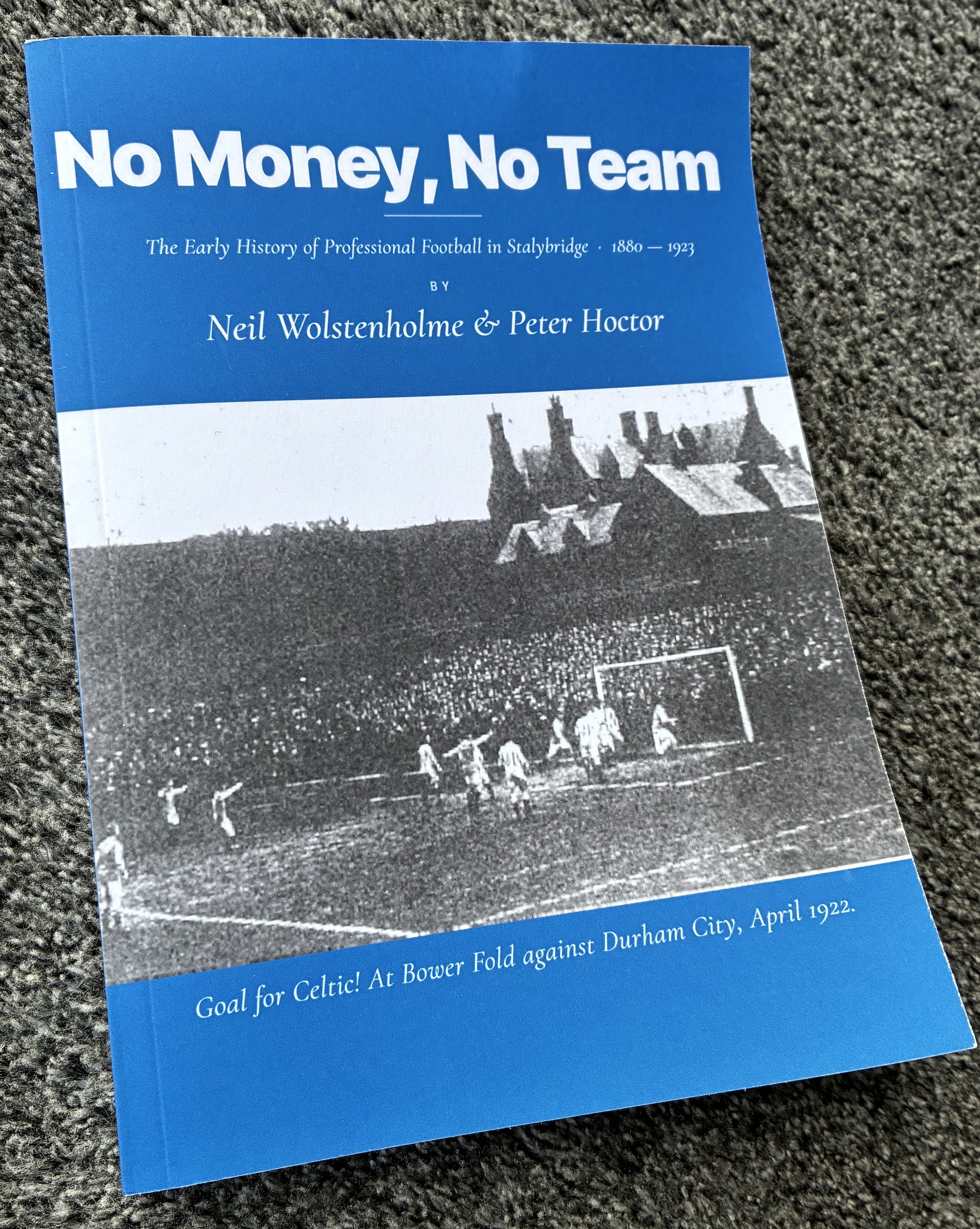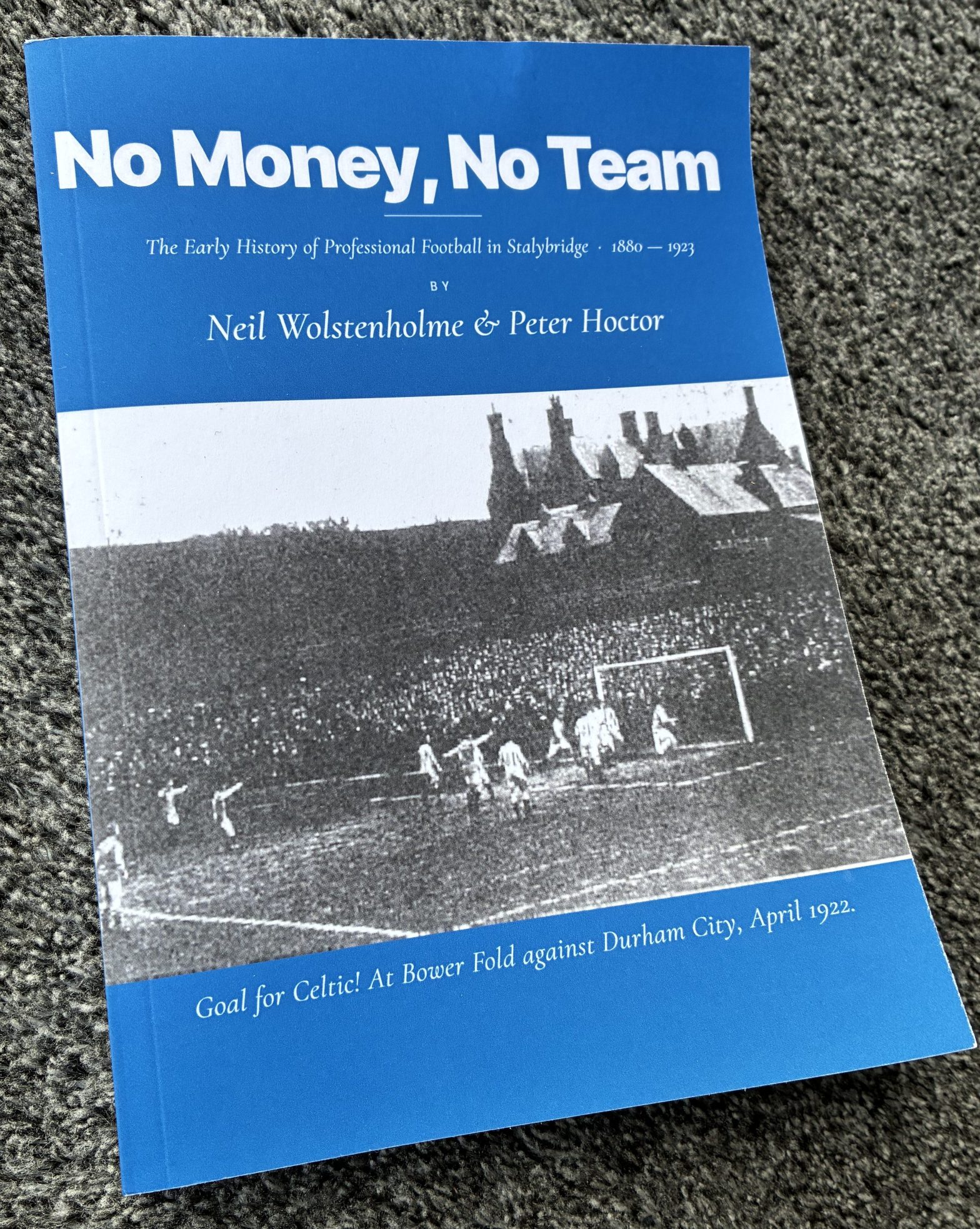
In the week when the musician Stevie Wonder turned up in Stalybridge for a meal it seems appropriate that the latest guest blog on this site is about football in that town. It’s by Neil Wolstenholme and Peter Hoctor. They are both Stalybridge natives and Stalybridge Celtic supporters. Neil is a former Celtic player and his father was a director of the club. Peter’s father was the club’s groundsman for many years. Today they’re talking about their new book on Stalybridge’s early football history. This piece talks of Stalybridge’s ‘other’ team Stalybridge Rovers. If you’re interested in football in Tameside or on the early history of the sport then get yourself a copy. It’s a fascinating book. Enjoy!
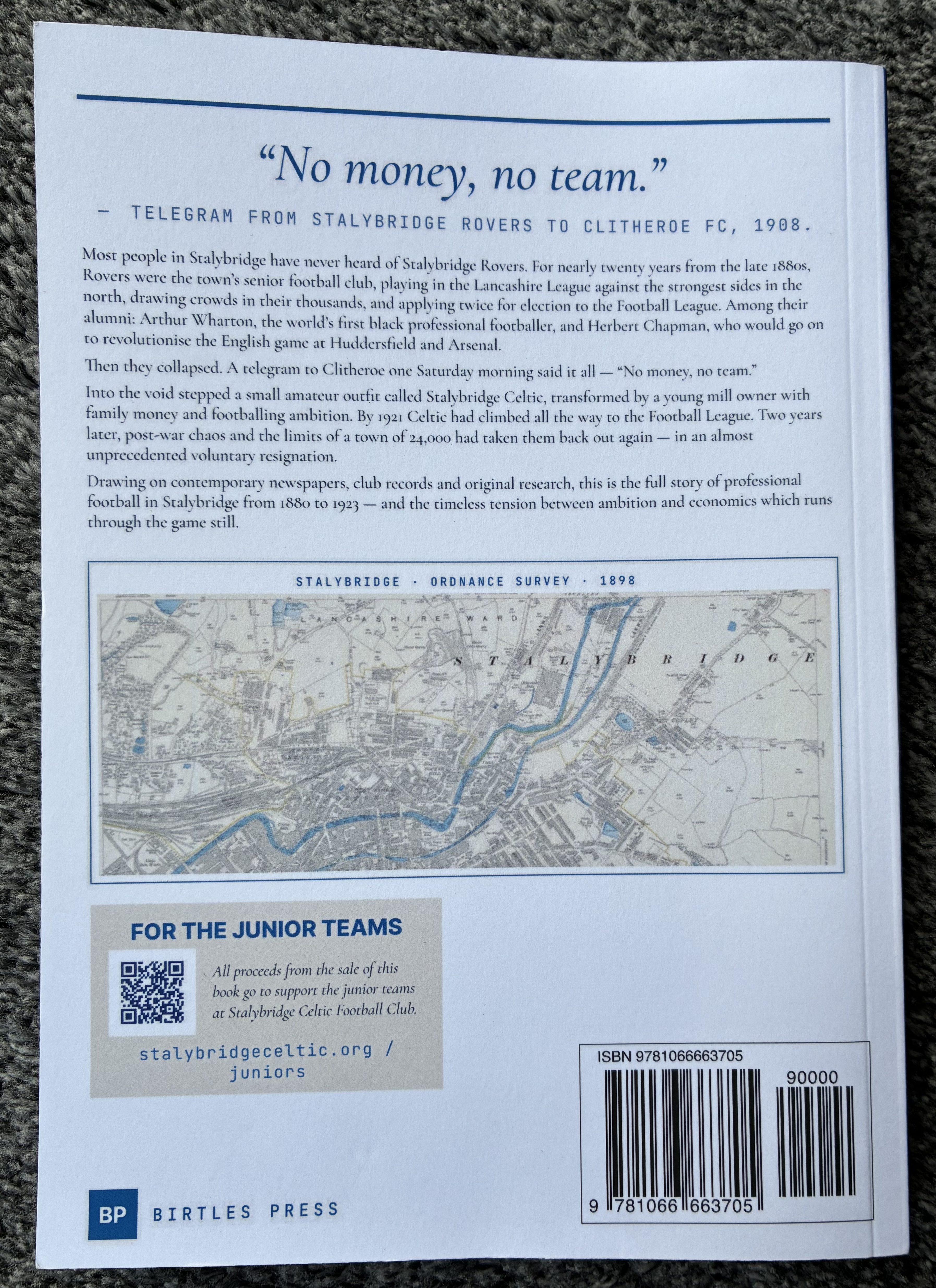
In April 1908 Stalybridge Rovers were due to play at Clitheroe. They never turned up. Instead, a telegram arrived with four words: ‘No money, no team.’
We were both born and bred in Stalybridge and we’re both Stalybridge Celtic fans. We had vaguely heard of Stalybridge Rovers, but we knew little about them until we started researching a book on Celtic. Most of their story had been forgotten or simply erased. Piece by piece, the old newspapers revealed a club which had won the Lancashire League, reached the first round proper of the FA Cup and twice tried to get into the Football League. That research became No Money, No Team: An early history of professional football in Stalybridge, 1880 to 1923.
So, who came before Rovers? Stalybridge St George’s, founded in 1883, with their headquarters at the Bull’s Head Inn and a pitch at Crookbottom. By 1887 they were the town’s leading club and members of the new Lancashire FA. Then, in January 1888, smallpox broke out in Stalybridge. Opponents refused to visit, fixtures were postponed for weeks, and the Saints faded away. Shades of 2020. By December 1888 the local paper was calling the new Stalybridge Rovers ‘late St George’s’.
Readers of this site will know Rovers’ world well. They played Ardwick, Newton Heath and Hurst, and in the 1890s they had a fierce rivalry with Ashton North End which could pull in 8,000 people. In October 1893 Newton Heath came to Crookbottom and the Clarion sent its writer, ‘the Bounder’, to kick off. He was not a fan: ‘There is no wetter place in England than Stalybridge.’ Having grown up there, we can’t really argue. In 1900 Rovers went to Hyde Road in the Manchester Senior Cup and lost 4-0, with legendary Billy Meredith scoring twice.
Some remarkable men wore the amber and black. Arthur Wharton, widely regarded as the world’s first black professional footballer, kept goal and captained the side. Herbert Chapman, later the very successful manager of Huddersfield Town and Arsenal, played for Rovers long before he changed how the game was played.
The good times rolled in 1899-1900 and 1900-01. Rovers knocked out Stockport County and Burslem Port Vale to reach the FA Cup first round proper, and 400 supporters caught a special train through the night to watch them lose 2-1 at Bristol City. The next season they won the Lancashire League on goal average. They applied to join the Football League in both years, gathering just one vote, then seven.
Within seven years of winning the league, Rovers were gone. How a champion club could fall so far, so fast, in a town which loved its football, is the story at the heart of the book.
Into the gap left by Rovers stepped a new club, Stalybridge Celtic, with a very different kind of backer. Herbert Rhodes was a local mill owner and magistrate, and with his support Celtic would go where Rovers never could, all the way into the Football League. Whether his money was enough, and whether Celtic learned from Rovers’ mistakes, is another matter.
This is a football story, but it is also a story about money. Without it, a club cannot compete and the reach for glory can end in disaster. Rovers were far from the last to learn that lesson. There have been numerous casualties. In 1962 Accrington Stanley resigned from the Football League in the middle of the season. In the 1980s Wolves slid from the First Division to the Fourth, while Bristol City survived only because eight players tore up their contracts. Aldershot and Maidstone United both went under in 1992. Leeds United borrowed to ‘live the dream’ and ended up in administration, Portsmouth won the FA Cup and then became the first Premier League club to go bust, and Glasgow Rangers were liquidated and restarted in Scotland’s fourth tier. More recently Bury were thrown out of the Football League and Macclesfield Town were wound up. The names and places may be different, but the pattern is one Rovers would have recognised.
What happened to Wharton after Stalybridge? Why did the League turn Rovers away? And how far was Herbert Rhodes prepared to go for Celtic? It’s all in No Money, No Team.
The book is available on Amazon: https://www.amazon.co.uk/dp/106666370X.
Every penny of profit goes to the Stalybridge Celtic junior teams, so if you buy a copy you’re helping the next generation of Celtic players.
Neil Wolstenholme and Peter Hoctor are both Stalybridge natives and Celtic supporters. Neil is a former Celtic player and his father was a director of the club. Peter’s father was the club’s groundsman for many years.