El Rubio: Barnes, United & Betis

This week Manchester United play Real Betis in the Europa League. This immediately brings to mind the stories of the former England international winger Peter Barnes. Barnes, or El Rubio as he was known in Spain (it means the blond one).

Peter’s time at both clubs is covered in my authorised biography of him. There are some touching moments and some great stories too. The book was started before the Covid pandemic and then was delayed because of Covid. Despite the delays it was great to write this biography and Peter’s a wonderful person who has an interesting story. I’m sure fans of every club Peter was involved with and neutrals will enjoy reading the book.

You can buy the book below.

This 372 page, colour paperback book is £16.95 (including UK postage).

United Kingdom

The Peter Barnes Authorised Biography – UNITED KINGDOM

Order today for £16.95 (incl UK Postage and Packaging).

£16.95

To order please use the button above (UK postage included; outside UK contact me for additional postage costs). You do not need to have a PayPal account to order – use the ‘Pay with PayPal’ button above and it will give you the option to pay by credit/debit card without creating a PayPal account.

Here are the contents pages:

This long awaited authorised biography, written by Gary James with the memories and stories of Peter’s career throughout, tells the story of Peter’s life from his childhood in Manchester and Wrexham through to the modern day. With particular focus on his footballing career with Manchester City, West Bromwich Albion, Leeds United, Real Betis, Coventry City, Manchester United, Tampa Bay Rowdies and, of course, England.

If you run a book shop and would like to know more about the book please email: accounts@manchesterfootball.org

The ISBN is 978-1-9168852-0-2.

You can listen to Peter in conversation with myself about the book here:

Thanks,

Gary James

Manchester City Hall of Fame: Francis Lee’s significant game

City 2 West Bromwich Albion 1

League Cup Final

7th March 1970

Goalscorers: Pardoe, Doyle

City Team: Corrigan, Book, Mann, Doyle, Booth, Oakes, Heslop, Bell, Summerbee (Bowyer), Lee, Pardoe

Attendance: 97,963

Subscribe to get access

Read more of this content when you subscribe today.

Subscribe to get access

Read more of this content when you subscribe today.

Borussia Mönchengladbach, City and Romark’s curse!

Today (7 March) in 1979 Manchester City faced top German side Borussia Mönchengladbach in the first leg of the UEFA Cup quarter-final at Maine Road.

There was a 39,005 crowd present and the City team was: Corrigan; Donachie, Power, Reid, Watson, Booth, Channon, Viljoen, Kidd, Hartford & Barnes.

Believe it or not (this may surprise a modern audience but leading clubs often did what I’m about to say) Liverpool, in particular Bob Paisley, had spent considerable time helping the Blues prepare for this match by providing vital information on the West German side.  

Liverpool had faced Mönchengladbach on five occasions, the most famous was the 1977 European Cup final and the most recent being in the 1978 European Cup semi-final.  Paisley told City that the game would be tough, and outlined the players to watch.  He also suggested that Dave Watson and Tommy Booth might be the key men in City’s side as the Germans seemed to lack ability to attack the ball in the air.

While City had Liverpool doing all they could to help there was someone who was becoming a bit of a thorn in the side of Malcolm Allison. That was hypnotist Romark. Romark had previously ‘cursed’ Allison while the City man had been manager of Crystal Palace (a really interesting story which I covered in my biography of Peter Barnes, published in 2021).

The Peter Barnes book is available here:

The hypnotist had offered to help Allison but Big Mal was having none of it. The following year Romark helped Halifax Town defeat City in the FA Cup! If only Allison had not angered the hypnotist all those years ago. Maybe life would’ve been so different for City!

The first leg saw Malcolm Allison, who had returned to the Blues in January as the self-styled ‘coaching overlord’, perform one of his many shock moves when Nicky Reid was thrust in to the spotlight at the age of 18 for his debut.  Allison selected him to mark Allan Simonsen.  It was an amazing selection at the time, but Reid did enough to justify Allison’s bold move.

Nicky Reid

Mike Channon, who was rumoured to be unhappy at the Club,  managed to give the Blues a 1-0 lead.  Unfortunately, the highly disciplined Mönchengladbach kept the pressure on and managed to snatch an equaliser and the often vital away goal.  

The second leg of the tie took place 13 days later, on 20 March 1979 watched by around 30,000. The City team was: Corrigan; Donachie, Power, Viljoen, Watson, Booth, Channon, Reid (Deyna), Henry, Hartford & Barnes

Nicky Reid retained his place for the second leg (but still didn’t make his League debut until eleven days later when he scored against Ipswich).  He was clearly a talented player but his arrival in the heat of European competition without even making an appearance in the League did raise many questions about the way Malcolm Allison was influencing things.  Reid went on to captain the Blues to the FA Youth Cup final the following May, and was voted City’s young player of the year.

Malcolm Allison made yet another surprise selection as Tony Henry – another reserve who up to that point had only featured in two League game (once being substituted by Kenny Clements, once coming on for Asa Hartford) – was included while experienced European campaigners Deyna, Bell, and Kidd were left on the bench with Paul Futcher.  

It was not a good night at all for City and having so much experience on the bench seemed baffling to fans, the media and also most of the players. City were very much the underdogs throughout and were losing 3-0 when, late on, Reid was substituted by Deyna.  The experienced Pole provided City’s only goal of the match, but it was too late and City were out of Europe.

Kenny Clements explained to me when I interviewed him years later: “I broke my leg a few weeks after Milan so that made life a bit difficult for me, but the big problem was the return of Malcolm Allison.  I know he was a great coach first time at City, but second time he really did ruin everything.  All the older players told me it’d be great having him back, and then when he was back they all admitted they were wrong.  I think he’d become too hung up on new ideas that he forgot about the basics.  I remember he used to give us homework.  He’d tell us to go home and write “I must win” or “I will win” a thousand times, then the next day he’d ask us if we’d done it.  

“I always used to say ‘yeah’, but some of the younger, more impressionable lads would produce their lists and some would even write out twice as many lines!  He insisted we drank coffee before a game to keep us alert, and brought in lots of motivational people.  It didn’t motivate me I’m afraid!

“By the time of the next UEFA match (Mönchengladbach) I was fit but didn’t start, and then for the second leg both Brian Kidd and I had to sit it out while Nicky Reid made his debut marking one of the greatest players of all time.  When we were two goals down Kiddo threw his shirt at Allison in anger.”

For many connected with City Mönchengladbach became the game that would be quoted when they discussed how things had changed following Allison’s return. Tony Book had developed a good team with a nice blend of young up-and-coming talent, like Peter Barnes (who was still only 21 but an exciting England winger), with the older experienced internationals like Dave Watson, Brian Kidd, Asa Hartford. Book’s team had been runners up to Liverpool in 1977 and had impressed with many great individual victories since then, especially that Milan victory of course, but the return of Malcolm Allison changed the dynamics at the club.

Ah well! Without that I guess City wouldn’t have what they have today, but for those of us who lived through the 70s to the present, it was the return of Allison that started the process of transforming City from regular challenging giant into a club that had lost its way. The 1978-79 Mönchengladbach games are a reminder of what we were, what we lost, but also of what we have now. Let’s ensure we enjoy the present because, as Allison once said to me: “Celebrate every success as if it’s your first, because it could be your last!”

When City walked out to face Mönchengladbach in the quarter final none of us, especially Allison, expected it would be our last European tie for 25 years! To read about the significance and facts of City’s European heritage (there are a few points that may surprise fans of certain other clubs) then take a look at another post:

https://gjfootballarchive.com/2021/01/11/manchester-citys-european-heritage-facts-not-fiction/

The results of City’s 1979 meetings with the German side are:

7/3/1979 City 1-1 Mönchengladbach (UEFA Cup)

20/3/1979 Mönchengladbach 3-1 City (UEFA Cup)

Kevin Keegan Resigns; Stuart Pearce Becomes Manchester City Manager

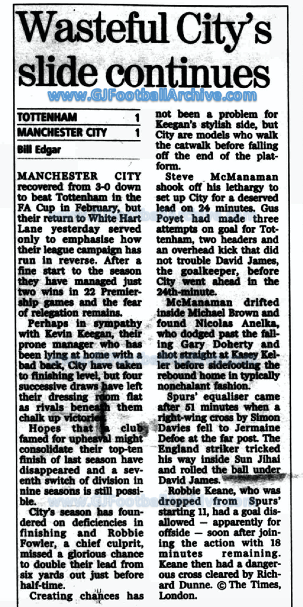
Manchester City suffered a 1-0 home defeat by Bolton Wanderers on this day (7 March) in 2005 and this game ultimately led to a significant change to the then 12th placed Blues.  Years later, in an interview I did with him the City chairman John Wardle told me that Kevin Keegan, the City manager, took him to one side:  “There were nine games left and Kevin said ‘John, I can’t do any more for you’.  I didn’t believe him.  I thought it was a joke at first but with Kevin you knew when he was being serious.  He said ‘I know when I’m done and it’s only right that you put somebody else in’.  I sat there shell-shocked.  He said that if I wanted him to recommend someone he would.  He then recommended Stuart Pearce. 

“Stuart had already left Carrington and we had to call him back.  I spoke with him, then Kevin talked with him.  It was like a handover.  Kevin packed his bags and left.  We never saw him again at the training ground.  That’s Kevin.  Once he makes a decision to move on, he moves on.  Obviously, it stunned me on the day but I have to stress that I cannot speak highly enough about Kevin Keegan.  He’s a real football person and he also cares about people.”  

Keegan was hugely popular with fans and they recognised that he had been responsible for the second stage in City’s redevelopment following the disastrous mid-nineties.  They also felt that the departure of Nicolas Anelka in January was a sign that financial issues were having a severe impact on the Club.  The player was sold for a reported £7m to Fenerbahce.  At the time this was City’s record sale.  

It is fair to say that Keegan’s time brought a great deal of pride back to the Club.  Director Dennis Tueart felt that bringing Keegan in during 2002 was absolutely the right move for the Club. He told me:  “I knew he wouldn’t stay for years and years because I knew him.  He said to me in 1975 that he would never stay anywhere longer than about five years.  People told us he wouldn’t stay but I said if he can have control for a couple of years and get us out of this division then that’s fine.  That’s what we needed.  Let’s manage first things first and get out of this division.  If we can’t do that then what hope? So it was no surprise to me when he eventually left us.”

Former City and England captain Stuart Pearce guided the Blues through the final nine games of 2004-05, taking over on this day (11th March) in 2005.  Apart from a 2-1 defeat in his first game, the Blues were unbeaten until the end of the season.  This run included victories over Liverpool (1-0), Birmingham (3-0), Portsmouth (2-0) and Villa (2-1).  As a result Stuart Pearce was named the Barclays Premiership Manager of the Month for April.  The Club announced he was the first City manager to win the award since the birth of the Premier League.  That was not true – Alan Ball had, of course, previously won the award in 1995-96.

Subscribe to get access to the entire site

This is a sample of the in-depth material available on this site. If you would like to read all the in-depth articles (including the entire Manchester A Football History book and listen to a frank interview from John Bond) then please subscribe. It works out about £1.67 a month if you take out an annual subscription (£20 per year) or £3 a month if you’d like to sign up for a month at a time. Each subscriber gets full access to all the articles posted so far and the hundreds scheduled to be posted in the coming months..

True Blues – Tom Maley

Continuing the weekly series of ‘True Blue’ figures associated with the early years of Manchester City, here’s an article on the first manager to bring major trophy success to Manchester – Tom Maley. You can find out why this man was such an important figure in Manchester City history below:

Subscribe to get access – Annual

Read more of this content when you subscribe today. Annual subscribers can access all the articles, talks, books and interviews posted since December 2020 for an annual subscription of £20 (works out about £1.67 per month). There’s also a monthly subscription (see below).

Subscribe to get access – Monthly

Monthly subscribers can access all the articles, talks, books and interviews posted since 1 October 2022 for a monthly subscription of £3 (cancel any time).

There will be another ‘True Blue’ featured next Monday. Use the tag ‘True Blues’ to find other profiles in this series.

The full series of True Blue profiles will feature:

Lawrence Furniss, John Allison, Joshua Parlby, Walter Chew, William Sumner, Tom Maley, St Mark’s community leaders, Billy Meredith, John Chapman, William Beastow and James Moores.

On This Day 1963: The 1st FA Cup Tie

On this day (6 March) in 1963, due to an exceptionally snowy winter, both Manchester City’s and Manchester United’s first appearances in the FA Cup that season occurred. The games had been delayed until this date due to the poor weather.  

For the record, the Blues won away at Walsall 1-0 in the 3rd round (Alex Harley scored).  7 days later they beat Bury (1-0 at Maine Road, 41,575 crowd) in the 4th round and then lose to Norwich (2-1 at Maine Road on 16 March) in round 5.

The Reds defeated Huddersfield 5-0 at Old Trafford (Law 3, Giles & Quixall) before 47,703. They also defeated Aston Villa (1-0 on 11 March at Old Trafford), Chelsea (2-1 on 16 March at Old Trafford), Coventry (3-1 on 30th March), Southampton (1-0 at Villa Park on 27th April) and Leicester City 3-1 in the final at Wembley on 25 May.

Subscribe to get access to the entire site

This was a brief sample of the site. If you would like to read the in-depth articles (including the books, articles, history talks and interviews etc.) then please subscribe. It works out about £1.67 a month if you take out an annual subscription (£20 per year) or £3 a month if you’d like to sign up for a month at a time (see below).

Subscribe to get access to the entire site

If you would like to read the in-depth articles (including the books, articles, history talks and interviews etc.) then please subscribe. It costs £3 a month (access everything since 1 October 2022; cancel anytime) or £20 a year (see above)

The League Cup: City Women

On this day (March 5) in 2022 Manchester City’s women’s team faced Chelsea in the 11th final of the FA Women’s League Cup at Wimbledon. This was Chelsea’s third appearance in a League Cup final and they had won the previous two editions. City, who had won the competition three times, contested their fifth League Cup final. It was the first time the women’s teams had met in a major cup final. Manchester’s Blues won the final 3-1 with goals from Weir (49 & 69) and White (58).

You can read the BBC material on this final here:

https://www.bbc.co.uk/sport/live/football/60088827

The League Cup is a hugely important trophy to Manchester’s Blues and to commemorate that success here’s a piece looking at the history of the competition from Manchester City’s view point. The League Cup, sponsored by Continental during the seasons Manchester City first won the competition and therefore known as the Continental Cup, was the first national competition won after the relaunch of the women’s team. As such it became highly significant.

City supporter David Sheel explains how the first final was viewed: “The club put on some coaches for us. It was night match – that doesn’t help. It was played at Adams Park, Wycombe Wanderers’ ground. There were two coaches. The first was full of parents and young academy girls and a few supporters with the second just supporters. All free. We went – sadly a lot couldn’t go because it was a week night – and we played against Arsenal. A team full of established top players who had beat us 4-0 at City in the League. But, like semi final win over Chelsea at Hyde, there was just something about that night. Arsenal were all over us at times and did everything but score. Our defence was outstanding but we also had a few chances at the other end. Got to half-time nil-nil and you’re thinking ‘just one chance, please.’ I can remember the goal… Joey Johnston went down the line, whipped the ball in and Izzy Christiansen, the smallest player on the pitch, headed it in. There were four of us sat together – the coaches had arrived just before kick off so we’d had to leg it in and grab the first spaces you could find. The four of us jumped up but we were surrounded by Arsenal fans. They started giving us some abuse. The goal was in the 73rd minute and we hung on. 

“When the final whistle went I was as proud of that achievement as I was in 2011 when the men won the FA Cup. To me personally it was the same. I never ever felt I’d see the men win anything in my life and then the same was true with the women. I was so proud of the club. After that they did the trophy presentation and I picked up some of the tinsel that got fired out of the cannons when they did the presentation. All the players came over to the side afterwards. Jill Scott was showing me her medal. They shared it with the fans. They even let me put my hands on the trophy. We were all there together. A bit like the men and their success in 2011 I think this told the outside world that City were here to do business. Inside the club the ambition was there but until you win a major trophy the other clubs may not take you seriously.”

When I interviewed her in 2018-19 player Abbie McManus remembered: “That feeling of beating Arsenal, who have dominated women’s football for years and years. At the time we were perceived to be a bunch of nobodies that have just thrown a team together and everyone was saying you’re just throwing money at it. I didn’t actually play that game. I got sent off the game before so I missed it! But watching the game and the feeling of that win. Being the underdog. I don’t think that feeling will ever come back.”

Izzy Christiansen scored in the final and told me how she felt: “An amazing feeling to score in that game. There’s no other words to describe it. It was just probably one of the best days of my life, the fact that the ball hit the back of the net. The fact that it meant that we, as a team, and a club, got our first trophy. That kind of set us off on our journey really.  We had a taste of success at the start and that’s where we’ve stayed, wanting success.”

The Blues went on to win the Continental Cup in 2014, 2016, 2019 and then 2022. City’s finals:

2014 City 1 Arsenal 0

Goalscorer: Christiansen (73)

Attendance: 3,697 (Adams Park, High Wycombe).

Referee Nigel Lugg (Surrey)

2016 City 1 Birmingham City 0 (aet)

Goalscorer: Bronze (105)

Attendance: 4,214  (Academy Stadium, Manchester). 

Referee Rebecca Welch (Durham)

2019 Arsenal 0 City 0 (City won 4-2 on penalties)

Attendance: 2,424  (Bramall Lane, Sheffield). 

Referee Lucy Oliver (Newcastle)

2022 City 3 Arsenal 1

Goalscorers: Caroline Weir (49 & 69) and Ellen White (58).

Attendance: 8,004

Referee Lisa Benn

You can find out more about the history of City Women in my book Manchester City Women: An Oral History. Follow the link for details of how to buy:

On This Day: Manchester City V Coimbra

Progressing to a European quarter-final is always a significant milestone that needs to be celebrated. No one ever takes this sort of achievement for granted even though it is something that Manchester City has managed frequently in recent years. Back in the 1960s and 1970s, despite major success in England, reaching a European quarter-final was a bit of a rarity. So, as today is the anniversary of City’s first ever European quarter-final (4 March), I’ve written this feature looking at the first time the Blues reached a UEFA organised tournament’s quarter-final. That was in 1969-70.

This article is available to subscribers below (you can subscribe now and access this and all the other content on my site):

Subscribe to get access

Read more of this content when you subscribe today.

Manchester City Hall of Fame: Eric Brook’s significant game

City 1 Stoke City 0

FA Cup 6th round

3rd March 1934

Goalscorer: Brook

City Team: Swift, Barnett, Dale, Busby, Cowan, Bray, Toseland, Marshall, Tilson, Herd, Brook 

Attendance: 84,569

Subscribe to get access

Read more of this content when you subscribe today.

Subscribe to get access

Read more of this content when you subscribe today.

History Talk Video: Joshua Parlby and the Launch of MCFC

Here’s my presentation on Joshua Parlby and the launch of Manchester City FC. It lasts about 58 minutes and was recorded on 1 March 2023. There are lots of myths out there, but I focused on the facts and my latest research. 

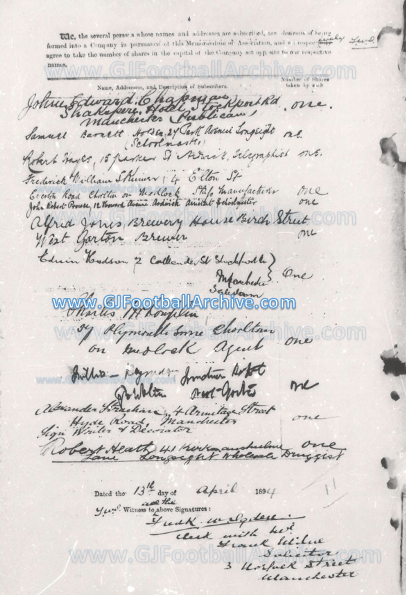
The presentation is all about the visionary who promoted a new club to represent Manchester, Manchester City and about the steps taken in 1894. This talk was free to download until this morning (9 March). Now it is available to subscribers (see below for details of how to subscribe).

Subscribers can also see the previous history talk on St Mark’s and City’s development in the Gorton area during the 1870s and 1880s below.

Subscribe to get access – Annual

Annual subscribers get access to everything posted since December 2020 (interviews, history talks, articles, PDFs of books etc.) and everything to be posted during your subscription. It costs £20 a year (about 5p a day).

Subscribe to get access – Monthly

Monthly subscribers get access to everything posted since 1 October 2022 and everything to be posted during your subscription. It costs £3 a month (cancel any time).

If you enjoy all the free material on my website and would like to support my research and keep this website going (but don’t want to subscribe) then why not make a one-time donation (or buy me a coffee). All support for my research is valued and welcome. It allows me to keep some free material available for all. Thanks.

Choose an amount

£2.50
£5.00
£7.50

Or enter a custom amount

£

Your contribution is appreciated.

Donate