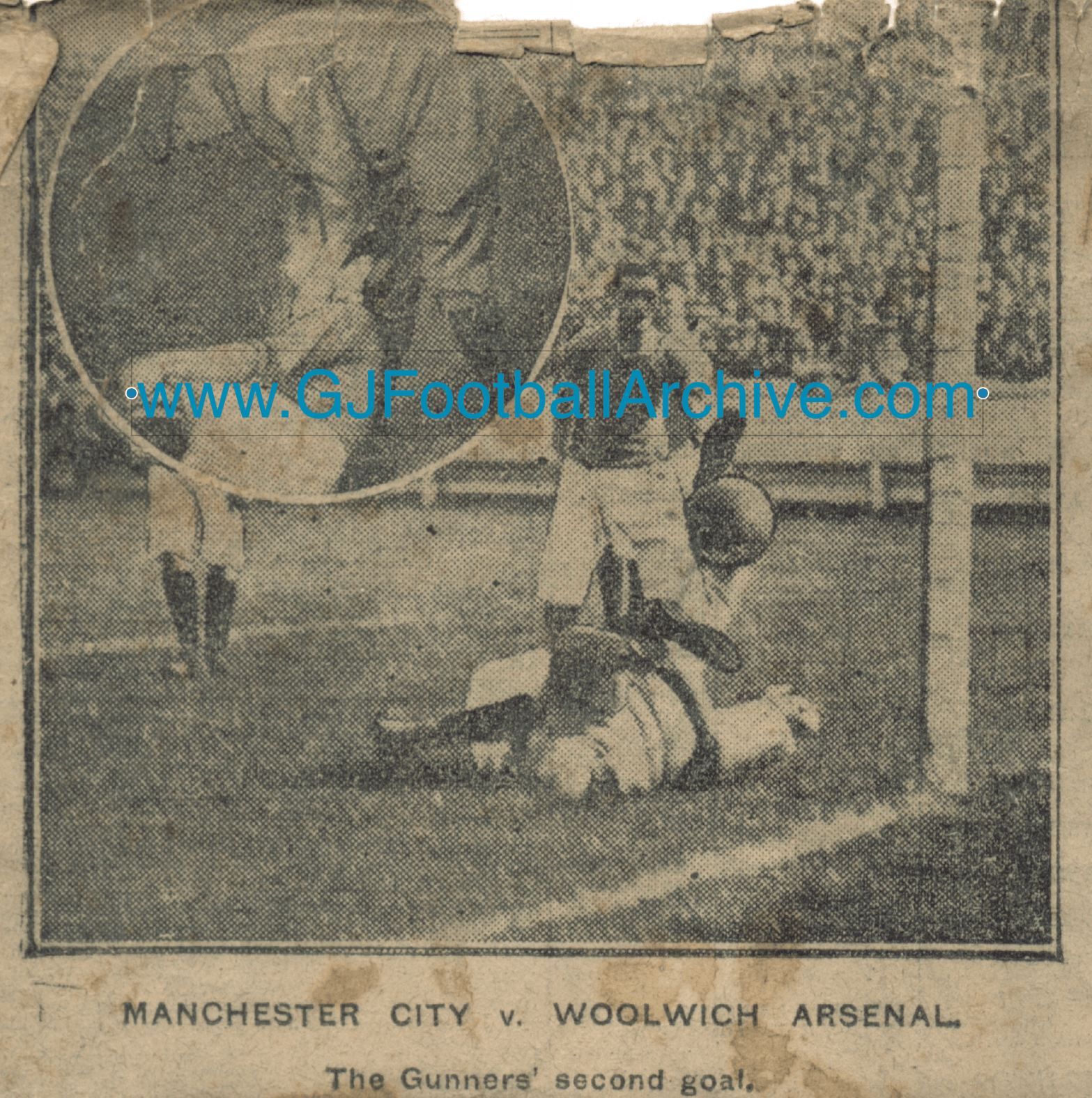
Today is the 120th anniversary of an odd day when Manchester City and Arsenal played in a heatwave. Here’s the background and the story. I start with the 1906 close season… Following the banning of so many Manchester City players and officials (I’ll cover this another day!) the future leaked seriously bleak for the club during the summer of 1906. Not only did the Blues have to find players, but they also had to identify a manager and some directors to help move the Club forward. It was not easy. Fortunately the Derby County secretary-manager Harry Newbould accepted the challenge, even though the rest of football felt that City were a dead side with no chance of resurrection.
Newbould spent the summer bringing in new players and setting a plan to avoid relegation – with so few recognisable first team players nothing more than avoiding relegation could be expected. When Newbould joined City in July 1906, there were only eleven players of any description available.
Somehow he pulled together a side. Many of the players were of good quality, but when the season opened at home to Arsenal on 1 September 1906 no one could have predicted how Newbould’s first game would develop. City’s team, including five debutants, was Frank Davies, John Christie, Tommy Kelso, Alex Steel, Jimmy Buchan, George Dorsett, George Stewart, Irvine Thornley, Robert Grieve, Billy Lot Jones, and Jimmy Conlin. In extreme heat, the Blues took the field before a low Hyde Road crowd of around 18,000. The weather at ninety degrees in the shade had a tremendous impact on the game as the players found it difficult to cope.
After thirty minutes Arsenal took the lead as City’s large number of debutants found it difficult to play together. A couple of minutes later Irvine Thornley fell “prostrate and very ill” was taken from the field. For the rest of the match he lay flat on his back trying to recover from sunstroke. Shortly after Arsenal had scored a second Jimmy Conlin collapsed. According to reports he had even placed a handkerchief on his head to protect him from the sun.
At half time Robert Grieve failed to reappear. Down to eight men, with three forwards missing, the Blues stood no chance of matching the Gunners, but the referee refused to abandon the game. Bravely the Blues fought on, and for a while Newbould pushed one of his defenders up front to compensate for the three missing men. This gave the Blues a formation made up of three attackers, three half-backs, one full-back and a goalkeeper. Five minutes into the half, winger Jimmy Conlin bravely returned to the pitch.
After a short spell of City pressure, George Dorsett scored for the Blues to make the score 2-1, but the effort was perhaps a little too much for the player as he collapsed with exhaustion a few moments later (see the inset part of the image at the top of this page). Any hope of equalising disappeared at that moment, and Arsenal dominated the match completely. Bravely City played on, but it wasn’t long before the Gunners managed to increase their lead to 4-1. Shortly afterwards City lost Tommy Kelso, then Jimmy Buchan, leaving only six City players on the pitch. Three of whom – including goalkeeper Davies – were making their debuts.
Somehow the six Blues held out until the final whistle, in a game that provided new secretary-manager Newbould with yet more problems. Two days later the new look City travelled to Everton with remarkably only two changes – Albert Fisher replaced Thornley and Kelso made way for Frank Norgrove. Unfortunately, any hope that this game would see the Blues fortunes change were quickly dashed as City suffered their heaviest defeat of all time as Everton annihilated Newbould’s side 9-1. Debutant Fisher provided the consolation goal.
Despite the start of season struggles City ended their first season following the FA bans in 17th place, five points above the relegation zone. Interestingly, Newbould’s old side were relegated.

 Gary James' Football Archive