I’m always conscious that time moves quickly within football and that names of legendary players that your parents were familiar with may not be known by your children. Today, as it was 101 years since his birth yesterday (he was born on 22 October 1923) I’m publishing here a brief folklore piece I did on Manchester City goalkeeper Bert Trautmann. Hopefully, some newer/younger football fans may be familiar with the name. If not this may help…
It is one of City’s greatest stories involving a true Blue legend and a remarkable example of how Manchester has always been a welcoming city. Bernhard Trautmann was born in Germany in 1923 and, as a keen young athlete, he became a member of the Hitler Youth. He had high hopes of representing Germany in the decathlon at the 1940 Olympic Games and went to Berlin for several training camps. Sadly, war was to end all possibility of him becoming an Olympic hero.
Indoctrinated throughout his teenage and early adult life, Trautmann became a paratrooper during World War Two. The simple facts of what followed are astounding:
- After being captured and escaping from the Russians and the Americans, Trautmann became a Prisoner of War held by the British.
- He began playing as a goalkeeper while a prisoner.
- He joined St Helen’s Town.
- City’s goalkeeping crisis meant the Blues were desperate for a ‘keeper, any ‘keeper!
- Trautmann given chance and joined City.
- Protests and season tickets returned in disgust, but some including Rabbi Altmann spoke in support
- Known as ‘Bert’, Trautmann soon became a hero to City fans.
- In 1955 he became the first German to play in the FAC final.
- 1956 he helped City win the FA Cup.
In the 1956 final Trautmann was outstanding, diving brilliantly at times and bravely often. With a little over 15 minutes left to play the ‘keeper made a daring save at the feet of Birmingham’s Murphy. The collision left Bert in tremendous pain and film of the final shows that his head and neck were at an odd angle. The ‘keeper bravely played on, despite obvious pain. No one knew the full extent of the dramatic injury and then a second collision occurred a short while later. These were the days before substitutes and City had been down to ten men the previous year. Bert knew that it had cost them the final, but the pain was excruciating.
City won the FA Cup and in the days that followed the full extent of Bert’s injury was revealed. It was claimed he had ‘broken’ his neck and that a slight knock could have killed him.

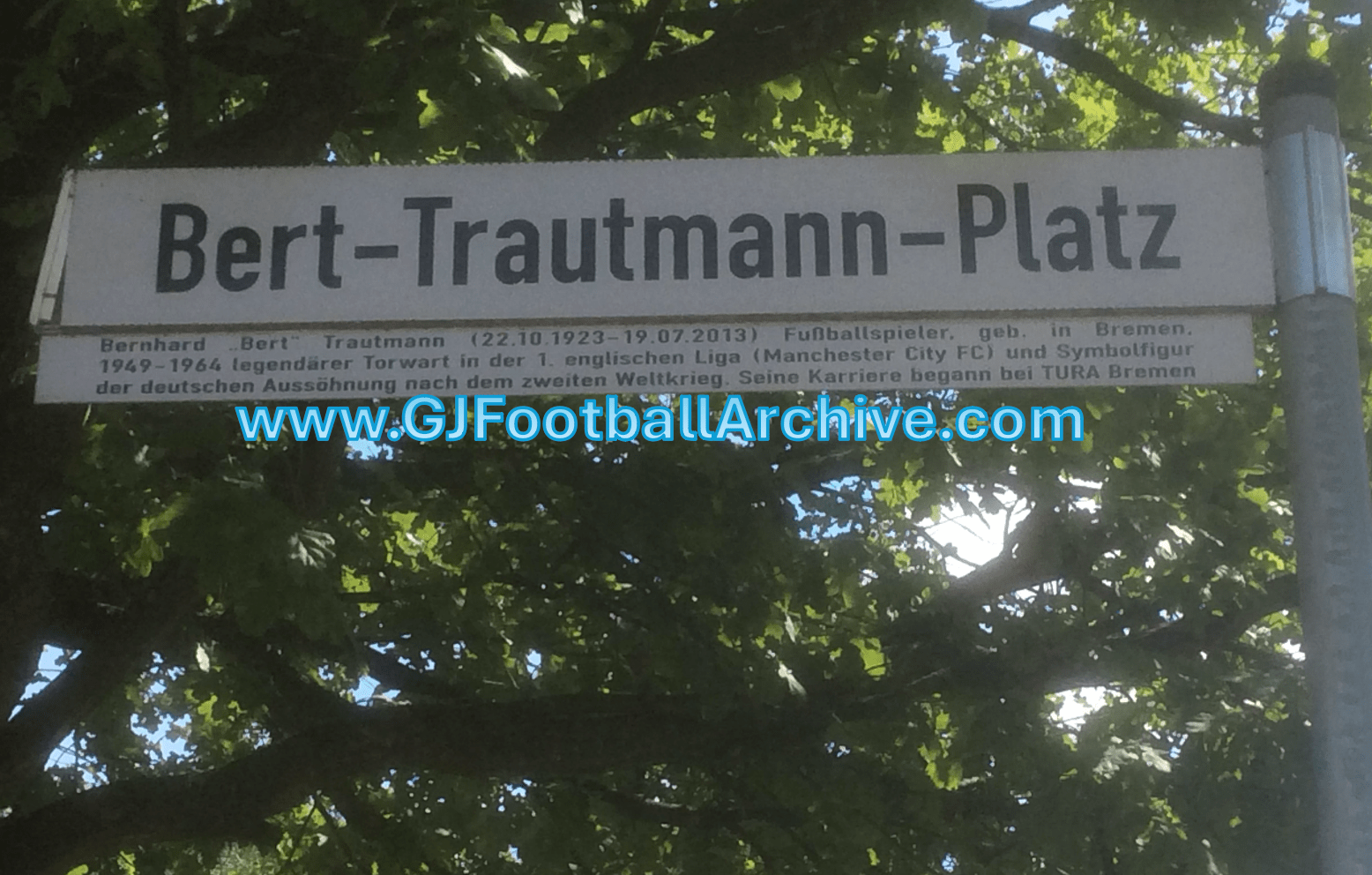
Bert’s home city of Bremen, Germany, is well worth a visit and his boyhood home is still standing. There is also a small square named after him, next to his first football club Tura Bremen – where he played as a midfielder! Significantly, the square uses the English version of his name, adding to the view that Trautmann did so much for Anglo-German relations.
Bert once told me “I was born in Germany but I grew up in Manchester”. Now his birth city recognises his significance to our city.


 Gary James' Football Archive