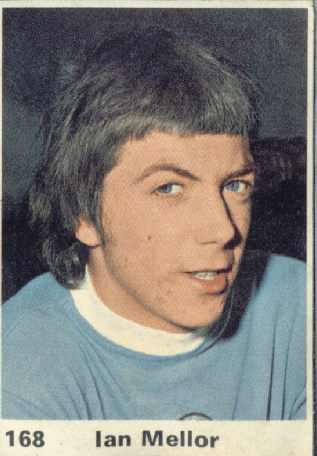
I’ve heard the news that Ian Mellor has passed away at the age of 74 and so I wanted to pay tribute by publishing an interview I did with him several years ago and also provide a few biographical details too. As always, I think it’s best in these moments to remember the player by using their own comments and thoughts, so I’ll start with that.
In December 2003 I interviewed Ian for a feature in the Manchester City match programme. Here is the interview as it was written and published back then:
IN SEARCH OF THE BLUES – IAN MELLOR
Ian Mellor made his debut in March 1971 and went on to make a total of 48 League and Cup appearances for the Blues. In 1973 he moved on to Norwich. Gary James, author of Farewell To Maine Road, caught up with Ian last week.
Let’s start with your role today, you’re still very much involved in football. Can you explain your role and how it came about?
I’m the Commercial Executive to the Professional Footballers’ Association (PFA). I suppose it started when I first finished playing. I was 34 and unemployed for about four months. I needed to find something new and like any former player it can be difficult at first, but I got myself on to an intensive sales course and really tried to push myself in that direction.
I was in the Sheffield area – I’d been a player with Wednesday and so that helped to some extent – but it was a very tough time to be selling there. The industry had been decimated.
Eventually the athlete Derek Ibbotson – who had been involved with fitness training at City when I was a player – brought me in to work for Puma and my involvement with sports commercial activities really started then. One of my main activities was to persuade key League players to wear Puma goods.
Did your playing career help?
Yes, of course. The fact that I’d played did help, but it wasn’t too difficult. Paul Gascoigne was signed up and, like with any major sports company today, it’s great if a major star wears your products. From that I went on to work for Gola and I’d also spent some time talking with the PFA about providing sportswear for their various initiatives. One thing led to another and, through Mickey Burns, Gordon Taylor asked me to join the PFA as its first Commercial Manager about ten years ago.
As a player did you feel the PFA was important?
Like many unions you don’t appreciate what they do until you need them. As an ex-player the game took its toll on my body and I’ve had to have 2 new hip joints replaced and without the support of the PFA I would have been a cripple. I’m just one of thousands of members of the PFA who have received vital assistance when needed. As a player I didn’t really think about it at the time, but now I have come to realise how much the union helps present and former players, and is involved in so many areas such as community programmes, anti racism campaigns and supporters’ organisations. As you get older you also start to understand how football’s developed and what the union has achieved. The PFA has a major role in football and it puts so much back into the game that we all love.
Going back to your early career, did your elevation to the first team come easily?
I was certainly worried – I’d been sent to Altrincham on loan and was paid something like £2 a week. I played two games and started to wonder what was going on. When that happens you can’t help but feel your career is not going to be in the first team. Then Ken Barnes started working closely with the City youngsters and he started to look at me. That got things moving.
Your debut came against Coventry in March 1971. Do you feel you performed well?
It was a lot to handle really. I was nervous, very nervous. I knew I’d be facing Wilf Smith who I think was the most expensive fullback in the game at the time. I became a nervous wreck, and in the first half I think that was obvious. I just wasn’t right. Malcolm Allison had a real go at me at half time and warned: “If you don’t pull your finger out, you’ll be off!” So that got me playing! The second half I really worked hard and played my normal game. I tried not to worry. I just got on and did it.
You must have performed well enough because you kept your place.
Well the Coventry draw was on 20th March and four days later I played in the second leg of the European Cup Winners’ Cup and managed to score, so it was a great start really. I still wasn’t a regular, but I played in another five league games and even scored against United in the derby match on the last day of the season. As a City fan the derby meant an awful lot and scoring your first League goal in a derby is something special, especially for a local lad.
Was that your biggest moment?
I suppose my biggest moment came when I actually signed professional forms. Johnny Hart took me into a little room hidden away under the Main Stand at Maine Road and I signed the forms. All the time I was thinking where’s the press? Where’s Granada? Instead of the hype you always imagine surrounds these things there were Johnny and I in a damp, cold corner of the ground. Johnny though said something which has stuck with me ever since, he said: “I wish you all that you wish yourself”. Which is a great comment because in football… and in life for that matter… you have to have aims and dreams. You need to want to be a player to be a player.
Who would you say was the biggest influence in your playing career?
Well, we were very fortunate at City to have Johnny Hart, Ken Barnes, and Dave Ewing in the coaching set up. They were very knowledgeable and men of real quality. They knew what they were talking about and they also cared passionately about the game and the Club. They’d all had great careers and as a young player you listened and learned.
At times they could be very hard. They pushed you because they knew you had to be hard to survive in football, and they certainly made you work. They gave me the right sort of grounding.
The biggest coaching influence though has to be Malcolm Allison. In those days he was the best as a coach and motivator and I learnt so much from him. Again he could be tough, but you listened because he had already delivered so much by the time I got into the first team.
As players did you socialise as a group?
There were quite a few of us who came up the ranks together so people like Donachie, Carrodus, Gibbons, McBeth, and Jeffries were the ones I went out with. I suppose there were two age groups. The older players were married and had also come through the Sixties team together, and then there were the younger single guys. Naturally, as in any environment, you stick in your peer groups, but obviously on the pitch you’re one team and work hard for each other.
Willie Donachie was probably the closest to me. Our wives went to the same school and he was the Best Man at my wedding, and we get on really well.
Was it one of the players who gave you the nickname ‘Spider’?
Ah yes. Spider’s been my nickname since those early days at City. It was Ken Mulhearn who gave it to me, although he probably doesn’t realise that now. On a Saturday morning if we were at an away match and sat in the hotel, we’d usually watch a bit of television and it always seemed to be that Spiderman was on. Ken shouted “look it’s Ian Mellor” and the name Spider then stuck because of my long legs and the comparison with Spiderman!
The funny thing is there are many, many of my business contacts who don’t really know my proper name. It’s always Spider. I always get introduced as Spider, and so if I ever give my name as Ian Mellor when I’m calling someone I deal with they get confused. It’s amazing how these things stick, but it’s great.
How did the fans treat you?
Always well. It was a great side to join, and as long as you put the effort in the fans loved you. I never received any stick and the fans have always loved to see players who attack. Once I’d made my first appearance I started to get recognised. Being tall and thin helps you get noticed, and I enjoyed the support they gave.
The team was great as well. There was tremendous camaraderie and the success must have helped to create that spirit.
Clearly, there must have been a downside. What was your biggest regret?
Leaving! I should never have gone to Norwich. I went from a top five side to a bottom five side overnight and it was such an alien environment. Norwich is a nice place, and a good club, but at that time the move was totally the wrong move to make. Because they were struggling there was no confidence. The contrast with City was unbelievable.
At City everything was so positive, and as a Blue I shouldn’t have gone.
You come from a family of Blues, don’t you?
Yes. We were season ticket holders and I used to stand on the Kippax.
Naturally, I have to ask how you felt when your son Neil played for Liverpool against City in the FA Cup last season?
It was great to see him play at Maine Road, and I felt very proud. It was a very strange feeling really though because he was playing against the family’s team. We’re all Blues and the best result would have been for him to score but for City to win. It didn’t go that way of course, but it was great to see him play in that match. A great feeling.
I hope that gave a sense of the man and now here’s a brief career overview:
Ian Mellor Career Detail
Ian was with Manchester City between July 1968 and March 1973. He also played for Norwich City (joined 7 Mar 1973), Brighton & Hove Albion (6 May 1974), Chester City (24 Feb 1978), Sheffield Wednesday (11 June 1979), Bradford City (24 June 1982), Hong Kong (Jan 1984) and Worksop Town. and here is a brief profile of him:
Known affectionately as Spider, Ian Mellor was recognised for his speed and dedication. He signed for City first as an amateur (July 1968) then as a professional (16 Dec 1969), making his Reserve debut in October 1970 away at Aston Villa. A former Cheshire Boys player, he won an England youth cap with City.
In March 1971 there was an injury crisis at Maine Road and Spider was given his debut against Coventry City (h) on 20 March. City drew 1-1 with Franny Lee scoring.
Ian scored his first League goal in the last match of the 1970-71 season against United. He was virtually an ever-present for the first half of the following season until replaced by Tony Towers.
You can see a goal he scored at Arsenal in 1971 here:
In 1972-73 his appearances were limited and then came a controversial transfer to Norwich City in March for £70,000. This transfer was often cited as the cause of the resignation of Malcolm Allison who felt that the player had been sold behind his back. Spider’s last City appearance was against Wolves on 3 March 1973.
Later Ian was employed by a sportswear company and also for the PFA in Manchester.

 Gary James' Football Archive
Such sad news Gary. Spider was a true gent : a terrific footballer whose leaving City (for Norwich) was a huge mistake – he should have stayed – especially as he loved City (all his life). He was popular amongst everyone who worked alongside him – and he will be very much missed. Your interview was excellent by the way! RIP Spider
Best wishes as always Gary Cheers Roger
LikeLike